• Both Crohn’s Disease and Ulcerative
Colitis (UC) are conditions that affect
the gastrointestinal (digestive) tract,
causing inflammation and various
uncomfortable GI symptoms.
• Both fall under the umbrella of
Inflammatory Bowel Disease (IBD) but
are unique issues that require unique
care.
• As many as 3 million adults in the U.S.
are estimated to have been diagnosed
with either Crohn’s or UC as of 2015.¹
• Doctors aren’t completely sure what
causes either condition, but they have
some ideas.
• Experts suggest Crohn’s may be caused
by genetics, autoimmune reactions, or
external factors like smoking, certain
drugs (like NSAID anti-inflammatories),
or eating too much fat.
• Similar causes are suspected for
Ulcerative Colitis, including
autoimmune issues and genetics, but
family history is less common in UC.
• The most obvious difference between
the two is the location of inflammation
in the body.
– Crohn’s Disease can affect any
area along the GI tract, causing
inflammation at any point from
the mouth to the anus.
– Ulcerative Colitis affects only the
colon (as its name suggests).
• Crohn’s Disease symptoms include
weight loss, vomiting, abdominal pain
and nausea, but only occasional
diarrhea and/or rectal bleeding.
• Ulcerative Colitis symptoms include
persistent diarrhea, abdominal pain,
blood/mucus in stool, reduced appetite
and a feeling of needing to defecate
(even when one doesn’t).
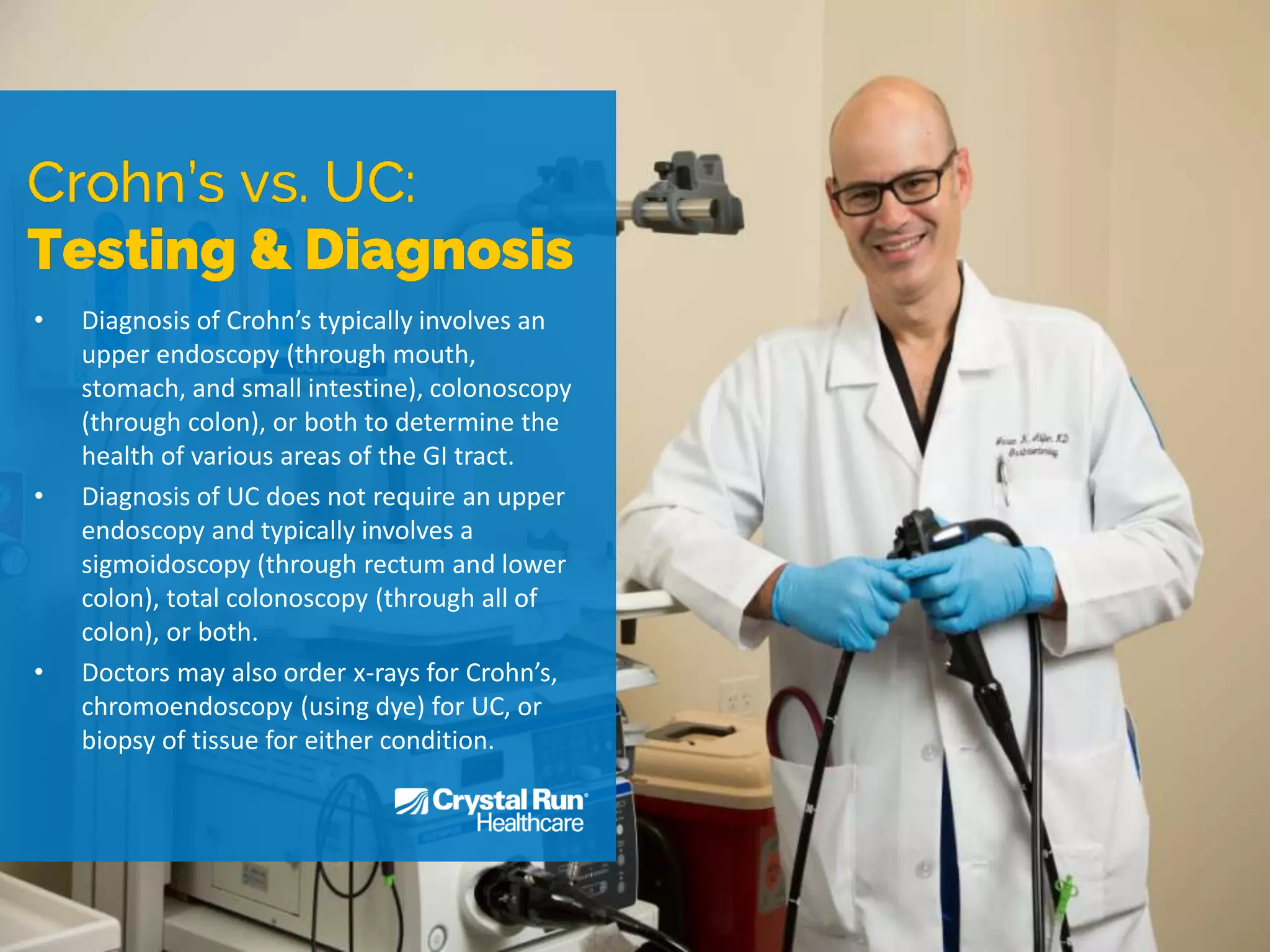
• Diagnosis of Crohn’s typically involves an
upper endoscopy (through mouth,
stomach, and small intestine), colonoscopy
(through colon), or both to determine the
health of various areas of the GI tract.
• Diagnosis of UC does not require an upper
endoscopy and typically involves a
sigmoidoscopy (through rectum and lower
colon), total colonoscopy (through all of
colon), or both.
• Doctors may also order x-rays for Crohn’s,
chromoendoscopy (using dye) for UC, or
biopsy of tissue for either condition.
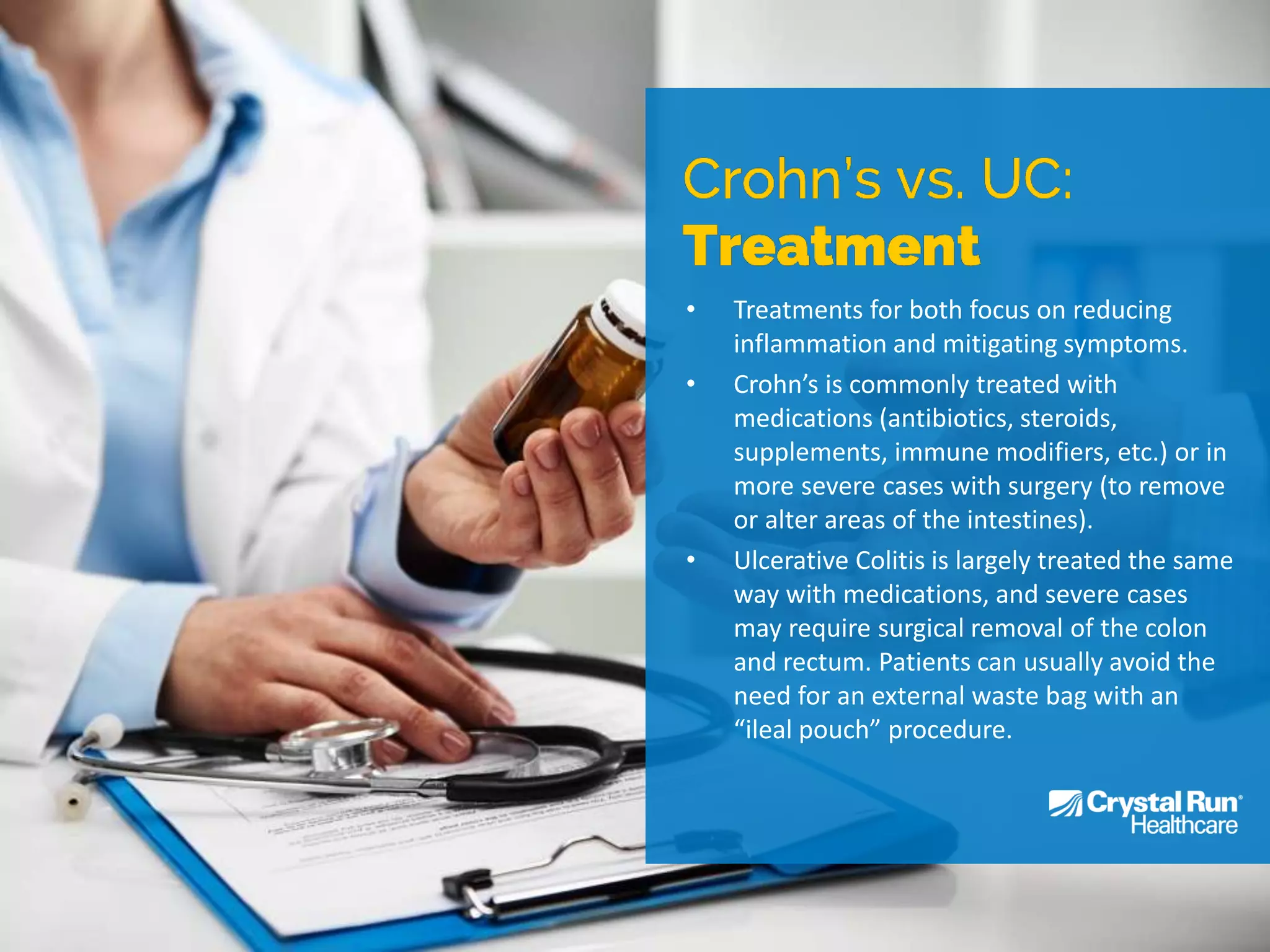
• Treatments for both focus on reducing
inflammation and mitigating symptoms.
• Crohn’s is commonly treated with
medications (antibiotics, steroids,
supplements, immune modifiers, etc.) or in
more severe cases with surgery (to remove
or alter areas of the intestines).
• Ulcerative Colitis is largely treated the same
way with medications, and severe cases
may require surgical removal of the colon
and rectum. Patients can usually avoid the
need for an external waste bag with an
“ileal pouch” procedure.
• If you are having suspicious symptoms
and/or your family has a genetic history of
gastrointestinal disease, it’s a good idea to
get examined.
• Patients frequently ask, “How do I find a
gastroenterologist near me?” If you live in
New York, the gastroenterologists at Crystal
Run Healthcare are experts in the care of
patients with Crohn’s, UC, and other serious
GI conditions.
• Pediatric Gastroenterology appointments are
also available for children suffering from
gastrointestinal symptoms.
• Crystal Run Healthcare is a trusted medical
center with locations throughout New
York. Our gastroenterologists can help
treat a wide variety of conditions like
Crohn’s Disease and Ulcerative Colitis.
• You can easily book an appointment with
many Crystal Run Healthcare physicians
through the website or contact us if you
need additional assistance.
1. https://www.cdc.gov/ibd/data-statistics.htm

Crohn's Disease vs. Ulcerative Colitis

  • 2.
    • Both Crohn’sDisease and Ulcerative Colitis (UC) are conditions that affect the gastrointestinal (digestive) tract, causing inflammation and various uncomfortable GI symptoms. • Both fall under the umbrella of Inflammatory Bowel Disease (IBD) but are unique issues that require unique care. • As many as 3 million adults in the U.S. are estimated to have been diagnosed with either Crohn’s or UC as of 2015.¹
  • 3.
    • Doctors aren’tcompletely sure what causes either condition, but they have some ideas. • Experts suggest Crohn’s may be caused by genetics, autoimmune reactions, or external factors like smoking, certain drugs (like NSAID anti-inflammatories), or eating too much fat. • Similar causes are suspected for Ulcerative Colitis, including autoimmune issues and genetics, but family history is less common in UC.
  • 4.
    • The mostobvious difference between the two is the location of inflammation in the body. – Crohn’s Disease can affect any area along the GI tract, causing inflammation at any point from the mouth to the anus. – Ulcerative Colitis affects only the colon (as its name suggests).
  • 5.
    • Crohn’s Diseasesymptoms include weight loss, vomiting, abdominal pain and nausea, but only occasional diarrhea and/or rectal bleeding. • Ulcerative Colitis symptoms include persistent diarrhea, abdominal pain, blood/mucus in stool, reduced appetite and a feeling of needing to defecate (even when one doesn’t).
  • 6.
    • Diagnosis ofCrohn’s typically involves an upper endoscopy (through mouth, stomach, and small intestine), colonoscopy (through colon), or both to determine the health of various areas of the GI tract. • Diagnosis of UC does not require an upper endoscopy and typically involves a sigmoidoscopy (through rectum and lower colon), total colonoscopy (through all of colon), or both. • Doctors may also order x-rays for Crohn’s, chromoendoscopy (using dye) for UC, or biopsy of tissue for either condition.
  • 7.
    • Treatments forboth focus on reducing inflammation and mitigating symptoms. • Crohn’s is commonly treated with medications (antibiotics, steroids, supplements, immune modifiers, etc.) or in more severe cases with surgery (to remove or alter areas of the intestines). • Ulcerative Colitis is largely treated the same way with medications, and severe cases may require surgical removal of the colon and rectum. Patients can usually avoid the need for an external waste bag with an “ileal pouch” procedure.
  • 8.
    • If youare having suspicious symptoms and/or your family has a genetic history of gastrointestinal disease, it’s a good idea to get examined. • Patients frequently ask, “How do I find a gastroenterologist near me?” If you live in New York, the gastroenterologists at Crystal Run Healthcare are experts in the care of patients with Crohn’s, UC, and other serious GI conditions. • Pediatric Gastroenterology appointments are also available for children suffering from gastrointestinal symptoms.
  • 9.
    • Crystal RunHealthcare is a trusted medical center with locations throughout New York. Our gastroenterologists can help treat a wide variety of conditions like Crohn’s Disease and Ulcerative Colitis. • You can easily book an appointment with many Crystal Run Healthcare physicians through the website or contact us if you need additional assistance.
  • 10.