SHELLFISH BEEDING AND HATCHEY MANAGEMENT
AQC-311,2(1+1)
A Presentation on
“Life cycle of Squid”
Presented By:
Joynal Abedin
SQUIDS
• The two main groups, Myopsid squids, “covered-eyed”, near-
shore (neritic) squids,and
• Oegopsid squids, “open-eyed” oceanic (pelagic) squids, occur
in the oceans and seas of the world and together form the basis of
major cephalopods production of the globe.
• Over 800 species known yet
• Exclusively Marine
TAXONOMICAL CLASSIFICATION
KINGDOM:Animalia
PHYLUM:Mollusca
CLASSS:Cephalopoda
ORDER:Teuthida
FAMILY:Loliginidae
GENUS:Uroteuthis
SPECIES:U.duvaucelii
Morphology
Bilaterally symmetrical.
Oval shaped body.
Body –divided into head
and trunk.
Internal shell (gladius) is
present.
8 sessile arms and 2
tentacular arms.
Fin lobes fused
posteriorly.
Locomotin – jet of water
produced by ventral
siphon.
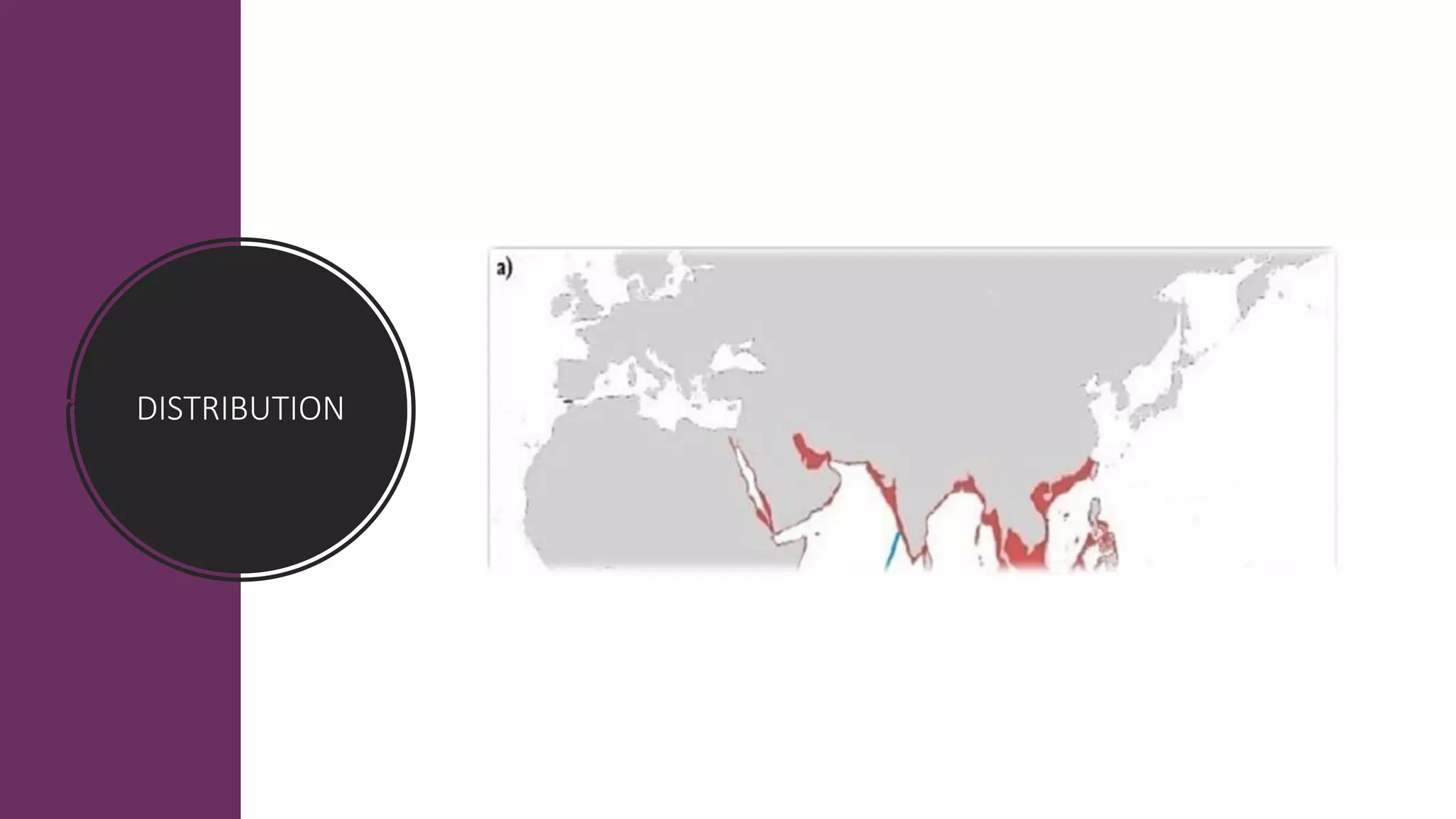
DISTRIBUTION
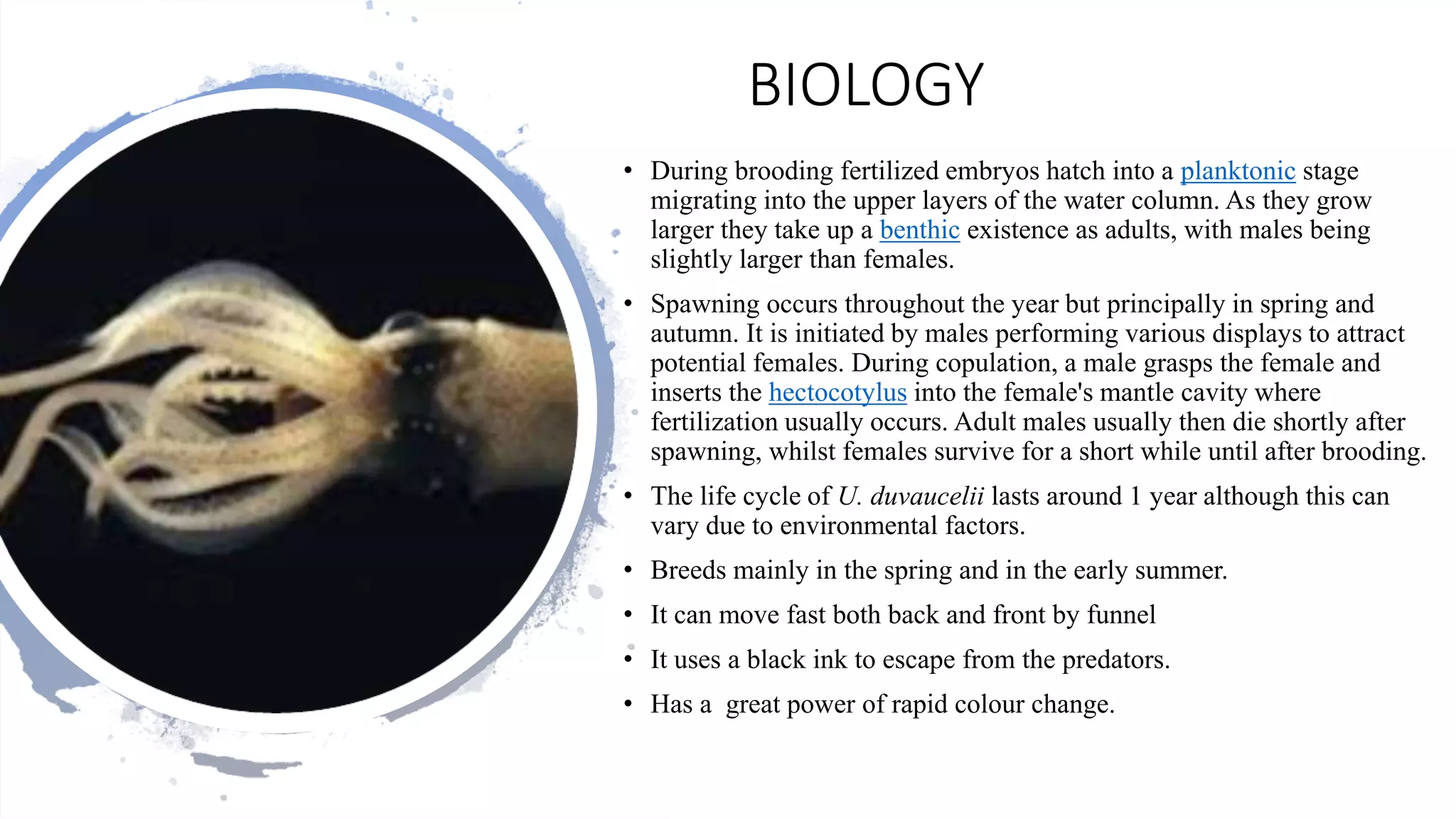
BIOLOGY
• During brooding fertilized embryos hatch into a planktonic stage
migrating into the upper layers of the water column. As they grow
larger they take up a benthic existence as adults, with males being
slightly larger than females.
• Spawning occurs throughout the year but principally in spring and
autumn. It is initiated by males performing various displays to attract
potential females. During copulation, a male grasps the female and
inserts the hectocotylus into the female's mantle cavity where
fertilization usually occurs. Adult males usually then die shortly after
spawning, whilst females survive for a short while until after brooding.
• The life cycle of U. duvaucelii lasts around 1 year although this can
vary due to environmental factors.
• Breeds mainly in the spring and in the early summer.
• It can move fast both back and front by funnel
• It uses a black ink to escape from the predators.
• Has a great power of rapid colour change.
SEXUAL DIMORPHISM
Male
It includes a testis, a vas deferens,
a spermatophoric sac containing
sperm packets & a copulatory
organ or penis.
Female
It comprises of an ovary, an
oviductal gland, and a part of
nidamental glands, which produce
a jelly in which the eggs are
embedded.
Male
1.Gonoducts single
2.Suckers on buccal
lappets.
3.Hooks present
in tentacular
club.
Female
1.Gonoducts paired
2.Suckers absent
3.Hooks
absent.
REPRODUCTION
• Sexes are separate.
• Single testis.
• A single gland of the visceral mass opens directly into the coelom by
slit.
• Gonoduct runs on the left from the coelom to the mantle cavity &
opens near funnel.
• Hectocotylized arm – copulatory organ
• It is used for the transfer of sperm.
MATTING
• Attracting females begins in the morning
• Around dawn swims rapidly in very large circles
• After some time the squids they start swimming
in pairs.
• These are mating couples.
• Males start changing colours to attract female.
• Once the female shows interest mating takes
place.
• The females have an ink sac under a set of glands in gills.
• During mating ,sperms are stored inside sac where they
will fertilize her eggs.
• Male uses the shorter arm to place the sperm.
• Female uses the nidamental secretion to stick the eggs in the solid
object in the event.
• 7-8 weeks to hatch out.
Simalparity
 All cephalopods undergo only one breeding cycle(monocycly), except
nautiluses.
 All the modern cephalopods are single-season breeders
 Death is followed after that.
PRODUCTION TRENDS
• The present status of the fishery, biology and stock assessment of the India squid Loligo duvauceli
Orbigny was studied, based on the data collected at different centres on both the coasts of India for
1979-1989. The production had increased by over 280% in 3 states on the west coast, viz. Kerala,
Maharashtra and Gujarat. These states accounted for about 80% of the all-India squid production
(23,941 t in 1989). Trawl is the main gear, taking 86% of the total squid landings.
THANK YOU ALL
-“FOR YOUR PATIENCE LISTENING”

Life cycle of squid

  • 1.
    SHELLFISH BEEDING ANDHATCHEY MANAGEMENT AQC-311,2(1+1) A Presentation on “Life cycle of Squid” Presented By: Joynal Abedin
  • 2.
    SQUIDS • The twomain groups, Myopsid squids, “covered-eyed”, near- shore (neritic) squids,and • Oegopsid squids, “open-eyed” oceanic (pelagic) squids, occur in the oceans and seas of the world and together form the basis of major cephalopods production of the globe. • Over 800 species known yet • Exclusively Marine
  • 3.
  • 4.
    Morphology Bilaterally symmetrical. Oval shapedbody. Body –divided into head and trunk. Internal shell (gladius) is present. 8 sessile arms and 2 tentacular arms. Fin lobes fused posteriorly. Locomotin – jet of water produced by ventral siphon.
  • 5.
  • 6.
    BIOLOGY • During broodingfertilized embryos hatch into a planktonic stage migrating into the upper layers of the water column. As they grow larger they take up a benthic existence as adults, with males being slightly larger than females. • Spawning occurs throughout the year but principally in spring and autumn. It is initiated by males performing various displays to attract potential females. During copulation, a male grasps the female and inserts the hectocotylus into the female's mantle cavity where fertilization usually occurs. Adult males usually then die shortly after spawning, whilst females survive for a short while until after brooding. • The life cycle of U. duvaucelii lasts around 1 year although this can vary due to environmental factors. • Breeds mainly in the spring and in the early summer. • It can move fast both back and front by funnel • It uses a black ink to escape from the predators. • Has a great power of rapid colour change.
  • 7.
    SEXUAL DIMORPHISM Male It includesa testis, a vas deferens, a spermatophoric sac containing sperm packets & a copulatory organ or penis. Female It comprises of an ovary, an oviductal gland, and a part of nidamental glands, which produce a jelly in which the eggs are embedded.
  • 8.
    Male 1.Gonoducts single 2.Suckers onbuccal lappets. 3.Hooks present in tentacular club. Female 1.Gonoducts paired 2.Suckers absent 3.Hooks absent.
  • 9.
    REPRODUCTION • Sexes areseparate. • Single testis. • A single gland of the visceral mass opens directly into the coelom by slit. • Gonoduct runs on the left from the coelom to the mantle cavity & opens near funnel. • Hectocotylized arm – copulatory organ • It is used for the transfer of sperm.
  • 10.
    MATTING • Attracting femalesbegins in the morning • Around dawn swims rapidly in very large circles • After some time the squids they start swimming in pairs. • These are mating couples. • Males start changing colours to attract female. • Once the female shows interest mating takes place.
  • 11.
    • The femaleshave an ink sac under a set of glands in gills. • During mating ,sperms are stored inside sac where they will fertilize her eggs. • Male uses the shorter arm to place the sperm. • Female uses the nidamental secretion to stick the eggs in the solid object in the event. • 7-8 weeks to hatch out.
  • 12.
    Simalparity  All cephalopodsundergo only one breeding cycle(monocycly), except nautiluses.  All the modern cephalopods are single-season breeders  Death is followed after that.
  • 13.
    PRODUCTION TRENDS • Thepresent status of the fishery, biology and stock assessment of the India squid Loligo duvauceli Orbigny was studied, based on the data collected at different centres on both the coasts of India for 1979-1989. The production had increased by over 280% in 3 states on the west coast, viz. Kerala, Maharashtra and Gujarat. These states accounted for about 80% of the all-India squid production (23,941 t in 1989). Trawl is the main gear, taking 86% of the total squid landings.
  • 14.
    THANK YOU ALL -“FORYOUR PATIENCE LISTENING”