




1
Aeromedical 
transfer of the 
critically ill patient 
Dr.Ebadi 
2
3 
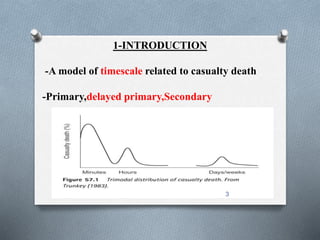
1-INTRODUCTION 
-A model of timescale related to casualty death 
-Primary,delayed primary,Secondary
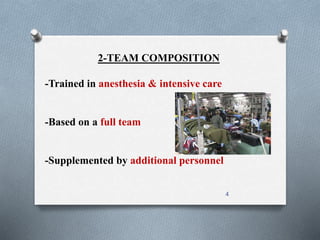
2-TEAM COMPOSITION 
-Trained in anesthesia & intensive care 
-Based on a full team 
-Supplemented by additional personnel 
4
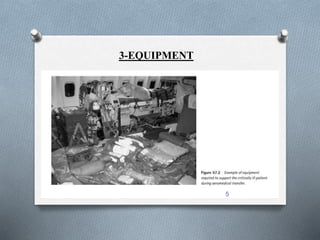
3-EQUIPMENT 
5
-Testing procedures 
-Ventilators 
-Monitors 
-Pacemakers 
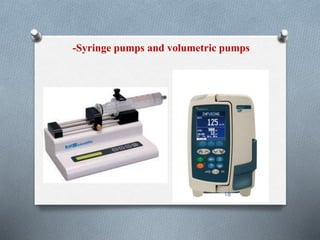
-Syringe pumps and volumetric pumps 
-Suction apparatus 
-Blood analysis 
-Peripheral nerve stimulators 
6
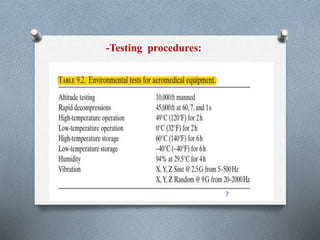
-Testing procedures: 
7
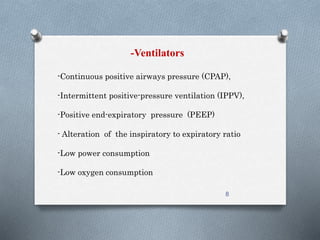
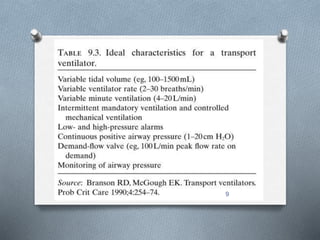
-Ventilators 
-Continuous positive airways pressure (CPAP), 
-Intermittent positive-pressure ventilation (IPPV), 
-Positive end-expiratory pressure (PEEP) 
- Alteration of the inspiratory to expiratory ratio 
-Low power consumption 
-Low oxygen consumption 
8
9
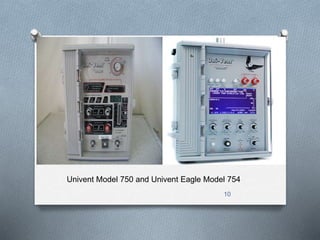
Univent Model 750 and Univent Eagle Model 754 
10
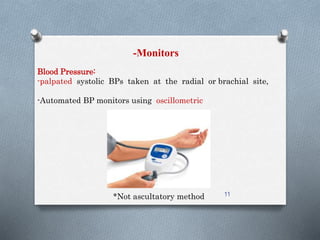
-Monitors 
Blood Pressure: 
-palpated systolic BPs taken at the radial or brachial site, 
-Automated BP monitors using oscillometric 
*Not ascultatory method 11
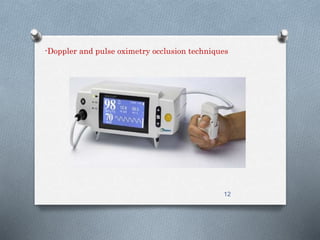
-Doppler and pulse oximetry occlusion techniques 
12
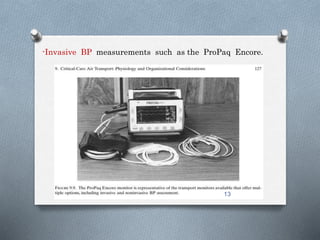
-Invasive BP measurements such as the ProPaq Encore. 
13
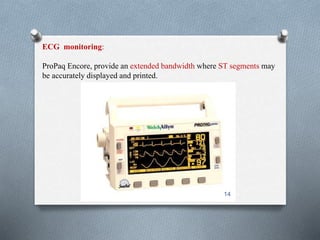
ECG monitoring: 
ProPaq Encore, provide an extended bandwidth where ST segments may 
be accurately displayed and printed. 
14
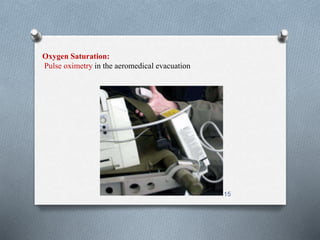
Oxygen Saturation: 
Pulse oximetry in the aeromedical evacuation 
15
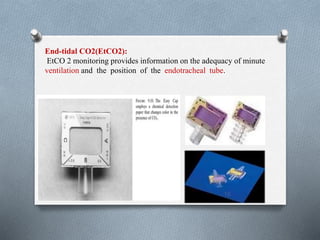
End-tidal CO2(EtCO2): 
EtCO 2 monitoring provides information on the adequacy of minute 
ventilation and the position of the endotracheal tube. 
16
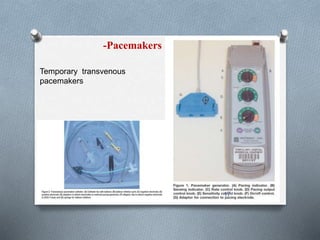
-Pacemakers 
Temporary transvenous 
pacemakers 
17
-Syringe pumps and volumetric pumps 
18
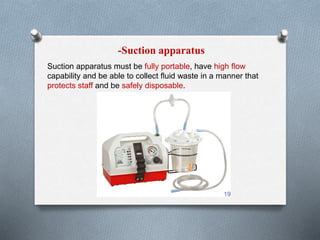
-Suction apparatus 
Suction apparatus must be fully portable, have high flow 
capability and be able to collect fluid waste in a manner that 
protects staff and be safely disposable. 
19
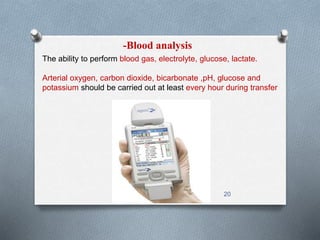
-Blood analysis 
The ability to perform blood gas, electrolyte, glucose, lactate. 
Arterial oxygen, carbon dioxide, bicarbonate ,pH, glucose and 
potassium should be carried out at least every hour during transfer 
20
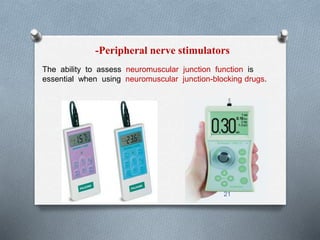
-Peripheral nerve stimulators 
The ability to assess neuromuscular junction function is 
essential when using neuromuscular junction-blocking drugs. 
21
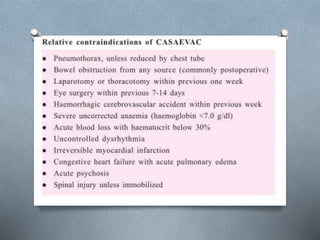
4-Cotaindications 
22
23
24 
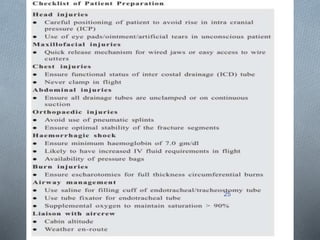
5-Check list
25
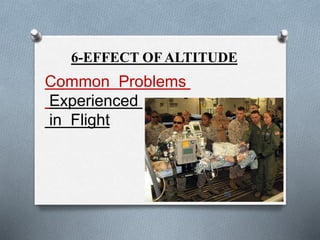
6-EFFECT OF ALTITUDE 
Common Problems 
Experienced 
in Flight 
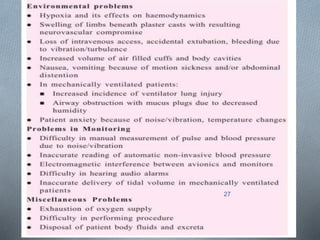
26
27
Special Problems 
Experienced in 
Flight 
28
*Changes in pulmonary blood flow: 
-may be due to abnormal responses to 
hypoxia 
-reflection of the general state of the 
circulation 
29
*Intubated patient 
-The endotracheal tube should be checked 
and a chest X-ray performed to determine 
the tube position. 
-Endotracheal tube cuff pressures should 
be checked and monitored during flight. 
30
*Tube thoracostomy: 
-They should be on free drainage, not be clamped at 
any stage and remain dependent. 
-If possible, systems that do not require fluid to 
function and have non-return systems should be 
used. 
-The use of the Heimlich-type valve incorporated in 
the system or certain types of emergency chest 
drainage systems, as used in acute trauma, may 
be problematic. 
31
*Tracheostomy 
-It is important to remember that this is not 
without risk. 
-The patient should not be transferred until 
the risk of immediate post-procedure 
haemorrhage has passed (at least 24 
hours) and a tract has begun to form. 
32
*Air in the cerebrospinal fluid (CSF): 
-expanding the skull can raise intracranial 
pressure. 
*A sudden increase in volume skull: 
-may lead to acute cardiovascular instability 
-further neurological damage. 
33
*Air-containing cavities: 
-within the lung, bullae, post-surgery or air 
leaks from trauma can lead to 
pneumothorax. 
*Expanding air in the pleura or pericardium : 
-may lead to the conversion of a simple 
pneumothorax or pneumopericardium to a 
tension pneumothorax or 
pneumopericardium, 34
*Patients who are post-trauma, post-surgery: 
- impaired gastric motility. 
*Delayed gastric emptying : 
- raised gastric volume and nausea, vomiting, 
regurgitation and electrolyte disturbances. 
*Passive regurgitation in the unconscious patient: 
-pulmonary aspiration and the risk of chemical 
pneumonitis and pulmonary sepsis 
35
*Surgery in the peritoneal cavity : 
-residual air trapped after closure 
- In large amounts, it may lead to a rise in 
intra-abdominal pressure and a degree of intra-abdominal 
hypertension. 
*Air or other gases within the lumen of the bowel: 
-rise to pain and discomfort and put anastomotic 
suture lines at risk. 
*Ileus or deranged bowel motility: 
-may also lead to raised intra-abdominal pressure 
36
*Intra-abdominal hypertension : 
-respiratory and cardiovascular 
dysfunction. 
-renal function may be impaired,with a 
rise in creatinine and urea. 
-The liver is also vulnerable, and 
37 
deranged hepatic function may occur.
*Fluid balance&resuscitation: 
-replacing losses and restricting fluids 
-baseline maintenance requirements and 
insensible losses 
38
-The circulation must be optimally filled in 
flight . 
-Some patients,with major trauma or burns, 
may require additional fluids. 
39
-Continued resuscitation by large-bore 
cannulae. 
-Vasoactive drugs require administration 
via the central venous route, 
40
*sympathomimetics: 
-Inotropic sympathomimetics such as adrenaline 
(epinephrine), dopexamine, dobutamine and 
dopamine may already be in use. 
-These drugs are life-vital components of care, 
as any sudden interruption in their administration 
may result in severe instability or cardiac arrest. 
41
-The circulation will also require 
optimal filling but may need increases 
in support from inotropic or 
vasoconstrictive drugs as transfer 
begins. 
42 
*SIRS:
*myocardial infarction: 
-The myocardium may be extremely 
irritable and prone to arrhythmias, which 
may precipitate cardiac arrest. 
-Cardiac failure and cardiogenic shock may 
also occur. 
43
*Stomach decompression: 
-A nasogastric drainage tube is normally a 
requirement for aeromedical transfers of 
critically ill patients. 
-Feeding should be stopped a number of 
hours before transfer, in order to reduce the 
likelihood of reflux. 
44
-Nasogastric or orogastric tubes should 
be aspirated and then placed on free 
drainage, while remaining dependent. 
45 
-prokinetic drugs such as 
metoclopramide
*Upper GI bleeding: 
- H2 -receptor-blocking 
drugs,proton-pump inhibitors. 
46
-An intra-abdominal surgery and/or bowel 
surgery without sufficient time to allow 
anastomoses to heal, then sea-level cabin 
altitude should be requested. 
47 
*Intra-abdominal surgery:
*Hepatic dysfunction 
-In the critically ill patient, changes in blood 
flow, the presence of toxins and drugs in 
the circulation, and the direct effects of 
infective 
agents compromise hepatic function. 
-Impaired hepatocyte function increases the 
potential for coagulopathy and for 48 
altered 
metabolism of drugs.
-In practice, mildly deranged hepatic function is 
of little significance during transfer. 
-In the case of acute hepatic failure, even short-distance 
ground transfer may be extremely 
hazardous due to the circulatory and neurological 
effects associated with the condition. 
-Transfer by air to enable the patient to receive 
hepatic transplantation may be justified and the 
attendant risk accepted. 
49
*Renal dysfunction 
-Patients who are treated inadequately may 
be subject to changes in electrolytes during 
the flight, which will compromise their safety. 
- If this occurs, then there is a limited 
response available and the patient may 
suffer irreversible cardiac dysfunction. 
50
Urinary catheters need to be 
checked to ensure that there is 
free drainage. Urine output 
should be measured hourly, as in 
the ICU. 
51
52 
*CNS problems: 
-If the level of consciousness is reduced 
sufficiently, then it is associated with 
hypoventilation. 
-Hypoventilation will lead initially to 
hypercarbia and then to hypoxia. 
.
-Hypercarbia leads to an increase in 
intracranial pressure,which may be 
critical for the already injured brain. 
53 
-Hypoxia will also lead to further 
neurological injury. 
-The airway be maintained and ventilation 
is controlled.
-Patients with a GCS of 8 or less should be 
intubated and ventilated. 
-Vasodilation caused by induction agents 
may lead to hypotension and cerebral 
hypoperfusion. 
-Conversely,intubation may lead to a - 
marked sympathetic stimulation and a 
marked increase in intracranial pressure. 
54
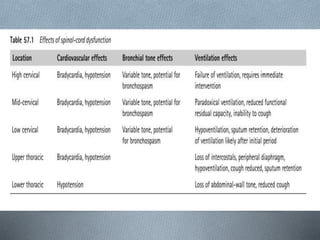
-Injuries to the cervical and upper thoracic 
region may lead to cardiovascular 
instability due to loss of cardio-accelerator 
55 
nerve. 
-Below T5, sympathetic innervation of the 
myocardium is preserved. 
-Ventilation and bronchomotor tone are 
also affected.
-Ileus, urinary retention, gastric 
ulceration and haemorrhage may also 
occur in the early period. 
-These patients have a markedly 
increased risk of deep venous 
thrombosis. 
56
-The patients with unopposed vagal 
influence due to high spinal-cord injury 
may be prone to profound bradycardia 
or even asystole when subjected to 
endobronchial suctioning. 
57
58
-Care must be taken to exclude compartment 
syndromes and any required fasciotomies 
should be undertaken pre-transfer. 
-Fractures need to be stabilized adequately, 
preferably with a rigid fixation device. 
-In the case of serious pelvic fracture, where there 
is risk of further haemorrhage, external fixation 
is also essential. 
59 
*limb trauma
*Hypothermia 
-Hypothermia interferes with normal 
metabolic processes, including the 
metabolism of drugs, and it can delay 
elimination of drugs. 
-Hypothermia affects cardiovascular 
function; when severe,this leads to life-threatening 
60 
arrhythmias. 
-It also interferes with clotting mechanisms.
*Therapeutic regimen 
-As a general principle, the patients should 
remain on an established regimen if they 
are stable and are suitable for transfer. 
-This will normally include, at the very basic 
level, analgesia, sedation and often 
neuromuscular blockade. 
61
-The critically ill patient requires other 
therapeutic agents such as 
antimicrobials, anticoagulants, 
antiarrhythmics and drugs to aid in the 
prevention of gastrointestinal 
haemorrhage. 
62
63 
*TRANSFER 
-Short transfers by rotary-wing aircraft or 
fixed-wing aircraft can be achieved by 
the minimum of a critical-care 
aeromedical physician and a critical-care 
aeromedical nurse. 
-For longer, fixed-wing flights,technical 
support and additional logistic personnel 
should be included.
با تشکر از توجه شما 
64 
عزیزان

Critically ill patient transfer

  • 1.
  • 2.
    Aeromedical transfer ofthe critically ill patient Dr.Ebadi 2
  • 3.
    3 1-INTRODUCTION -Amodel of timescale related to casualty death -Primary,delayed primary,Secondary
  • 4.
    2-TEAM COMPOSITION -Trainedin anesthesia & intensive care -Based on a full team -Supplemented by additional personnel 4
  • 5.
  • 6.
    -Testing procedures -Ventilators -Monitors -Pacemakers -Syringe pumps and volumetric pumps -Suction apparatus -Blood analysis -Peripheral nerve stimulators 6
  • 7.
  • 8.
    -Ventilators -Continuous positiveairways pressure (CPAP), -Intermittent positive-pressure ventilation (IPPV), -Positive end-expiratory pressure (PEEP) - Alteration of the inspiratory to expiratory ratio -Low power consumption -Low oxygen consumption 8
  • 9.
  • 10.
    Univent Model 750and Univent Eagle Model 754 10
  • 11.
    -Monitors Blood Pressure: -palpated systolic BPs taken at the radial or brachial site, -Automated BP monitors using oscillometric *Not ascultatory method 11
  • 12.
    -Doppler and pulseoximetry occlusion techniques 12
  • 13.
    -Invasive BP measurementssuch as the ProPaq Encore. 13
  • 14.
    ECG monitoring: ProPaqEncore, provide an extended bandwidth where ST segments may be accurately displayed and printed. 14
  • 15.
    Oxygen Saturation: Pulseoximetry in the aeromedical evacuation 15
  • 16.
    End-tidal CO2(EtCO2): EtCO2 monitoring provides information on the adequacy of minute ventilation and the position of the endotracheal tube. 16
  • 17.
  • 18.
    -Syringe pumps andvolumetric pumps 18
  • 19.
    -Suction apparatus Suctionapparatus must be fully portable, have high flow capability and be able to collect fluid waste in a manner that protects staff and be safely disposable. 19
  • 20.
    -Blood analysis Theability to perform blood gas, electrolyte, glucose, lactate. Arterial oxygen, carbon dioxide, bicarbonate ,pH, glucose and potassium should be carried out at least every hour during transfer 20
  • 21.
    -Peripheral nerve stimulators The ability to assess neuromuscular junction function is essential when using neuromuscular junction-blocking drugs. 21
  • 22.
  • 23.
  • 24.
  • 25.
  • 26.
    6-EFFECT OF ALTITUDE Common Problems Experienced in Flight 26
  • 27.
  • 28.
  • 29.
    *Changes in pulmonaryblood flow: -may be due to abnormal responses to hypoxia -reflection of the general state of the circulation 29
  • 30.
    *Intubated patient -Theendotracheal tube should be checked and a chest X-ray performed to determine the tube position. -Endotracheal tube cuff pressures should be checked and monitored during flight. 30
  • 31.
    *Tube thoracostomy: -Theyshould be on free drainage, not be clamped at any stage and remain dependent. -If possible, systems that do not require fluid to function and have non-return systems should be used. -The use of the Heimlich-type valve incorporated in the system or certain types of emergency chest drainage systems, as used in acute trauma, may be problematic. 31
  • 32.
    *Tracheostomy -It isimportant to remember that this is not without risk. -The patient should not be transferred until the risk of immediate post-procedure haemorrhage has passed (at least 24 hours) and a tract has begun to form. 32
  • 33.
    *Air in thecerebrospinal fluid (CSF): -expanding the skull can raise intracranial pressure. *A sudden increase in volume skull: -may lead to acute cardiovascular instability -further neurological damage. 33
  • 34.
    *Air-containing cavities: -withinthe lung, bullae, post-surgery or air leaks from trauma can lead to pneumothorax. *Expanding air in the pleura or pericardium : -may lead to the conversion of a simple pneumothorax or pneumopericardium to a tension pneumothorax or pneumopericardium, 34
  • 35.
    *Patients who arepost-trauma, post-surgery: - impaired gastric motility. *Delayed gastric emptying : - raised gastric volume and nausea, vomiting, regurgitation and electrolyte disturbances. *Passive regurgitation in the unconscious patient: -pulmonary aspiration and the risk of chemical pneumonitis and pulmonary sepsis 35
  • 36.
    *Surgery in theperitoneal cavity : -residual air trapped after closure - In large amounts, it may lead to a rise in intra-abdominal pressure and a degree of intra-abdominal hypertension. *Air or other gases within the lumen of the bowel: -rise to pain and discomfort and put anastomotic suture lines at risk. *Ileus or deranged bowel motility: -may also lead to raised intra-abdominal pressure 36
  • 37.
    *Intra-abdominal hypertension : -respiratory and cardiovascular dysfunction. -renal function may be impaired,with a rise in creatinine and urea. -The liver is also vulnerable, and 37 deranged hepatic function may occur.
  • 38.
    *Fluid balance&resuscitation: -replacinglosses and restricting fluids -baseline maintenance requirements and insensible losses 38
  • 39.
    -The circulation mustbe optimally filled in flight . -Some patients,with major trauma or burns, may require additional fluids. 39
  • 40.
    -Continued resuscitation bylarge-bore cannulae. -Vasoactive drugs require administration via the central venous route, 40
  • 41.
    *sympathomimetics: -Inotropic sympathomimeticssuch as adrenaline (epinephrine), dopexamine, dobutamine and dopamine may already be in use. -These drugs are life-vital components of care, as any sudden interruption in their administration may result in severe instability or cardiac arrest. 41
  • 42.
    -The circulation willalso require optimal filling but may need increases in support from inotropic or vasoconstrictive drugs as transfer begins. 42 *SIRS:
  • 43.
    *myocardial infarction: -Themyocardium may be extremely irritable and prone to arrhythmias, which may precipitate cardiac arrest. -Cardiac failure and cardiogenic shock may also occur. 43
  • 44.
    *Stomach decompression: -Anasogastric drainage tube is normally a requirement for aeromedical transfers of critically ill patients. -Feeding should be stopped a number of hours before transfer, in order to reduce the likelihood of reflux. 44
  • 45.
    -Nasogastric or orogastrictubes should be aspirated and then placed on free drainage, while remaining dependent. 45 -prokinetic drugs such as metoclopramide
  • 46.
    *Upper GI bleeding: - H2 -receptor-blocking drugs,proton-pump inhibitors. 46
  • 47.
    -An intra-abdominal surgeryand/or bowel surgery without sufficient time to allow anastomoses to heal, then sea-level cabin altitude should be requested. 47 *Intra-abdominal surgery:
  • 48.
    *Hepatic dysfunction -Inthe critically ill patient, changes in blood flow, the presence of toxins and drugs in the circulation, and the direct effects of infective agents compromise hepatic function. -Impaired hepatocyte function increases the potential for coagulopathy and for 48 altered metabolism of drugs.
  • 49.
    -In practice, mildlyderanged hepatic function is of little significance during transfer. -In the case of acute hepatic failure, even short-distance ground transfer may be extremely hazardous due to the circulatory and neurological effects associated with the condition. -Transfer by air to enable the patient to receive hepatic transplantation may be justified and the attendant risk accepted. 49
  • 50.
    *Renal dysfunction -Patientswho are treated inadequately may be subject to changes in electrolytes during the flight, which will compromise their safety. - If this occurs, then there is a limited response available and the patient may suffer irreversible cardiac dysfunction. 50
  • 51.
    Urinary catheters needto be checked to ensure that there is free drainage. Urine output should be measured hourly, as in the ICU. 51
  • 52.
    52 *CNS problems: -If the level of consciousness is reduced sufficiently, then it is associated with hypoventilation. -Hypoventilation will lead initially to hypercarbia and then to hypoxia. .
  • 53.
    -Hypercarbia leads toan increase in intracranial pressure,which may be critical for the already injured brain. 53 -Hypoxia will also lead to further neurological injury. -The airway be maintained and ventilation is controlled.
  • 54.
    -Patients with aGCS of 8 or less should be intubated and ventilated. -Vasodilation caused by induction agents may lead to hypotension and cerebral hypoperfusion. -Conversely,intubation may lead to a - marked sympathetic stimulation and a marked increase in intracranial pressure. 54
  • 55.
    -Injuries to thecervical and upper thoracic region may lead to cardiovascular instability due to loss of cardio-accelerator 55 nerve. -Below T5, sympathetic innervation of the myocardium is preserved. -Ventilation and bronchomotor tone are also affected.
  • 56.
    -Ileus, urinary retention,gastric ulceration and haemorrhage may also occur in the early period. -These patients have a markedly increased risk of deep venous thrombosis. 56
  • 57.
    -The patients withunopposed vagal influence due to high spinal-cord injury may be prone to profound bradycardia or even asystole when subjected to endobronchial suctioning. 57
  • 58.
  • 59.
    -Care must betaken to exclude compartment syndromes and any required fasciotomies should be undertaken pre-transfer. -Fractures need to be stabilized adequately, preferably with a rigid fixation device. -In the case of serious pelvic fracture, where there is risk of further haemorrhage, external fixation is also essential. 59 *limb trauma
  • 60.
    *Hypothermia -Hypothermia interfereswith normal metabolic processes, including the metabolism of drugs, and it can delay elimination of drugs. -Hypothermia affects cardiovascular function; when severe,this leads to life-threatening 60 arrhythmias. -It also interferes with clotting mechanisms.
  • 61.
    *Therapeutic regimen -Asa general principle, the patients should remain on an established regimen if they are stable and are suitable for transfer. -This will normally include, at the very basic level, analgesia, sedation and often neuromuscular blockade. 61
  • 62.
    -The critically illpatient requires other therapeutic agents such as antimicrobials, anticoagulants, antiarrhythmics and drugs to aid in the prevention of gastrointestinal haemorrhage. 62
  • 63.
    63 *TRANSFER -Shorttransfers by rotary-wing aircraft or fixed-wing aircraft can be achieved by the minimum of a critical-care aeromedical physician and a critical-care aeromedical nurse. -For longer, fixed-wing flights,technical support and additional logistic personnel should be included.
  • 64.
    با تشکر ازتوجه شما 64 عزیزان