CRITICAL ANALYSIS OF
VARIOUS PROGRAMS OF
TEACHER EDUCATION IN
INDIA
PRESENTED BY:
MISS. SHWETA SHARMA
M.SC. NURSING
1ST YEAR
AIIMS, JODHPUR
INTRODUCTION
•According to National Council of Teacher Education
(NCTE), teachers play an important role in shaping the
future of the country and hence it is important that a
lot of attention is paid on the quality of teachers
trained every year.
•The focal importance of teacher in the total educative
process is not new to educational thinking. But, with
the changes in theory and practice of education, the
concept of teacher preparation has undergone a
considerable change.
•There has been a shift in the
character of teacher
preparation from one of
apprenticeship to one suited
to a profession. The
substitution of the word
'education' for ‘training’ in
recent years in connection
with the preparation of
teachers is implicitly indicative
of this shift in emphasis.
TEACHER EDUCATION
“A programme of education, research and
training of persons to teach from pre- primary
to higher education level.”
- National Council for Teacher Education
• Teacher training course in India is designed for aspiring teachers to
learn interactive and better ways of teaching to make a subject
interesting.
• In the broader sense 'teacher education' refers to the total of
educative experience which contribute to the preparation of a
person for a teaching position in schools, but the term is more
commonly employed to designate the programme of courses and
other experiences offered by an educational institute for the
announced purpose of preparing persons for teaching and other
educational service and for contributing to their growth in
competency for such service.
• Such teacher education programs are offered in teacher's colleges
and normal schools and in colleges and universities.
KEYPOINTS OF TEACHER
EDUCATION PROGRAMME
•Teacher education curriculum has faced
severe criticism over the years. Drastic
changes are required to bring a big change to
the curriculum. These changes are slow but
can be seen as International teaching
agencies with a more advanced teaching
curriculum helping to shape better teachers
in India.
•The educational requirement for a primary
and secondary teacher is also different.
People who wish to teach primary school
should minimum pass higher secondary
examination with 50% marks, whereas for
teaching at secondary school, one needs to
be postgraduate in the subject one wishes
to teach.
• There are several schools and
colleges in India, which cater to teacher
training schools in India and these offer
teaching courses for different levels.
Teacher education in India is institution
based, along with internship programs in
real classroom settings.
• Teacher education is provided by several
Universities, affiliated colleges, private and open
Universities in India. Some of these institutions are
more like an eye wash and provide certification
just by paying the fee, and this leads to rise of
unqualified teachers in India. The situation of
primary teachers in India has seen a dramatic
change, but a lot has to be done to improve the
curriculum of secondary and vocational teachers.
•Many Institutes of Advanced Study in
Education, Colleges of Teacher Education and
District Institutes of Education are functioning
in the country. It has been found that in a large
number of cases, this is an example of wastage
of funds.
•Teacher education programs are being
delivered by a large number of unaided private
teacher education institutions.
•According to Dr. V.K. Maheshwari, teaching can be
made more effective if a teacher is fully satisfied with
the curriculum which she has to teach. Also, he should
know its utility. It can be possible only when she
studies the prevalent syllabus critically.
•It should be fully clear to him that each subject has
certain specific aims, which his students have to
achieve. A teacher should examine these aims and
how they can be achieved on the basis of the present
syllabus.
NATURE OF TEACHER
EDUCATION
1) Teacher education is a continuous process.
2) Teacher education is broad and comprehensive.
3) It is ever-evolving and dynamic.
4) The crux of the entire process of teacher education
lies in its curriculum, design, structure, organization
and transaction modes.
AIMS OF TEACHER EDUCATION
IN INDIA
• To enhance the institutional capacity available at
present for ensuring the adequate supply of trained
teachers for all levels of school education.
• To utilize all possible kinds of institutions for in-
service training of the existing cadre at all levels.
• To bring about synergy between institutional
structures operating at different levels.
• To facilitate co-operation and collaboration
between institutes of teacher training and
colleges.
• To envision a comprehensive model of teacher
education.
• To prepare a curriculum policy and framework
for teacher education which is consistent with
the vision of NCF (National Curriculum
Framework).
OBJECTIVES OF TEACHER
EDUCATION
1.Imparting an adequate knowledge of the subject matter.
2.Equipping the prospective teachers with necessary
pedagogic skills.
3.Enabling the teacher to acquire understanding of child
psychology.
4.Developing proper attitudes towards teaching.
5.Developing self-confidence in the teachers.
6.Enabling teachers to make proper use of instructional
facilities.
IMPORTANCE OF TEACHER
TRAINING
•Better Understanding of the Student.
•Building Confidence.
•Using Methodology of Teaching.
•Building favorable Attitude.
•Familiarizing with the Latest in Education.
•Making familiar with School organization.
•Creating social Insight.
•Improving Standards.
•Training for Democracy.
TYPES OF TEACHER EDUCATION
PROGRAMMES
1. Pre-primary teacher education [higher secondary, one year]
2. Primary teacher education [higher secondary, two years]
3. Secondary teacher education [graduation, one year]
4. Higher education programs [One-year M.Ed. Course, Two-year M.
A in Education, Two-year Ph.D. course after M.Ed./M.A.]
5. Vocational Teachers Training [One-year Diploma in Physical
Education (DPE), Training courses to prepare teachers of Music,
Dancing, Painting and Fine Arts, One-year training course to
prepare teachers for Home Science, Certificate courses in Arts &
Crafts]
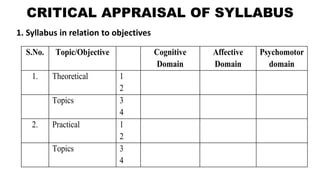
CRITICAL APPRAISAL OF SYLLABUS
1. Syllabus in relation to objectives
S.No. Topic/Objective Cognitive
Domain
Affective
Domain
Psychomotor
domain
1. Theoretical 1
2
Topics 3
4
2. Practical 1
2
Topics 3
4
2. Selection of organization of the syllabus
S.No. Approaches of
syllabus
Topic
(1)
Topic
(2)
Topic
(3)
Topic
(4)
Topic
(5)
1. Theoretical
2. Topical approach
3. Concentric approach
4. Interest and need-
oriented approach
5. Democratic approach
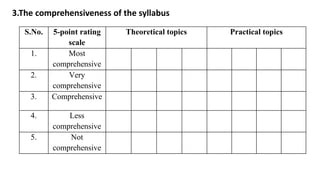
3.The comprehensiveness of the syllabus
S.No. 5-point rating
scale
Theoretical topics Practical topics
1. Most
comprehensive
2. Very
comprehensive
3. Comprehensive
4. Less
comprehensive
5. Not
comprehensive
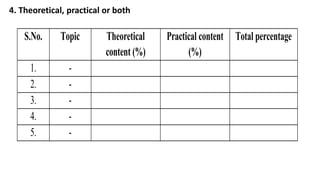
4. Theoretical, practical or both
S.No. Topic Theoretical
content (%)
Practical content
(%)
Total percentage
1. -
2. -
3. -
4. -
5. -
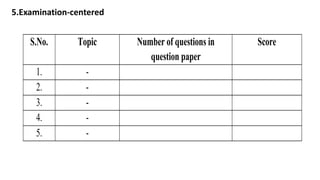
5.Examination-centered
S.No. Topic Number of questions in
question paper
Score
1. -
2. -
3. -
4. -
5. -
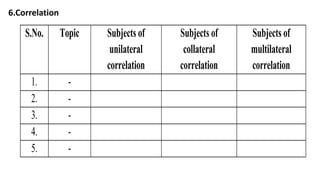
6.Correlation
S.No. Topic Subjects of
unilateral
correlation
Subjects of
collateral
correlation
Subjects of
multilateral
correlation
1. -
2. -
3. -
4. -
5. -
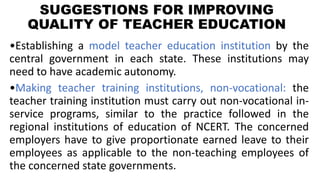
SUGGESTIONS FOR IMPROVING
QUALITY OF TEACHER EDUCATION
•Establishing a model teacher education institution by the
central government in each state. These institutions may
need to have academic autonomy.
•Making teacher training institutions, non-vocational: the
teacher training institution must carry out non-vocational in-
service programs, similar to the practice followed in the
regional institutions of education of NCERT. The concerned
employers have to give proportionate earned leave to their
employees as applicable to the non-teaching employees of
the concerned state governments.
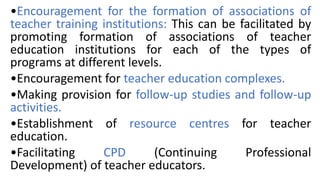
•Encouragement for the formation of associations of
teacher training institutions: This can be facilitated by
promoting formation of associations of teacher
education institutions for each of the types of
programs at different levels.
•Encouragement for teacher education complexes.
•Making provision for follow-up studies and follow-up
activities.
•Establishment of resource centres for teacher
education.
•Facilitating CPD (Continuing Professional
Development) of teacher educators.
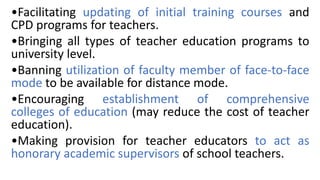
•Facilitating updating of initial training courses and
CPD programs for teachers.
•Bringing all types of teacher education programs to
university level.
•Banning utilization of faculty member of face-to-face
mode to be available for distance mode.
•Encouraging establishment of comprehensive
colleges of education (may reduce the cost of teacher
education).
•Making provision for teacher educators to act as
honorary academic supervisors of school teachers.
•Encouraging the formation of state boards for
teacher education.
•Carrying out a continuous evaluation of initial
teacher training curricula.
•Increasing stress on school experience.
•Improving quality of school support for teacher
training.
•Carrying out a continuous evaluation of teacher
education institutions and their programs.
CRITICAL ANALYSIS
INC
• PHILOSOPHY OF INC
The Indian Nursing council presents the
following statements of belief about
Master’s program in nursing; The
master’s program in nursing is offered by
institution of higher education and is
built upon a recognized bachelor’s
curriculum in nursing.
The Program prepares for leadership
positions in nursing and health fields
who can function as specialist Nurse
practitioners, consultants, Educators,
Administrators and investigators in a
wide variety of professional setting in
meeting the national priorities and the
changing needs of the society.
AIIMS
• PHILOSOPHY OF AIIMS
College of nursing AIIMS believe and
fulfils the philosophy as that of INC but
has not developed its own philosophy.
• The program prepares nursing
graduates who are
professionally equipped,
creative, self-directed and
socially motivated to effectively
deal with day to day problems
within the existing constraints
and thus act as an agent of
social change.
• The program encourages
accountability and commitment
to lifelong learning which
fosters improvement of quality
of care.
• AIMS AND OBJECTIVES
Graduates of Master of Nursing
program demonstrate: Increased
cognitive and psychomotor
competencies and the ability to utilize
these potentialities for efficient nursing
performance.
Expertise in the utilization of concepts
and theories for the assessment,
planning and intervention in meeting
the self-care needs of the individual for
the attainment of fullest potential in
the field of speciality.
Ability to practice independently as a
nurse specialist.
Ability to function effectively as
educators and administrators.
• AIMS AND OBJECTIVES
• Utilize/ apply the concepts,
theories and principles drawn
from the nursing and allied
sciences in his/her nursing
specialty.
• Demonstrate advance
competence in practice of nursing
in his/her area of nursing
speciality.
• Function effectively as educators
and managers in nursing and
allied discipline.
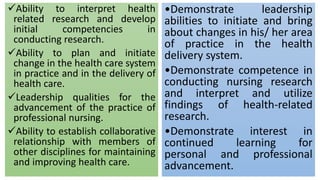
Ability to interpret health
related research and develop
initial competencies in
conducting research.
Ability to plan and initiate
change in the health care system
in practice and in the delivery of
health care.
Leadership qualities for the
advancement of the practice of
professional nursing.
Ability to establish collaborative
relationship with members of
other disciplines for maintaining
and improving health care.
•Demonstrate leadership
abilities to initiate and bring
about changes in his/ her area
of practice in the health
delivery system.
•Demonstrate competence in
conducting nursing research
and interpret and utilize
findings of health-related
research.
•Demonstrate interest in
continued learning for
personal and professional
advancement.
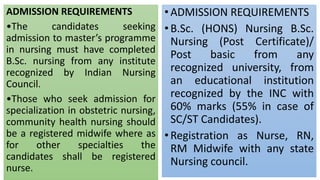
ADMISSION REQUIREMENTS
•The candidates seeking
admission to master’s programme
in nursing must have completed
B.Sc. nursing from any institute
recognized by Indian Nursing
Council.
•Those who seek admission for
specialization in obstetric nursing,
community health nursing should
be a registered midwife where as
for other specialties the
candidates shall be registered
nurse.
•ADMISSION REQUIREMENTS
•B.Sc. (HONS) Nursing B.Sc.
Nursing (Post Certificate)/
Post basic from any
recognized university, from
an educational institution
recognized by the INC with
60% marks (55% in case of
SC/ST Candidates).
•Registration as Nurse, RN,
RM Midwife with any state
Nursing council.
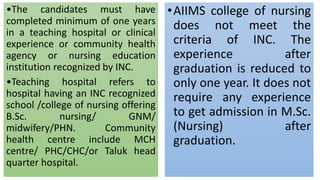
•The candidates must have
completed minimum of one years
in a teaching hospital or clinical
experience or community health
agency or nursing education
institution recognized by INC.
•Teaching hospital refers to
hospital having an INC recognized
school /college of nursing offering
B.Sc. nursing/ GNM/
midwifery/PHN. Community
health centre include MCH
centre/ PHC/CHC/or Taluk head
quarter hospital.
•AIIMS college of nursing
does not meet the
criteria of INC. The
experience after
graduation is reduced to
only one year. It does not
require any experience
to get admission in M.Sc.
(Nursing) after
graduation.
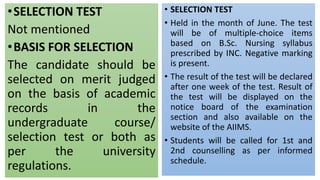
•SELECTION TEST
Not mentioned
•BASIS FOR SELECTION
The candidate should be
selected on merit judged
on the basis of academic
records in the
undergraduate course/
selection test or both as
per the university
regulations.
• SELECTION TEST
• Held in the month of June. The test
will be of multiple-choice items
based on B.Sc. Nursing syllabus
prescribed by INC. Negative marking
is present.
• The result of the test will be declared
after one week of the test. Result of
the test will be displayed on the
notice board of the examination
section and also available on the
website of the AIIMS.
• Students will be called for 1st and
2nd counselling as per informed
schedule.
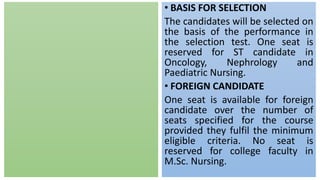
• BASIS FOR SELECTION
The candidates will be selected on
the basis of the performance in
the selection test. One seat is
reserved for ST candidate in
Oncology, Nephrology and
Paediatric Nursing.
• FOREIGN CANDIDATE
One seat is available for foreign
candidate over the number of
seats specified for the course
provided they fulfil the minimum
eligible criteria. No seat is
reserved for college faculty in
M.Sc. Nursing.
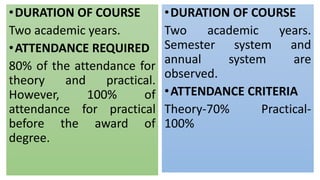
•DURATION OF COURSE
Two academic years.
•ATTENDANCE REQUIRED
80% of the attendance for
theory and practical.
However, 100% of
attendance for practical
before the award of
degree.
•DURATION OF COURSE
Two academic years.
Semester system and
annual system are
observed.
•ATTENDANCE CRITERIA
Theory-70% Practical-
100%
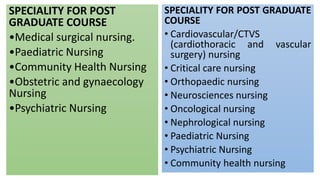
SPECIALITY FOR POST
GRADUATE COURSE
•Medical surgical nursing.
•Paediatric Nursing
•Community Health Nursing
•Obstetric and gynaecology
Nursing
•Psychiatric Nursing
SPECIALITY FOR POST GRADUATE
COURSE
• Cardiovascular/CTVS
(cardiothoracic and vascular
surgery) nursing
• Critical care nursing
• Orthopaedic nursing
• Neurosciences nursing
• Oncological nursing
• Nephrological nursing
• Paediatric Nursing
• Psychiatric Nursing
• Community health nursing
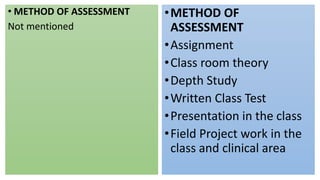
• METHOD OF ASSESSMENT
Not mentioned
•METHOD OF
ASSESSMENT
•Assignment
•Class room theory
•Depth Study
•Written Class Test
•Presentation in the class
•Field Project work in the
class and clinical area
•LABORATORIES
As required for the
undergraduate students.
•RESIDENTIAL
ACCOMODATION
The post graduate students
should be preferably
provided with single
accommodation facility in
the campus.
• LABORATORIES
AIIMS College of Nursing has its
own laboratories like
Fundamental Lab, Advanced
nursing practice lab, OBG Lab,
Paediatrics lab, etc.
• RESIDENTIAL ACCOMODATION
Single room accommodation
facility is available outside the
campus. Transportation facility
with fixed timings is available.
Staying in the hostel is optional.
RESEARCH ARTICLE
TEACHER EDUCATION IN INDIA - PROBLEMS AND
SUGGESTIONS
The intent of this research was to enhance the teacher education quality in
India by focusing on the emerging issues & related concerns. Various issues of
teacher education namely, institutional inertia, brand inequity, quality crisis,
overgrowing establishment, rare humane and professional teachers, poor
integration of skills, alienated and incompatible modes of teacher education,
little contribution to higher education, domain pedagogy mismatches, identity
crisis, rare innovations, stake holders' non-alignment, inadequate technology
infusion, little choice base, poor research scenario, vision and vision
mismatches, non-scientific manpower planning, illusive laboratories, over
activism of distance/open universities, invalid recognition and accreditation
and no teacher education policy have been dealt on in this paper. It concluded
that teacher education system in India calls for revolutionary changes.
CONCLUSION
•Teacher education is a programme that is related to the
development of teacher proficiency and competence
that would enable and empower the teacher to meet
the requirements of the profession and face the
challenges therein.
•The teacher education programme helps to learn latest
techniques, discover classroom technologies, network
with other education professionals, improve teaching
skills and gain experience.
REFERENCES
1.Jaspreet Kaur Sodhi. Comprehensive Textbook of Nursing Education. 2017. New
Delhi. Jaypee Brothers Medical Publishers (P) Ltd. First edition. Pg. no. 397-399.
2.Teacher Education in India. Available from
https://shodhganga.inflibnet.ac.in/bitstream/10603/83326/8/08_chapter%201.pdf
[cited 5 Mar 2020]
3.Teacher education in India. Amrita Roy. Available from
https://www.slideshare.net/AMRITAROY26/teacher-education-in-india [cited 6 Mar
2020]
4.Critical analysis teacher nursing programme in India. FIROZ QURESHI. Available from
https://www.slideshare.net/FIROZQURESHI/critical-analysis-teacher-nursing-
programme-in-india [cited 6 Mar 2020]
5.Dr. Mohit Dixit. TEACHER EDUCATION IN INDIA - PROBLEMS AND SUGGESTIONS.
International Journal of Research (IJR) Vol-1, Issue-4, May 2014 ISSN 2348-6848
criticalanalysiseducation-200430184846.pdf

criticalanalysiseducation-200430184846.pdf

  • 1.
    CRITICAL ANALYSIS OF VARIOUSPROGRAMS OF TEACHER EDUCATION IN INDIA PRESENTED BY: MISS. SHWETA SHARMA M.SC. NURSING 1ST YEAR AIIMS, JODHPUR
  • 2.
    INTRODUCTION •According to NationalCouncil of Teacher Education (NCTE), teachers play an important role in shaping the future of the country and hence it is important that a lot of attention is paid on the quality of teachers trained every year. •The focal importance of teacher in the total educative process is not new to educational thinking. But, with the changes in theory and practice of education, the concept of teacher preparation has undergone a considerable change.
  • 3.
    •There has beena shift in the character of teacher preparation from one of apprenticeship to one suited to a profession. The substitution of the word 'education' for ‘training’ in recent years in connection with the preparation of teachers is implicitly indicative of this shift in emphasis.
  • 4.
    TEACHER EDUCATION “A programmeof education, research and training of persons to teach from pre- primary to higher education level.” - National Council for Teacher Education
  • 5.
    • Teacher trainingcourse in India is designed for aspiring teachers to learn interactive and better ways of teaching to make a subject interesting. • In the broader sense 'teacher education' refers to the total of educative experience which contribute to the preparation of a person for a teaching position in schools, but the term is more commonly employed to designate the programme of courses and other experiences offered by an educational institute for the announced purpose of preparing persons for teaching and other educational service and for contributing to their growth in competency for such service. • Such teacher education programs are offered in teacher's colleges and normal schools and in colleges and universities.
  • 6.
    KEYPOINTS OF TEACHER EDUCATIONPROGRAMME •Teacher education curriculum has faced severe criticism over the years. Drastic changes are required to bring a big change to the curriculum. These changes are slow but can be seen as International teaching agencies with a more advanced teaching curriculum helping to shape better teachers in India.
  • 7.
    •The educational requirementfor a primary and secondary teacher is also different. People who wish to teach primary school should minimum pass higher secondary examination with 50% marks, whereas for teaching at secondary school, one needs to be postgraduate in the subject one wishes to teach.
  • 8.
    • There areseveral schools and colleges in India, which cater to teacher training schools in India and these offer teaching courses for different levels. Teacher education in India is institution based, along with internship programs in real classroom settings.
  • 9.
    • Teacher educationis provided by several Universities, affiliated colleges, private and open Universities in India. Some of these institutions are more like an eye wash and provide certification just by paying the fee, and this leads to rise of unqualified teachers in India. The situation of primary teachers in India has seen a dramatic change, but a lot has to be done to improve the curriculum of secondary and vocational teachers.
  • 10.
    •Many Institutes ofAdvanced Study in Education, Colleges of Teacher Education and District Institutes of Education are functioning in the country. It has been found that in a large number of cases, this is an example of wastage of funds. •Teacher education programs are being delivered by a large number of unaided private teacher education institutions.
  • 11.
    •According to Dr.V.K. Maheshwari, teaching can be made more effective if a teacher is fully satisfied with the curriculum which she has to teach. Also, he should know its utility. It can be possible only when she studies the prevalent syllabus critically. •It should be fully clear to him that each subject has certain specific aims, which his students have to achieve. A teacher should examine these aims and how they can be achieved on the basis of the present syllabus.
  • 12.
    NATURE OF TEACHER EDUCATION 1)Teacher education is a continuous process. 2) Teacher education is broad and comprehensive. 3) It is ever-evolving and dynamic. 4) The crux of the entire process of teacher education lies in its curriculum, design, structure, organization and transaction modes.
  • 13.
    AIMS OF TEACHEREDUCATION IN INDIA • To enhance the institutional capacity available at present for ensuring the adequate supply of trained teachers for all levels of school education. • To utilize all possible kinds of institutions for in- service training of the existing cadre at all levels. • To bring about synergy between institutional structures operating at different levels.
  • 14.
    • To facilitateco-operation and collaboration between institutes of teacher training and colleges. • To envision a comprehensive model of teacher education. • To prepare a curriculum policy and framework for teacher education which is consistent with the vision of NCF (National Curriculum Framework).
  • 15.
    OBJECTIVES OF TEACHER EDUCATION 1.Impartingan adequate knowledge of the subject matter. 2.Equipping the prospective teachers with necessary pedagogic skills. 3.Enabling the teacher to acquire understanding of child psychology. 4.Developing proper attitudes towards teaching. 5.Developing self-confidence in the teachers. 6.Enabling teachers to make proper use of instructional facilities.
  • 16.
    IMPORTANCE OF TEACHER TRAINING •BetterUnderstanding of the Student. •Building Confidence. •Using Methodology of Teaching. •Building favorable Attitude. •Familiarizing with the Latest in Education. •Making familiar with School organization. •Creating social Insight. •Improving Standards. •Training for Democracy.
  • 17.
    TYPES OF TEACHEREDUCATION PROGRAMMES 1. Pre-primary teacher education [higher secondary, one year] 2. Primary teacher education [higher secondary, two years] 3. Secondary teacher education [graduation, one year] 4. Higher education programs [One-year M.Ed. Course, Two-year M. A in Education, Two-year Ph.D. course after M.Ed./M.A.] 5. Vocational Teachers Training [One-year Diploma in Physical Education (DPE), Training courses to prepare teachers of Music, Dancing, Painting and Fine Arts, One-year training course to prepare teachers for Home Science, Certificate courses in Arts & Crafts]
  • 18.
    CRITICAL APPRAISAL OFSYLLABUS 1. Syllabus in relation to objectives S.No. Topic/Objective Cognitive Domain Affective Domain Psychomotor domain 1. Theoretical 1 2 Topics 3 4 2. Practical 1 2 Topics 3 4
  • 19.
    2. Selection oforganization of the syllabus S.No. Approaches of syllabus Topic (1) Topic (2) Topic (3) Topic (4) Topic (5) 1. Theoretical 2. Topical approach 3. Concentric approach 4. Interest and need- oriented approach 5. Democratic approach
  • 20.
    3.The comprehensiveness ofthe syllabus S.No. 5-point rating scale Theoretical topics Practical topics 1. Most comprehensive 2. Very comprehensive 3. Comprehensive 4. Less comprehensive 5. Not comprehensive
  • 21.
    4. Theoretical, practicalor both S.No. Topic Theoretical content (%) Practical content (%) Total percentage 1. - 2. - 3. - 4. - 5. -
  • 22.
    5.Examination-centered S.No. Topic Numberof questions in question paper Score 1. - 2. - 3. - 4. - 5. -
  • 23.
    6.Correlation S.No. Topic Subjectsof unilateral correlation Subjects of collateral correlation Subjects of multilateral correlation 1. - 2. - 3. - 4. - 5. -
  • 24.
    SUGGESTIONS FOR IMPROVING QUALITYOF TEACHER EDUCATION •Establishing a model teacher education institution by the central government in each state. These institutions may need to have academic autonomy. •Making teacher training institutions, non-vocational: the teacher training institution must carry out non-vocational in- service programs, similar to the practice followed in the regional institutions of education of NCERT. The concerned employers have to give proportionate earned leave to their employees as applicable to the non-teaching employees of the concerned state governments.
  • 25.
    •Encouragement for theformation of associations of teacher training institutions: This can be facilitated by promoting formation of associations of teacher education institutions for each of the types of programs at different levels. •Encouragement for teacher education complexes. •Making provision for follow-up studies and follow-up activities. •Establishment of resource centres for teacher education. •Facilitating CPD (Continuing Professional Development) of teacher educators.
  • 26.
    •Facilitating updating ofinitial training courses and CPD programs for teachers. •Bringing all types of teacher education programs to university level. •Banning utilization of faculty member of face-to-face mode to be available for distance mode. •Encouraging establishment of comprehensive colleges of education (may reduce the cost of teacher education). •Making provision for teacher educators to act as honorary academic supervisors of school teachers.
  • 27.
    •Encouraging the formationof state boards for teacher education. •Carrying out a continuous evaluation of initial teacher training curricula. •Increasing stress on school experience. •Improving quality of school support for teacher training. •Carrying out a continuous evaluation of teacher education institutions and their programs.
  • 28.
    CRITICAL ANALYSIS INC • PHILOSOPHYOF INC The Indian Nursing council presents the following statements of belief about Master’s program in nursing; The master’s program in nursing is offered by institution of higher education and is built upon a recognized bachelor’s curriculum in nursing. The Program prepares for leadership positions in nursing and health fields who can function as specialist Nurse practitioners, consultants, Educators, Administrators and investigators in a wide variety of professional setting in meeting the national priorities and the changing needs of the society. AIIMS • PHILOSOPHY OF AIIMS College of nursing AIIMS believe and fulfils the philosophy as that of INC but has not developed its own philosophy.
  • 29.
    • The programprepares nursing graduates who are professionally equipped, creative, self-directed and socially motivated to effectively deal with day to day problems within the existing constraints and thus act as an agent of social change. • The program encourages accountability and commitment to lifelong learning which fosters improvement of quality of care.
  • 30.
    • AIMS ANDOBJECTIVES Graduates of Master of Nursing program demonstrate: Increased cognitive and psychomotor competencies and the ability to utilize these potentialities for efficient nursing performance. Expertise in the utilization of concepts and theories for the assessment, planning and intervention in meeting the self-care needs of the individual for the attainment of fullest potential in the field of speciality. Ability to practice independently as a nurse specialist. Ability to function effectively as educators and administrators. • AIMS AND OBJECTIVES • Utilize/ apply the concepts, theories and principles drawn from the nursing and allied sciences in his/her nursing specialty. • Demonstrate advance competence in practice of nursing in his/her area of nursing speciality. • Function effectively as educators and managers in nursing and allied discipline.
  • 31.
    Ability to interprethealth related research and develop initial competencies in conducting research. Ability to plan and initiate change in the health care system in practice and in the delivery of health care. Leadership qualities for the advancement of the practice of professional nursing. Ability to establish collaborative relationship with members of other disciplines for maintaining and improving health care. •Demonstrate leadership abilities to initiate and bring about changes in his/ her area of practice in the health delivery system. •Demonstrate competence in conducting nursing research and interpret and utilize findings of health-related research. •Demonstrate interest in continued learning for personal and professional advancement.
  • 32.
    ADMISSION REQUIREMENTS •The candidatesseeking admission to master’s programme in nursing must have completed B.Sc. nursing from any institute recognized by Indian Nursing Council. •Those who seek admission for specialization in obstetric nursing, community health nursing should be a registered midwife where as for other specialties the candidates shall be registered nurse. •ADMISSION REQUIREMENTS •B.Sc. (HONS) Nursing B.Sc. Nursing (Post Certificate)/ Post basic from any recognized university, from an educational institution recognized by the INC with 60% marks (55% in case of SC/ST Candidates). •Registration as Nurse, RN, RM Midwife with any state Nursing council.
  • 33.
    •The candidates musthave completed minimum of one years in a teaching hospital or clinical experience or community health agency or nursing education institution recognized by INC. •Teaching hospital refers to hospital having an INC recognized school /college of nursing offering B.Sc. nursing/ GNM/ midwifery/PHN. Community health centre include MCH centre/ PHC/CHC/or Taluk head quarter hospital. •AIIMS college of nursing does not meet the criteria of INC. The experience after graduation is reduced to only one year. It does not require any experience to get admission in M.Sc. (Nursing) after graduation.
  • 34.
    •SELECTION TEST Not mentioned •BASISFOR SELECTION The candidate should be selected on merit judged on the basis of academic records in the undergraduate course/ selection test or both as per the university regulations. • SELECTION TEST • Held in the month of June. The test will be of multiple-choice items based on B.Sc. Nursing syllabus prescribed by INC. Negative marking is present. • The result of the test will be declared after one week of the test. Result of the test will be displayed on the notice board of the examination section and also available on the website of the AIIMS. • Students will be called for 1st and 2nd counselling as per informed schedule.
  • 35.
    • BASIS FORSELECTION The candidates will be selected on the basis of the performance in the selection test. One seat is reserved for ST candidate in Oncology, Nephrology and Paediatric Nursing. • FOREIGN CANDIDATE One seat is available for foreign candidate over the number of seats specified for the course provided they fulfil the minimum eligible criteria. No seat is reserved for college faculty in M.Sc. Nursing.
  • 36.
    •DURATION OF COURSE Twoacademic years. •ATTENDANCE REQUIRED 80% of the attendance for theory and practical. However, 100% of attendance for practical before the award of degree. •DURATION OF COURSE Two academic years. Semester system and annual system are observed. •ATTENDANCE CRITERIA Theory-70% Practical- 100%
  • 37.
    SPECIALITY FOR POST GRADUATECOURSE •Medical surgical nursing. •Paediatric Nursing •Community Health Nursing •Obstetric and gynaecology Nursing •Psychiatric Nursing SPECIALITY FOR POST GRADUATE COURSE • Cardiovascular/CTVS (cardiothoracic and vascular surgery) nursing • Critical care nursing • Orthopaedic nursing • Neurosciences nursing • Oncological nursing • Nephrological nursing • Paediatric Nursing • Psychiatric Nursing • Community health nursing
  • 38.
    • METHOD OFASSESSMENT Not mentioned •METHOD OF ASSESSMENT •Assignment •Class room theory •Depth Study •Written Class Test •Presentation in the class •Field Project work in the class and clinical area
  • 39.
    •LABORATORIES As required forthe undergraduate students. •RESIDENTIAL ACCOMODATION The post graduate students should be preferably provided with single accommodation facility in the campus. • LABORATORIES AIIMS College of Nursing has its own laboratories like Fundamental Lab, Advanced nursing practice lab, OBG Lab, Paediatrics lab, etc. • RESIDENTIAL ACCOMODATION Single room accommodation facility is available outside the campus. Transportation facility with fixed timings is available. Staying in the hostel is optional.
  • 40.
    RESEARCH ARTICLE TEACHER EDUCATIONIN INDIA - PROBLEMS AND SUGGESTIONS The intent of this research was to enhance the teacher education quality in India by focusing on the emerging issues & related concerns. Various issues of teacher education namely, institutional inertia, brand inequity, quality crisis, overgrowing establishment, rare humane and professional teachers, poor integration of skills, alienated and incompatible modes of teacher education, little contribution to higher education, domain pedagogy mismatches, identity crisis, rare innovations, stake holders' non-alignment, inadequate technology infusion, little choice base, poor research scenario, vision and vision mismatches, non-scientific manpower planning, illusive laboratories, over activism of distance/open universities, invalid recognition and accreditation and no teacher education policy have been dealt on in this paper. It concluded that teacher education system in India calls for revolutionary changes.
  • 42.
    CONCLUSION •Teacher education isa programme that is related to the development of teacher proficiency and competence that would enable and empower the teacher to meet the requirements of the profession and face the challenges therein. •The teacher education programme helps to learn latest techniques, discover classroom technologies, network with other education professionals, improve teaching skills and gain experience.
  • 43.
    REFERENCES 1.Jaspreet Kaur Sodhi.Comprehensive Textbook of Nursing Education. 2017. New Delhi. Jaypee Brothers Medical Publishers (P) Ltd. First edition. Pg. no. 397-399. 2.Teacher Education in India. Available from https://shodhganga.inflibnet.ac.in/bitstream/10603/83326/8/08_chapter%201.pdf [cited 5 Mar 2020] 3.Teacher education in India. Amrita Roy. Available from https://www.slideshare.net/AMRITAROY26/teacher-education-in-india [cited 6 Mar 2020] 4.Critical analysis teacher nursing programme in India. FIROZ QURESHI. Available from https://www.slideshare.net/FIROZQURESHI/critical-analysis-teacher-nursing- programme-in-india [cited 6 Mar 2020] 5.Dr. Mohit Dixit. TEACHER EDUCATION IN INDIA - PROBLEMS AND SUGGESTIONS. International Journal of Research (IJR) Vol-1, Issue-4, May 2014 ISSN 2348-6848