Name Azra Khan
D/o M.Arshad Khan
Semester 05
Subject Technical Writing and
presentation skills
Critical Thinking
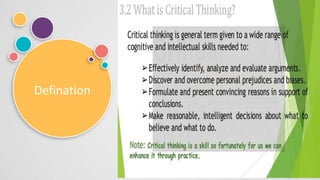
Defination
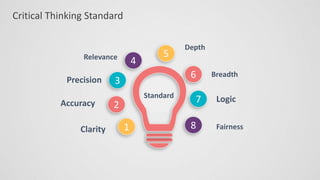
Critical Thinking Standard
3
2
1
6
7
8
4
5
Breadth
Logic
Fairness
Relevance
Precision
Accuracy
Clarity
Standard
Depth
How many steps of critical Thinking?
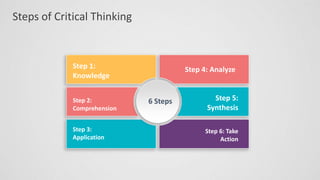
Steps of Critical Thinking
Step 1:
Knowledge
Step 2:
Comprehension
Step 3:
Application
Step 4: Analyze
Step 5:
Synthesis
Step 6: Take
Action
6 Steps
Step 1: Knowledge
Add your words here.according to your need to draw
the text boxase read the instructions and more work at
the end of the manual template.
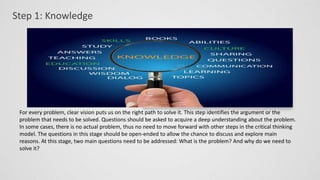
For every problem, clear vision puts us on the right path to solve it. This step identifies the argument or the
problem that needs to be solved. Questions should be asked to acquire a deep understanding about the problem.
In some cases, there is no actual problem, thus no need to move forward with other steps in the critical thinking
model. The questions in this stage should be open-ended to allow the chance to discuss and explore main
reasons. At this stage, two main questions need to be addressed: What is the problem? And why do we need to
solve it?
Step 2: Comprehension
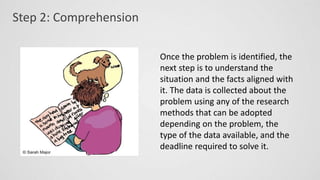
Once the problem is identified, the
next step is to understand the
situation and the facts aligned with
it. The data is collected about the
problem using any of the research
methods that can be adopted
depending on the problem, the
type of the data available, and the
deadline required to solve it.
Step 3: Application
This step continues the previous
one to complete the understanding
of different facts and resources
required to solve the problem by
building a linkage between the
information and resources. Mind
maps can be used to analyze the
situation, build a relation between
it and the core problem, and
determine the best way to move
forward.
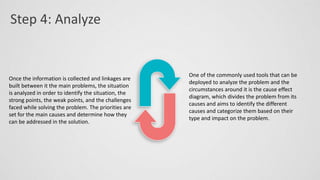
Step 4: Analyze
.
Once the information is collected and linkages are
built between it the main problems, the situation
is analyzed in order to identify the situation, the
strong points, the weak points, and the challenges
faced while solving the problem. The priorities are
set for the main causes and determine how they
can be addressed in the solution.
One of the commonly used tools that can be
deployed to analyze the problem and the
circumstances around it is the cause effect
diagram, which divides the problem from its
causes and aims to identify the different
causes and categorize them based on their
type and impact on the problem.
Step 5: Synthesis
In this stage, once the problem is fully analyzed and all the
related information is considered, a decision should be formed
about how to solve the problem and the initial routes to follow
to take this decision into action. If there are number of
solutions, they should be evaluated and prioritized in order to
find the most advantageous solution. One of the tools that
contribute choosing the problem solution is the SWOT analysis
that tends to identify the solution’s strength, weakness,
opportunity, and threats.
Step 6:
Take
Action
The final step is to build an evaluation about the problem that can be
put into action. The result of critical thinking should be transferred into
action steps. If the decision involves a specific project or team, a plan
of action could be implemented to ensure that the solution is adopted
and executed as planned.
The critical thinking method can be adopted to replace emotions and
perusal biases when trying to think about a situation or a problem. The
time for adopting critical thinking varies based on the problem; it may
take few minutes to number of days. The advantage of deploying
critical thinking is that it contributes to widening our perspectives
about situations and broadening our thinking possibilities. However,
these steps should be translated into a plan of action that ensures that
the decided resolution is well achieved and integrated between all the
involved bodies.
Importance of critical Thinking
1. Critical Thinking Is Universal
Critical thinking is a domain-general thinking skill.
What does this mean? It means that no matter what
path or profession you pursue, these skills will always
be relevant and will always be beneficial to your
success. They are not specific to any field.
2. Improves Language & Presentation
Skills
In order to best express ourselves, we need to know how to
think clearly and systematically — meaning practice critical
thinking! Critical thinking also means knowing how to break
down texts, and in turn, improve our ability to comprehend.
3. Promotes Creativity
By practicing critical thinking, we are allowing ourselves
not only to solve problems, but also come up with new
and creative ideas to do so. Critical thinking allows us to
analyze these ideas and adjust them accordingly.
4. Key For Career Success
Critical thinking is crucial for many career paths. Not
just for scientists, but lawyers, doctors, reporters,
engineers, accountants, and analysts (among many
others) all have to use critical thinking in their
positions.
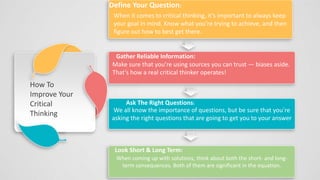
We all know the importance of questions, but be sure that you’re
asking the right questions that are going to get you to your answer
Define Your Question:
When it comes to critical thinking, it’s important to always keep
your goal in mind. Know what you’re trying to achieve, and then
figure out how to best get there.
Gather Reliable Information:
Make sure that you’re using sources you can trust — biases aside.
That’s how a real critical thinker operates!
Ask The Right Questions:
Add your words here
When coming up with solutions, think about both the short- and long-
term consequences. Both of them are significant in the equation.
Look Short & Long Term:
How To
Improve Your
Critical
Thinking
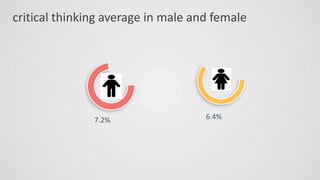
critical thinking average in male and female
7.2% 6.4%
A Z R A
THANK YOU

Critical writing and presentation skills

  • 1.
    Name Azra Khan D/oM.Arshad Khan Semester 05 Subject Technical Writing and presentation skills
  • 2.
  • 3.
  • 4.
  • 5.
    How many stepsof critical Thinking?
  • 6.
    Steps of CriticalThinking Step 1: Knowledge Step 2: Comprehension Step 3: Application Step 4: Analyze Step 5: Synthesis Step 6: Take Action 6 Steps
  • 7.
    Step 1: Knowledge Addyour words here.according to your need to draw the text boxase read the instructions and more work at the end of the manual template. For every problem, clear vision puts us on the right path to solve it. This step identifies the argument or the problem that needs to be solved. Questions should be asked to acquire a deep understanding about the problem. In some cases, there is no actual problem, thus no need to move forward with other steps in the critical thinking model. The questions in this stage should be open-ended to allow the chance to discuss and explore main reasons. At this stage, two main questions need to be addressed: What is the problem? And why do we need to solve it?
  • 8.
    Step 2: Comprehension Oncethe problem is identified, the next step is to understand the situation and the facts aligned with it. The data is collected about the problem using any of the research methods that can be adopted depending on the problem, the type of the data available, and the deadline required to solve it.
  • 9.
    Step 3: Application Thisstep continues the previous one to complete the understanding of different facts and resources required to solve the problem by building a linkage between the information and resources. Mind maps can be used to analyze the situation, build a relation between it and the core problem, and determine the best way to move forward.
  • 10.
    Step 4: Analyze . Oncethe information is collected and linkages are built between it the main problems, the situation is analyzed in order to identify the situation, the strong points, the weak points, and the challenges faced while solving the problem. The priorities are set for the main causes and determine how they can be addressed in the solution. One of the commonly used tools that can be deployed to analyze the problem and the circumstances around it is the cause effect diagram, which divides the problem from its causes and aims to identify the different causes and categorize them based on their type and impact on the problem.
  • 11.
    Step 5: Synthesis Inthis stage, once the problem is fully analyzed and all the related information is considered, a decision should be formed about how to solve the problem and the initial routes to follow to take this decision into action. If there are number of solutions, they should be evaluated and prioritized in order to find the most advantageous solution. One of the tools that contribute choosing the problem solution is the SWOT analysis that tends to identify the solution’s strength, weakness, opportunity, and threats.
  • 12.
    Step 6: Take Action The finalstep is to build an evaluation about the problem that can be put into action. The result of critical thinking should be transferred into action steps. If the decision involves a specific project or team, a plan of action could be implemented to ensure that the solution is adopted and executed as planned. The critical thinking method can be adopted to replace emotions and perusal biases when trying to think about a situation or a problem. The time for adopting critical thinking varies based on the problem; it may take few minutes to number of days. The advantage of deploying critical thinking is that it contributes to widening our perspectives about situations and broadening our thinking possibilities. However, these steps should be translated into a plan of action that ensures that the decided resolution is well achieved and integrated between all the involved bodies.
  • 13.
    Importance of criticalThinking 1. Critical Thinking Is Universal Critical thinking is a domain-general thinking skill. What does this mean? It means that no matter what path or profession you pursue, these skills will always be relevant and will always be beneficial to your success. They are not specific to any field. 2. Improves Language & Presentation Skills In order to best express ourselves, we need to know how to think clearly and systematically — meaning practice critical thinking! Critical thinking also means knowing how to break down texts, and in turn, improve our ability to comprehend. 3. Promotes Creativity By practicing critical thinking, we are allowing ourselves not only to solve problems, but also come up with new and creative ideas to do so. Critical thinking allows us to analyze these ideas and adjust them accordingly. 4. Key For Career Success Critical thinking is crucial for many career paths. Not just for scientists, but lawyers, doctors, reporters, engineers, accountants, and analysts (among many others) all have to use critical thinking in their positions.
  • 14.
    We all knowthe importance of questions, but be sure that you’re asking the right questions that are going to get you to your answer Define Your Question: When it comes to critical thinking, it’s important to always keep your goal in mind. Know what you’re trying to achieve, and then figure out how to best get there. Gather Reliable Information: Make sure that you’re using sources you can trust — biases aside. That’s how a real critical thinker operates! Ask The Right Questions: Add your words here When coming up with solutions, think about both the short- and long- term consequences. Both of them are significant in the equation. Look Short & Long Term: How To Improve Your Critical Thinking
  • 15.
    critical thinking averagein male and female 7.2% 6.4%
  • 16.
    A Z RA THANK YOU