PS-16
Dynamic Schedule Management
Glen B. Alleman
PrimePM
glen.alleman@niwotridge.com
+1 303 241 9633
EVM World 2017
Rick Price
ClearPlan / Waypoint Consulting
Rick.A.Price2016@gmail.com
+1 303 667 3379
2
Structure of Workshop
ď‚§ This workshop amplifies the concepts presented in the practice symposium
titled “Critical Thinking on Critical Path Analysis”
ď‚§ Core principles
– All work is probabilistic
– Complex programs are always dynamic
– Plan B and Plan C can be defined in the PMB as alternatives
– Emerging plans must be dealt with as well
ď‚§ Notional example
– A notional spacecraft mission
ď‚§ Hands on identification of alternative points of integration (API)
– Have students identify New API
– Have students discuss and present their own issues with API on their
own projects
All Successful Projects Require Credible
Answers To These 5 Questions …
3 Performance–Based Project Management®, Copyright © Glen B. Alleman, 2012 - 2017
1. What Does DONE Look
Like?
2. How Do We Get to DONE?
3. Is There Enough Time,
Money, and Resources, To
Get to DONE?
4. What Impediments Will Be
Encountered Along The
Way to DONE?
5. What Are The Units Of
Measures For Progress To
Plan for each Deliverable?
4
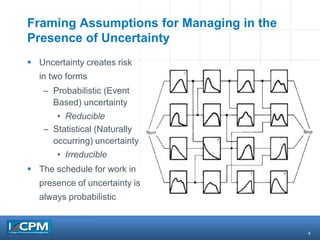
Framing Assumptions for Managing in the
Presence of Uncertainty
ď‚§ Uncertainty creates risk
in two forms
– Probabilistic (Event
Based) uncertainty
• Reducible
– Statistical (Naturally
occurring) uncertainty
• Irreducible
ď‚§ The schedule for work in
presence of uncertainty is
always probabilistic
5
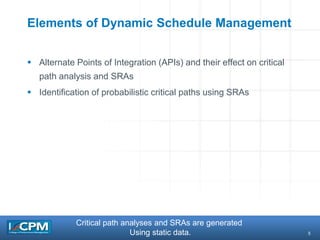
Elements of Dynamic Schedule Management
ď‚§ Alternate Points of Integration (APIs) and their effect on critical
path analysis and SRAs
ď‚§ Identification of probabilistic critical paths using SRAs
Critical path analyses and SRAs are generated
Using static data.
6
The “End Item”
7
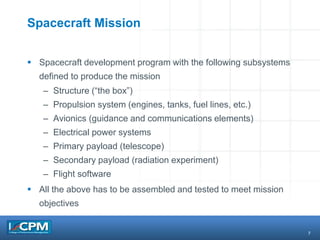
Spacecraft Mission
ď‚§ Spacecraft development program with the following subsystems
defined to produce the mission
– Structure (“the box”)
– Propulsion system (engines, tanks, fuel lines, etc.)
– Avionics (guidance and communications elements)
– Electrical power systems
– Primary payload (telescope)
– Secondary payload (radiation experiment)
– Flight software
ď‚§ All the above has to be assembled and tested to meet mission
objectives
8
Exercise
ď‚§ Ask questions to determine sequencing options for integrating
subsystems, schedule risk associated with developing each
subsystem, and criticality of each element
ď‚§ Assess effects (positive or negative) of employing alternate
points of integration
ď‚§ Determine how to handle remaining residual or undefined
schedule risk
9
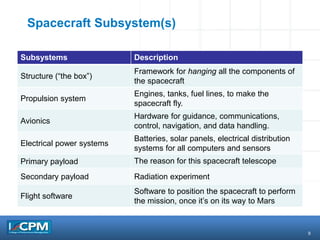
Spacecraft Subsystem(s)
Subsystems Description
Structure (“the box”)
Framework for hanging all the components of
the spacecraft
Propulsion system
Engines, tanks, fuel lines, to make the
spacecraft fly.
Avionics
Hardware for guidance, communications,
control, navigation, and data handling.
Electrical power systems
Batteries, solar panels, electrical distribution
systems for all computers and sensors
Primary payload The reason for this spacecraft telescope
Secondary payload Radiation experiment
Flight software
Software to position the spacecraft to perform
the mission, once it’s on its way to Mars
10
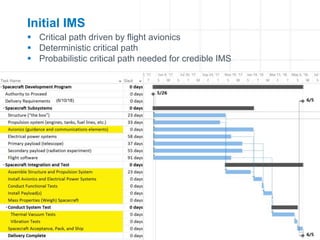
Initial IMS
ď‚§ Critical path driven by flight avionics
ď‚§ Deterministic critical path
ď‚§ Probabilistic critical path needed for credible IMS
(6/10/18)
11
Confidence in Completing On-Time
Cost, Schedule, Technical Model†
WBS
Task 100
Task 101
Task 102
Task 103
Task 104
Task 105
Task 106
Probability
Density
Function
ď‚§ Research the Project
ď‚§ Find Analogies
ď‚§ Ask Endless Questions
ď‚§ Analyze the Results
ď‚§ What can go wrong?
ď‚§ How likely is it to go wrong?
ď‚§ What is the cause?
ď‚§ What is the consequence?
Monte Carlo Simulation
Tool is Mandatory
1.0
.8
.6
.4
.2
0
Days, Facilities, Parts, People
Cumulative Distribution Function
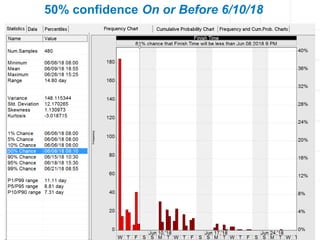
50% confidence On or Before 6/10/18
13
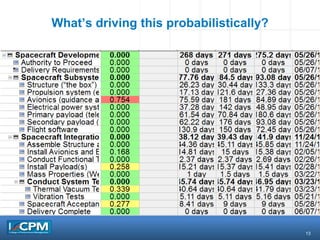
What’s driving this probabilistically?
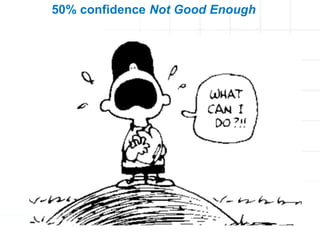
50% confidence Not Good Enough
15
Spacecraft Subsystem(s) ‒ School Solution
Subsystems Latest Alternate Points of
Integration
Negative Effects of API
Structure (“the
box”)
None None
Propulsion
system
Addition after structure assembled
Assembly inefficiencies – take
spacecraft apart and put it back
together.
Duplicate work.
Avionics
Prior to Spacecraft mass properties
(weighing Spacecraft)
Electrical power
systems
Prior to start of system level testing
Primary payload None Must be installed as planned
Secondary
payload
Option to drop secondary payload
Loss of secondary science
objective
Flight software Uploaded on orbit
Little opportunity to make
corrections
94% confidence On or Before 6/10/18
17
Recognition and Management of
Probabilistic Paths
ď‚§ Probabilistic critical paths may have greater total float than the
deterministic path but have higher schedule risk (consequence
and probability) and need to be managed
ď‚§ Strategically placed schedule margin is a proven effective tool
for managing unmitigated schedule risks
Define & manage paths most likely to drive delivery.
18
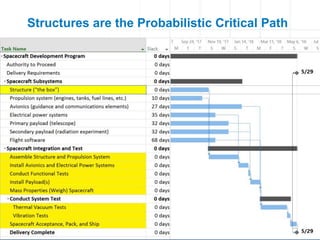
Structures are the Probabilistic Critical Path
19
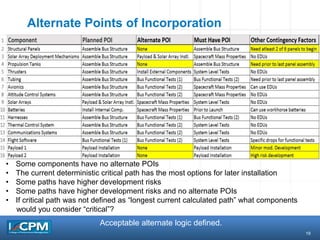
Alternate Points of Incorporation
• Some components have no alternate POIs
• The current deterministic critical path has the most options for later installation
• Some paths have higher development risks
• Some paths have higher development risks and no alternate POIs
• If critical path was not defined as “longest current calculated path” what components
would you consider “critical”?
Acceptable alternate logic defined.
20
Things To Remember
ď‚§ All critical path analyses are entirely dependent upon well
defined, structured, and managed schedule data
ď‚§ CP analysis is based off a single set of data (including logic);
you may have viable options (alternate POIs)
ď‚§ The real value of critical path analysis is the analysis.
ď‚§ Dynamic schedule management-Identifying and managing
probabilistic critical paths, by considering risk and viable
alternate logic, enables superior programmatic decisions.
Planning is a verb!

Dynamic Schedule Management

  • 1.
    PS-16 Dynamic Schedule Management GlenB. Alleman PrimePM glen.alleman@niwotridge.com +1 303 241 9633 EVM World 2017 Rick Price ClearPlan / Waypoint Consulting Rick.A.Price2016@gmail.com +1 303 667 3379
  • 2.
    2 Structure of Workshop This workshop amplifies the concepts presented in the practice symposium titled “Critical Thinking on Critical Path Analysis”  Core principles – All work is probabilistic – Complex programs are always dynamic – Plan B and Plan C can be defined in the PMB as alternatives – Emerging plans must be dealt with as well  Notional example – A notional spacecraft mission  Hands on identification of alternative points of integration (API) – Have students identify New API – Have students discuss and present their own issues with API on their own projects
  • 3.
    All Successful ProjectsRequire Credible Answers To These 5 Questions … 3 Performance–Based Project Management®, Copyright © Glen B. Alleman, 2012 - 2017 1. What Does DONE Look Like? 2. How Do We Get to DONE? 3. Is There Enough Time, Money, and Resources, To Get to DONE? 4. What Impediments Will Be Encountered Along The Way to DONE? 5. What Are The Units Of Measures For Progress To Plan for each Deliverable?
  • 4.
    4 Framing Assumptions forManaging in the Presence of Uncertainty  Uncertainty creates risk in two forms – Probabilistic (Event Based) uncertainty • Reducible – Statistical (Naturally occurring) uncertainty • Irreducible  The schedule for work in presence of uncertainty is always probabilistic
  • 5.
    5 Elements of DynamicSchedule Management ď‚§ Alternate Points of Integration (APIs) and their effect on critical path analysis and SRAs ď‚§ Identification of probabilistic critical paths using SRAs Critical path analyses and SRAs are generated Using static data.
  • 6.
  • 7.
    7 Spacecraft Mission  Spacecraftdevelopment program with the following subsystems defined to produce the mission – Structure (“the box”) – Propulsion system (engines, tanks, fuel lines, etc.) – Avionics (guidance and communications elements) – Electrical power systems – Primary payload (telescope) – Secondary payload (radiation experiment) – Flight software  All the above has to be assembled and tested to meet mission objectives
  • 8.
    8 Exercise ď‚§ Ask questionsto determine sequencing options for integrating subsystems, schedule risk associated with developing each subsystem, and criticality of each element ď‚§ Assess effects (positive or negative) of employing alternate points of integration ď‚§ Determine how to handle remaining residual or undefined schedule risk
  • 9.
    9 Spacecraft Subsystem(s) Subsystems Description Structure(“the box”) Framework for hanging all the components of the spacecraft Propulsion system Engines, tanks, fuel lines, to make the spacecraft fly. Avionics Hardware for guidance, communications, control, navigation, and data handling. Electrical power systems Batteries, solar panels, electrical distribution systems for all computers and sensors Primary payload The reason for this spacecraft telescope Secondary payload Radiation experiment Flight software Software to position the spacecraft to perform the mission, once it’s on its way to Mars
  • 10.
    10 Initial IMS ď‚§ Criticalpath driven by flight avionics ď‚§ Deterministic critical path ď‚§ Probabilistic critical path needed for credible IMS (6/10/18)
  • 11.
    11 Confidence in CompletingOn-Time Cost, Schedule, Technical Model† WBS Task 100 Task 101 Task 102 Task 103 Task 104 Task 105 Task 106 Probability Density Function  Research the Project  Find Analogies  Ask Endless Questions  Analyze the Results  What can go wrong?  How likely is it to go wrong?  What is the cause?  What is the consequence? Monte Carlo Simulation Tool is Mandatory 1.0 .8 .6 .4 .2 0 Days, Facilities, Parts, People Cumulative Distribution Function
  • 12.
    50% confidence Onor Before 6/10/18
  • 13.
  • 14.
    50% confidence NotGood Enough
  • 15.
    15 Spacecraft Subsystem(s) ‒School Solution Subsystems Latest Alternate Points of Integration Negative Effects of API Structure (“the box”) None None Propulsion system Addition after structure assembled Assembly inefficiencies – take spacecraft apart and put it back together. Duplicate work. Avionics Prior to Spacecraft mass properties (weighing Spacecraft) Electrical power systems Prior to start of system level testing Primary payload None Must be installed as planned Secondary payload Option to drop secondary payload Loss of secondary science objective Flight software Uploaded on orbit Little opportunity to make corrections
  • 16.
    94% confidence Onor Before 6/10/18
  • 17.
    17 Recognition and Managementof Probabilistic Paths ď‚§ Probabilistic critical paths may have greater total float than the deterministic path but have higher schedule risk (consequence and probability) and need to be managed ď‚§ Strategically placed schedule margin is a proven effective tool for managing unmitigated schedule risks Define & manage paths most likely to drive delivery.
  • 18.
    18 Structures are theProbabilistic Critical Path
  • 19.
    19 Alternate Points ofIncorporation • Some components have no alternate POIs • The current deterministic critical path has the most options for later installation • Some paths have higher development risks • Some paths have higher development risks and no alternate POIs • If critical path was not defined as “longest current calculated path” what components would you consider “critical”? Acceptable alternate logic defined.
  • 20.
    20 Things To Remember ď‚§All critical path analyses are entirely dependent upon well defined, structured, and managed schedule data ď‚§ CP analysis is based off a single set of data (including logic); you may have viable options (alternate POIs) ď‚§ The real value of critical path analysis is the analysis. ď‚§ Dynamic schedule management-Identifying and managing probabilistic critical paths, by considering risk and viable alternate logic, enables superior programmatic decisions. Planning is a verb!

Editor's Notes

  • #4 The five immutable principles of project management are: Know where you are going by defining “done” at some point in the future. This point may be far in the future – months or years from now. Or closer in the future days or weeks from now. Have some kind of plan to get to where you are going. This plan can be simple or it can be complex. The fidelity of the plan depends on the tolerance for risk by the users of the plan. Understand the resources needed to execute the plan. How much time and money is needed to reach the destination. This can be fixed or it can be variable. Identify the impediments to progress along the way to the destination. Have some means of removing, avoiding, or ignoring these impediments. Have some way to measure your planned progress, not just your progress. Progress to Plan must be measured in units of physical percent complete.