CRITICAL INCIDENT
TECHNIQUE
PRESENTED BY: PALAK
MSC NURSING FIRST YEAR
SHIMLA NURSING COLLEGE SHURALA
INTRODUCTION
• The critical incident and the steps which are useful for analysing of the event is known as
critical incident technique.
• The critical incident technique is used to look for the cause of human-system (or
product) problems to minimize loss to person, property, money or data.
• To evaluate performance of the student, the evaluator record specific incidence of
effective behaviour (positive)
Example: completion of an assignment, maintain a quality of nursing care of the patient
benefit.
• Ineffective behaviour(negative)
Example: lead a poor nursing care, fail to provide patient benefits.
CRITICAL INCIDENT TECHNIQUE was originated by JOHN FLANAGAN in 1950.
DEFINITION
• It is a description of an event in which data are limited to factors that have
direct bearing an the event itself. (B.T Basavanthappa)
• It is a set of procedure used for collecting direct observations of human
behaviour that have critical significance and methodically criticize.
For example: a nurse enters the room of a 45 years old male to take BP as
ordered q4hrly. She finds that the reading is 80/50, a drop from 100/80 at
the recording 4 hour ago.

Critical incident is defined as extreme effective behaviour or
ineffective behaviour to attain the general aims of the activity.
INCIDENT mean any observable human activity that is
sufficiently complete in itself.
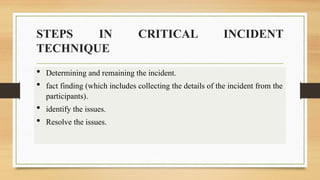
STEPS IN CRITICAL INCIDENT
TECHNIQUE
 Determining and remaining the incident.
 fact finding (which includes collecting the details of the incident from the
participants).
 identify the issues.
 Resolve the issues.
GUIDELINES FOR COLLECTING DATA
 To ask right question.
 Keep the question simple and direct.
 In survey and focus group method, don’t ask employee to attach their
name.
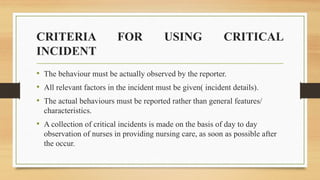
CRITERIA FOR USING CRITICAL
INCIDENT
• The behaviour must be actually observed by the reporter.
• All relevant factors in the incident must be given( incident details).
• The actual behaviours must be reported rather than general features/
characteristics.
• A collection of critical incidents is made on the basis of day to day
observation of nurses in providing nursing care, as soon as possible after
the occur.
CHARACTERISTICS OF CRITICAL
INCIDENT TECHNIQUE
 Specific
 Focus on observable behaviours on the job.
 Describe the content in which the behaviour occurred.
 Indicate the outcomes.
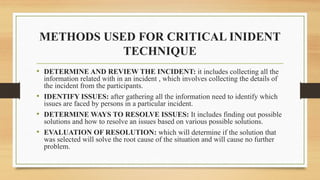
METHODS USED FOR CRITICAL INIDENT
TECHNIQUE
• DETERMINE AND REVIEW THE INCIDENT: it includes collecting all the
information related with in an incident , which involves collecting the details of
the incident from the participants.
• IDENTIFY ISSUES: after gathering all the information need to identify which
issues are faced by persons in a particular incident.
• DETERMINE WAYS TO RESOLVE ISSUES: It includes finding out possible
solutions and how to resolve an issues based on various possible solutions.
• EVALUATION OF RESOLUTION: which will determine if the solution that
was selected will solve the root cause of the situation and will cause no further
problem.
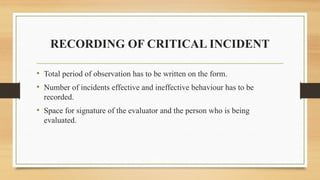
RECORDING OF CRITICAL INCIDENT
• Total period of observation has to be written on the form.
• Number of incidents effective and ineffective behaviour has to be
recorded.
• Space for signature of the evaluator and the person who is being
evaluated.
ADVANTAGES
• This is a flexible method that can be used to improve multi user systems.
• Identifies even rare events that might be missed by other methods which
only focus on common and everyday events.
• Useful when problems occur but the cause and severity are not known.
• Inexpensive and provide rich information.
• Can be applied using questionnaires or interviews.
• Easy to understand.
DISADVANTAGES
• Relay on memory.
• Even go unreported.
• Respondents may not be familiar to or willing to take the time to tell a
complete story when describing the critical incident.
• They are time consuming to write.
CONCLUSION
• The critical incident technique is frequently used to collect data on
observations previously made which are reported from memory. This is
usually satisfactory when the incidents reported are fairly recent and the
observers were motivated to make detailed observations and evaluations
at the time the incident occurred.
Thank you

CRITICAL INCIDENT TECHNIQUE (NURSING EDUCATION).

  • 1.
    CRITICAL INCIDENT TECHNIQUE PRESENTED BY:PALAK MSC NURSING FIRST YEAR SHIMLA NURSING COLLEGE SHURALA
  • 2.
    INTRODUCTION • The criticalincident and the steps which are useful for analysing of the event is known as critical incident technique. • The critical incident technique is used to look for the cause of human-system (or product) problems to minimize loss to person, property, money or data. • To evaluate performance of the student, the evaluator record specific incidence of effective behaviour (positive) Example: completion of an assignment, maintain a quality of nursing care of the patient benefit. • Ineffective behaviour(negative) Example: lead a poor nursing care, fail to provide patient benefits.
  • 3.
    CRITICAL INCIDENT TECHNIQUEwas originated by JOHN FLANAGAN in 1950.
  • 4.
    DEFINITION • It isa description of an event in which data are limited to factors that have direct bearing an the event itself. (B.T Basavanthappa) • It is a set of procedure used for collecting direct observations of human behaviour that have critical significance and methodically criticize. For example: a nurse enters the room of a 45 years old male to take BP as ordered q4hrly. She finds that the reading is 80/50, a drop from 100/80 at the recording 4 hour ago.
  • 5.
     Critical incident isdefined as extreme effective behaviour or ineffective behaviour to attain the general aims of the activity. INCIDENT mean any observable human activity that is sufficiently complete in itself.
  • 6.
    STEPS IN CRITICALINCIDENT TECHNIQUE  Determining and remaining the incident.  fact finding (which includes collecting the details of the incident from the participants).  identify the issues.  Resolve the issues.
  • 7.
    GUIDELINES FOR COLLECTINGDATA  To ask right question.  Keep the question simple and direct.  In survey and focus group method, don’t ask employee to attach their name.
  • 8.
    CRITERIA FOR USINGCRITICAL INCIDENT • The behaviour must be actually observed by the reporter. • All relevant factors in the incident must be given( incident details). • The actual behaviours must be reported rather than general features/ characteristics. • A collection of critical incidents is made on the basis of day to day observation of nurses in providing nursing care, as soon as possible after the occur.
  • 9.
    CHARACTERISTICS OF CRITICAL INCIDENTTECHNIQUE  Specific  Focus on observable behaviours on the job.  Describe the content in which the behaviour occurred.  Indicate the outcomes.
  • 10.
    METHODS USED FORCRITICAL INIDENT TECHNIQUE • DETERMINE AND REVIEW THE INCIDENT: it includes collecting all the information related with in an incident , which involves collecting the details of the incident from the participants. • IDENTIFY ISSUES: after gathering all the information need to identify which issues are faced by persons in a particular incident. • DETERMINE WAYS TO RESOLVE ISSUES: It includes finding out possible solutions and how to resolve an issues based on various possible solutions. • EVALUATION OF RESOLUTION: which will determine if the solution that was selected will solve the root cause of the situation and will cause no further problem.
  • 11.
    RECORDING OF CRITICALINCIDENT • Total period of observation has to be written on the form. • Number of incidents effective and ineffective behaviour has to be recorded. • Space for signature of the evaluator and the person who is being evaluated.
  • 12.
    ADVANTAGES • This isa flexible method that can be used to improve multi user systems. • Identifies even rare events that might be missed by other methods which only focus on common and everyday events. • Useful when problems occur but the cause and severity are not known. • Inexpensive and provide rich information. • Can be applied using questionnaires or interviews. • Easy to understand.
  • 13.
    DISADVANTAGES • Relay onmemory. • Even go unreported. • Respondents may not be familiar to or willing to take the time to tell a complete story when describing the critical incident. • They are time consuming to write.
  • 14.
    CONCLUSION • The criticalincident technique is frequently used to collect data on observations previously made which are reported from memory. This is usually satisfactory when the incidents reported are fairly recent and the observers were motivated to make detailed observations and evaluations at the time the incident occurred.
  • 15.