Dr Suzan Koseoglu (Goldsmiths, University
of London)
@suzankoseoglu
s.koseoglu@gold.ac.uk
Critical (Digital) Pedagogy
Taking over from Raed’s talk...
“It is one thing to read about critical pedagogy in the abstract, but I believe
there is much more to learn from contextual understandings of how the
philosophy of critical pedagogy works in practice.”
“Critical pedagogy, for me, is not about knowing how to do everything right,
or getting it right the first time, or every time. It is about putting faith in our
learners to take control of their learning, and teach us, each other, and
themselves in the process. Very often, we become better pedagogues by
learning from our mistakes ... accepting and even embracing the
uncertainties, unpredictability, the messiness of learning.”
Maha Bali, Critical Pedagogy Intentions and Realities
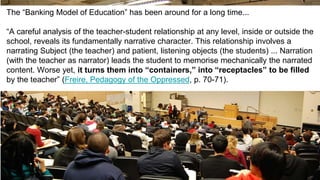
The “Banking Model of Education” has been around for a long time...
“A careful analysis of the teacher-student relationship at any level, inside or outside the
school, reveals its fundamentally narrative character. This relationship involves a
narrating Subject (the teacher) and patient, listening objects (the students) ... Narration
(with the teacher as narrator) leads the student to memorise mechanically the narrated
content. Worse yet, it turns them into “containers,” into “receptacles” to be filled
by the teacher” (Freire, Pedagogy of the Oppressed, p. 70-71).
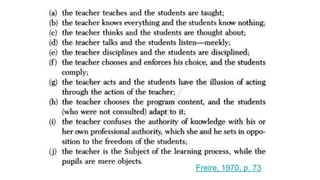
Freire, 1970, p. 73
Point made at the PGCERT:
“Banking model of education = simply
bad teaching!”
We need to think “critically about the nature and effects of technology. What we
must do is work to encourage students and ourselves to think critically about new
tools (and, more importantly, the tools we already use).”
Jesse Stommel, Critical Digital Pedagogy: A Definition
“A [online] course is a conversation, not a static reservoir or receptacle for content.”
Sean Morris, If Freire Made a MOOC: Open Education as Resistance
Suzan’s take on Critical (Digital) Pedagogy:
- The way we understand critical pedagogy is highly personal.
- Critical pedagogy and critical digital pedagogy don't have to be two different
things because online and offline worlds are becoming increasingly hybrid.
- A critical approach to education (online or face-to-face) starts with
questioning our assumptions, which include our assumptions about
students’ capabilities and their backgrounds and our beliefs and values in
teaching and learning.
- A critical approach to education means that we specifically question the
power structures in education, face-to-face or in online spaces.
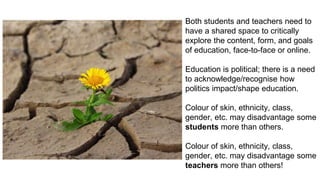
Both students and teachers need to
have a shared space to critically
explore the content, form, and goals
of education, face-to-face or online.
Education is political; there is a need
to acknowledge/recognise how
politics impact/shape education.
Colour of skin, ethnicity, class,
gender, etc. may disadvantage some
students more than others.
Colour of skin, ethnicity, class,
gender, etc. may disadvantage some
teachers more than others!
Ethics of Data Analytics on learn.gold?
Online Students Give Instructors Higher Marks If They Think
Instructors Are Men
Study finds faculty members more likely to respond to
inquiries from prospective graduate students who are white
males
Few cases for discussion:
In an online learning space:
● Who owns the space? Who owns the data produced? Or the content provided?
● How much power do you have in the learning space? How about students? Do
they have a say on how things should be?
● Whose voice can be heard in the learning space? Who is silenced? Why?
How?
● Is the space democratic or is it authoritarian? Does the space recognize the
whole person, learners and teachers as real human beings with feelings and
different ways of being? Do we get a sense of people’s identities?
● Who is represented in the images used, in the videos uploaded? Who is not?
“Critical Pedagogy, no matter how we define it, has a central place in the discussion
of how learning is changing in the 21st century because Critical Pedagogy is
primarily concerned with an equitable distribution of power. If students live in a
culture that digitizes and educates them through a screen, they require an
education that empowers them in that sphere, teaches them that language, and
offers new opportunities of human connectivity.”
Pete Rorabaugh, Occupy the Digital: Critical Pedagogy and New Media
● Critical pedagogy, experimental pedagogy, radical pedagogy,
transformative pedagogy, democratic pedagogy?
● Praxis?
● (Digital) Agency?
● Changing teacher roles? (facilitator, curator, co-learner, convenor…)
● What does critical pedagogy look like in my context? What role does
technology play in it?
● Anything else you would like to explore further?
To take this conversation further...
Bali, M. (2014). Critical Pedagogy: Intentions and Realities. Hybrid
Pedagogy.
Bayne, S. (2015). What's the matter with ‘technology-enhanced learning’?
Learning, Media and Technology, 40(1), 5-20.
Boyd, D. (2016). What would Paulo Freire think of Blackboard: Critical
pedagogy in an age of online learning. The International Journal of Critical
Pedagogy, 7(1), 165-186.
Freire, P. (1968). Pedagogy of the Oppressed.
hooks, b. (1994) Teaching to Transgress.
hooks, b. (2003). Teaching Community: A Pedagogy of Hope.
Morris, M. S., & Stommel, J. (2014). If Freire made a MOOC: Open
education as resistance. Hybrid Pedagogy.
Parker, P. (2018). Healing the Heart of Democracy: The Courage to
Create a Politics Worthy of the Human Spirit
Stommel, J. (2014).Critical digital pedagogy: A definition. Hybrid
Pedagogy. Hybrid Pedagogy.

Critical (Digital) Pedagogy

  • 1.
    Dr Suzan Koseoglu(Goldsmiths, University of London) @suzankoseoglu s.koseoglu@gold.ac.uk Critical (Digital) Pedagogy
  • 2.
    Taking over fromRaed’s talk...
  • 3.
    “It is onething to read about critical pedagogy in the abstract, but I believe there is much more to learn from contextual understandings of how the philosophy of critical pedagogy works in practice.” “Critical pedagogy, for me, is not about knowing how to do everything right, or getting it right the first time, or every time. It is about putting faith in our learners to take control of their learning, and teach us, each other, and themselves in the process. Very often, we become better pedagogues by learning from our mistakes ... accepting and even embracing the uncertainties, unpredictability, the messiness of learning.” Maha Bali, Critical Pedagogy Intentions and Realities
  • 4.
    The “Banking Modelof Education” has been around for a long time... “A careful analysis of the teacher-student relationship at any level, inside or outside the school, reveals its fundamentally narrative character. This relationship involves a narrating Subject (the teacher) and patient, listening objects (the students) ... Narration (with the teacher as narrator) leads the student to memorise mechanically the narrated content. Worse yet, it turns them into “containers,” into “receptacles” to be filled by the teacher” (Freire, Pedagogy of the Oppressed, p. 70-71).
  • 5.
  • 6.
    Point made atthe PGCERT: “Banking model of education = simply bad teaching!”
  • 7.
    We need tothink “critically about the nature and effects of technology. What we must do is work to encourage students and ourselves to think critically about new tools (and, more importantly, the tools we already use).” Jesse Stommel, Critical Digital Pedagogy: A Definition “A [online] course is a conversation, not a static reservoir or receptacle for content.” Sean Morris, If Freire Made a MOOC: Open Education as Resistance
  • 8.
    Suzan’s take onCritical (Digital) Pedagogy: - The way we understand critical pedagogy is highly personal. - Critical pedagogy and critical digital pedagogy don't have to be two different things because online and offline worlds are becoming increasingly hybrid. - A critical approach to education (online or face-to-face) starts with questioning our assumptions, which include our assumptions about students’ capabilities and their backgrounds and our beliefs and values in teaching and learning. - A critical approach to education means that we specifically question the power structures in education, face-to-face or in online spaces.
  • 9.
    Both students andteachers need to have a shared space to critically explore the content, form, and goals of education, face-to-face or online. Education is political; there is a need to acknowledge/recognise how politics impact/shape education. Colour of skin, ethnicity, class, gender, etc. may disadvantage some students more than others. Colour of skin, ethnicity, class, gender, etc. may disadvantage some teachers more than others!
  • 10.
    Ethics of DataAnalytics on learn.gold? Online Students Give Instructors Higher Marks If They Think Instructors Are Men Study finds faculty members more likely to respond to inquiries from prospective graduate students who are white males Few cases for discussion:
  • 11.
    In an onlinelearning space: ● Who owns the space? Who owns the data produced? Or the content provided? ● How much power do you have in the learning space? How about students? Do they have a say on how things should be? ● Whose voice can be heard in the learning space? Who is silenced? Why? How? ● Is the space democratic or is it authoritarian? Does the space recognize the whole person, learners and teachers as real human beings with feelings and different ways of being? Do we get a sense of people’s identities? ● Who is represented in the images used, in the videos uploaded? Who is not?
  • 12.
    “Critical Pedagogy, nomatter how we define it, has a central place in the discussion of how learning is changing in the 21st century because Critical Pedagogy is primarily concerned with an equitable distribution of power. If students live in a culture that digitizes and educates them through a screen, they require an education that empowers them in that sphere, teaches them that language, and offers new opportunities of human connectivity.” Pete Rorabaugh, Occupy the Digital: Critical Pedagogy and New Media
  • 13.
    ● Critical pedagogy,experimental pedagogy, radical pedagogy, transformative pedagogy, democratic pedagogy? ● Praxis? ● (Digital) Agency? ● Changing teacher roles? (facilitator, curator, co-learner, convenor…) ● What does critical pedagogy look like in my context? What role does technology play in it? ● Anything else you would like to explore further?
  • 14.
    To take thisconversation further... Bali, M. (2014). Critical Pedagogy: Intentions and Realities. Hybrid Pedagogy. Bayne, S. (2015). What's the matter with ‘technology-enhanced learning’? Learning, Media and Technology, 40(1), 5-20. Boyd, D. (2016). What would Paulo Freire think of Blackboard: Critical pedagogy in an age of online learning. The International Journal of Critical Pedagogy, 7(1), 165-186. Freire, P. (1968). Pedagogy of the Oppressed.
  • 15.
    hooks, b. (1994)Teaching to Transgress. hooks, b. (2003). Teaching Community: A Pedagogy of Hope. Morris, M. S., & Stommel, J. (2014). If Freire made a MOOC: Open education as resistance. Hybrid Pedagogy. Parker, P. (2018). Healing the Heart of Democracy: The Courage to Create a Politics Worthy of the Human Spirit Stommel, J. (2014).Critical digital pedagogy: A definition. Hybrid Pedagogy. Hybrid Pedagogy.

Editor's Notes

  • #3 Taking over from Raed, focusing on “power relations and various forms of control” in learning spaces.
  • #5 Image: A lecture hall at Baruch College, New York City, USA: https://en.wikipedia.org/wiki/Lecture_hall#/media/File:5th_Floor_Lecture_Hall.jpg
  • #6 Paulo Freire, Pedagogy of the Oppressed, p. 73 First published in 1968 Banking Model of Education You give knowledge to students and take it back with assessments!
  • #7 Suzan’s note: But sometimes we are limited by institutional frameworks.
  • #14 “Student agency is ultimately about how we share power in our classrooms and work collaboratively with students.” Karen Cangialosi, But You Can’t Do That in a STEM course!