Teaching from a Place of Compassion
Jesse Stommel
@Jessifer
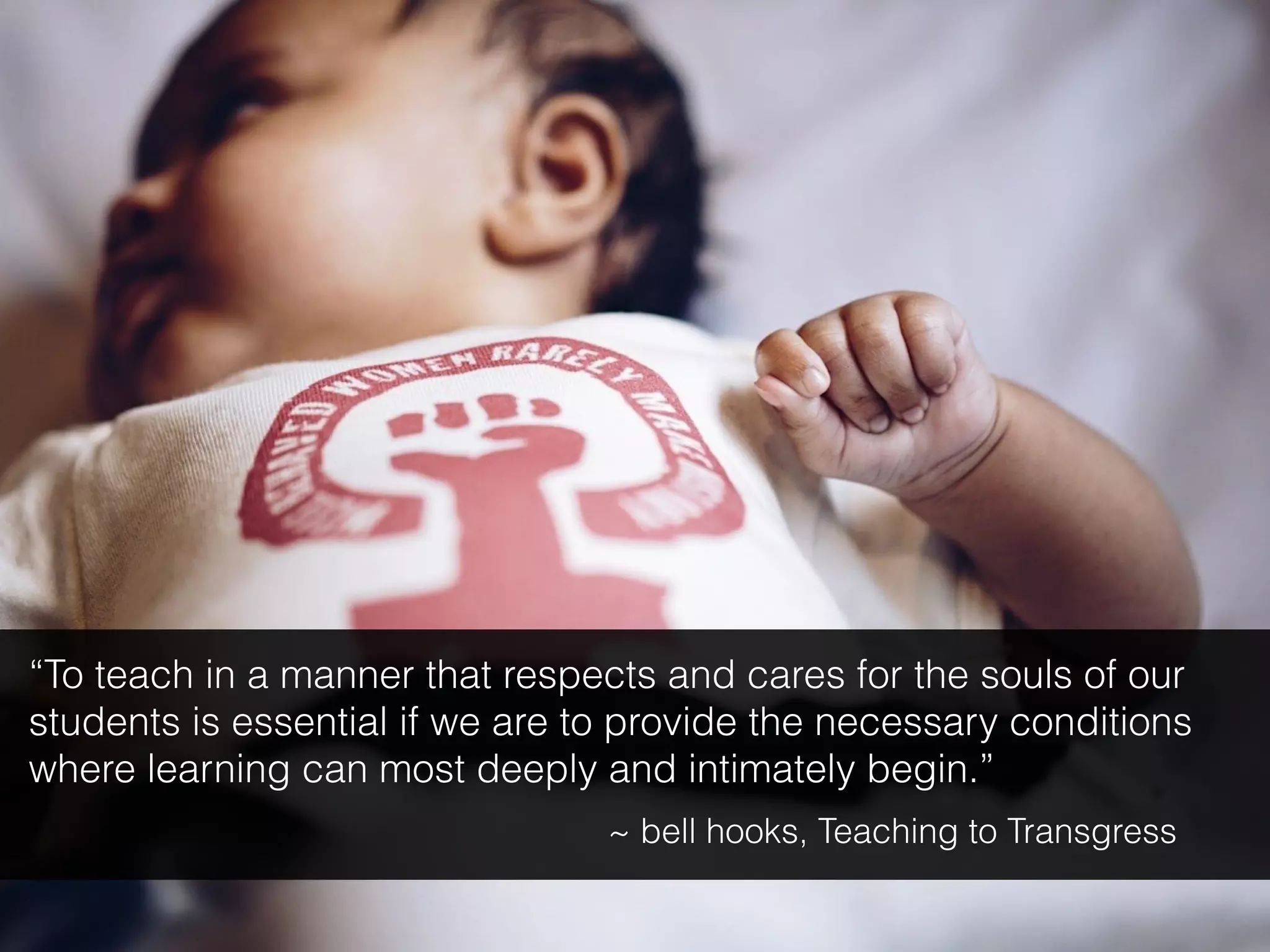
“To teach in a manner that respects and cares for the souls of our
students is essential if we are to provide the necessary conditions
where learning can most deeply and intimately begin.”
~ bell hooks, Teaching to Transgress
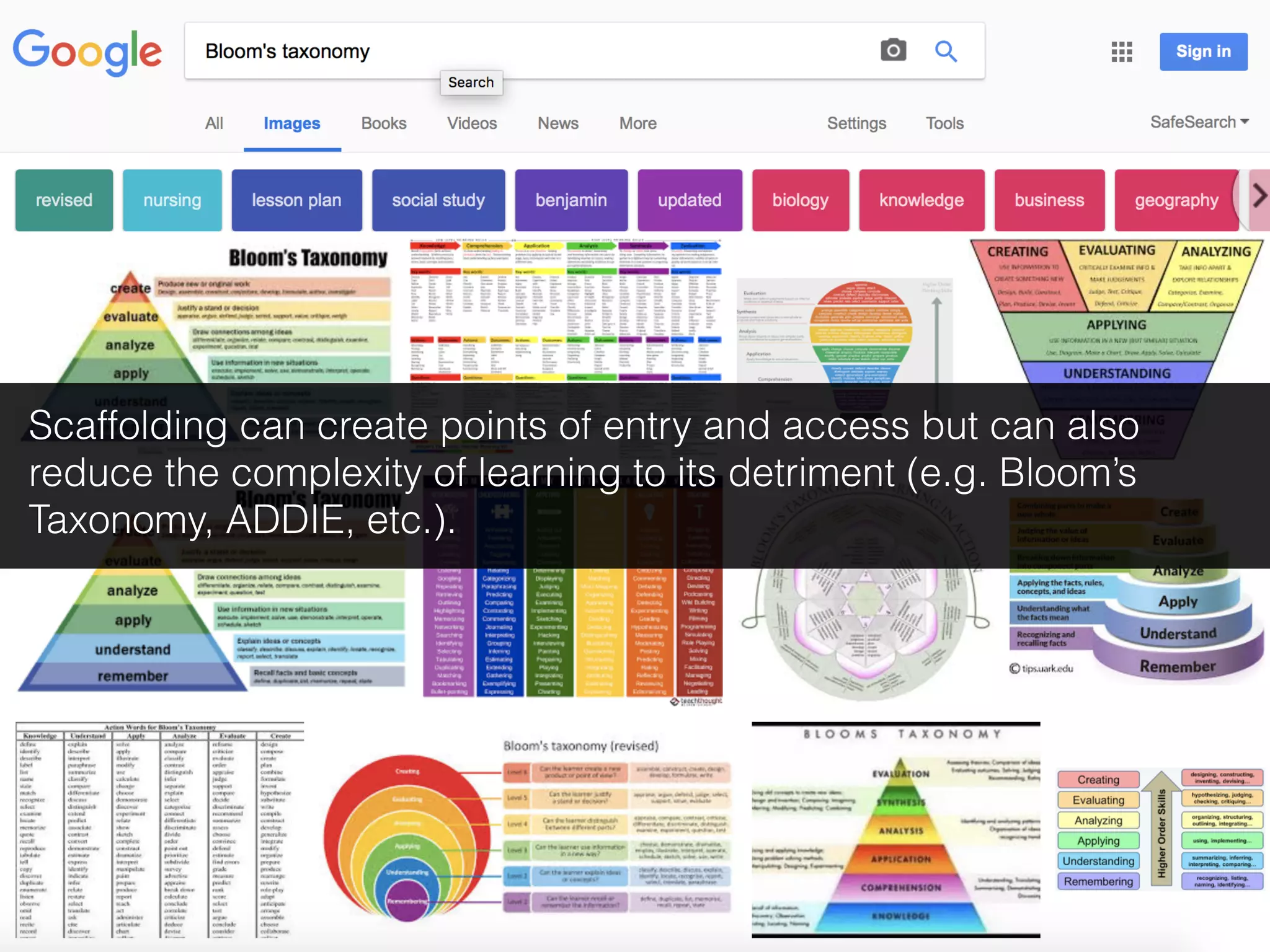
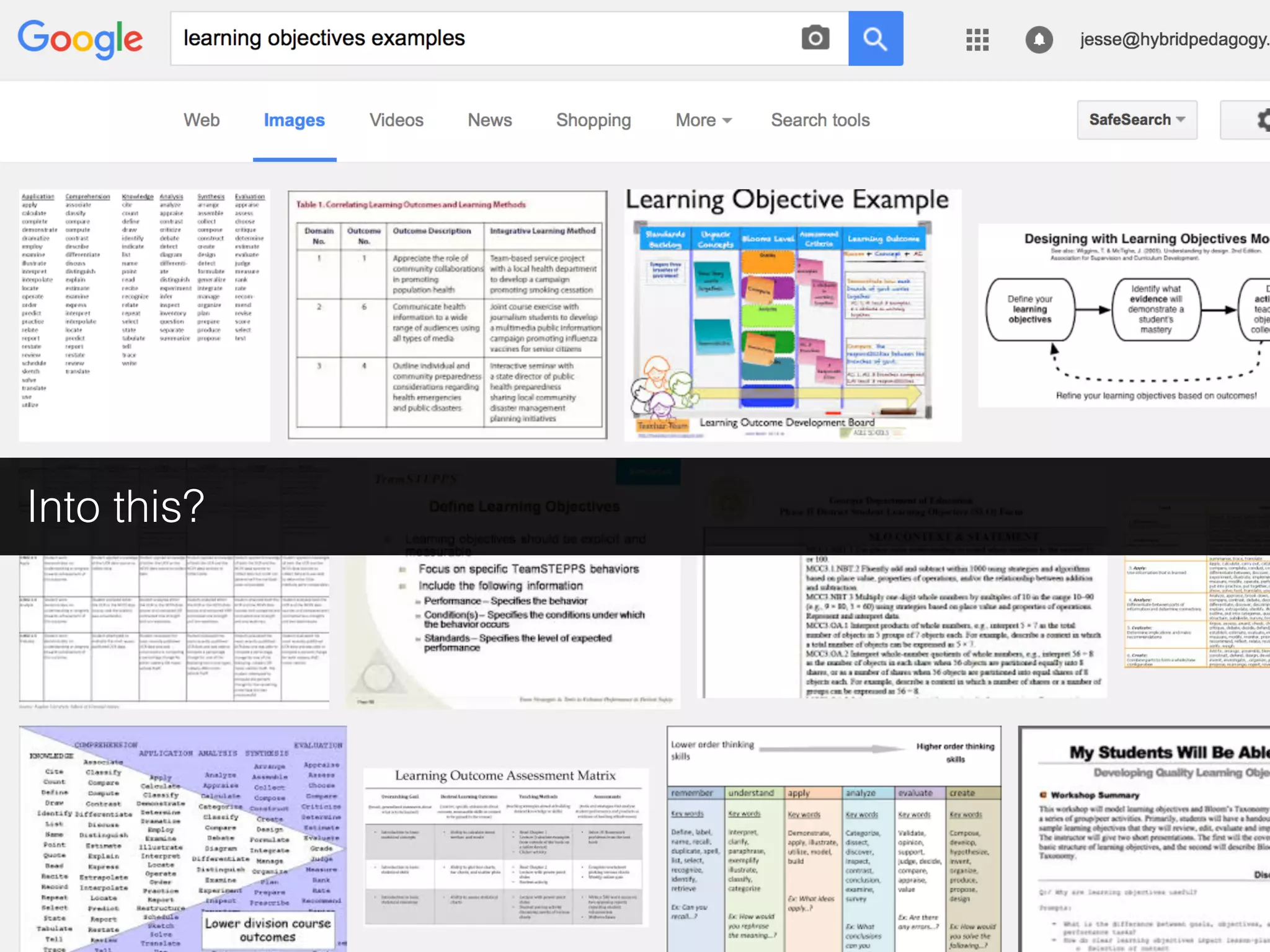
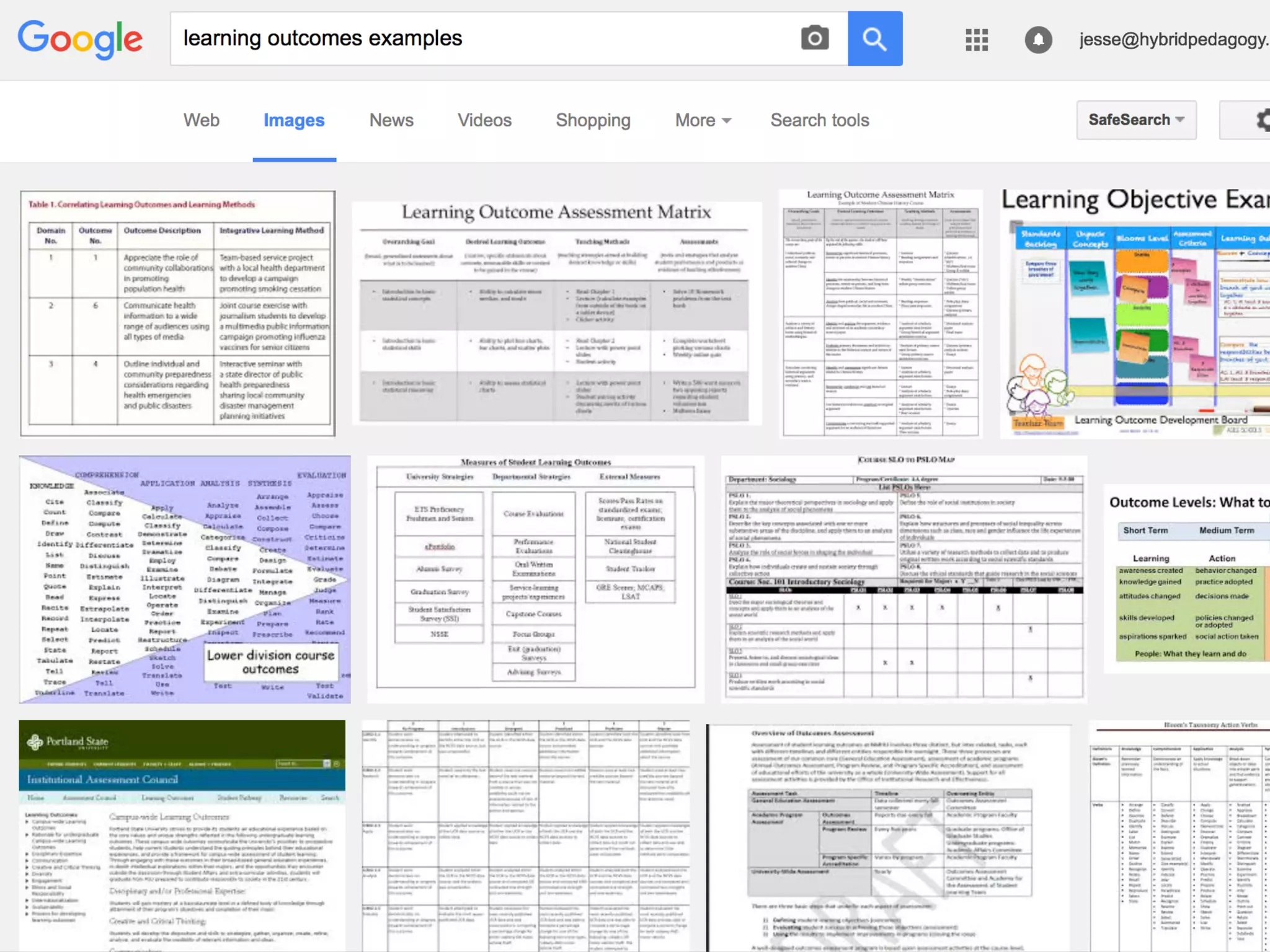
Scaffolding can create points of entry and access but can also
reduce the complexity of learning to its detriment (e.g. Bloom’s
Taxonomy, ADDIE, etc.).
Photo by flickr userVictoria Pickering
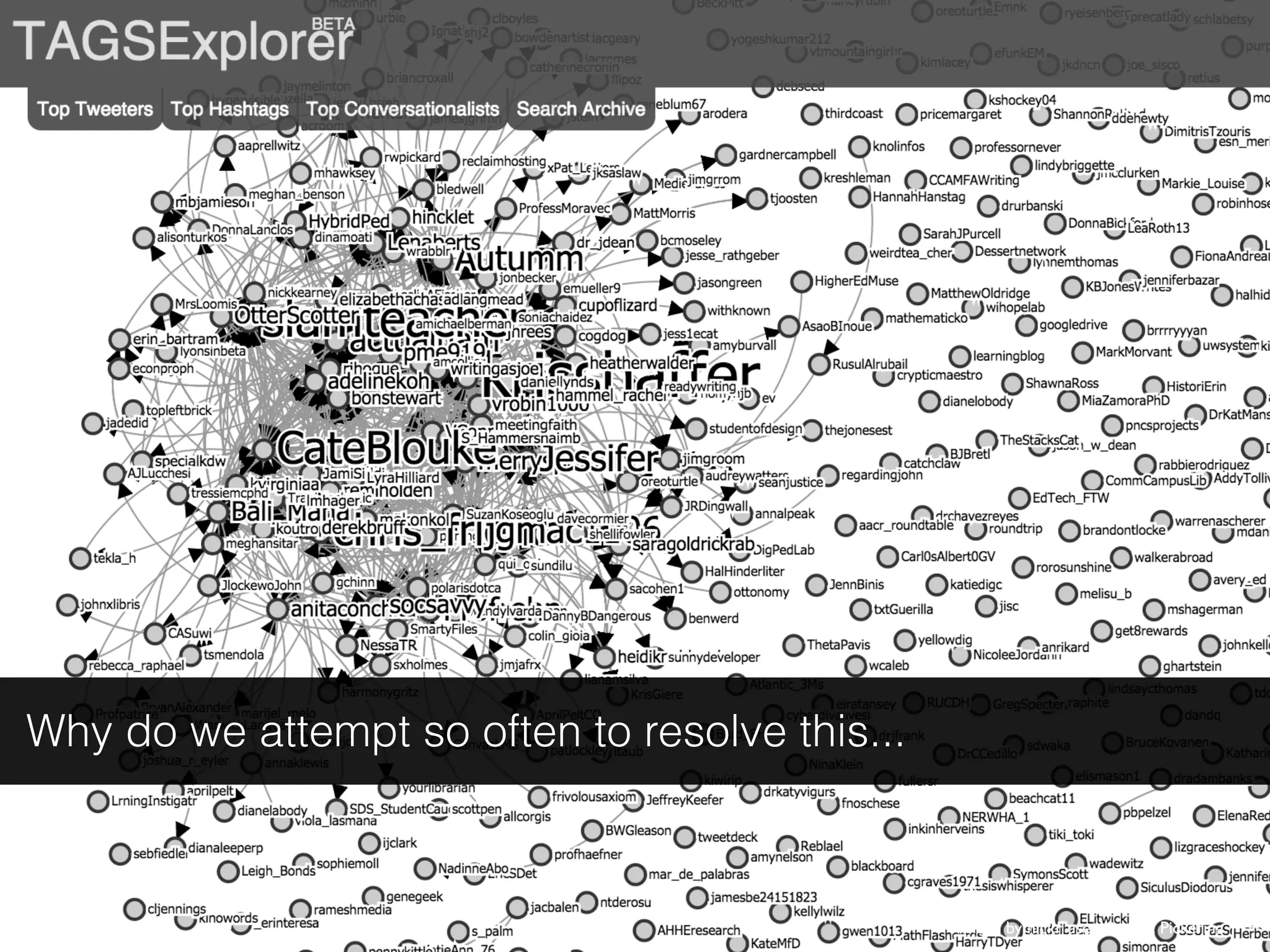
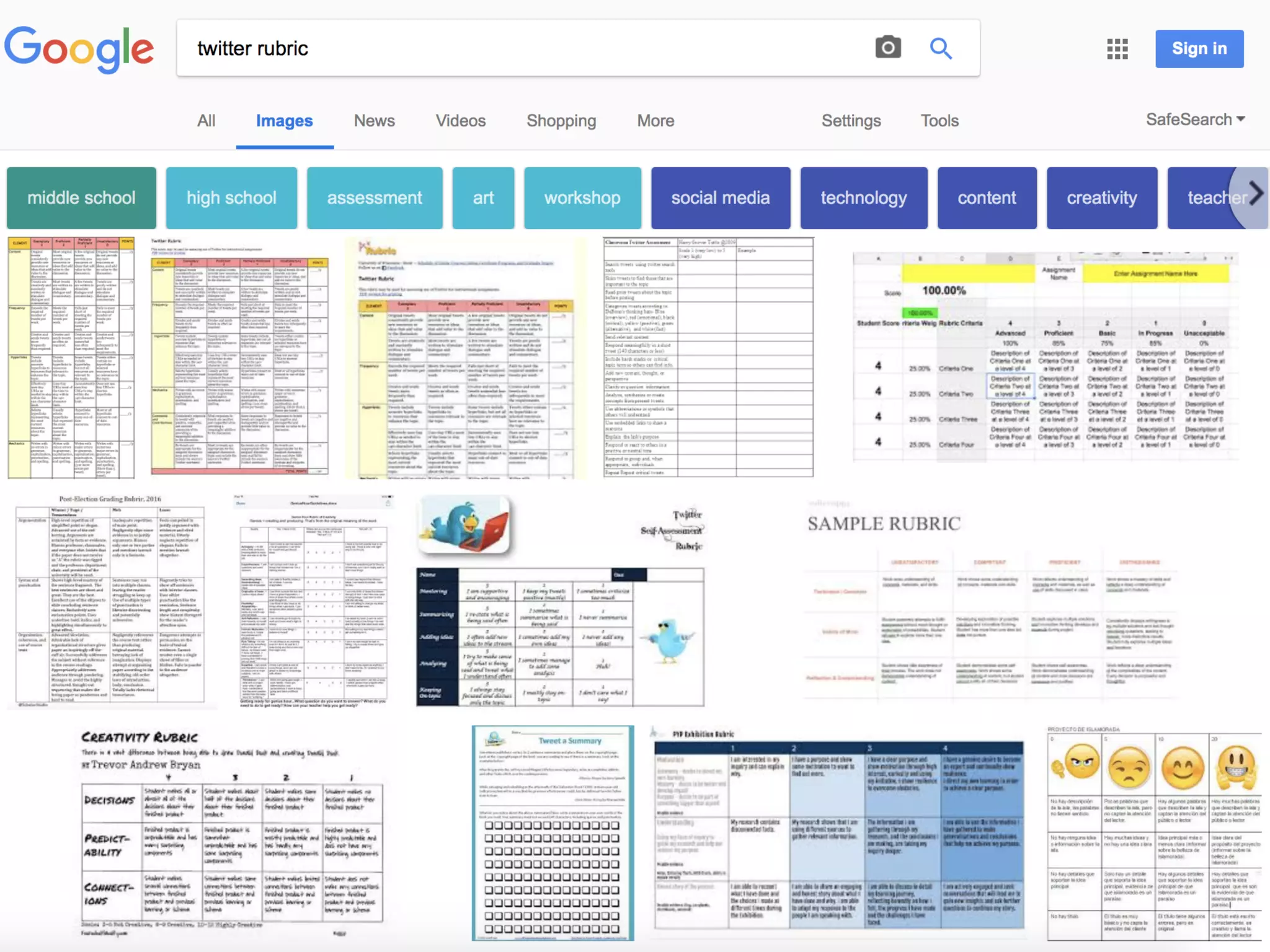
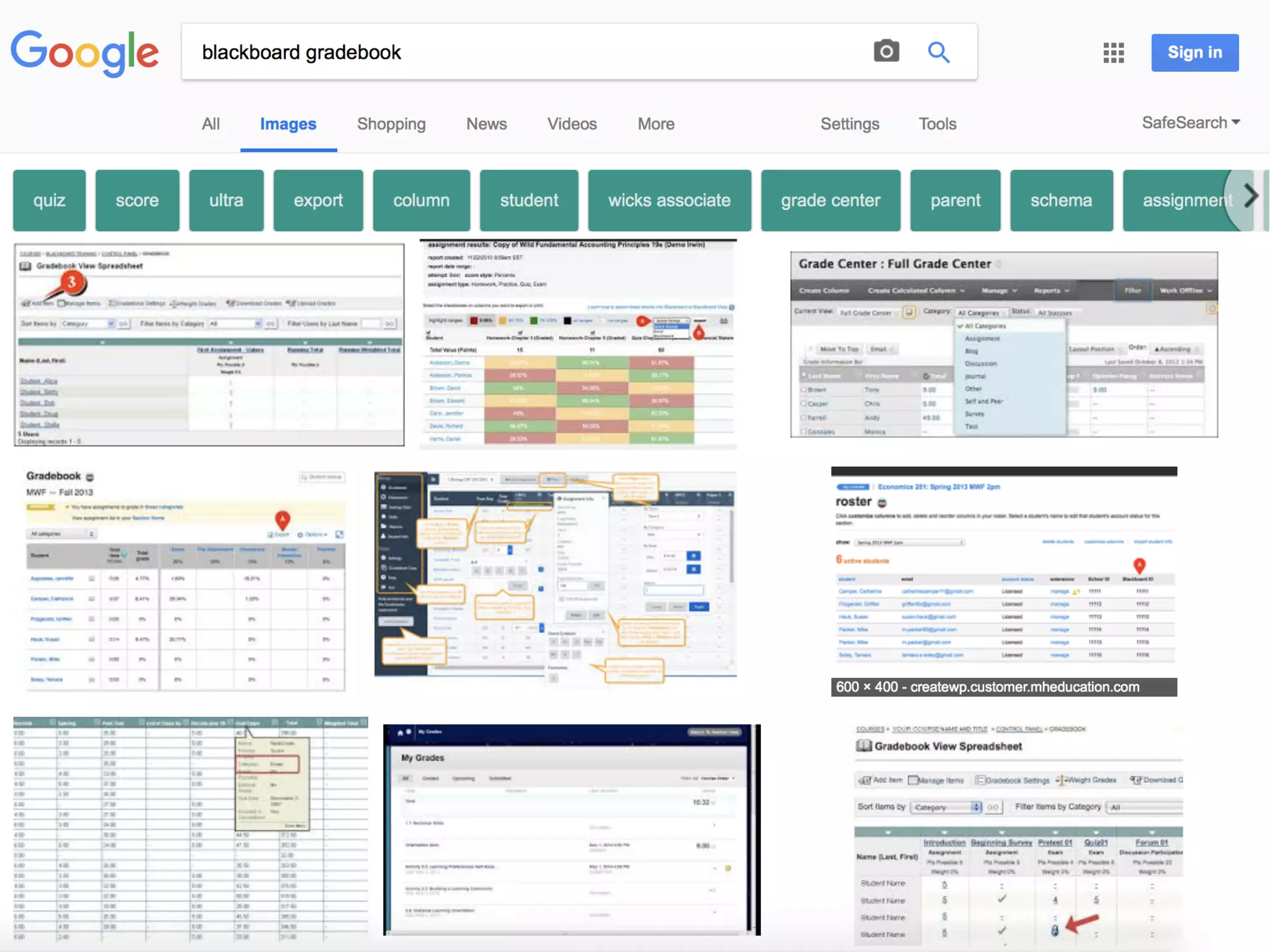
Why do we attempt so often to resolve this...
Into this?
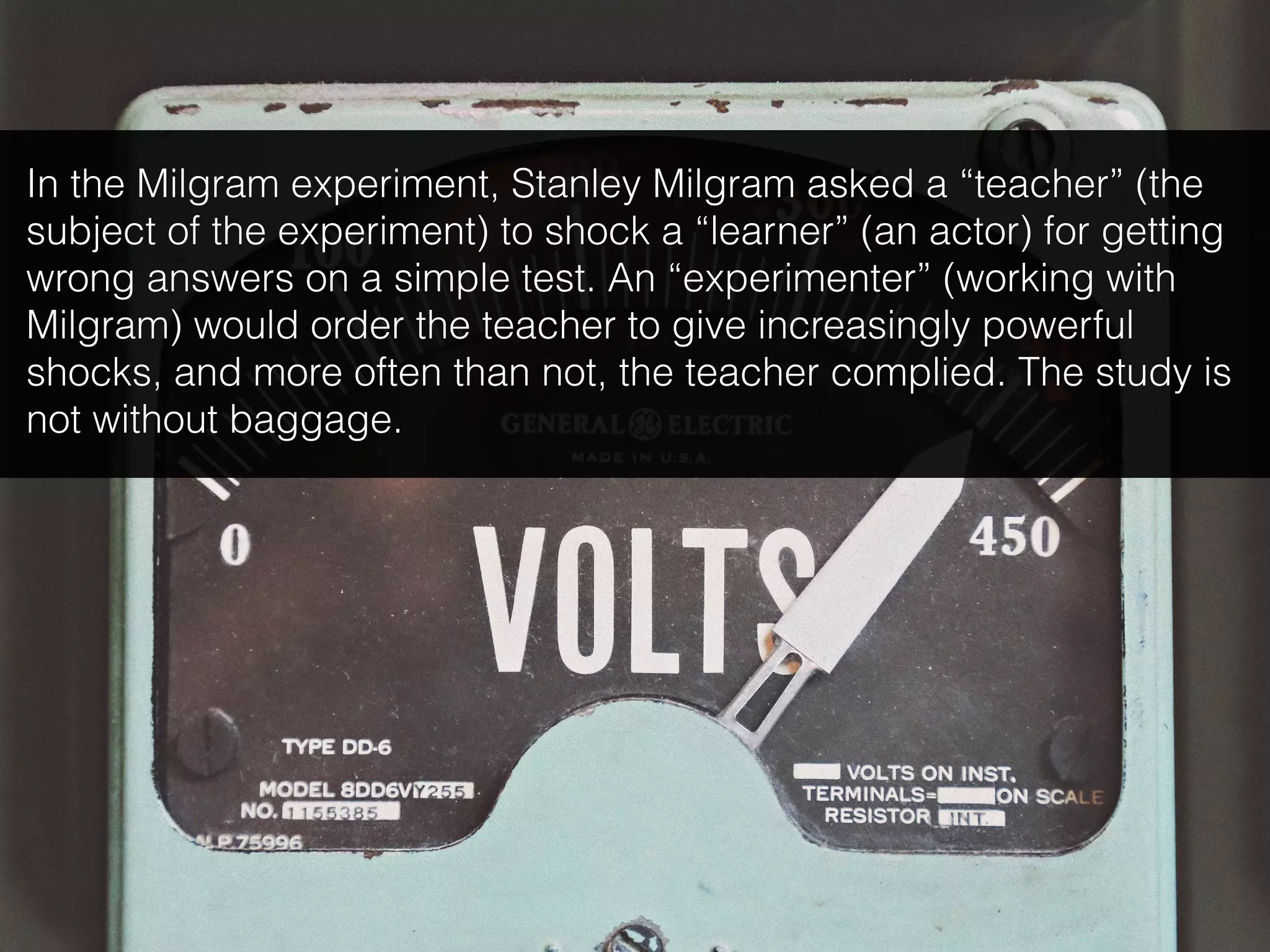
In the Milgram experiment, Stanley Milgram asked a “teacher” (the
subject of the experiment) to shock a “learner” (an actor) for getting
wrong answers on a simple test. An “experimenter” (working with
Milgram) would order the teacher to give increasingly powerful
shocks, and more often than not, the teacher complied. The study is
not without baggage.
Milgram himself describes the device that administered the shocks
as “an impressive shock generator. Its main feature is a horizontal
line of thirty switches, ranging from 15 volts to 450 volts, in 15-volt
increments. There are also verbal designations which range from
SLIGHT SHOCK to DANGER-SEVERE SHOCK.” I sense glee in the
language Milgram uses (“impressive”), something theatrical in the
excess (“thirty switches”), and a fastidiousness in his attention to
detail in reporting all this.
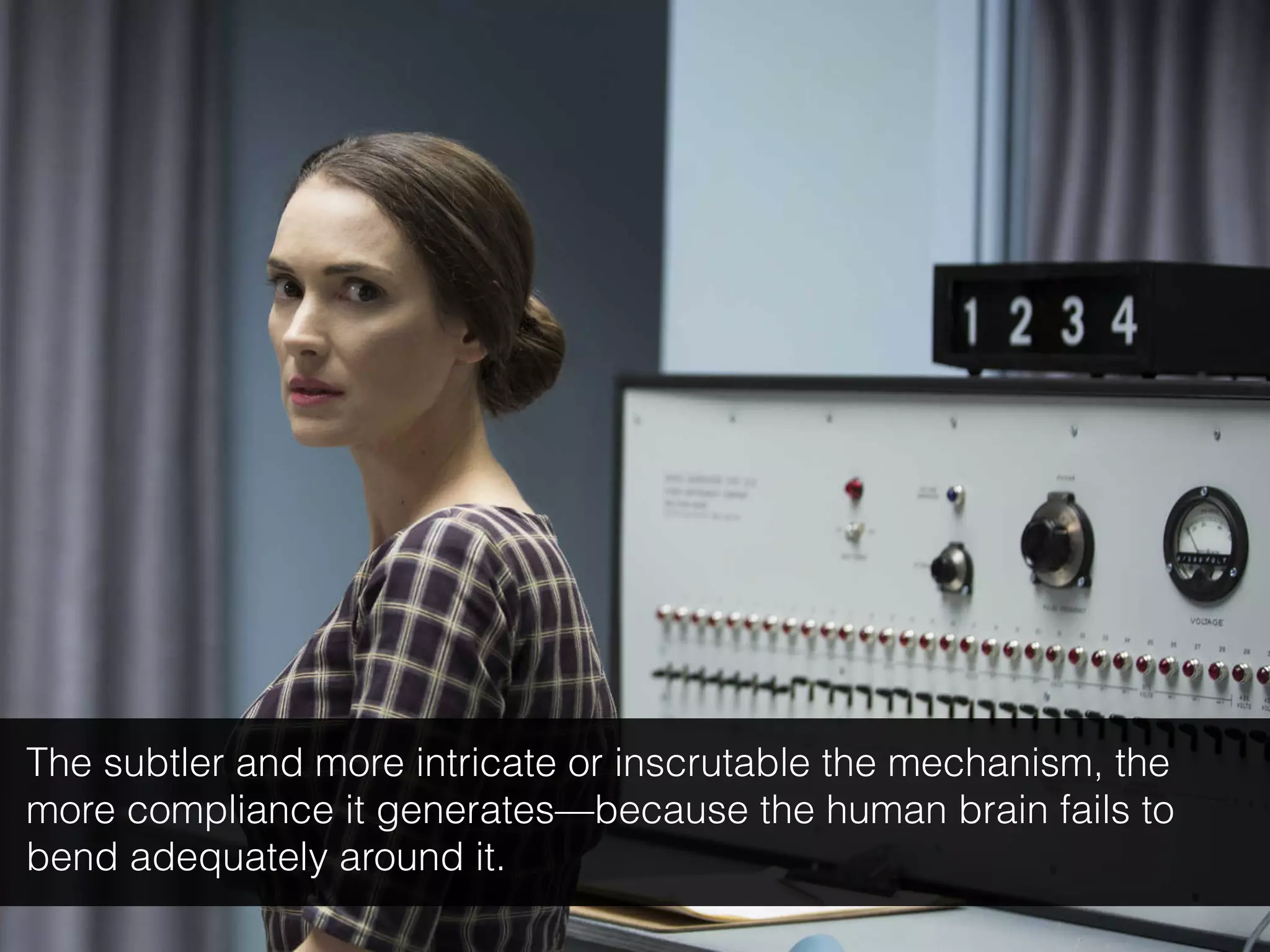
The subtler and more intricate or inscrutable the mechanism, the
more compliance it generates—because the human brain fails to
bend adequately around it.
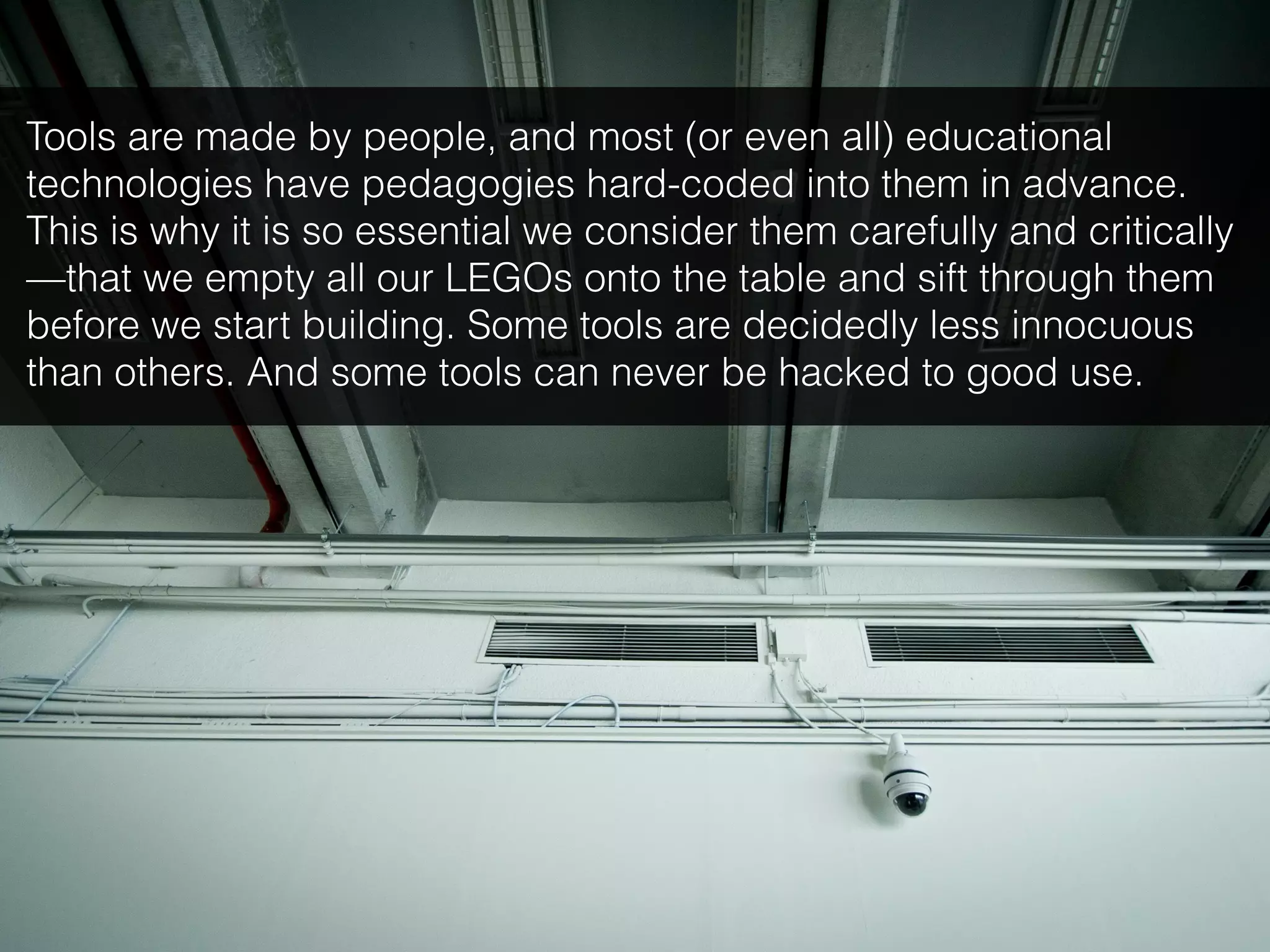
Tools are made by people, and most (or even all) educational
technologies have pedagogies hard-coded into them in advance.
This is why it is so essential we consider them carefully and critically
—that we empty all our LEGOs onto the table and sift through them
before we start building. Some tools are decidedly less innocuous
than others. And some tools can never be hacked to good use.
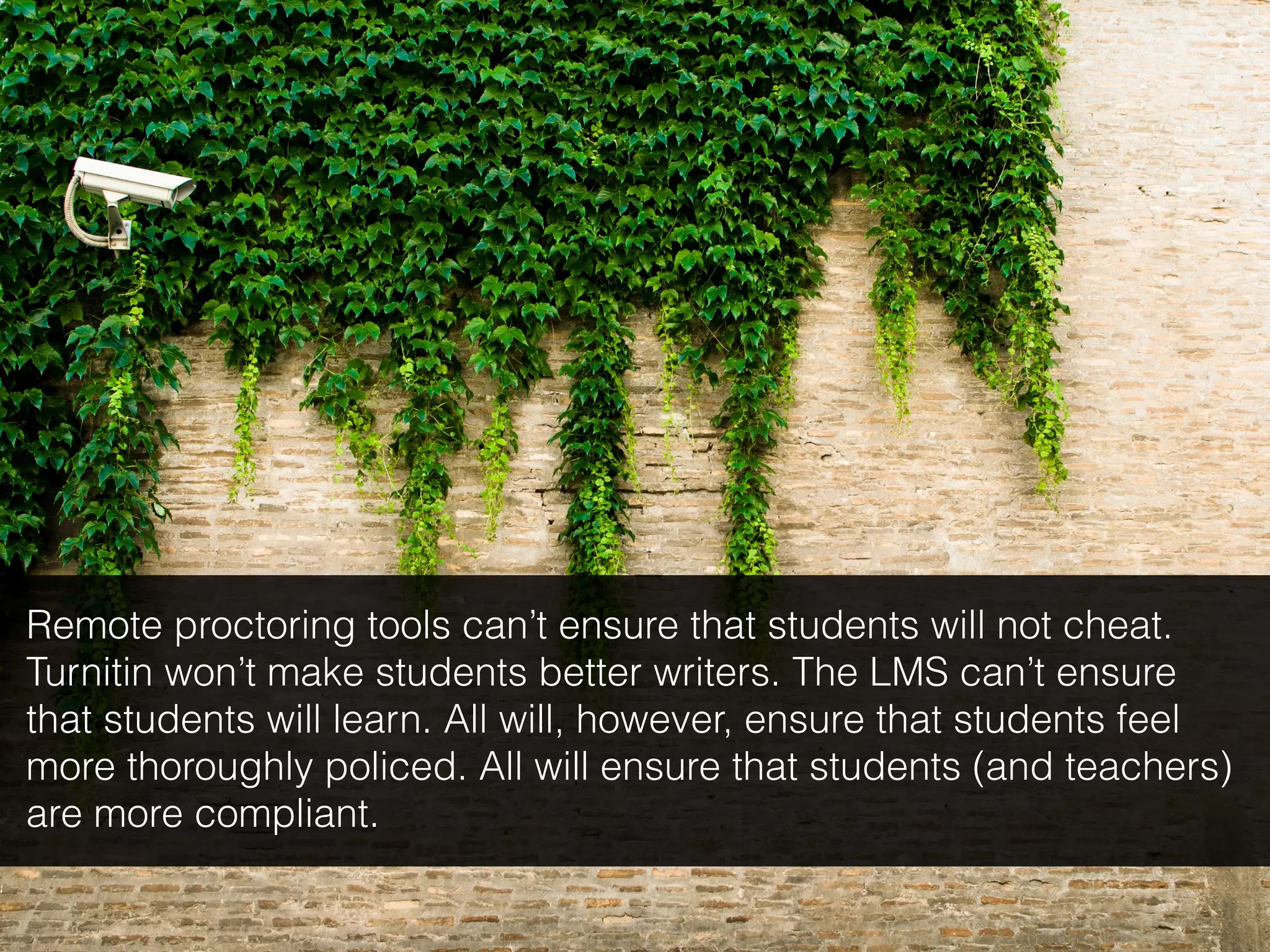
Remote proctoring tools can’t ensure that students will not cheat.
Turnitin won’t make students better writers. The LMS can’t ensure
that students will learn. All will, however, ensure that students feel
more thoroughly policed. All will ensure that students (and teachers)
are more compliant.
A discussion of pedagogy needs to include a critical examination of
our tools, what they afford, who they exclude, how they're
monetized, and what pedagogies they have already baked in. But it
requires we also begin with a consideration of what we value, the
kinds of relationships we want to develop with students, why we
gather together in places like universities, and how humans learn.
In his book Obedience to Authority, Stanley Milgram coins the term
“counteranthropomorphism”—the tendency we have to remove the
humanity of people we can’t see. These may be people on the other
side of a wall, as in Milgram’s experiment, or people mediated by
technology in a virtual classroom.
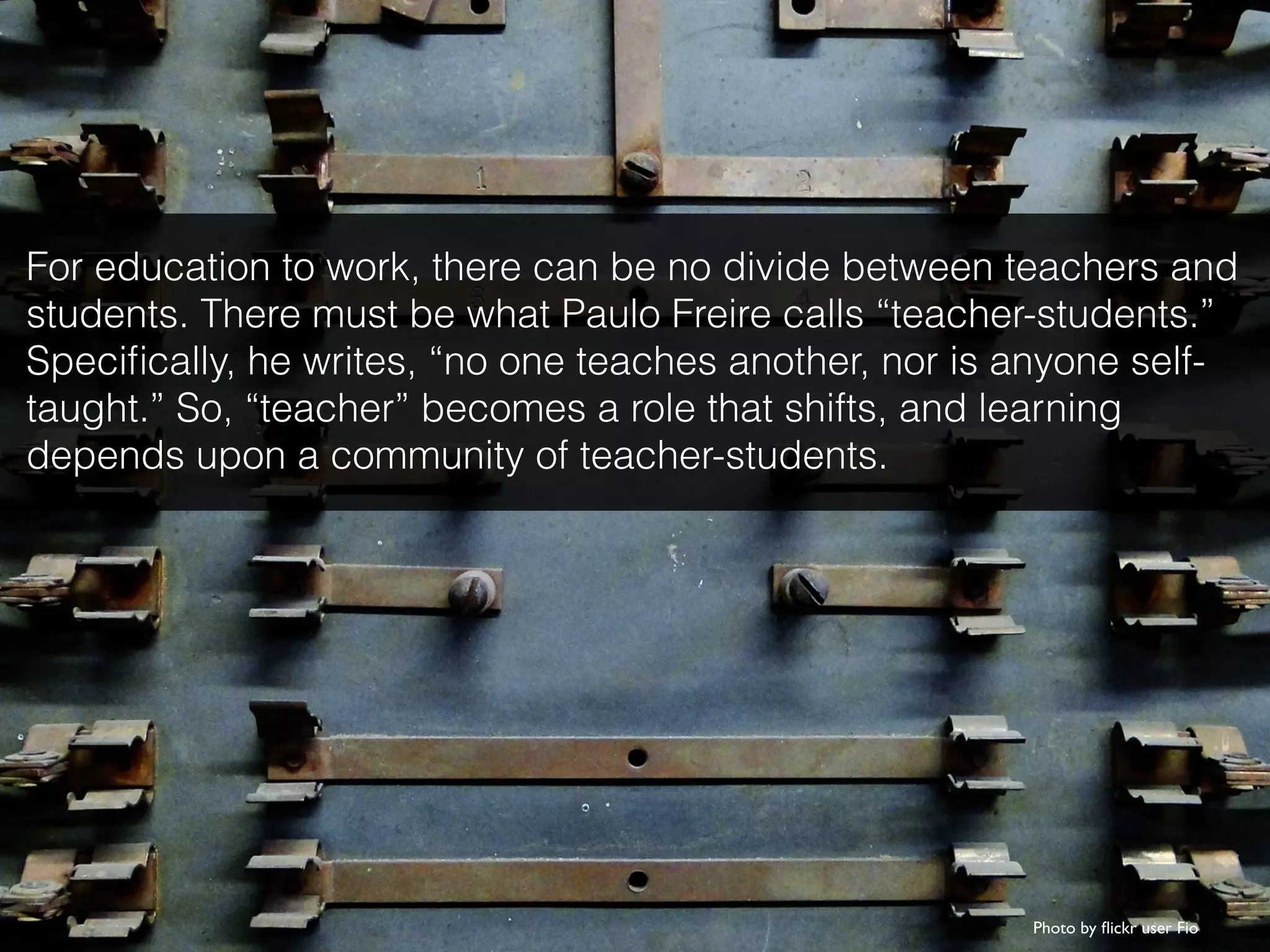
Photo by flickr user Fio
For education to work, there can be no divide between teachers and
students. There must be what Paulo Freire calls “teacher-students.”
Specifically, he writes, “no one teaches another, nor is anyone self-
taught.” So, “teacher” becomes a role that shifts, and learning
depends upon a community of teacher-students.
I'm increasingly disturbed when I see compassion, respect, and
equity for students being mislabeled with the derogatory word
“coddling."
Three years ago, I wrote a blog post responding to a series of
student-shaming articles published at the Chronicle of Higher
Education.
In that piece, I argued everyone working anywhere even near to
education needs to:
• Treat the least privileged among us with the most respect.
• Recognize the job of a teacher is to advocate for students, especially
in an educational system currently under direct threat at almost every
turn.
• Laugh at ourselves and not at those we and our system have made
most vulnerable.
• Rant up, not down.
My blog post was read by 50,000 people and spawned articles,
more than two dozen blog responses, and hundreds of comments,
some from the darker corners of the web.
The Dear Student articles weren’t the first published at the Chronicle
to demean students. And they weren’t the last. The first sentence of
an article published more recently: “My students can’t write a clear
sentence to save their lives.”
The Chronicle profits by encouraging a culture that pits vulnerable
students and teachers against each other. Nobody wins. Not
students. Not teachers. Not education in the eyes of its detractors.
Who in our educational system is most vulnerable?
Intersectionality is important when talking about power and
hierarchies. Teacher / student is a binary that needs deconstructing
but never at the expense of the other identities in play (race, class,
gender, sexuality, ability, etc.). No binary exists in a vacuum.
What I listened to intently during the aftermath of Dear Chronicle
were student voices, some of whom commented anonymously:
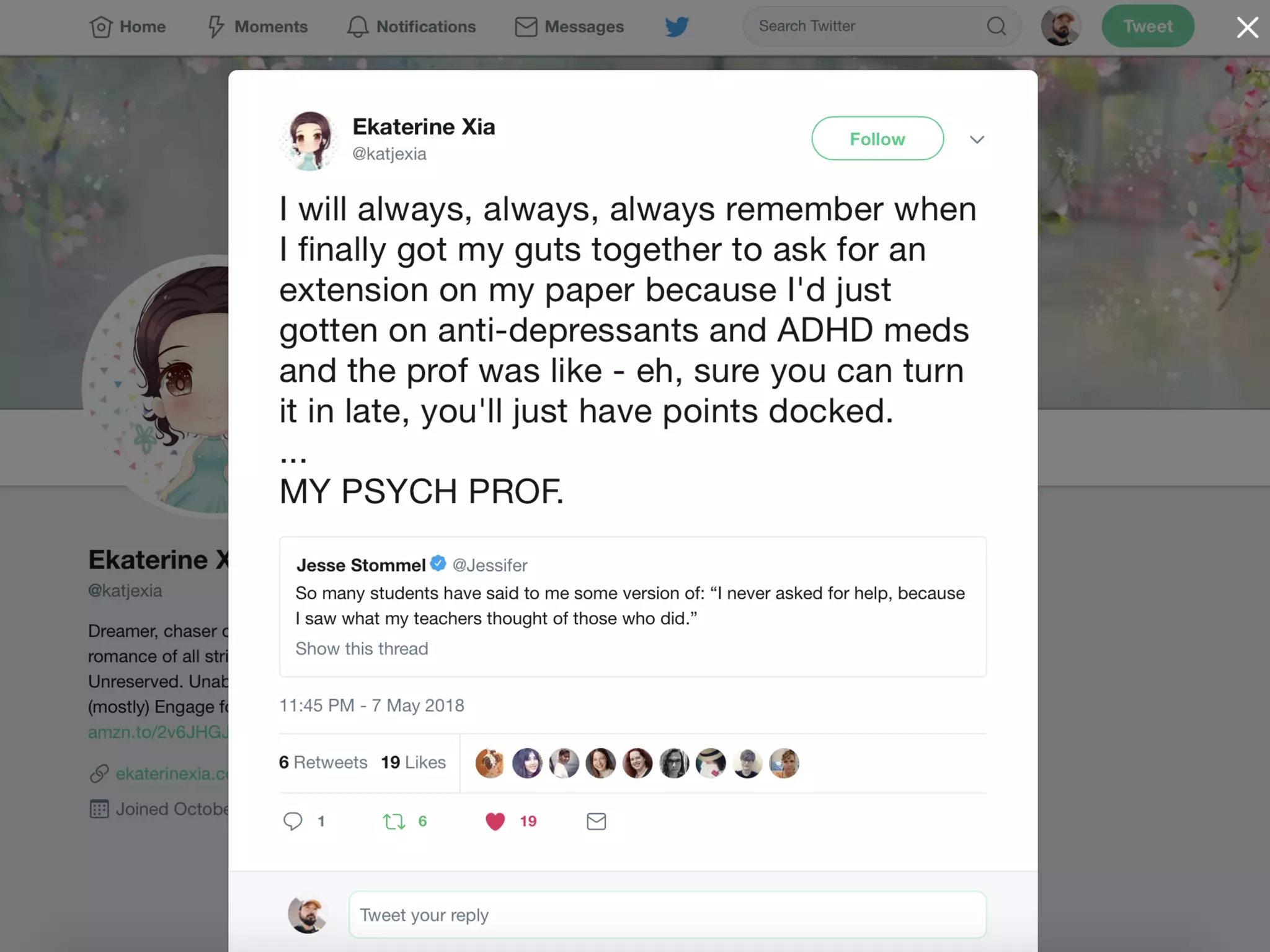
• “Part of the reason why I never asked for help was because I saw what
my professors thought of those who did.”
• “I dropped out of college, in large part due to the hoops I had to jump
through to get my disabilities recognized.”
• “It’s a lot easier to stay motivated when you’re not made to feel like
you’re stupid or a liar. It’s a lot easier to focus on studying when you’re
not focused on having to justify yourself.”
We can’t get to a place of listening to students if they don’t show up
to the conversation because we’ve excluded their voice in advance
by creating environments hostile to them and their work.
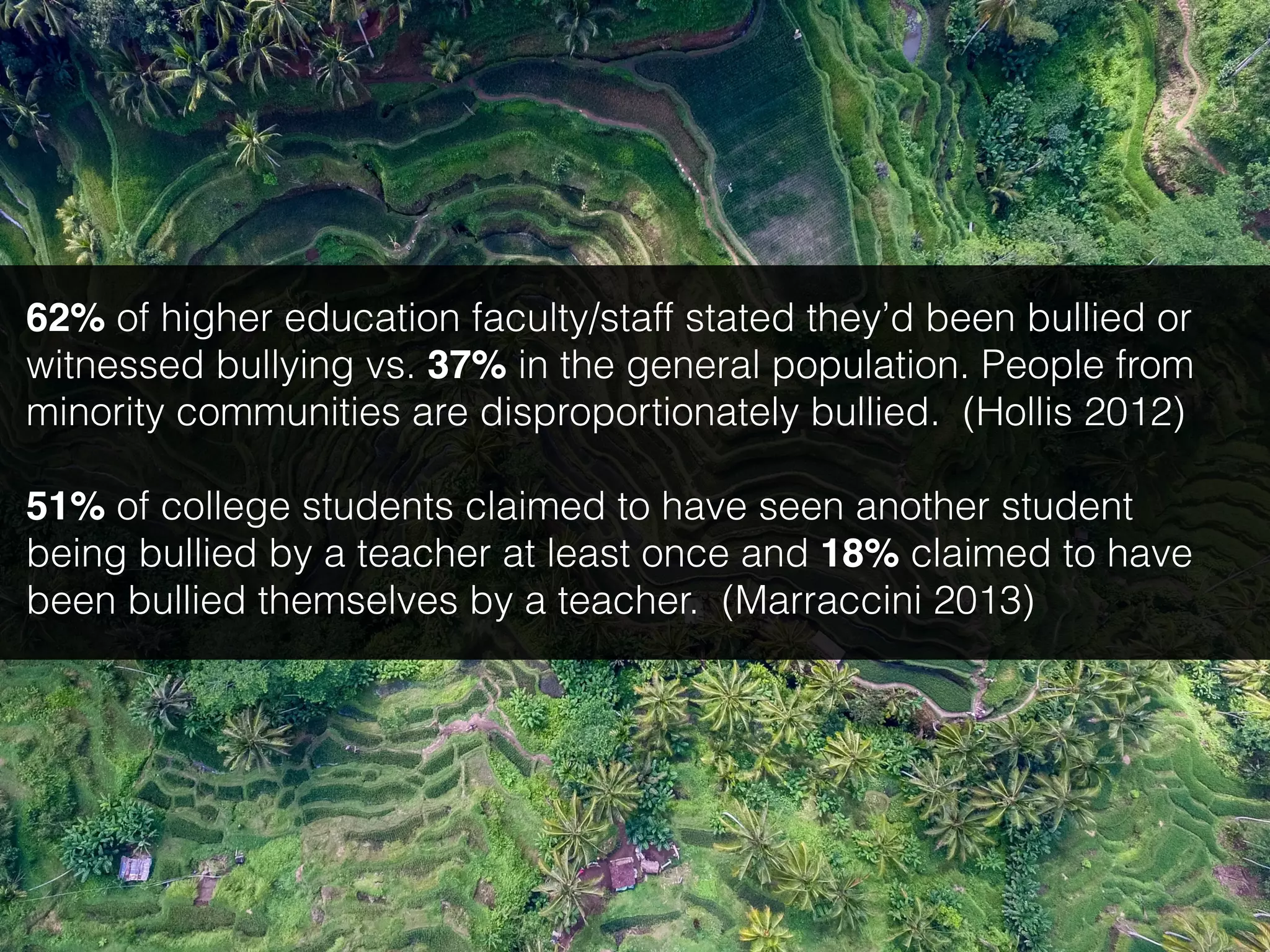
62% of higher education faculty/staff stated they’d been bullied or
witnessed bullying vs. 37% in the general population. People from
minority communities are disproportionately bullied. (Hollis 2012)
51% of college students claimed to have seen another student
being bullied by a teacher at least once and 18% claimed to have
been bullied themselves by a teacher. (Marraccini 2013)
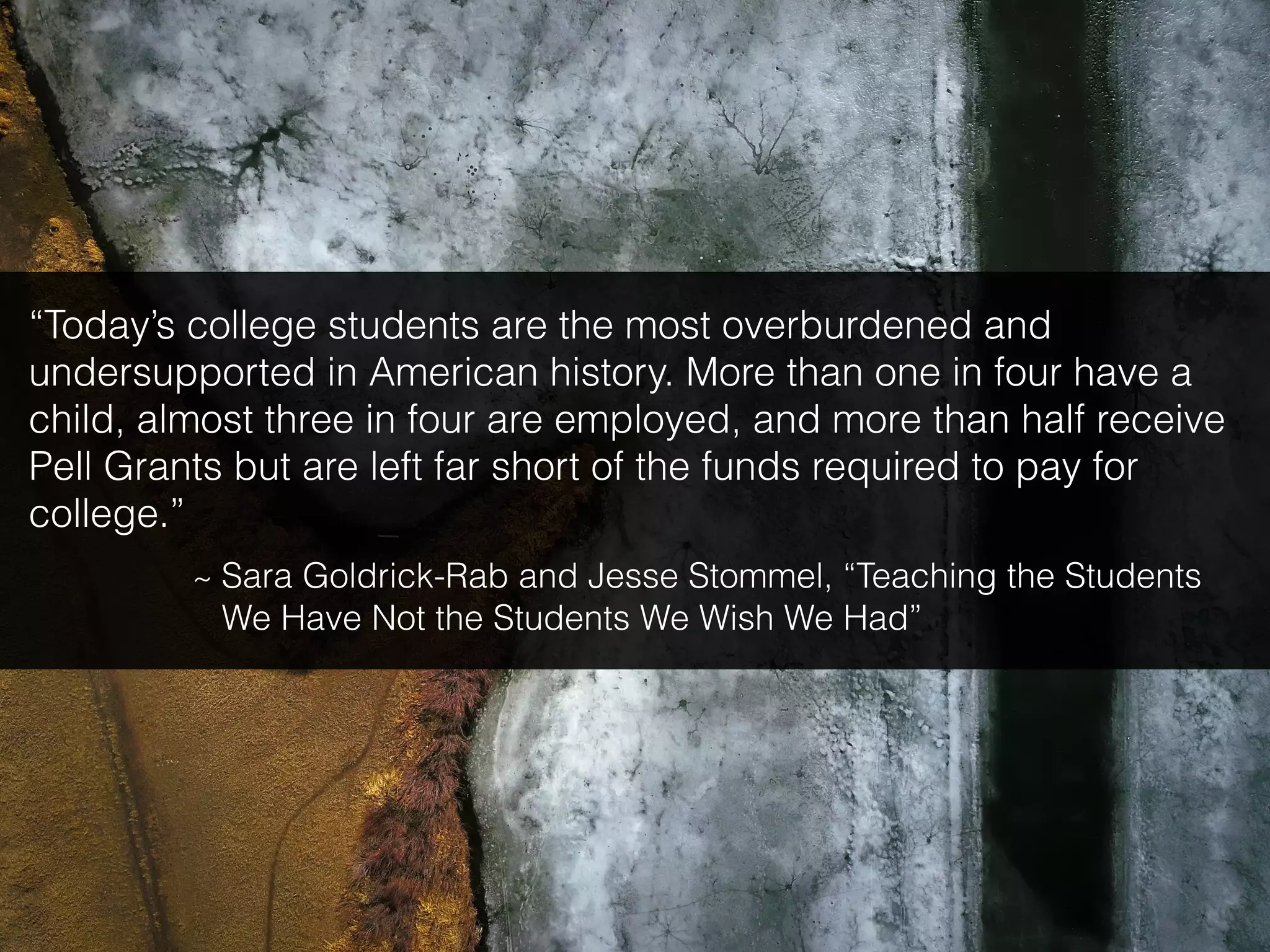
“Today’s college students are the most overburdened and
undersupported in American history. More than one in four have a
child, almost three in four are employed, and more than half receive
Pell Grants but are left far short of the funds required to pay for
college.”
~ Sara Goldrick-Rab and Jesse Stommel, “Teaching the Students
We Have Not the Students We Wish We Had”
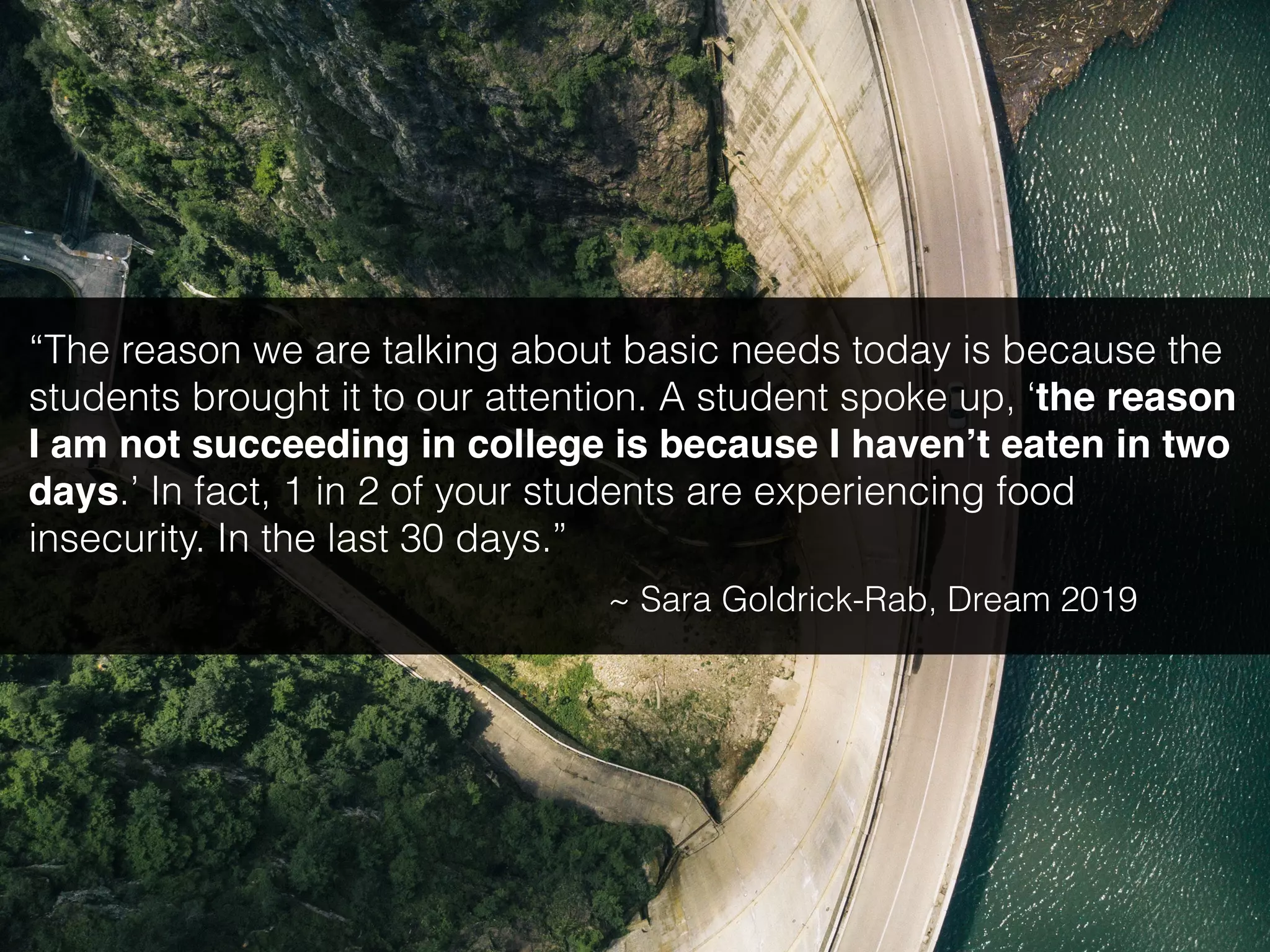
“The reason we are talking about basic needs today is because the
students brought it to our attention. A student spoke up, ‘the reason
I am not succeeding in college is because I haven’t eaten in two
days.’ In fact, 1 in 2 of your students are experiencing food
insecurity. In the last 30 days.”
~ Sara Goldrick-Rab, Dream 2019
This means we can’t throw students (with nowhere else to go) out of
their dorms over the holidays. Or craft laptop policies that make it
impossible for disabled students to receive accommodation without
their disability made visible to an entire classroom.
And it means we can’t throw college teachers into a classroom with
no (or virtually no) preparation for the work of educating these
students.
All of this demands exactly two pedagogical approaches, and these
are what I see at the heart of my pedagogy:
1. Start by trusting students.
2. Realize "fairness" is not a good excuse for a lack of compassion.
“We need to design our pedagogical approaches for the students
we have, not the students we wish we had. This requires
approaches that are responsive, inclusive, adaptive, challenging,
and compassionate. And it requires institutions find more creative
ways to support teachers and prepare them for the work of teaching.
This is not a theoretical exercise — it is a practical one.”
~ Sara Goldrick-Rab and Jesse Stommel, “Teaching the Students
We Have Not the Students We Wish We Had”
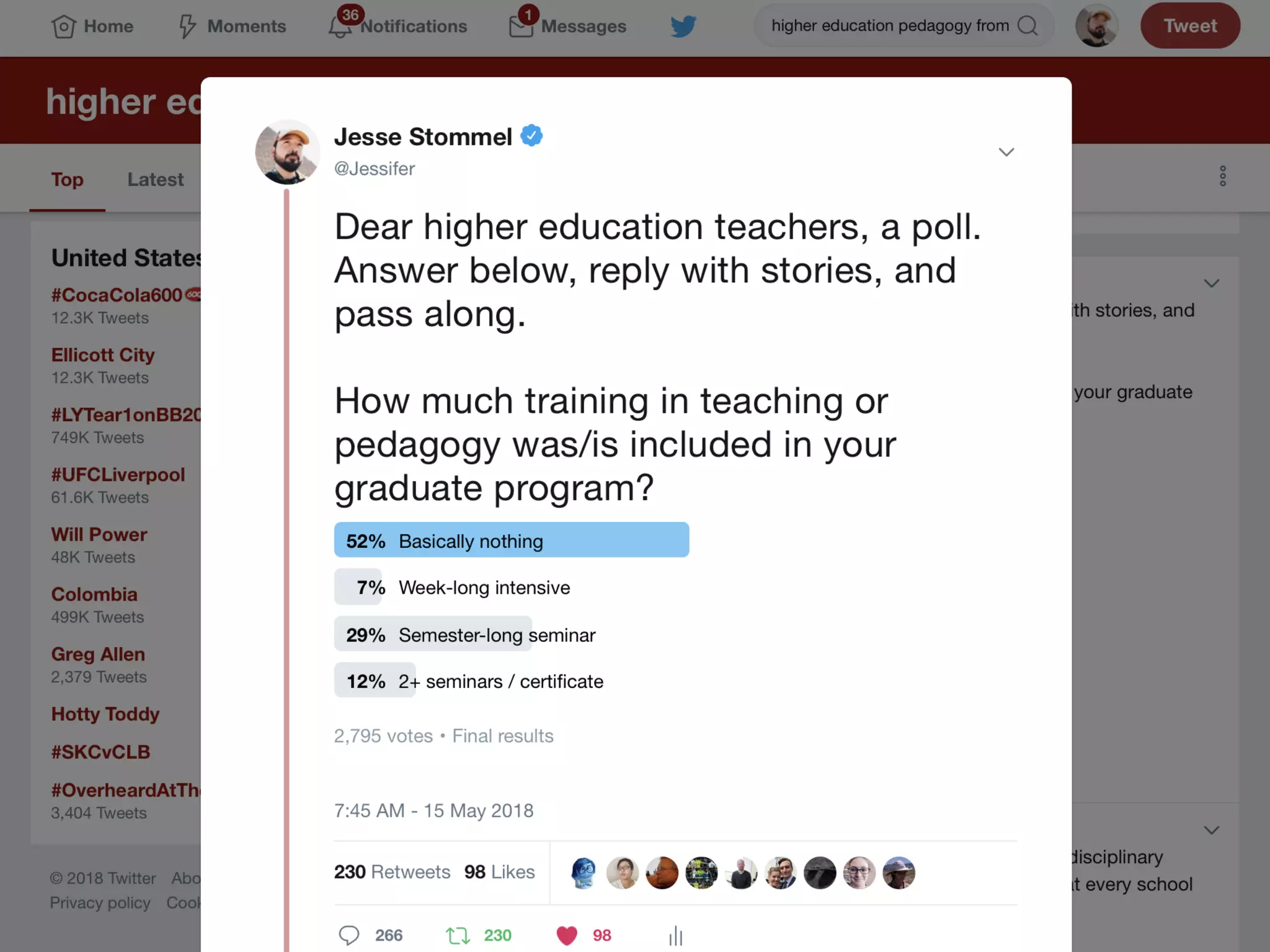
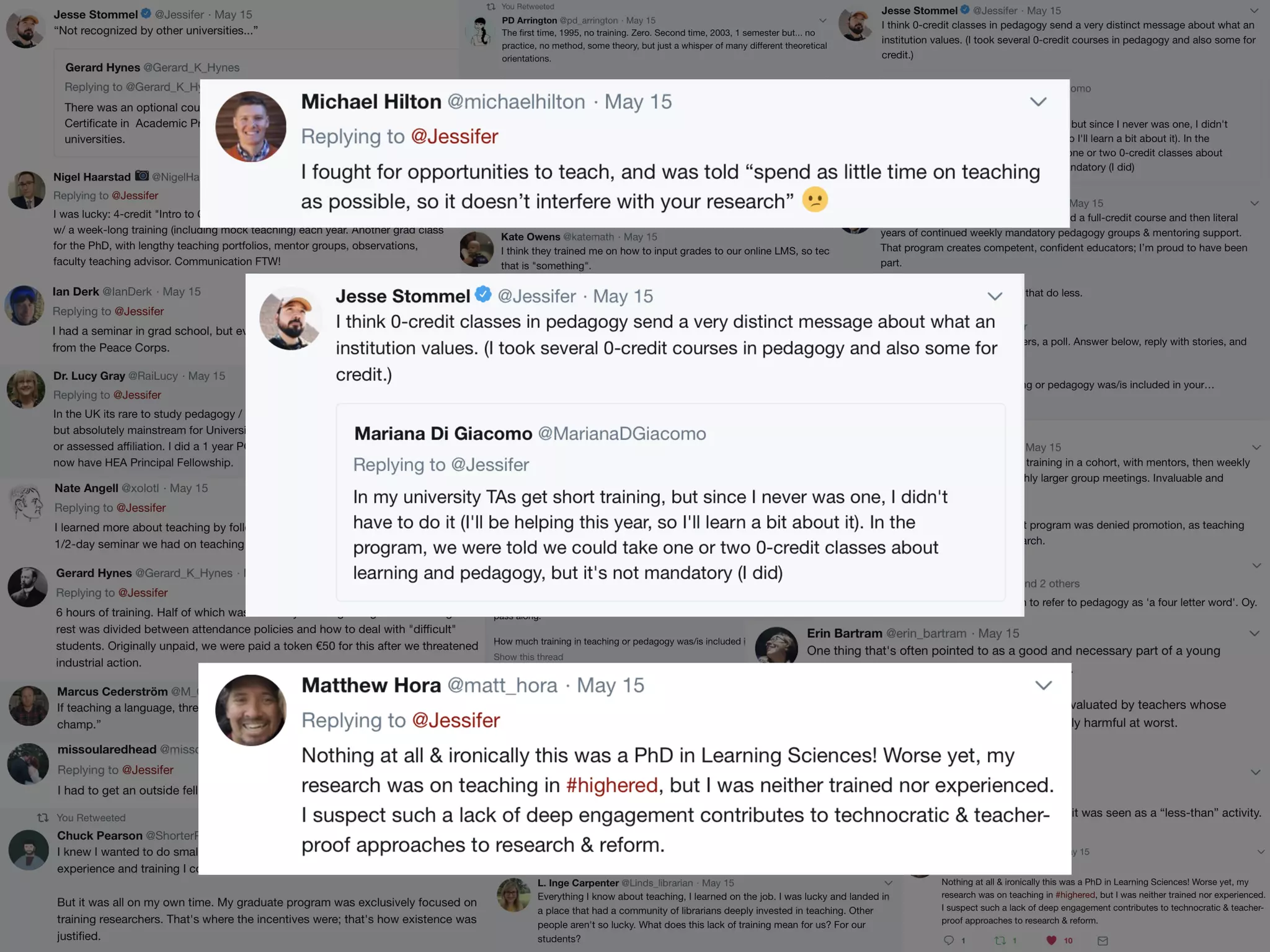
Teachers need teachers
Teachers in higher education are asked to do work they (often) have
no preparation for. And that usually isn’t even directly
acknowledged. Without higher education pedagogy recognized as
a discipline, discussions of teaching end up centered around purely
logistical or instrumental concerns.
“It’s okay that we are throwing you into a classroom with absolutely
no training. We trust you. And we are certain this will work, because
it was done to us.”
If what we want to create in new teachers is fear and compliance,
this messaging is a great strategy.
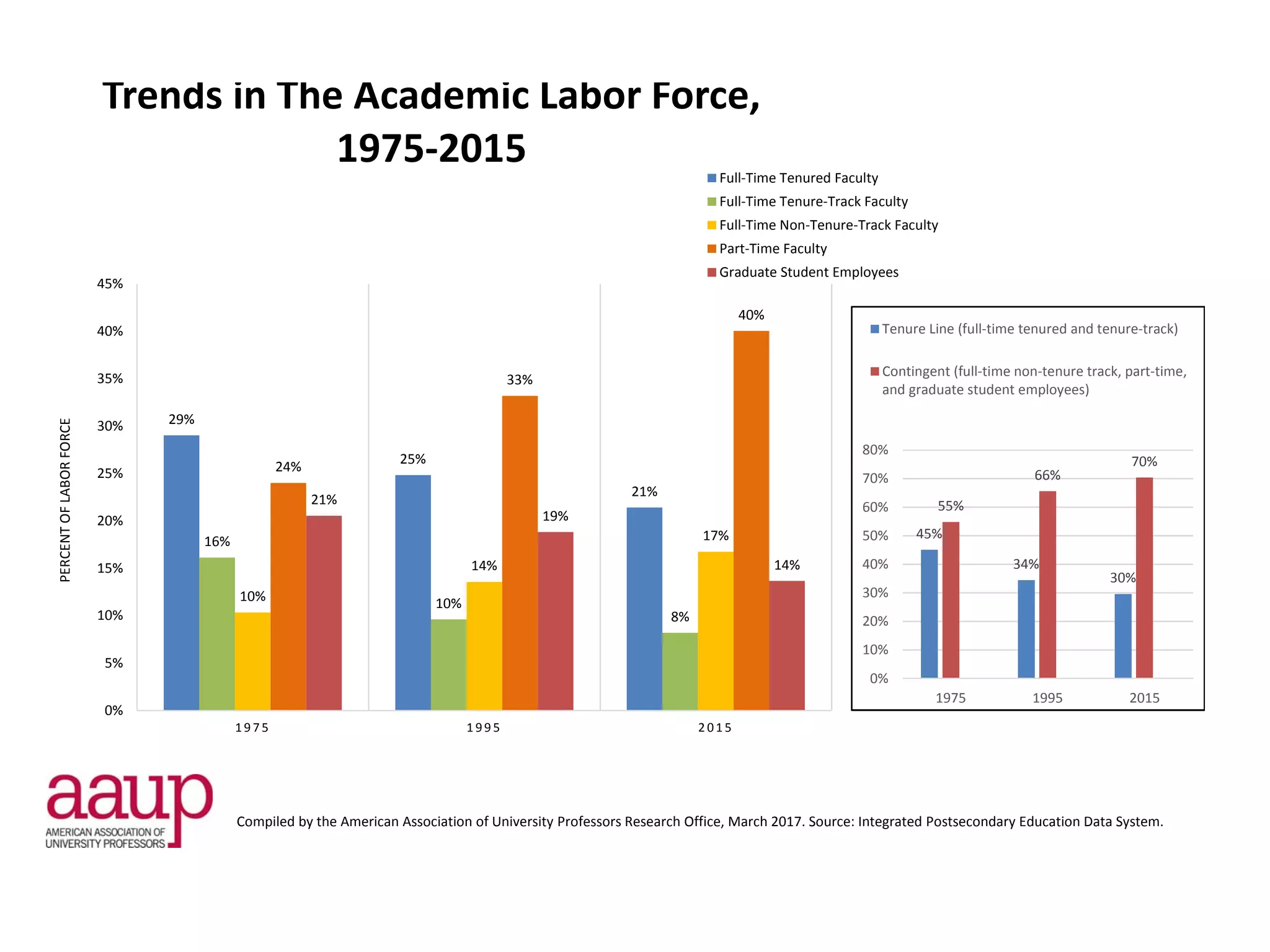
1975 1995 2015
Full‐Time Tenured Faculty 29% 25% 21%
Full‐Time Tenure‐Track Faculty 16% 10% 8%
Full‐Time Non‐Tenure‐Track Faculty 10% 14% 17%
Part‐Time Faculty 24% 33% 40%
Graduate Student Employees 21% 19% 14%
Labor Force Totals 100.00% 100.00% 100.00%
29%
25%
21%
16%
10%
8%
10%
14%
17%
24%
33%
40%
21%
19%
14%
0%
5%
10%
15%
20%
25%
30%
35%
40%
45%
1975 1995 2015
PERCENT OF LABOR FORCE
Trends in The Academic Labor Force, 
1975‐2015  Full‐Time Tenured Faculty
Full‐Time Tenure‐Track Faculty
Full‐Time Non‐Tenure‐Track Faculty
Part‐Time Faculty
Graduate Student Employees
45%
34%
30%
55%
66%
70%
0%
10%
20%
30%
40%
50%
60%
70%
80%
1975 1995 2015
Tenure Line (full‐time tenured and tenure‐track)
Contingent (full‐time non‐tenure track, part‐time,
and graduate student employees)
Compiled by the American Association of University Professors Research Office, March 2017. Source: Integrated Postsecondary Education Data System. 
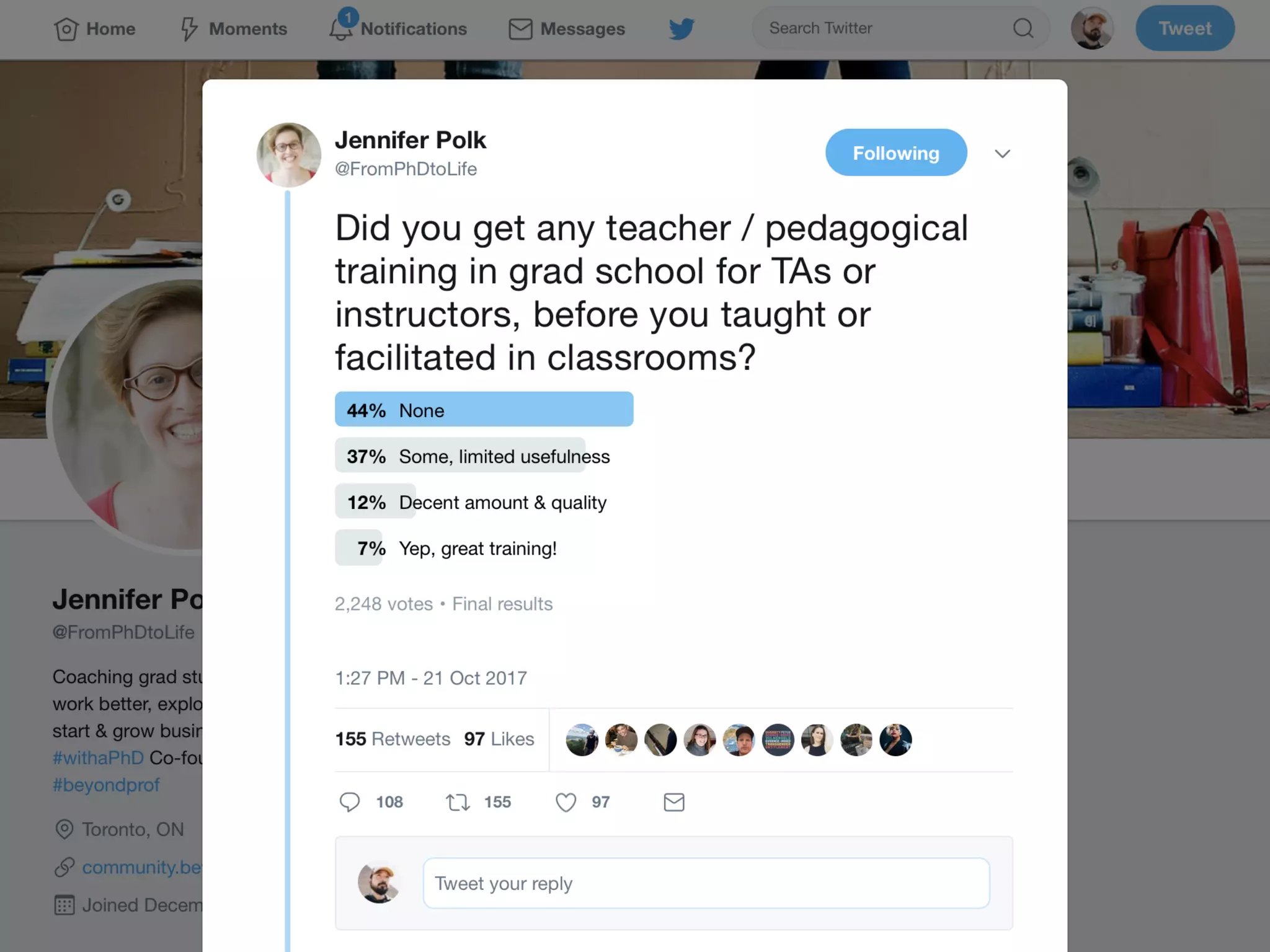
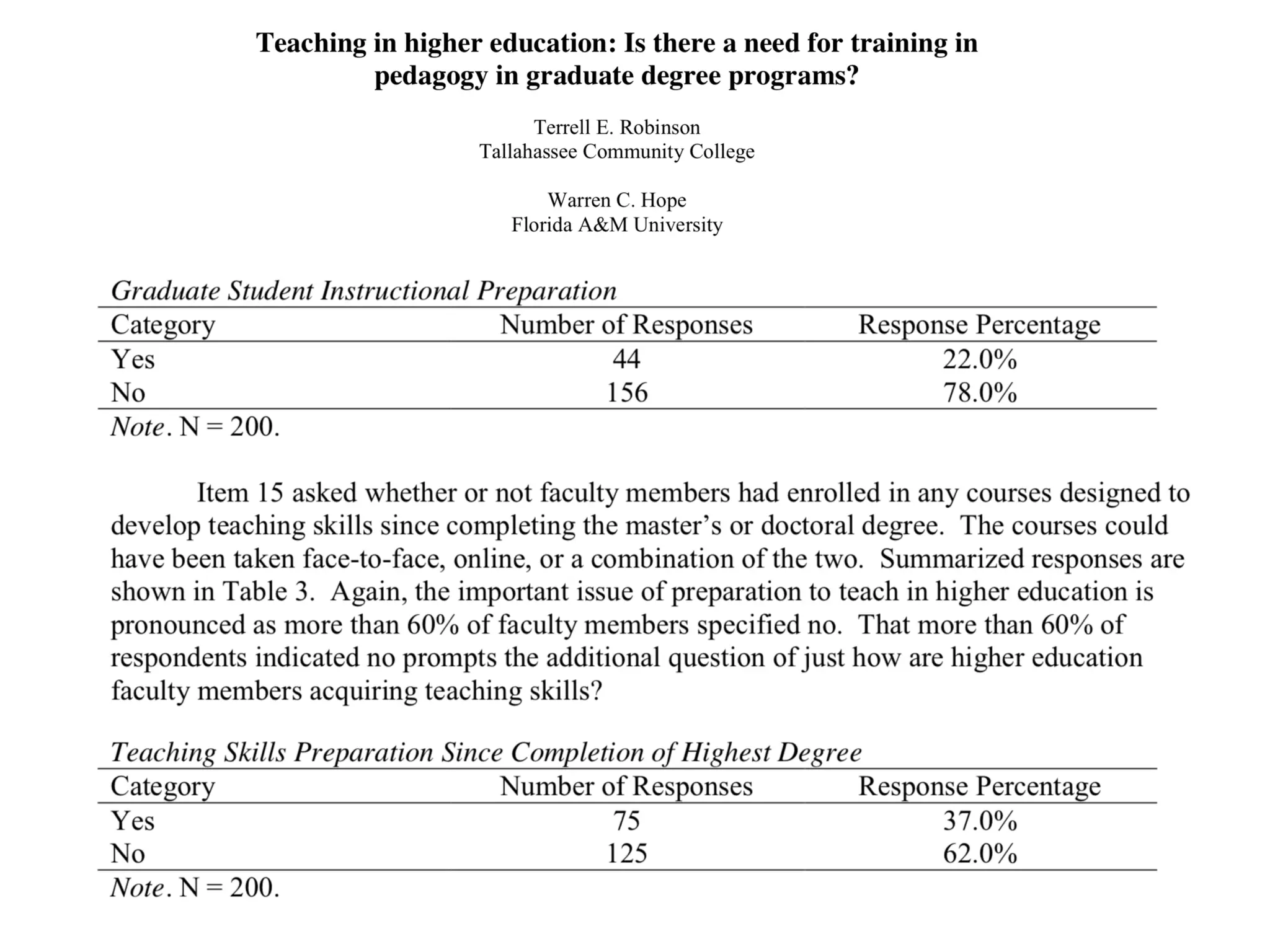
When at least 50% of the teachers in higher education have no
preparation at all for the work of teaching (and 70% are contingent),
the conversation about what higher education is for should begin
there. And not from a place of demeaning those (or any) teachers.
The process that makes teachers increasingly adjunct is the same
process that has made students into customers. And the gear that
makes this system go depends on the pitting of students and
teachers against one another. Not preparing higher education
teachers is a powerful lever in this system.
“It is urgent we have teachers, it is urgent we employ them, pay
them, support them with adequate resources; but it is also urgency
which defines the project of teaching. In a political climate
increasingly defined by its obstinacy, anti-intellectualism, and
deflection of fact and care; in a society still divided across lines of
race, nationality, religion, gender, sexuality, income, ability, and
privilege, teaching has an important (urgent) role to play.”
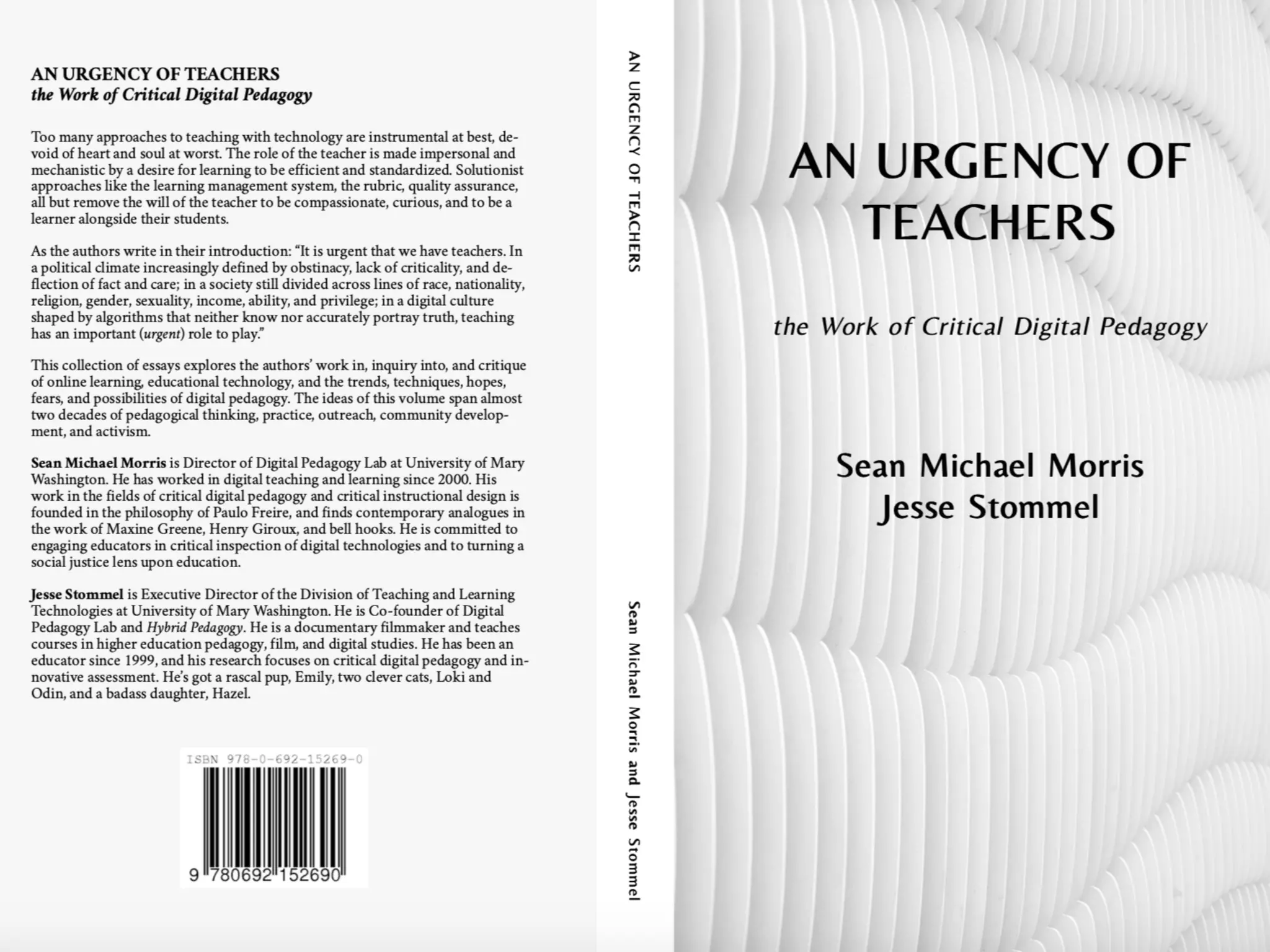
~ Sean Michael Morris and Jesse Stommel, An Urgency of
Teachers: The Work of Critical Digital Pedagogy
Teaching from a Place of Compassion

Teaching from a Place of Compassion

  • 1.
    Teaching from aPlace of Compassion Jesse Stommel @Jessifer
  • 2.
    “To teach ina manner that respects and cares for the souls of our students is essential if we are to provide the necessary conditions where learning can most deeply and intimately begin.” ~ bell hooks, Teaching to Transgress
  • 5.
    Scaffolding can createpoints of entry and access but can also reduce the complexity of learning to its detriment (e.g. Bloom’s Taxonomy, ADDIE, etc.).
  • 6.
    Photo by flickruserVictoria Pickering Why do we attempt so often to resolve this...
  • 7.
  • 11.
    In the Milgramexperiment, Stanley Milgram asked a “teacher” (the subject of the experiment) to shock a “learner” (an actor) for getting wrong answers on a simple test. An “experimenter” (working with Milgram) would order the teacher to give increasingly powerful shocks, and more often than not, the teacher complied. The study is not without baggage.
  • 12.
    Milgram himself describesthe device that administered the shocks as “an impressive shock generator. Its main feature is a horizontal line of thirty switches, ranging from 15 volts to 450 volts, in 15-volt increments. There are also verbal designations which range from SLIGHT SHOCK to DANGER-SEVERE SHOCK.” I sense glee in the language Milgram uses (“impressive”), something theatrical in the excess (“thirty switches”), and a fastidiousness in his attention to detail in reporting all this.
  • 13.
    The subtler andmore intricate or inscrutable the mechanism, the more compliance it generates—because the human brain fails to bend adequately around it.
  • 14.
    Tools are madeby people, and most (or even all) educational technologies have pedagogies hard-coded into them in advance. This is why it is so essential we consider them carefully and critically —that we empty all our LEGOs onto the table and sift through them before we start building. Some tools are decidedly less innocuous than others. And some tools can never be hacked to good use.
  • 15.
    Remote proctoring toolscan’t ensure that students will not cheat. Turnitin won’t make students better writers. The LMS can’t ensure that students will learn. All will, however, ensure that students feel more thoroughly policed. All will ensure that students (and teachers) are more compliant.
  • 16.
    A discussion ofpedagogy needs to include a critical examination of our tools, what they afford, who they exclude, how they're monetized, and what pedagogies they have already baked in. But it requires we also begin with a consideration of what we value, the kinds of relationships we want to develop with students, why we gather together in places like universities, and how humans learn.
  • 17.
    In his bookObedience to Authority, Stanley Milgram coins the term “counteranthropomorphism”—the tendency we have to remove the humanity of people we can’t see. These may be people on the other side of a wall, as in Milgram’s experiment, or people mediated by technology in a virtual classroom.
  • 18.
    Photo by flickruser Fio For education to work, there can be no divide between teachers and students. There must be what Paulo Freire calls “teacher-students.” Specifically, he writes, “no one teaches another, nor is anyone self- taught.” So, “teacher” becomes a role that shifts, and learning depends upon a community of teacher-students.
  • 19.
    I'm increasingly disturbedwhen I see compassion, respect, and equity for students being mislabeled with the derogatory word “coddling."
  • 20.
    Three years ago,I wrote a blog post responding to a series of student-shaming articles published at the Chronicle of Higher Education.
  • 21.
    In that piece,I argued everyone working anywhere even near to education needs to: • Treat the least privileged among us with the most respect. • Recognize the job of a teacher is to advocate for students, especially in an educational system currently under direct threat at almost every turn. • Laugh at ourselves and not at those we and our system have made most vulnerable. • Rant up, not down.
  • 22.
    My blog postwas read by 50,000 people and spawned articles, more than two dozen blog responses, and hundreds of comments, some from the darker corners of the web.
  • 23.
    The Dear Studentarticles weren’t the first published at the Chronicle to demean students. And they weren’t the last. The first sentence of an article published more recently: “My students can’t write a clear sentence to save their lives.”
  • 24.
    The Chronicle profitsby encouraging a culture that pits vulnerable students and teachers against each other. Nobody wins. Not students. Not teachers. Not education in the eyes of its detractors.
  • 25.
    Who in oureducational system is most vulnerable?
  • 26.
    Intersectionality is importantwhen talking about power and hierarchies. Teacher / student is a binary that needs deconstructing but never at the expense of the other identities in play (race, class, gender, sexuality, ability, etc.). No binary exists in a vacuum.
  • 27.
    What I listenedto intently during the aftermath of Dear Chronicle were student voices, some of whom commented anonymously: • “Part of the reason why I never asked for help was because I saw what my professors thought of those who did.” • “I dropped out of college, in large part due to the hoops I had to jump through to get my disabilities recognized.” • “It’s a lot easier to stay motivated when you’re not made to feel like you’re stupid or a liar. It’s a lot easier to focus on studying when you’re not focused on having to justify yourself.”
  • 28.
    We can’t getto a place of listening to students if they don’t show up to the conversation because we’ve excluded their voice in advance by creating environments hostile to them and their work.
  • 29.
    62% of highereducation faculty/staff stated they’d been bullied or witnessed bullying vs. 37% in the general population. People from minority communities are disproportionately bullied. (Hollis 2012) 51% of college students claimed to have seen another student being bullied by a teacher at least once and 18% claimed to have been bullied themselves by a teacher. (Marraccini 2013)
  • 39.
    “Today’s college studentsare the most overburdened and undersupported in American history. More than one in four have a child, almost three in four are employed, and more than half receive Pell Grants but are left far short of the funds required to pay for college.” ~ Sara Goldrick-Rab and Jesse Stommel, “Teaching the Students We Have Not the Students We Wish We Had”
  • 40.
    “The reason weare talking about basic needs today is because the students brought it to our attention. A student spoke up, ‘the reason I am not succeeding in college is because I haven’t eaten in two days.’ In fact, 1 in 2 of your students are experiencing food insecurity. In the last 30 days.” ~ Sara Goldrick-Rab, Dream 2019
  • 41.
    This means wecan’t throw students (with nowhere else to go) out of their dorms over the holidays. Or craft laptop policies that make it impossible for disabled students to receive accommodation without their disability made visible to an entire classroom. And it means we can’t throw college teachers into a classroom with no (or virtually no) preparation for the work of educating these students.
  • 42.
    All of thisdemands exactly two pedagogical approaches, and these are what I see at the heart of my pedagogy: 1. Start by trusting students. 2. Realize "fairness" is not a good excuse for a lack of compassion.
  • 43.
    “We need todesign our pedagogical approaches for the students we have, not the students we wish we had. This requires approaches that are responsive, inclusive, adaptive, challenging, and compassionate. And it requires institutions find more creative ways to support teachers and prepare them for the work of teaching. This is not a theoretical exercise — it is a practical one.” ~ Sara Goldrick-Rab and Jesse Stommel, “Teaching the Students We Have Not the Students We Wish We Had”
  • 44.
  • 47.
    Teachers in highereducation are asked to do work they (often) have no preparation for. And that usually isn’t even directly acknowledged. Without higher education pedagogy recognized as a discipline, discussions of teaching end up centered around purely logistical or instrumental concerns.
  • 49.
    “It’s okay thatwe are throwing you into a classroom with absolutely no training. We trust you. And we are certain this will work, because it was done to us.” If what we want to create in new teachers is fear and compliance, this messaging is a great strategy.
  • 51.
    1975 1995 2015 Full‐Time Tenured Faculty29% 25% 21% Full‐Time Tenure‐Track Faculty 16% 10% 8% Full‐Time Non‐Tenure‐Track Faculty 10% 14% 17% Part‐Time Faculty 24% 33% 40% Graduate Student Employees 21% 19% 14% Labor Force Totals 100.00% 100.00% 100.00% 29% 25% 21% 16% 10% 8% 10% 14% 17% 24% 33% 40% 21% 19% 14% 0% 5% 10% 15% 20% 25% 30% 35% 40% 45% 1975 1995 2015 PERCENT OF LABOR FORCE Trends in The Academic Labor Force,  1975‐2015  Full‐Time Tenured Faculty Full‐Time Tenure‐Track Faculty Full‐Time Non‐Tenure‐Track Faculty Part‐Time Faculty Graduate Student Employees 45% 34% 30% 55% 66% 70% 0% 10% 20% 30% 40% 50% 60% 70% 80% 1975 1995 2015 Tenure Line (full‐time tenured and tenure‐track) Contingent (full‐time non‐tenure track, part‐time, and graduate student employees) Compiled by the American Association of University Professors Research Office, March 2017. Source: Integrated Postsecondary Education Data System. 
  • 52.
    When at least50% of the teachers in higher education have no preparation at all for the work of teaching (and 70% are contingent), the conversation about what higher education is for should begin there. And not from a place of demeaning those (or any) teachers.
  • 53.
    The process thatmakes teachers increasingly adjunct is the same process that has made students into customers. And the gear that makes this system go depends on the pitting of students and teachers against one another. Not preparing higher education teachers is a powerful lever in this system.
  • 54.
    “It is urgentwe have teachers, it is urgent we employ them, pay them, support them with adequate resources; but it is also urgency which defines the project of teaching. In a political climate increasingly defined by its obstinacy, anti-intellectualism, and deflection of fact and care; in a society still divided across lines of race, nationality, religion, gender, sexuality, income, ability, and privilege, teaching has an important (urgent) role to play.” ~ Sean Michael Morris and Jesse Stommel, An Urgency of Teachers: The Work of Critical Digital Pedagogy