CRITICAL APPLIED
LINGUISTICS
BESNIK QYTEZA
OUTLINE
• What is applied linguistics
• Critical applied linguistics
• Criticality
• Critical social study
• Self-Reflexivity
• Micro-macro relations
• CDA and critical literacy
• Critical Translation
• Critical Approach to Teaching
• Critical Approach to Testing
• Preferred Future
WHAT IS APPLIED LINGUISTICS
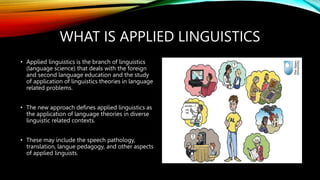
• Applied linguistics is the branch of linguistics
(language science) that deals with the foreign
and second language education and the study
of application of linguistics theories in language
related problems.
• The new approach defines applied linguistics as
the application of language theories in diverse
linguistic related contexts.
• These may include the speech pathology,
translation, langue pedagogy, and other aspects
of applied linguists.
CRITICAL APPLIED LINGUISTICS
• We are dealing with the critical study of
the aspects of applied linguistics.
• Not only an addition of criticality to
applied linguistics
• A continuous and sustainable,
uninterrupted, skeptics and critical
investigation in to the diverse fields of
applied linguistics.
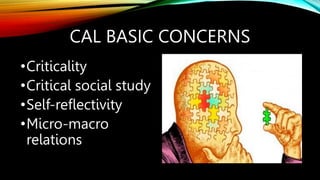
CAL BASIC CONCERNS
•Criticality
•Critical social study
•Self-reflectivity
•Micro-macro
relations
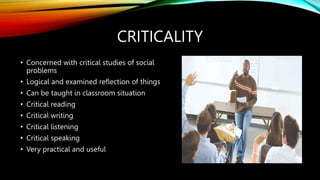
CRITICALITY
• Concerned with critical studies of social
problems
• Logical and examined reflection of things
• Can be taught in classroom situation
• Critical reading
• Critical writing
• Critical listening
• Critical speaking
• Very practical and useful
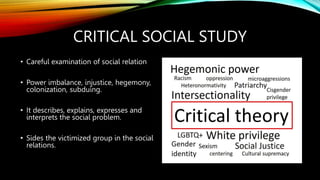
CRITICAL SOCIAL STUDY
• Careful examination of social relation
• Power imbalance, injustice, hegemony,
colonization, subduing.
• It describes, explains, expresses and
interprets the social problem.
• Sides the victimized group in the social
relations.
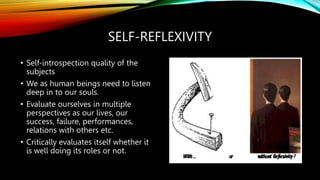
SELF-REFLEXIVITY
• Self-introspection quality of the
subjects
• We as human beings need to listen
deep in to our souls.
• Evaluate ourselves in multiple
perspectives as our lives, our
success, failure, performances,
relations with others etc.
• Critically evaluates itself whether it
is well doing its roles or not.
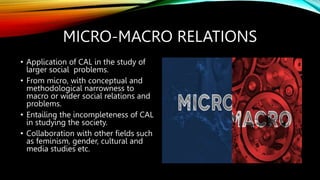
MICRO-MACRO RELATIONS
• Application of CAL in the study of
larger social problems.
• From micro, with conceptual and
methodological narrowness to
macro or wider social relations and
problems.
• Entailing the incompleteness of CAL
in studying the society.
• Collaboration with other fields such
as feminism, gender, cultural and
media studies etc.
SOME DOMAINS OF CAL
 CDA and Critical Literacy
 Critical Approach to Translation
 Critical Approach to Language Teaching
Critical Approach to Language Testing
CDA AND CRITICAL LITERACY
• CDA deals with the study of the text in relation to the context
• Relies on the critical social theory
• It calls for the political intervention in the sides of the victimized people
• Tries to reshape literacy education for people who were marginalized from it in their mother
town.
• It focuses on the role of discourse in the production and challenges of dominance and
hegemony.
CRITICAL TRANSLATION
• Its main concern is dealing with politics of translation.
• How is translation and interpretation of the originals texts of the target languages related to
concerns such as class, gender, difference, ideology and social context.
• The devaluation of native values, culture, norms and ethics.
• The power relation between the source and target culture
• Sign posts for political nature of translation.
CRITICAL APPROACH TO TEACHING
• Critical observation of language teaching practices.
• Language teaching is not free from political conceptions.
• Gender is also an aspect of critical aspect of language teaching.
• The curriculum, syllabus, materials, methods, assessment, feedback provision etc. have
political agenda at their deep back
• Thus critical applied linguistic dictates critical study of language teaching practices in the
school and classroom context in critical and perilous manners.
CRITICAL APPROACH TO TESTING
• The assumption that the act of language testing is not neutral
• It is a product of cultural, social, political, educational and ideological agenda that
shape the life of individual participants, teachers and students
• As teaching, testing is not free from conveying the dominant beliefs, philosophies,
hegemony and others in a society.
• Critical applied linguistics looks in to how tests are planned, designed, administered,
corrected, notified and interpreted.
• Language tests must be indigenous, locally constructed; culture free, corrected
through psychometric and none psychometric means, serve the interest of the
minority,
• Needs to fulfill validity, reliability, practicality, backwash effects criteria.
PREFERRED FUTURE
• Critical applied linguistics deals with critical social studies
• It does not only study the problem plainly just for the sake of studying
• Through description, expression, explanation and interpretation of the
problems, it works on how to establish harmonious life among individuals,
groups, societies and the nations
• The subject believes that humans are created equally irrespective of nothing
else, and life is too short so that everyone needs to entertain life equally,
peacefully, richly, abundantly and harmoniously.
CRITICAL APPLIED LINGUISTICS.pptx presentation

CRITICAL APPLIED LINGUISTICS.pptx presentation

  • 1.
  • 2.
    OUTLINE • What isapplied linguistics • Critical applied linguistics • Criticality • Critical social study • Self-Reflexivity • Micro-macro relations • CDA and critical literacy • Critical Translation • Critical Approach to Teaching • Critical Approach to Testing • Preferred Future
  • 3.
    WHAT IS APPLIEDLINGUISTICS • Applied linguistics is the branch of linguistics (language science) that deals with the foreign and second language education and the study of application of linguistics theories in language related problems. • The new approach defines applied linguistics as the application of language theories in diverse linguistic related contexts. • These may include the speech pathology, translation, langue pedagogy, and other aspects of applied linguists.
  • 4.
    CRITICAL APPLIED LINGUISTICS •We are dealing with the critical study of the aspects of applied linguistics. • Not only an addition of criticality to applied linguistics • A continuous and sustainable, uninterrupted, skeptics and critical investigation in to the diverse fields of applied linguistics.
  • 5.
    CAL BASIC CONCERNS •Criticality •Criticalsocial study •Self-reflectivity •Micro-macro relations
  • 6.
    CRITICALITY • Concerned withcritical studies of social problems • Logical and examined reflection of things • Can be taught in classroom situation • Critical reading • Critical writing • Critical listening • Critical speaking • Very practical and useful
  • 7.
    CRITICAL SOCIAL STUDY •Careful examination of social relation • Power imbalance, injustice, hegemony, colonization, subduing. • It describes, explains, expresses and interprets the social problem. • Sides the victimized group in the social relations.
  • 8.
    SELF-REFLEXIVITY • Self-introspection qualityof the subjects • We as human beings need to listen deep in to our souls. • Evaluate ourselves in multiple perspectives as our lives, our success, failure, performances, relations with others etc. • Critically evaluates itself whether it is well doing its roles or not.
  • 9.
    MICRO-MACRO RELATIONS • Applicationof CAL in the study of larger social problems. • From micro, with conceptual and methodological narrowness to macro or wider social relations and problems. • Entailing the incompleteness of CAL in studying the society. • Collaboration with other fields such as feminism, gender, cultural and media studies etc.
  • 10.
    SOME DOMAINS OFCAL  CDA and Critical Literacy  Critical Approach to Translation  Critical Approach to Language Teaching Critical Approach to Language Testing
  • 11.
    CDA AND CRITICALLITERACY • CDA deals with the study of the text in relation to the context • Relies on the critical social theory • It calls for the political intervention in the sides of the victimized people • Tries to reshape literacy education for people who were marginalized from it in their mother town. • It focuses on the role of discourse in the production and challenges of dominance and hegemony.
  • 12.
    CRITICAL TRANSLATION • Itsmain concern is dealing with politics of translation. • How is translation and interpretation of the originals texts of the target languages related to concerns such as class, gender, difference, ideology and social context. • The devaluation of native values, culture, norms and ethics. • The power relation between the source and target culture • Sign posts for political nature of translation.
  • 13.
    CRITICAL APPROACH TOTEACHING • Critical observation of language teaching practices. • Language teaching is not free from political conceptions. • Gender is also an aspect of critical aspect of language teaching. • The curriculum, syllabus, materials, methods, assessment, feedback provision etc. have political agenda at their deep back • Thus critical applied linguistic dictates critical study of language teaching practices in the school and classroom context in critical and perilous manners.
  • 14.
    CRITICAL APPROACH TOTESTING • The assumption that the act of language testing is not neutral • It is a product of cultural, social, political, educational and ideological agenda that shape the life of individual participants, teachers and students • As teaching, testing is not free from conveying the dominant beliefs, philosophies, hegemony and others in a society. • Critical applied linguistics looks in to how tests are planned, designed, administered, corrected, notified and interpreted. • Language tests must be indigenous, locally constructed; culture free, corrected through psychometric and none psychometric means, serve the interest of the minority, • Needs to fulfill validity, reliability, practicality, backwash effects criteria.
  • 15.
    PREFERRED FUTURE • Criticalapplied linguistics deals with critical social studies • It does not only study the problem plainly just for the sake of studying • Through description, expression, explanation and interpretation of the problems, it works on how to establish harmonious life among individuals, groups, societies and the nations • The subject believes that humans are created equally irrespective of nothing else, and life is too short so that everyone needs to entertain life equally, peacefully, richly, abundantly and harmoniously.