SUBJECT REVIEW: APPLIED LINGUISTICS AND LANGUAGE LEARNING/ TEACHING
NURFAIZAH,S.PD
MAGISTER OF ENGLISH EDUCATION AND ART
UNIVERSITY OF PADANG STATE 2023
EMAIL: NOVASYAHMINAN@GMAIL.COM
ABSTRACT
 This sentence discusses how fundamental sciences are applied by linguists to address
language teaching problems. It highlights three reasons why language learners study a
second or foreign language, emphasizing the need for practical application. The paper
provides an overview of applied linguistics and its connection to second language
education, emphasizing the need for further investigation in the education system. It also
mentions how applied linguists help bridge the gap between teachers and researchers to
improve language teaching methods based on theoretical insights.
INTRODUCTION
Origins and Foundations of Applied Linguistics:
Evolution of Language Teaching Methods
Role of Applied Linguistics in Communication
Challenges in Current Applied Linguistics Practices
Chomsky's Contributions to Linguistics
Achievements of Applied Linguistics
Conclusion and Future Outlook
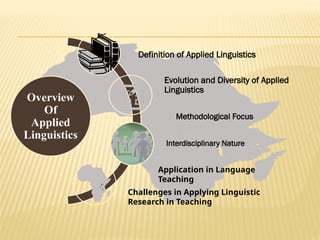
Overview
Of
Applied
Linguistics
Definition of Applied Linguistics
Evolution and Diversity of Applied
Linguistics
Methodological Focus
Interdisciplinary Nature
Application in Language
Teaching
Challenges in Applying Linguistic
Research in Teaching
THE APPLIED LINGUISTICS OF LANGUAGE TEACHING
 Applied Linguistics Impact on Education
 Challenges in Language Learning for Non-Native Speakers
 Historical Influences on Language Teaching Methods
 Cultural, Political, and Ethical Implications in Language
Teaching
 Issues with Native Speaker Model in Language Teaching
 Unsolved Challenges in Language Acquisition and Teaching
 Disconnection Between Applied Linguistics and Language
Teaching
THE RESEARCH OF APPLIED LINGUISTIC ON LANGUAGE TEACHING
 Distinction Between Applied Linguistics and
Second Language Acquisition
 Role of Applied Linguistics in Language Teaching
 Evolution of Applied Linguistics Focus
 Real-World Application in Education
 Practical Strategies for Improvement
 Overall Impact of Applied Linguistics
CONCLUSION
1. Essential Role of Applied Linguistics:
1. Crucial for understanding language-related challenges and their impact on future learning.
2. Originated in the 1950s, with a rich history shaping its complexity.
2. Interest from Educators and Linguists:
1. Significant interest from educators and linguists dedicated to improving communication
among learners.
3. Interdisciplinary Nature:
1. Intersects with various linguistics subfields, connecting theoretical knowledge with practical
language application in education.
4. Enhancement of Understanding:
1. Improves educators' understanding of language and cultural aspects.
2. Strengthens the link between theory and actual language use.
5. Importance in Education:
1. Practical implementation in education reinforces the connection between theory and real-
world language application.
6. Call for Further Research:
1. Suggests the need for additional research within the educational system to deepen the link
between applied linguistics and language instruction.
2. Encourages incorporating insights from different linguistic domains to address ongoing
challenges.
7. Limitations and Need for Continuous Research:
1. Acknowledges limitations in addressing specific language development problems and
societal conflicts.
2. Emphasizes the necessity for ongoing research and experimentation to advance the field.
REFERENCES
 Cook, Guy & Seidlhofer, Barbara. 2009. Principle & Practice in Applied Linguistics. NY: Oxford Univ. Press.
 Cook, Vivian and Li wei. 2009. Contemporary Applied Linguistics (ed. Vol. 1). Great Britain: MPG Books group.
 Fauziati, Endang. 2002. Readings on Applied Linguistics. Surakarta: Muhammadiah Univ. press.
 Research in language teaching. en.citizendium.org/wiki/Applied_linguistics. Retrieved 28/04/2013.
 Byrnes, H.: Notes from the editor. Mod. Lang. J. 97, 825–827 (2013)
 Cook, G. (2003). Applied linguistics.
 Li, W., & Cook, V. (2009). Contemporary applied linguistics: V. 2. London: Continuum.
 Madhu, J. (2019). Integration of Applied Linguistics and Business Communication: A Pilot Study. In: Mateev, M.,
Poutziouris, P. (eds) Creative Business and Social Innovations for a Sustainable Future. Advances in Science, Technology &
Innovation. Springer, Cham. https://doi.org/10.1007/978-3-030-01662- 3_21
 McDonough, S. (2002). Applied Linguistics in Language Education (1st ed.). Routledge.
https://doi.org/10.4324/9781315097169
 Phakiti, A., De Costa, P., Plonsky, L., & Starfield, S. (2018). Applied linguistics research: Current issues, methods, and
trends. In The Palgrave handbook of applied linguistics research methodology (pp. 5-29). Palgrave Macmillan, London.
 Plonsky, L.: Quantitative research methods. In: Loewen, S., Sato, M. (eds.) The Routledge Handbook of Instructed Second
Language Research, pp. 505–521. Routledge, New York (2017)
 Thank You
1. GENERAL BACKGROUND
Applied Linguistics is an interdiciplinary field of
reseach and practice dealing with practical
problems of language and communication that
can be identified, analyzed or solved by
applying available theories, methods or result
of linguistics or by developing new theorical
andmethodological frameworks in linguistics to
work on these problems.
THERE ARE THREE IMPLICATIONS FORM APPLIED LINGUISTICS SOLVE :
 1. the applied linguist is a jack of all trade.
 2. the applied linguist is a go-between,not
enforier,no a master.
 3. sheer description ofany area of language is
not applied linguistics as such but descriptive
linguistic.
2. THE APPLIED LINGUISTICS OF LANGUAGE
TEACHING
 A. If there is no language element.
 B. If the language elements are handled
without any theories of language.
 C. If the research base is neither directly
concerned teaching nor related to it in a
demonstrable way.
3. THIS VOLUME INDIVIDUALS LOOKING TO THE FUTURE
This volume is the intended to show the
importance of the contribution that applied
linguistics can make to language teaching.
APPLIED LINGUISTICS AND LANGUAGE LEARNING /
TEACHING
 Introduction
there is a view, held by some linguistics and
applied linguist that language teaching and
language
 Claims
in spite of the widening range of activities
undertaken by apllied linguistics and in spite
of the general agreement about the reachof
its pevenance claimed in the status of
internasional association of applied linguistic.
 A personal Account
Alice kaplan’s 1993 evocative account of her
own love story with learning is doomed. Kaplan
is blunt about the difficult task of being a
language teacher
 Applied Linguistics and and institutional problems
language problem are the key to understanding
applied linguistics. Many of these problems will
manifest themselves in individual in reactions but
the applied linguistics enterprise engages itself
with such problems only when they are considered
by society to be matters of institutional concern
Proceeding electicaly is legitimate because for the
applied linguist language. They involve there factors:
1. The educational
2. The social
3. The psychological
4. The anthropological
5. The political
6. Religious
7. The bussiness
8. The planning
9. The linguistic
 Optimum Age:
1. Presbyterian ladies’s collage
2. English teaching in Nepal
3. Immersion language teaching
4. factors relevant to the optimum-age problem
5. Doing applied linguistic
 Factors relevant to the ELTS evaluation:
A. Educational factor
B. Social factor
C. Psychological factors
D. Anthropological factors
E. Political factors
F. Regilius factors
G. Economis factors
H. Bussiness factors
i. Policy factors
J. Linguistic and phonetic factors
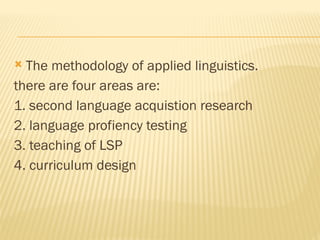
 The methodology of applied linguistics.
there are four areas are:
1. second language acquistion research
2. language profiency testing
3. teaching of LSP
4. curriculum design
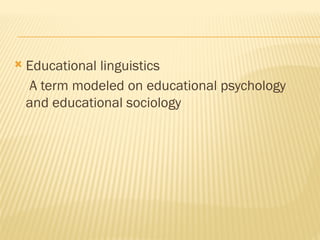
 Educational linguistics
A term modeled on educational psychology
and educational sociology
THANK YOU
 .

Applied_linguistics_and_language_teachin (2).pptx

  • 1.
    SUBJECT REVIEW: APPLIEDLINGUISTICS AND LANGUAGE LEARNING/ TEACHING NURFAIZAH,S.PD MAGISTER OF ENGLISH EDUCATION AND ART UNIVERSITY OF PADANG STATE 2023 EMAIL: NOVASYAHMINAN@GMAIL.COM
  • 2.
    ABSTRACT  This sentencediscusses how fundamental sciences are applied by linguists to address language teaching problems. It highlights three reasons why language learners study a second or foreign language, emphasizing the need for practical application. The paper provides an overview of applied linguistics and its connection to second language education, emphasizing the need for further investigation in the education system. It also mentions how applied linguists help bridge the gap between teachers and researchers to improve language teaching methods based on theoretical insights.
  • 3.
    INTRODUCTION Origins and Foundationsof Applied Linguistics: Evolution of Language Teaching Methods Role of Applied Linguistics in Communication Challenges in Current Applied Linguistics Practices Chomsky's Contributions to Linguistics Achievements of Applied Linguistics Conclusion and Future Outlook
  • 4.
    Overview Of Applied Linguistics Definition of AppliedLinguistics Evolution and Diversity of Applied Linguistics Methodological Focus Interdisciplinary Nature Application in Language Teaching Challenges in Applying Linguistic Research in Teaching
  • 5.
    THE APPLIED LINGUISTICSOF LANGUAGE TEACHING  Applied Linguistics Impact on Education  Challenges in Language Learning for Non-Native Speakers  Historical Influences on Language Teaching Methods  Cultural, Political, and Ethical Implications in Language Teaching  Issues with Native Speaker Model in Language Teaching  Unsolved Challenges in Language Acquisition and Teaching  Disconnection Between Applied Linguistics and Language Teaching
  • 6.
    THE RESEARCH OFAPPLIED LINGUISTIC ON LANGUAGE TEACHING  Distinction Between Applied Linguistics and Second Language Acquisition  Role of Applied Linguistics in Language Teaching  Evolution of Applied Linguistics Focus  Real-World Application in Education  Practical Strategies for Improvement  Overall Impact of Applied Linguistics
  • 7.
    CONCLUSION 1. Essential Roleof Applied Linguistics: 1. Crucial for understanding language-related challenges and their impact on future learning. 2. Originated in the 1950s, with a rich history shaping its complexity. 2. Interest from Educators and Linguists: 1. Significant interest from educators and linguists dedicated to improving communication among learners. 3. Interdisciplinary Nature: 1. Intersects with various linguistics subfields, connecting theoretical knowledge with practical language application in education. 4. Enhancement of Understanding: 1. Improves educators' understanding of language and cultural aspects. 2. Strengthens the link between theory and actual language use. 5. Importance in Education: 1. Practical implementation in education reinforces the connection between theory and real- world language application. 6. Call for Further Research: 1. Suggests the need for additional research within the educational system to deepen the link between applied linguistics and language instruction. 2. Encourages incorporating insights from different linguistic domains to address ongoing challenges. 7. Limitations and Need for Continuous Research: 1. Acknowledges limitations in addressing specific language development problems and societal conflicts. 2. Emphasizes the necessity for ongoing research and experimentation to advance the field.
  • 8.
    REFERENCES  Cook, Guy& Seidlhofer, Barbara. 2009. Principle & Practice in Applied Linguistics. NY: Oxford Univ. Press.  Cook, Vivian and Li wei. 2009. Contemporary Applied Linguistics (ed. Vol. 1). Great Britain: MPG Books group.  Fauziati, Endang. 2002. Readings on Applied Linguistics. Surakarta: Muhammadiah Univ. press.  Research in language teaching. en.citizendium.org/wiki/Applied_linguistics. Retrieved 28/04/2013.  Byrnes, H.: Notes from the editor. Mod. Lang. J. 97, 825–827 (2013)  Cook, G. (2003). Applied linguistics.  Li, W., & Cook, V. (2009). Contemporary applied linguistics: V. 2. London: Continuum.  Madhu, J. (2019). Integration of Applied Linguistics and Business Communication: A Pilot Study. In: Mateev, M., Poutziouris, P. (eds) Creative Business and Social Innovations for a Sustainable Future. Advances in Science, Technology & Innovation. Springer, Cham. https://doi.org/10.1007/978-3-030-01662- 3_21  McDonough, S. (2002). Applied Linguistics in Language Education (1st ed.). Routledge. https://doi.org/10.4324/9781315097169  Phakiti, A., De Costa, P., Plonsky, L., & Starfield, S. (2018). Applied linguistics research: Current issues, methods, and trends. In The Palgrave handbook of applied linguistics research methodology (pp. 5-29). Palgrave Macmillan, London.  Plonsky, L.: Quantitative research methods. In: Loewen, S., Sato, M. (eds.) The Routledge Handbook of Instructed Second Language Research, pp. 505–521. Routledge, New York (2017)
  • 9.
  • 10.
    1. GENERAL BACKGROUND AppliedLinguistics is an interdiciplinary field of reseach and practice dealing with practical problems of language and communication that can be identified, analyzed or solved by applying available theories, methods or result of linguistics or by developing new theorical andmethodological frameworks in linguistics to work on these problems.
  • 11.
    THERE ARE THREEIMPLICATIONS FORM APPLIED LINGUISTICS SOLVE :  1. the applied linguist is a jack of all trade.  2. the applied linguist is a go-between,not enforier,no a master.  3. sheer description ofany area of language is not applied linguistics as such but descriptive linguistic.
  • 12.
    2. THE APPLIEDLINGUISTICS OF LANGUAGE TEACHING  A. If there is no language element.  B. If the language elements are handled without any theories of language.  C. If the research base is neither directly concerned teaching nor related to it in a demonstrable way.
  • 13.
    3. THIS VOLUMEINDIVIDUALS LOOKING TO THE FUTURE This volume is the intended to show the importance of the contribution that applied linguistics can make to language teaching.
  • 14.
    APPLIED LINGUISTICS ANDLANGUAGE LEARNING / TEACHING  Introduction there is a view, held by some linguistics and applied linguist that language teaching and language
  • 15.
     Claims in spiteof the widening range of activities undertaken by apllied linguistics and in spite of the general agreement about the reachof its pevenance claimed in the status of internasional association of applied linguistic.
  • 16.
     A personalAccount Alice kaplan’s 1993 evocative account of her own love story with learning is doomed. Kaplan is blunt about the difficult task of being a language teacher
  • 17.
     Applied Linguisticsand and institutional problems language problem are the key to understanding applied linguistics. Many of these problems will manifest themselves in individual in reactions but the applied linguistics enterprise engages itself with such problems only when they are considered by society to be matters of institutional concern
  • 18.
    Proceeding electicaly islegitimate because for the applied linguist language. They involve there factors: 1. The educational 2. The social 3. The psychological 4. The anthropological 5. The political 6. Religious 7. The bussiness 8. The planning 9. The linguistic
  • 19.
     Optimum Age: 1.Presbyterian ladies’s collage 2. English teaching in Nepal 3. Immersion language teaching 4. factors relevant to the optimum-age problem 5. Doing applied linguistic
  • 20.
     Factors relevantto the ELTS evaluation: A. Educational factor B. Social factor C. Psychological factors D. Anthropological factors E. Political factors F. Regilius factors G. Economis factors H. Bussiness factors i. Policy factors J. Linguistic and phonetic factors
  • 21.
     The methodologyof applied linguistics. there are four areas are: 1. second language acquistion research 2. language profiency testing 3. teaching of LSP 4. curriculum design
  • 22.
     Educational linguistics Aterm modeled on educational psychology and educational sociology
  • 23.