Tadha Vanita P.
Roll No. :- 31 Sem :- 1 Year :2014-15
Enrollment no.:-pg14101029
Paper :- 3 [Literary Theory and Criticism]
I. Introduction
II. Crites view on Ancient dramatist
III. Ctites view on Modern dramatist
IV. Ancient v/s Modern
V. conclusion
Dryden’s essay as a dramatic dialogue with for
character representing four critical position. These
four critical position deal with five issues.
1] Eugenius : Modern over the ancient
2] Crites : Ancient
3] Lisidius : French superior to English
4] Neander : French drama essential for its smallness
The ancient are the acknowledge models of the
moderns.
The ancient had a special genius for drama and in
their particular branch of poetry they could reach
perfection.
Ancients Greek and Roma drama was more
honored than any other branch of knowledge.
The ancient drama is superior because the ancient
closely observed nature and faithfully represented
her/his in their work.
Crites makes special mention of the unities of the
time place and action which he says, “ought-to be
observed in every regular drama”.
 They must have also written well by the use of art
and their beauty of language.
The moderns are imitator of ancient.
The moderns are genius for the study of natural
science as medicine, anatomy, and in these studies
they have more progress.
Modern drama are not suitably rewarded and
honored, they do not take pains and put in their
best efforts.
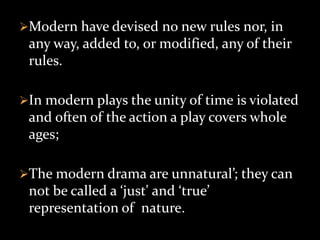
Modern have devised no new rules nor, in
any way, added to, or modified, any of their
rules.
In modern plays the unity of time is violated
and often of the action a play covers whole
ages;
The modern drama are unnatural’; they can
not be called a ‘just' and ‘true’
representation of nature.
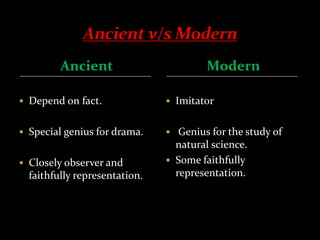
Ancient
 Depend on fact.
 Special genius for drama.
 Closely observer and
faithfully representation.
 Imitator
 Genius for the study of
natural science.
 Some faithfully
representation.
Modern
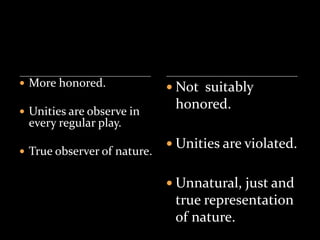
 More honored.
 Unities are observe in
every regular play.
 True observer of nature.
 Not suitably
honored.
 Unities are violated.
 Unnatural, just and
true representation
of nature.
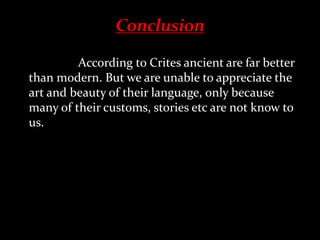
According to Crites ancient are far better
than modern. But we are unable to appreciate the
art and beauty of their language, only because
many of their customs, stories etc are not know to
us.
Thank you...

Crites view on ancient and modern dramatist

  • 1.
    Tadha Vanita P. RollNo. :- 31 Sem :- 1 Year :2014-15 Enrollment no.:-pg14101029 Paper :- 3 [Literary Theory and Criticism]
  • 2.
    I. Introduction II. Critesview on Ancient dramatist III. Ctites view on Modern dramatist IV. Ancient v/s Modern V. conclusion
  • 3.
    Dryden’s essay asa dramatic dialogue with for character representing four critical position. These four critical position deal with five issues. 1] Eugenius : Modern over the ancient 2] Crites : Ancient 3] Lisidius : French superior to English 4] Neander : French drama essential for its smallness
  • 4.
    The ancient arethe acknowledge models of the moderns. The ancient had a special genius for drama and in their particular branch of poetry they could reach perfection. Ancients Greek and Roma drama was more honored than any other branch of knowledge.
  • 5.
    The ancient dramais superior because the ancient closely observed nature and faithfully represented her/his in their work. Crites makes special mention of the unities of the time place and action which he says, “ought-to be observed in every regular drama”.  They must have also written well by the use of art and their beauty of language.
  • 6.
    The moderns areimitator of ancient. The moderns are genius for the study of natural science as medicine, anatomy, and in these studies they have more progress. Modern drama are not suitably rewarded and honored, they do not take pains and put in their best efforts.
  • 7.
    Modern have devisedno new rules nor, in any way, added to, or modified, any of their rules. In modern plays the unity of time is violated and often of the action a play covers whole ages; The modern drama are unnatural’; they can not be called a ‘just' and ‘true’ representation of nature.
  • 8.
    Ancient  Depend onfact.  Special genius for drama.  Closely observer and faithfully representation.  Imitator  Genius for the study of natural science.  Some faithfully representation. Modern
  • 9.
     More honored. Unities are observe in every regular play.  True observer of nature.  Not suitably honored.  Unities are violated.  Unnatural, just and true representation of nature.
  • 10.
    According to Critesancient are far better than modern. But we are unable to appreciate the art and beauty of their language, only because many of their customs, stories etc are not know to us.
  • 11.