 Name :- Rathod Nikita P.
 Roll no :- 32
 Sem :- M.A. Sem-1
 Enrollment no :- 2069108420190038
 Paper no :- 3 ( Literary Theory and Criticism –
Western Poetics-1 )
 Email-id :- nikitarathod0101@gamail.com
 Year :- 2018-2020
 Submitted to :- Smt.S.B.Gardi Department of
English,Maharaja Krishankumarshiji
Bhavangar University.
 Ancient V/s Modern controversy is part of
this essay.
 There is a relationship
Between past and
Present.
 Both are attached with
Together for some
Points.
 Eugenius is in fever of the Modern.
 Crites is in fever of the Ancient.
 Eugenius is charles Sackville.
 And Crites is Sir Robert Howard.
 Swift has treated his debate strically in his
well-known work ‘ The Battle of The Books’.
 In his essay of dramatic poesy.
 Dryden has argued moderately on behalf of
moderns through the mouth of Eugenius.
 Crites develops the main points in defending the
ancients and raises objection to modern play.
 The moderns are still imitating the ancients and
using their forms and subjects, replying on
Aristotle and Horace, adding nothing new and yet
not following their good advice closely either,
especially with respect to the Unities of time,
place and action.
 While the unity of time suggests that all the
action should be portrayed within a single day,
the English plays attempt to use long periods
 In term of place, the setting should be the
same from beginning to end with the scenes
marked by the entrances and exits of the
persons having business within each.
 The English, on the other hand, try to have all
kinds of places, even far off countries shown
within a single play.
 The third unity, that of action, requires that
the play “ aim at one great and complete
action”, but the English have all kinds of sub-
plots which destroy the unity of the action.
Says that we have to remember that we are
probably missing a lot of subtitles because
the languages are dead and the customs are
far removed from this time crites uses Ben
Johnson as the example of the best in English
drama, saying that he followed the Ancients.
“ In all things and offered nothing really new in
terms of “ serious thoughts “.
 In Greece and Rome poetry was more
honored than any other branch of knowledge.
Faithfully represents her in their work.
 The ancients followed the rules and the
effect is satisfying and pleasing.
 The Ancients could organize their plays well
and from this it follows that they must have
also written well.
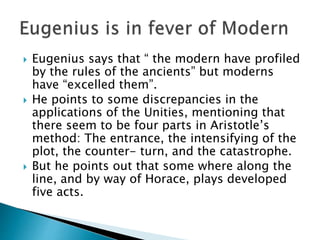
 Eugenius says that “ the modern have profiled
by the rules of the ancients” but moderns
have “excelled them”.
 He points to some discrepancies in the
applications of the Unities, mentioning that
there seem to be four parts in Aristotle’s
method: The entrance, the intensifying of the
plot, the counter- turn, and the catastrophe.
 But he points out that some where along the
line, and by way of Horace, plays developed
five acts.
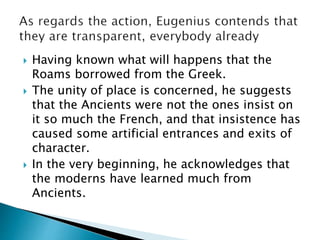
 Having known what will happens that the
Roams borrowed from the Greek.
 The unity of place is concerned, he suggests
that the Ancients were not the ones insist on
it so much the French, and that insistence has
caused some artificial entrances and exits of
character.
 In the very beginning, he acknowledges that
the moderns have learned much from
Ancients.
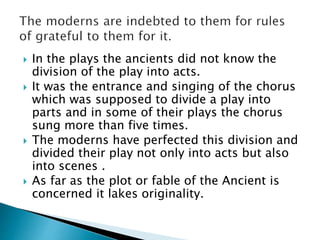
 In the plays the ancients did not know the
division of the play into acts.
 It was the entrance and singing of the chorus
which was supposed to divide a play into
parts and in some of their plays the chorus
sung more than five times.
 The moderns have perfected this division and
divided their play not only into acts but also
into scenes .
 As far as the plot or fable of the Ancient is
concerned it lakes originality.
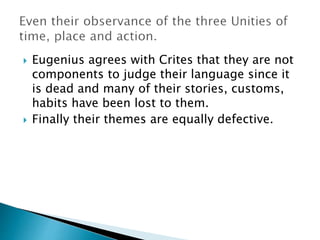
 Eugenius agrees with Crites that they are not
components to judge their language since it
is dead and many of their stories, customs,
habits have been lost to them.
 Finally their themes are equally defective.
 Eugenius wanted to proceed with the
discussion, but crites cut him short. He could
not agree with him in the view that the
moderns were more perfect, but the moderns
were more perfect, but the conceded that
they, the moderns, have altered the mode of
writing.
 Ides and values have changed and this
accounts for much of the difference between
the Ancients and the Moderns.
Ancient V/S Modern controversy

Ancient V/S Modern controversy

  • 1.
     Name :-Rathod Nikita P.  Roll no :- 32  Sem :- M.A. Sem-1  Enrollment no :- 2069108420190038  Paper no :- 3 ( Literary Theory and Criticism – Western Poetics-1 )  Email-id :- nikitarathod0101@gamail.com  Year :- 2018-2020  Submitted to :- Smt.S.B.Gardi Department of English,Maharaja Krishankumarshiji Bhavangar University.
  • 2.
     Ancient V/sModern controversy is part of this essay.  There is a relationship Between past and Present.  Both are attached with Together for some Points.
  • 3.
     Eugenius isin fever of the Modern.  Crites is in fever of the Ancient.  Eugenius is charles Sackville.  And Crites is Sir Robert Howard.  Swift has treated his debate strically in his well-known work ‘ The Battle of The Books’.  In his essay of dramatic poesy.  Dryden has argued moderately on behalf of moderns through the mouth of Eugenius.
  • 5.
     Crites developsthe main points in defending the ancients and raises objection to modern play.  The moderns are still imitating the ancients and using their forms and subjects, replying on Aristotle and Horace, adding nothing new and yet not following their good advice closely either, especially with respect to the Unities of time, place and action.  While the unity of time suggests that all the action should be portrayed within a single day, the English plays attempt to use long periods
  • 6.
     In termof place, the setting should be the same from beginning to end with the scenes marked by the entrances and exits of the persons having business within each.  The English, on the other hand, try to have all kinds of places, even far off countries shown within a single play.  The third unity, that of action, requires that the play “ aim at one great and complete action”, but the English have all kinds of sub- plots which destroy the unity of the action.
  • 7.
    Says that wehave to remember that we are probably missing a lot of subtitles because the languages are dead and the customs are far removed from this time crites uses Ben Johnson as the example of the best in English drama, saying that he followed the Ancients. “ In all things and offered nothing really new in terms of “ serious thoughts “.  In Greece and Rome poetry was more honored than any other branch of knowledge.
  • 8.
    Faithfully represents herin their work.  The ancients followed the rules and the effect is satisfying and pleasing.  The Ancients could organize their plays well and from this it follows that they must have also written well.
  • 9.
     Eugenius saysthat “ the modern have profiled by the rules of the ancients” but moderns have “excelled them”.  He points to some discrepancies in the applications of the Unities, mentioning that there seem to be four parts in Aristotle’s method: The entrance, the intensifying of the plot, the counter- turn, and the catastrophe.  But he points out that some where along the line, and by way of Horace, plays developed five acts.
  • 10.
     Having knownwhat will happens that the Roams borrowed from the Greek.  The unity of place is concerned, he suggests that the Ancients were not the ones insist on it so much the French, and that insistence has caused some artificial entrances and exits of character.  In the very beginning, he acknowledges that the moderns have learned much from Ancients.
  • 11.
     In theplays the ancients did not know the division of the play into acts.  It was the entrance and singing of the chorus which was supposed to divide a play into parts and in some of their plays the chorus sung more than five times.  The moderns have perfected this division and divided their play not only into acts but also into scenes .  As far as the plot or fable of the Ancient is concerned it lakes originality.
  • 12.
     Eugenius agreeswith Crites that they are not components to judge their language since it is dead and many of their stories, customs, habits have been lost to them.  Finally their themes are equally defective.
  • 13.
     Eugenius wantedto proceed with the discussion, but crites cut him short. He could not agree with him in the view that the moderns were more perfect, but the moderns were more perfect, but the conceded that they, the moderns, have altered the mode of writing.  Ides and values have changed and this accounts for much of the difference between the Ancients and the Moderns.