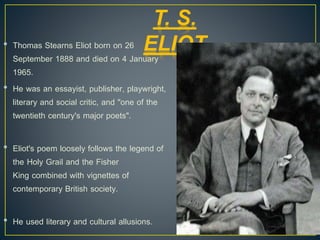

• Thomas Stearns Eliot born on 26
September 1888 and died on 4 January
1965.
• He was an essayist, publisher, playwright,
literary and social critic, and "one of the
twentieth century's major poets".
• Eliot's poem loosely follows the legend of
the Holy Grail and the Fisher
King combined with vignettes of
contemporary British society.
• He used literary and cultural allusions.
T. S.
ELIOT
A traditional story, especially one
concerning the early history of a
people or explaining a natural or
social phenomenon, and typically
involving supernatural beings or
events.
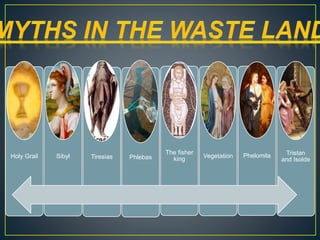
Holy Grail Sibyl Tiresias Phlebas
The fisher
king Vegetation Phelomila Tristan
and Isolde
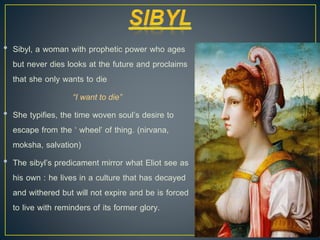
• Sibyl, a woman with prophetic power who ages
but never dies looks at the future and proclaims
that she only wants to die
“I want to die”
• She typifies, the time woven soul’s desire to
escape from the ‘ wheel’ of thing. (nirvana,
moksha, salvation)
• The sibyl’s predicament mirror what Eliot see as
his own : he lives in a culture that has decayed
and withered but will not expire and be is forced
to live with reminders of its former glory.
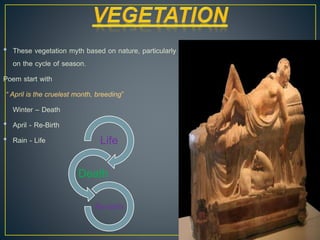
• These vegetation myth based on nature, particularly
on the cycle of season.
Poem start with
“ April is the cruelest month, breeding”
Winter – Death
• April - Re-Birth
• Rain - Life Life
Death
Re-birth
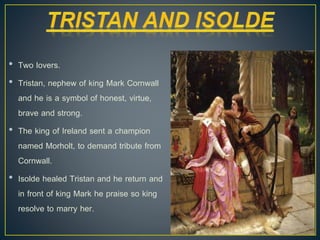
• Two lovers.
• Tristan, nephew of king Mark Cornwall
and he is a symbol of honest, virtue,
brave and strong.
• The king of Ireland sent a champion
named Morholt, to demand tribute from
Cornwall.
• Isolde healed Tristan and he return and
in front of king Mark he praise so king
resolve to marry her.
• The medieval waste land of the fisher king, a
myth which is closely related with the grail
legend. In this waste land soldier of king fisher
ravished the nun of the chapels perilous said to
contain the holy grail and because of that king
became important and his land suffered from
famine.
• The impotency of the fisher king was reflected
sympathetically in the land of which he was the
head and ruler. It has become dry and barren
the haunt and home of want and famine one
day the knight of the pure soul came and solve
riddle.
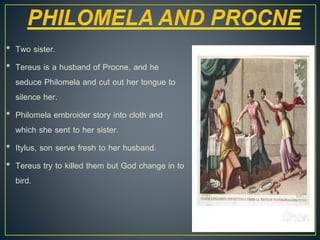
• Two sister.
• Tereus is a husband of Procne, and he
seduce Philomela and cut out her tongue to
silence her.
• Philomela embroider story into cloth and
which she sent to her sister.
• Itylus, son serve fresh to her husband.
• Tereus try to killed them but God change in to
bird.
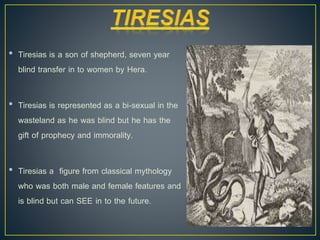
• Tiresias is a son of shepherd, seven year
blind transfer in to women by Hera.
• Tiresias is represented as a bi-sexual in the
wasteland as he was blind but he has the
gift of prophecy and immorality.
• Tiresias a figure from classical mythology
who was both male and female features and
is blind but can SEE in to the future.
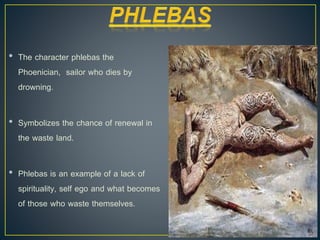
• The character phlebas the
Phoenician, sailor who dies by
drowning.
• Symbolizes the chance of renewal in
the waste land.
• Phlebas is an example of a lack of
spirituality, self ego and what becomes
of those who waste themselves.
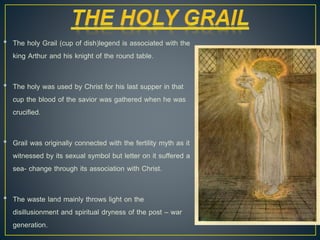
• The holy Grail (cup of dish)legend is associated with the
king Arthur and his knight of the round table.
• The holy was used by Christ for his last supper in that
cup the blood of the savior was gathered when he was
crucified.
• Grail was originally connected with the fertility myth as it
witnessed by its sexual symbol but letter on it suffered a
sea- change through its association with Christ.
• The waste land mainly throws light on the
disillusionment and spiritual dryness of the post – war
generation.
Myth in 'The Waste Land'

Myth in 'The Waste Land'

  • 2.
    • Thomas StearnsEliot born on 26 September 1888 and died on 4 January 1965. • He was an essayist, publisher, playwright, literary and social critic, and "one of the twentieth century's major poets". • Eliot's poem loosely follows the legend of the Holy Grail and the Fisher King combined with vignettes of contemporary British society. • He used literary and cultural allusions. T. S. ELIOT
  • 3.
    A traditional story,especially one concerning the early history of a people or explaining a natural or social phenomenon, and typically involving supernatural beings or events.
  • 4.
    Holy Grail SibylTiresias Phlebas The fisher king Vegetation Phelomila Tristan and Isolde
  • 5.
    • Sibyl, awoman with prophetic power who ages but never dies looks at the future and proclaims that she only wants to die “I want to die” • She typifies, the time woven soul’s desire to escape from the ‘ wheel’ of thing. (nirvana, moksha, salvation) • The sibyl’s predicament mirror what Eliot see as his own : he lives in a culture that has decayed and withered but will not expire and be is forced to live with reminders of its former glory.
  • 6.
    • These vegetationmyth based on nature, particularly on the cycle of season. Poem start with “ April is the cruelest month, breeding” Winter – Death • April - Re-Birth • Rain - Life Life Death Re-birth
  • 7.
    • Two lovers. •Tristan, nephew of king Mark Cornwall and he is a symbol of honest, virtue, brave and strong. • The king of Ireland sent a champion named Morholt, to demand tribute from Cornwall. • Isolde healed Tristan and he return and in front of king Mark he praise so king resolve to marry her.
  • 8.
    • The medievalwaste land of the fisher king, a myth which is closely related with the grail legend. In this waste land soldier of king fisher ravished the nun of the chapels perilous said to contain the holy grail and because of that king became important and his land suffered from famine. • The impotency of the fisher king was reflected sympathetically in the land of which he was the head and ruler. It has become dry and barren the haunt and home of want and famine one day the knight of the pure soul came and solve riddle.
  • 9.
    • Two sister. •Tereus is a husband of Procne, and he seduce Philomela and cut out her tongue to silence her. • Philomela embroider story into cloth and which she sent to her sister. • Itylus, son serve fresh to her husband. • Tereus try to killed them but God change in to bird.
  • 10.
    • Tiresias isa son of shepherd, seven year blind transfer in to women by Hera. • Tiresias is represented as a bi-sexual in the wasteland as he was blind but he has the gift of prophecy and immorality. • Tiresias a figure from classical mythology who was both male and female features and is blind but can SEE in to the future.
  • 11.
    • The characterphlebas the Phoenician, sailor who dies by drowning. • Symbolizes the chance of renewal in the waste land. • Phlebas is an example of a lack of spirituality, self ego and what becomes of those who waste themselves.
  • 12.
    • The holyGrail (cup of dish)legend is associated with the king Arthur and his knight of the round table. • The holy was used by Christ for his last supper in that cup the blood of the savior was gathered when he was crucified. • Grail was originally connected with the fertility myth as it witnessed by its sexual symbol but letter on it suffered a sea- change through its association with Christ. • The waste land mainly throws light on the disillusionment and spiritual dryness of the post – war generation.