

“What are we going to
do today?”
ALL ABOUT LESSON PLANNING
APRIL SALERNO
Session Objectives
Discuss common challenges in lesson
planning (understand)
Learn approach for making students’
roles clear in lesson plans (do)
Learn the meaning of “Backward
Design.” (know)
Introductions
Please tell:
Your name
Your school and the grade levels you
teach
One question you have about lesson
planning that you’d like to discuss
today
Backward Design
How will students be assessed?
What skills do students need in order
to succeed on the assessment?
Make those your objectives!
 Wiggins, G., & McTighe, J. (2005). Understanding by Design. Boston:
Pearson
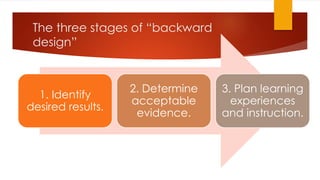
The three stages of “backward
design”
1. Identify
desired results.
2. Determine
acceptable
evidence.
3. Plan learning
experiences
and instruction.
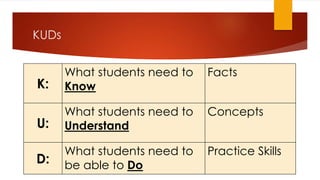
KUDs
K:
What students need to
Know
Facts
U:
What students need to
Understand
Concepts
D:
What students need to
be able to Do
Practice Skills
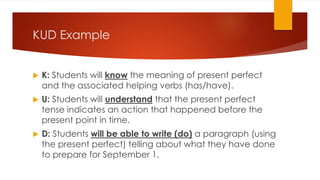
KUD Example
 K: Students will know the meaning of present perfect
and the associated helping verbs (has/have).
 U: Students will understand that the present perfect
tense indicates an action that happened before the
present point in time.
 D: Students will be able to write (do) a paragraph (using
the present perfect) telling about what they have done
to prepare for September 1.
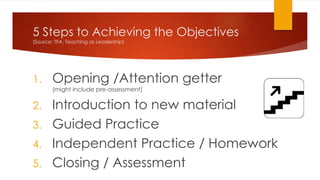
5 Steps to Achieving the Objectives
(Source: TFA, Teaching as Leadership)
1. Opening /Attention getter
(might include pre-assessment)
2. Introduction to new material
3. Guided Practice
4. Independent Practice / Homework
5. Closing / Assessment
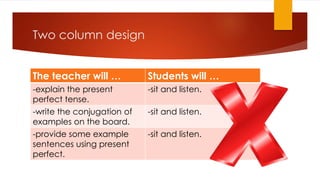
Two column design
The teacher will … Students will …
-explain the present
perfect tense.
-sit and listen.
-write the conjugation of
examples on the board.
-sit and listen.
-provide some example
sentences using present
perfect.
-sit and listen.
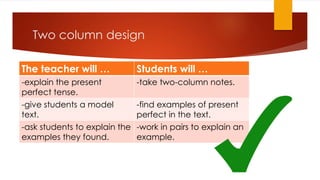
Two column design
The teacher will … Students will …
-explain the present
perfect tense.
-take two-column notes.
-give students a model
text.
-find examples of present
perfect in the text.
-ask students to explain the
examples they found.
-work in pairs to explain an
example.
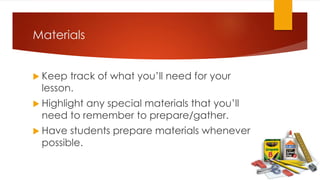
Materials
 Keep track of what you’ll need for your
lesson.
 Highlight any special materials that you’ll
need to remember to prepare/gather.
 Have students prepare materials whenever
possible.
Pacing/Timing
How much time will each step take?
Do you need to split the lesson plan
into different days?
What “sponge activities” can you
have ready in case students work
quickly?
Motor Mouth
(example sponge activity)
1. Students pick any 5-10 vocabulary words
from lessons they’ve studied.
2. They write them on a secret list.
3. In pairs, each takes a turn having 2-5
minutes describing the words to the partner
without saying the word. The partner tries to
guess the word. The pair that gets the most
words wins!
For a class that takes too long
Choice time system:
1. You estimate how long an activity should take and
tell the class.
2. Class earns “choice time” for every minute they
save in doing it.
3. On a special day, they get “choice time” where
they do fun learning activities for however many
minutes they earned.
 from Fred Jones, Tools for Teaching
Reflection
 Did students meet my objectives? What
evidence do I have?
 Even if not, what were the strengths of the
lesson?
 What will I do differently next time I teach
this lesson?
Additional Elements
Differentiation for individual
learners
Technology Use
Long-term, summative
assessment
What will you actually use when you
teach?
 A checklist?
 An agenda on the board?
 A highlighted version of the lesson plan?
 Notes in a notebook?
 What works for you?
Quick Write
 Take a moment to review the handout, your
notes, and/or the presentation slides.
 Write for 3-5 minutes, summarizing what you
have heard in the presentation.
 Identify and share one new (or improved)
thing that you would like to try.
 What questions do you have now?
Extra practice with KUDs
KUD Sort
In small groups, see if you
can sort the objectives into
K’s, U’s, and D’s.
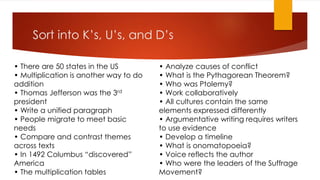
Sort into K’s, U’s, and D’s
• There are 50 states in the US
• Multiplication is another way to do
addition
• Thomas Jefferson was the 3rd
president
• Write a unified paragraph
• People migrate to meet basic
needs
• Compare and contrast themes
across texts
• In 1492 Columbus “discovered”
America
• The multiplication tables
• Analyze causes of conflict
• What is the Pythagorean Theorem?
• Who was Ptolemy?
• Work collaboratively
• All cultures contain the same
elements expressed differently
• Argumentative writing requires writers
to use evidence
• Develop a timeline
• What is onomatopoeia?
• Voice reflects the author
• Who were the leaders of the Suffrage
Movement?
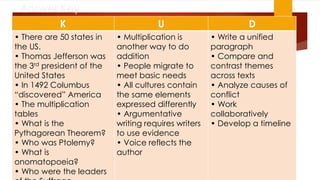
Answer Key
K U D
• There are 50 states in
the US.
• Thomas Jefferson was
the 3rd president of the
United States
• In 1492 Columbus
“discovered” America
• The multiplication
tables
• What is the
Pythagorean Theorem?
• Who was Ptolemy?
• What is
onomatopoeia?
• Who were the leaders
• Multiplication is
another way to do
addition
• People migrate to
meet basic needs
• All cultures contain
the same elements
expressed differently
• Argumentative
writing requires writers
to use evidence
• Voice reflects the
author
• Write a unified
paragraph
• Compare and
contrast themes
across texts
• Analyze causes of
conflict
• Work
collaboratively
• Develop a timeline
Contact information
 April Salerno, Fulbright Scholar, University of
Virginia, USA / Ion Creanga State
Pedagogical University, Moldova
 april.simun.salerno@gmail.com

Lesson Planning Tips

  • 1.
    “What are wegoing to do today?” ALL ABOUT LESSON PLANNING APRIL SALERNO
  • 2.
    Session Objectives Discuss commonchallenges in lesson planning (understand) Learn approach for making students’ roles clear in lesson plans (do) Learn the meaning of “Backward Design.” (know)
  • 3.
    Introductions Please tell: Your name Yourschool and the grade levels you teach One question you have about lesson planning that you’d like to discuss today
  • 4.
    Backward Design How willstudents be assessed? What skills do students need in order to succeed on the assessment? Make those your objectives!  Wiggins, G., & McTighe, J. (2005). Understanding by Design. Boston: Pearson
  • 5.
    The three stagesof “backward design” 1. Identify desired results. 2. Determine acceptable evidence. 3. Plan learning experiences and instruction.
  • 6.
    KUDs K: What students needto Know Facts U: What students need to Understand Concepts D: What students need to be able to Do Practice Skills
  • 7.
    KUD Example  K:Students will know the meaning of present perfect and the associated helping verbs (has/have).  U: Students will understand that the present perfect tense indicates an action that happened before the present point in time.  D: Students will be able to write (do) a paragraph (using the present perfect) telling about what they have done to prepare for September 1.
  • 8.
    5 Steps toAchieving the Objectives (Source: TFA, Teaching as Leadership) 1. Opening /Attention getter (might include pre-assessment) 2. Introduction to new material 3. Guided Practice 4. Independent Practice / Homework 5. Closing / Assessment
  • 9.
    Two column design Theteacher will … Students will … -explain the present perfect tense. -sit and listen. -write the conjugation of examples on the board. -sit and listen. -provide some example sentences using present perfect. -sit and listen.
  • 10.
    Two column design Theteacher will … Students will … -explain the present perfect tense. -take two-column notes. -give students a model text. -find examples of present perfect in the text. -ask students to explain the examples they found. -work in pairs to explain an example.
  • 11.
    Materials  Keep trackof what you’ll need for your lesson.  Highlight any special materials that you’ll need to remember to prepare/gather.  Have students prepare materials whenever possible.
  • 12.
    Pacing/Timing How much timewill each step take? Do you need to split the lesson plan into different days? What “sponge activities” can you have ready in case students work quickly?
  • 13.
    Motor Mouth (example spongeactivity) 1. Students pick any 5-10 vocabulary words from lessons they’ve studied. 2. They write them on a secret list. 3. In pairs, each takes a turn having 2-5 minutes describing the words to the partner without saying the word. The partner tries to guess the word. The pair that gets the most words wins!
  • 14.
    For a classthat takes too long Choice time system: 1. You estimate how long an activity should take and tell the class. 2. Class earns “choice time” for every minute they save in doing it. 3. On a special day, they get “choice time” where they do fun learning activities for however many minutes they earned.  from Fred Jones, Tools for Teaching
  • 15.
    Reflection  Did studentsmeet my objectives? What evidence do I have?  Even if not, what were the strengths of the lesson?  What will I do differently next time I teach this lesson?
  • 16.
    Additional Elements Differentiation forindividual learners Technology Use Long-term, summative assessment
  • 17.
    What will youactually use when you teach?  A checklist?  An agenda on the board?  A highlighted version of the lesson plan?  Notes in a notebook?  What works for you?
  • 18.
    Quick Write  Takea moment to review the handout, your notes, and/or the presentation slides.  Write for 3-5 minutes, summarizing what you have heard in the presentation.  Identify and share one new (or improved) thing that you would like to try.  What questions do you have now?
  • 19.
  • 20.
    KUD Sort In smallgroups, see if you can sort the objectives into K’s, U’s, and D’s.
  • 21.
    Sort into K’s,U’s, and D’s • There are 50 states in the US • Multiplication is another way to do addition • Thomas Jefferson was the 3rd president • Write a unified paragraph • People migrate to meet basic needs • Compare and contrast themes across texts • In 1492 Columbus “discovered” America • The multiplication tables • Analyze causes of conflict • What is the Pythagorean Theorem? • Who was Ptolemy? • Work collaboratively • All cultures contain the same elements expressed differently • Argumentative writing requires writers to use evidence • Develop a timeline • What is onomatopoeia? • Voice reflects the author • Who were the leaders of the Suffrage Movement?
  • 22.
    Answer Key K UD • There are 50 states in the US. • Thomas Jefferson was the 3rd president of the United States • In 1492 Columbus “discovered” America • The multiplication tables • What is the Pythagorean Theorem? • Who was Ptolemy? • What is onomatopoeia? • Who were the leaders • Multiplication is another way to do addition • People migrate to meet basic needs • All cultures contain the same elements expressed differently • Argumentative writing requires writers to use evidence • Voice reflects the author • Write a unified paragraph • Compare and contrast themes across texts • Analyze causes of conflict • Work collaboratively • Develop a timeline
  • 23.
    Contact information  AprilSalerno, Fulbright Scholar, University of Virginia, USA / Ion Creanga State Pedagogical University, Moldova  april.simun.salerno@gmail.com