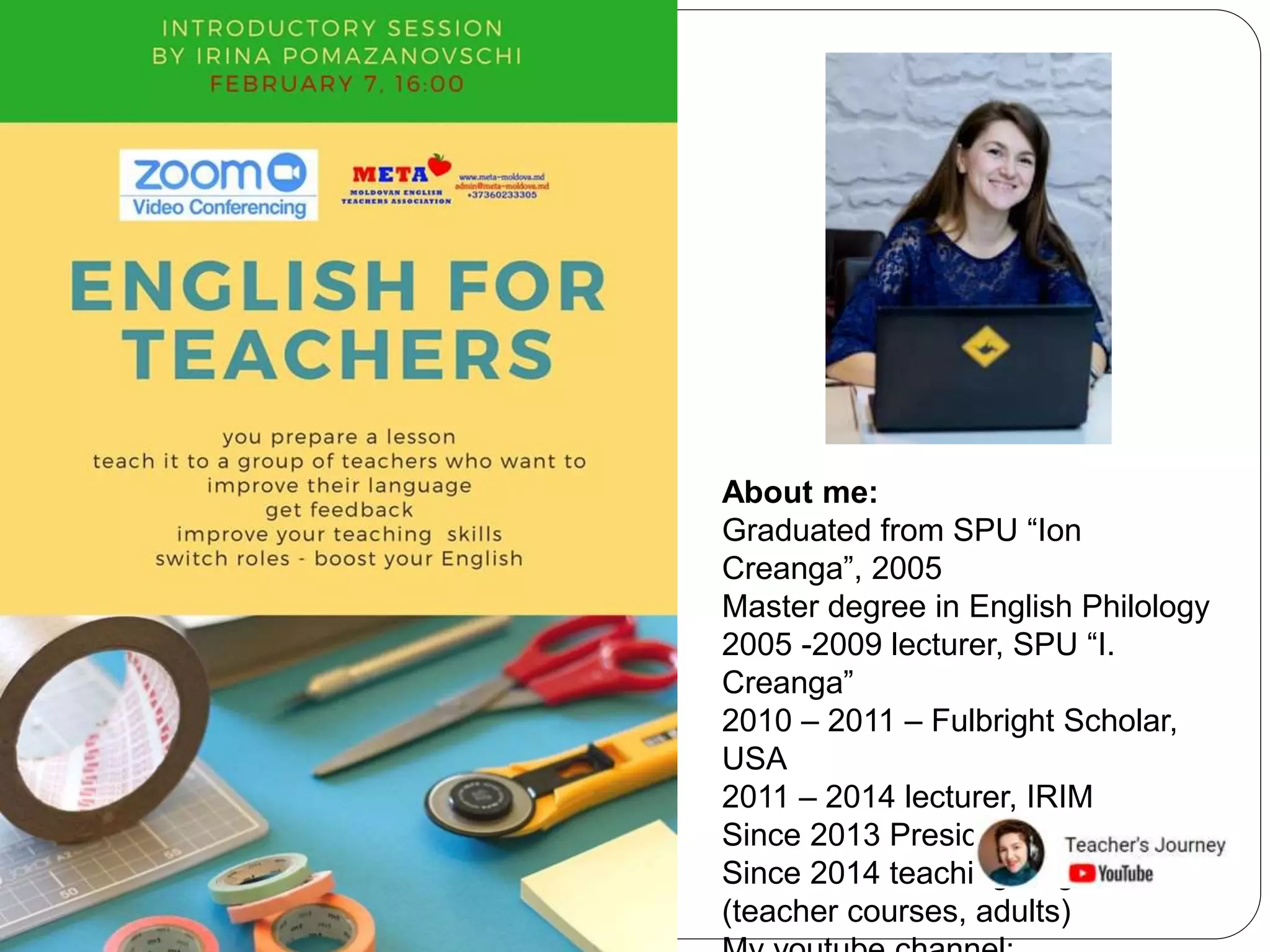
About me:
Graduated from SPU “Ion
Creanga”, 2005
Master degree in English Philology
2005 -2009 lecturer, SPU “I.
Creanga”
2010 – 2011 – Fulbright Scholar,
USA
2011 – 2014 lecturer, IRIM
Since 2013 President of META
Since 2014 teaching English online
(teacher courses, adults)
Agenda of the session
 Rules of conduct and expectations: what is
expected and what do you expect
 Course structure – schedule – next speaker
 Get to know each other
 Mini Demo lesson
 Feedback
Rules of conduct
 Be on time, we are all in the same boat now
 Be active, curious, encouraging and open
 Be kind and tolerant
 Make good mistakes
 Be yourself
 Invest in yourself: hometask required after each
session
Course structure
 You are the teacher – you are the student -
rotation
 Lesson plan – resources/links – share in google
classroom, textbook, Outcomes
 Classroom.google.com  Join class
code: rwzy2iy
 Sessions are recorded – why?
 Feedback form -
https://docs.google.com/forms/d/e/1FAIpQLSd1La7L_POMBIWyBlXmpZXrxrBXo
SBPCDnPV1LIvPSwEdQJdw/viewform
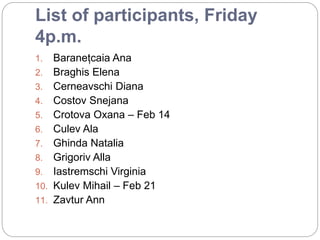
List of participants, Friday
4p.m.
1. Baranețcaia Ana
2. Braghis Elena
3. Cerneavschi Diana
4. Costov Snejana
5. Crotova Oxana – Feb 14
6. Culev Ala
7. Ghinda Natalia
8. Grigoriv Alla
9. Iastremschi Virginia
10. Kulev Mihail – Feb 21
11. Zavtur Ann
Questions?
Confirm your presence in advance - wed
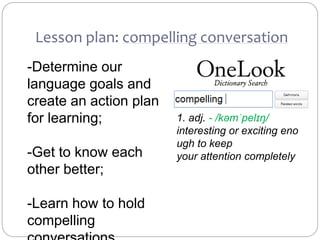
Lesson plan: compelling conversation
1. adj. - /kəmˈpelɪŋ/
interesting or exciting eno
ugh to keep
your attention completely
-Determine our
language goals and
create an action plan
for learning;
-Get to know each
other better;
-Learn how to hold
compelling
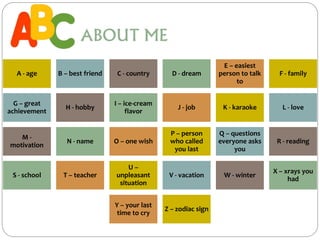
ABOUT ME
A - age B – best friend C - country D - dream
E – easiest
person to talk
to
F - family
G – great
achievement
H - hobby
I – ice-cream
flavor
J - job K - karaoke L - love
M -
motivation
N - name O – one wish
P – person
who called
you last
Q – questions
everyone asks
you
R - reading
S - school T – teacher
U –
unpleasant
situation
V - vacation W - winter
X – xrays you
had
Y – your last
time to cry
Z – zodiac sign
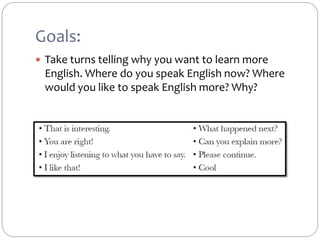
Goals:
 Take turns telling why you want to learn more
English. Where do you speak English now? Where
would you like to speak English more? Why?
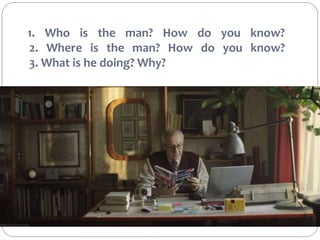
1. Who is the man? How do you know?
2. Where is the man? How do you know?
3. What is he doing? Why?
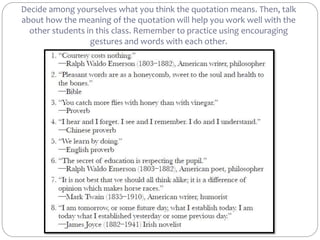
Decide among yourselves what you think the quotation means. Then, talk
about how the meaning of the quotation will help you work well with the
other students in this class. Remember to practice using encouraging
gestures and words with each other.
On your own
 People communicate with words 24 hours a day,
seven days a week. During the next 24 hours,
please carefully observe people talking to each
other .
 Note their communication style, gestures, and
word choices. You can watch people in stores, on
buses, at school and even on TV. Go head, be a
spy!
 Prepare to share three observations in google
classroom.
Feedback
 https://docs.google.com/forms/d/e/1FAIpQLSd
1La7L_POMBIWyBlXmpZXrxrBXoSBPCDnP
V1LIvPSwEdQJdw/viewform

English for teachers - Lesson 1

  • 1.
    About me: Graduated fromSPU “Ion Creanga”, 2005 Master degree in English Philology 2005 -2009 lecturer, SPU “I. Creanga” 2010 – 2011 – Fulbright Scholar, USA 2011 – 2014 lecturer, IRIM Since 2013 President of META Since 2014 teaching English online (teacher courses, adults)
  • 2.
    Agenda of thesession  Rules of conduct and expectations: what is expected and what do you expect  Course structure – schedule – next speaker  Get to know each other  Mini Demo lesson  Feedback
  • 3.
    Rules of conduct Be on time, we are all in the same boat now  Be active, curious, encouraging and open  Be kind and tolerant  Make good mistakes  Be yourself  Invest in yourself: hometask required after each session
  • 4.
    Course structure  Youare the teacher – you are the student - rotation  Lesson plan – resources/links – share in google classroom, textbook, Outcomes  Classroom.google.com  Join class code: rwzy2iy  Sessions are recorded – why?  Feedback form - https://docs.google.com/forms/d/e/1FAIpQLSd1La7L_POMBIWyBlXmpZXrxrBXo SBPCDnPV1LIvPSwEdQJdw/viewform
  • 5.
    List of participants,Friday 4p.m. 1. Baranețcaia Ana 2. Braghis Elena 3. Cerneavschi Diana 4. Costov Snejana 5. Crotova Oxana – Feb 14 6. Culev Ala 7. Ghinda Natalia 8. Grigoriv Alla 9. Iastremschi Virginia 10. Kulev Mihail – Feb 21 11. Zavtur Ann
  • 6.
  • 7.
    Lesson plan: compellingconversation 1. adj. - /kəmˈpelɪŋ/ interesting or exciting eno ugh to keep your attention completely -Determine our language goals and create an action plan for learning; -Get to know each other better; -Learn how to hold compelling
  • 8.
    ABOUT ME A -age B – best friend C - country D - dream E – easiest person to talk to F - family G – great achievement H - hobby I – ice-cream flavor J - job K - karaoke L - love M - motivation N - name O – one wish P – person who called you last Q – questions everyone asks you R - reading S - school T – teacher U – unpleasant situation V - vacation W - winter X – xrays you had Y – your last time to cry Z – zodiac sign
  • 9.
    Goals:  Take turnstelling why you want to learn more English. Where do you speak English now? Where would you like to speak English more? Why?
  • 10.
    1. Who isthe man? How do you know? 2. Where is the man? How do you know? 3. What is he doing? Why?
  • 11.
    Decide among yourselveswhat you think the quotation means. Then, talk about how the meaning of the quotation will help you work well with the other students in this class. Remember to practice using encouraging gestures and words with each other.
  • 12.
    On your own People communicate with words 24 hours a day, seven days a week. During the next 24 hours, please carefully observe people talking to each other .  Note their communication style, gestures, and word choices. You can watch people in stores, on buses, at school and even on TV. Go head, be a spy!  Prepare to share three observations in google classroom.
  • 13.

Editor's Notes

  • #10 In conversation, it is often helpful to show other people that we understand what they are trying to communicate. A smile, a nod of the head, and eye contact are encouraging to others and invite them to continue. Frowning, shaking one’s head no, or looking away while others are speaking will discourage others from trying.
  • #11 https://www.youtube.com/watch?v=tU5Rnd-HM6A&t=51s