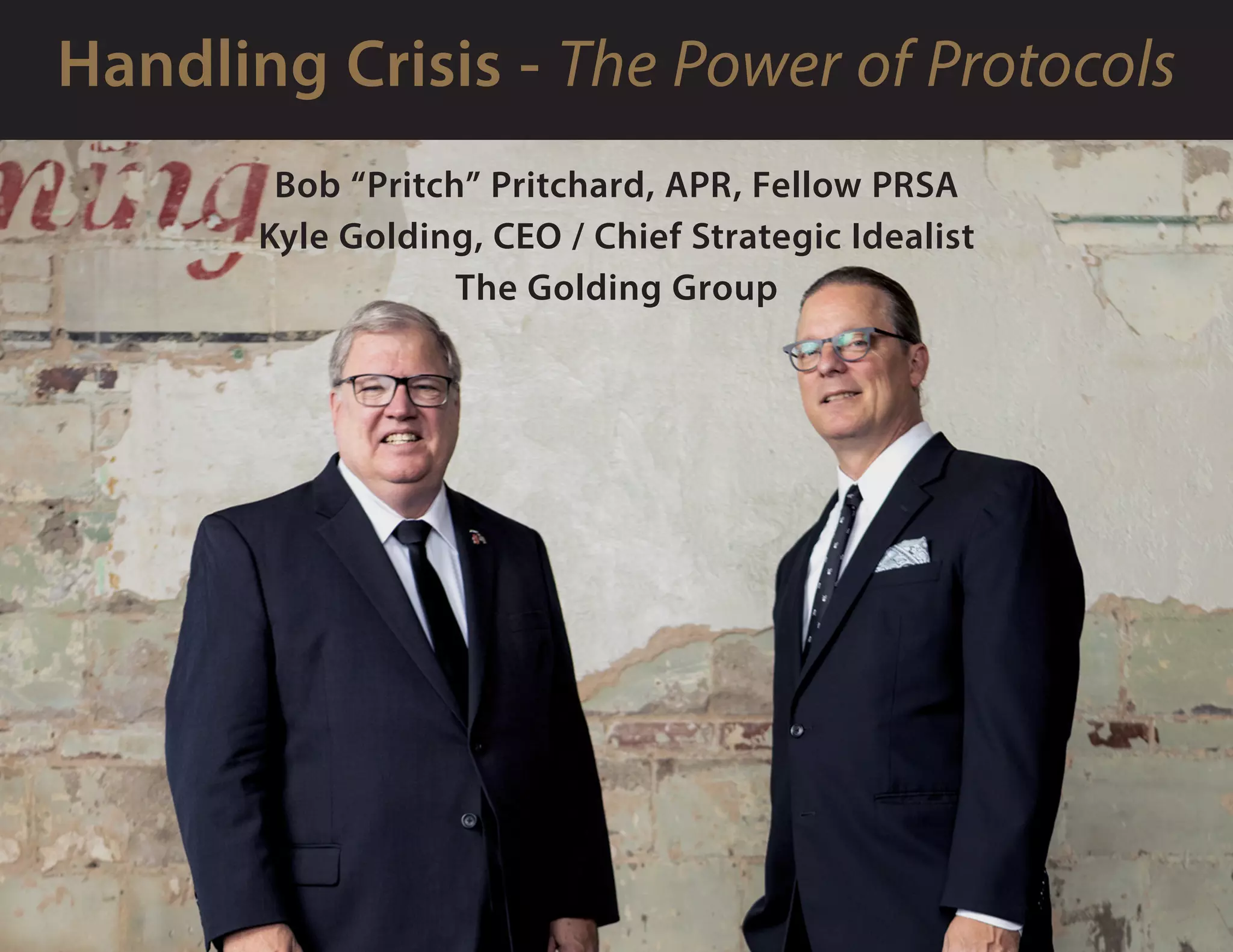
Bob “Pritch” Pritchard, APR, Fellow PRSA
Kyle Golding, CEO / Chief Strategic Idealist
The Golding Group
Basic Definition of a Crisis
Surprise
Threat
Short Response Time
Basic Definition of a Crisis
An organizational crisis is a specific, unexpected and non-
routine event or series of events that create high levels of
uncertainty and simultaneously present an organization with
both opportunities for and threats to its high-priority goals.
Ulmer, Sellnow, Seeger (2019). Effective Crisis Communication: Moving from Crisis to Opportunity
Key Components of a Working Definition
Unexpected
Non-routine
Produces uncertainty
Creates opportunities
Threat to image, reputation or high-priority goals
Differentiating
Risk
Crisis
Disaster
Emergency
Defining the Environment
Two Types of Crisis - Planned and Unplanned
Planned Crisis
Sufficient notice to enable planning
Have some control over timing of release
Can usually rally the right resources
Unplanned Crises
Little or no warning
No control over timing
 “Go with what you have”
Stages of a Crisis
Initial reports (1)
   Lack of reliable information
   High state of confusion
Stages of a Crisis
First reports (2)
   Demands for action
   Search for details/witnesses
Stages of a Crisis
Sustainment (3)
   Second Guessing
   Causes/victims
   Urban myth/conspiracy theories
Stages of a Crisis
Milestones (4)
Investigation/Charges/Indictments
Stages of a Crisis
Anniversary (5)
Basic Truths
The door always blows off at 1600…on Friday*
Bad news, unlike a fine wine, does NOT get better with age
Success is not totally dependent on natural talent
Timing is Everything 
(Responses, that is)
In General – Respond within one hour (if you can)
  Long enough to enable fact gathering
  Short enough to still be relevant
Timing is Everything 
But what about the speed of Social Media?
  Haters always show up first
  Give your supporters time to fight for you
  Ensure you give an official response
Basic Truths (2)
Preparation for even unplanned crises starts well before the
accident/incident
Time spent preparing today…in the calm…pays off
in the heat of the fray
No matter how prepared you are…you will ALWAYS be surprised
Precursors for Success (1)
Know your organization: be credible
Know the news media and the art of communication
Know your boss: Vision, Goals, Priorities
Establish a good network within your organization
Precursors for Success (2)
Stay ahead of the aircraft: Anticipate and plan ahead
Follow-through
Attention to detail
The more people you communicate with the better
Precursors for Success (3)
Give your boss the bad news early
Keep your network humming with helpful information
Take care of your people: Be a leader
Feed your boss, so she can feed her boss
Precursors for Success (4)
Be the “No!” person
Don’t be afraid to say “But, Sir!”
Find the time to train…that includes your Boss
Focus on solving the problem…not the problem itself
The Basics (1)
The door always blows off at 1600…on Friday!*
Go ugly early!
The first report is always wrong …
the worse the report, the more wrong it is!
The Basics (2)
If we don’t tell our side, who will?
Don’t ever “Spin”
Avoid, at all cost, the perception
that you are covering up ANYTHING
The Basics (3)
You can’t “jump-start” a dead press relationship…
pour on the energy early
The Basics (3)
There is no such thing as a timely wrong answer… you will be
remembered for your inaccuracy, not your good intentions
The Basics (4)
Wrong answers move at the speed of light…
corrections move glacially
While you’re worrying about the little things,
don’t forget the big things
We have more to fear from media ignorance than media malice
Some Specific Guidelines (1)
Talk from the viewpoint of the publics interest, not the
organization’s
Speak in personal terms whenever possible
If you do not want some statement quoted, do not make it
State the most important fact at the beginning
Some Specific Guidelines (2)
Do not argue with the reporter or lose your cool
If a question contains offensive language or simply words you do
not like, do not repeat them even to deny them
If the reporter asks a direct question, give an equally direct answer
Some Specific Guidelines (3)
If you don’t know the answer, say so…then say “
…but I’ll find out and get back to you.”
If you can’t answer the question, say so and tell the reporter why
Some Specific Guidelines (3)
Tell the truth, even if it hurts
Do not exaggerate the facts
Misconceptions Associated with Crisis
Communications
Crisis builds character
Misconceptions Associated with Crisis
Communications
Crisis does not have any positive value
Misconceptions Associated with Crisis
Communications
Crisis communication is about assigning blame and responsibility
(on others)
Misconceptions Associated with Crisis
Communications
Crisis communication is solely about getting information to
stakeholders
Misconceptions Associated with Crisis
Communications
Crisis communication involves taking a rigid and defensive stance
Misconceptions Associated with Crisis
Communications
Crisis communication is about enacting elaborate prefabricated
crisis plans
Misconceptions Associated with Crisis
Communications
Crisis communication is about over-reassuring the public about the
impact of the crisis to avoid panic
Misconceptions Associated with Crisis
Communications
Crisis communication is about communicating only when new
information is available
Misconceptions Associated with Crisis
Communications
Crisis communication is primarily about managing the image or
reputation of an organization
Misconceptions Associated with Crisis
Communications
Crisis communication involves spinning the facts surrounding the crisis
Navigating a Crisis Quick and Efficient
Hint: The crisis plan is dead!
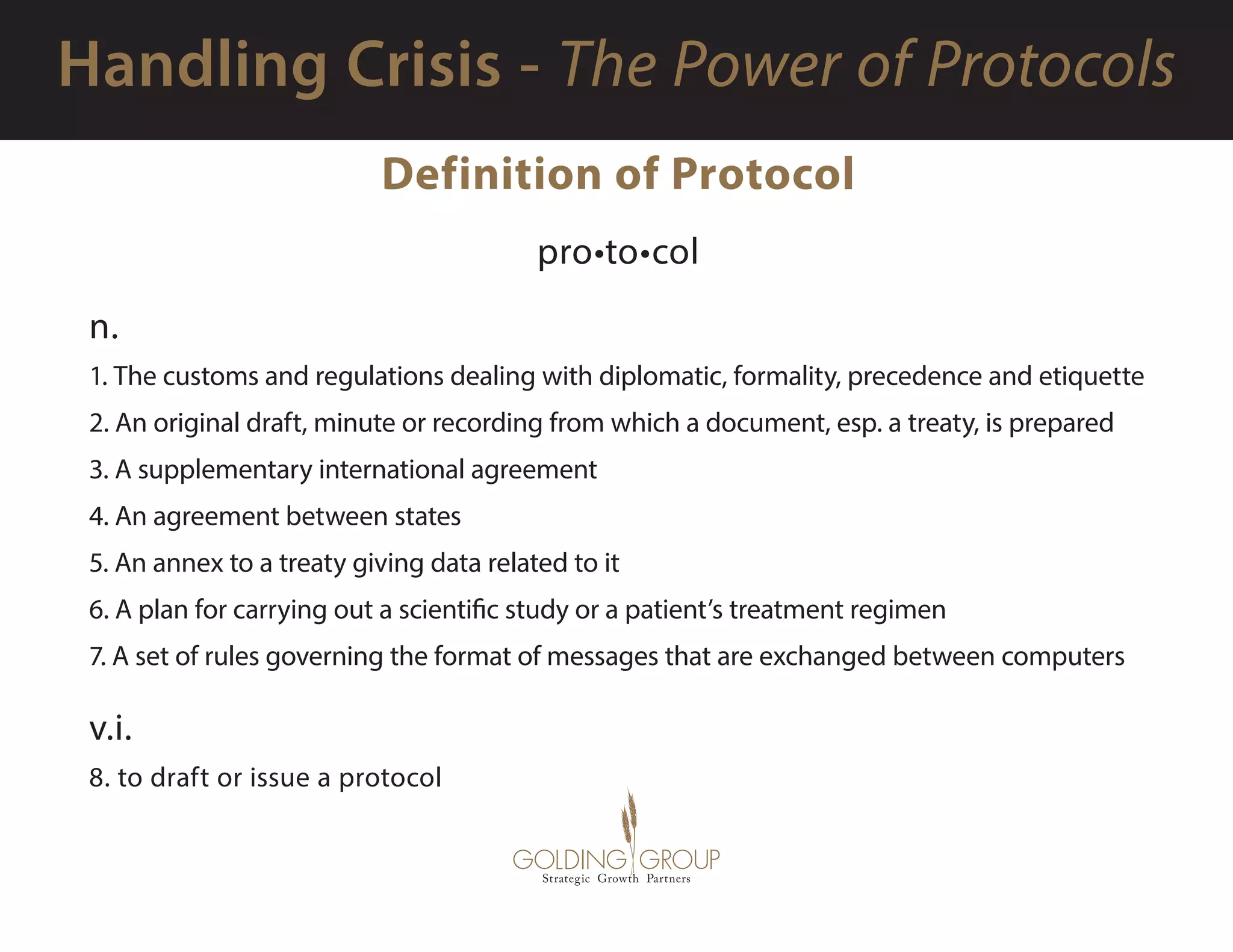
Definition of Protocol
pro•to•col
n.
1. The customs and regulations dealing with diplomatic, formality, precedence and etiquette
2. An original draft, minute or recording from which a document, esp. a treaty, is prepared
3. A supplementary international agreement
4. An agreement between states
5. An annex to a treaty giving data related to it
6. A plan for carrying out a scientific study or a patient’s treatment regimen
7. A set of rules governing the format of messages that are exchanged between computers
v.i.
8. to draft or issue a protocol
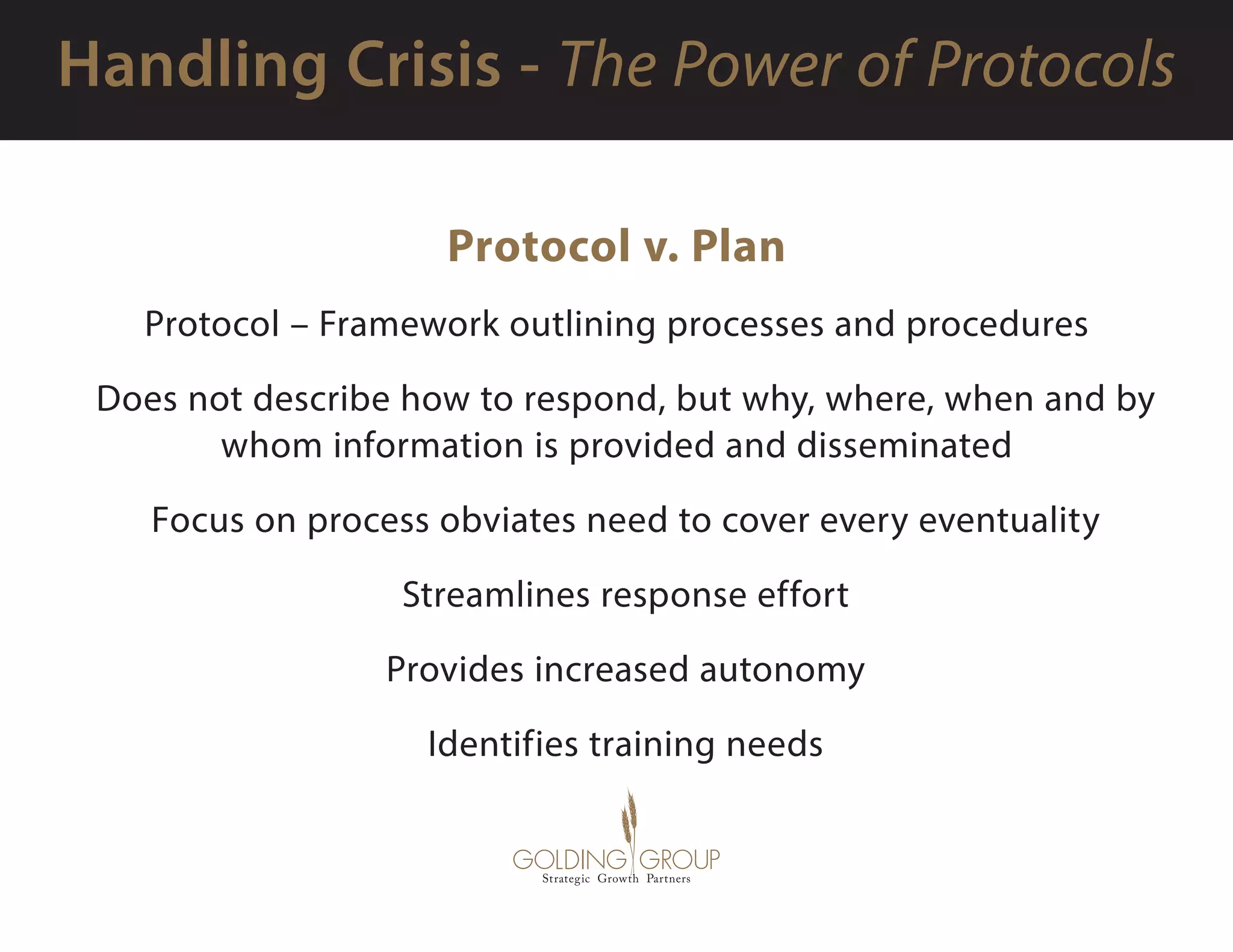
Protocol v. Plan
Protocol – Framework outlining processes and procedures
  Does not describe how to respond, but why, where, when and by
whom information is provided and disseminated
  Focus on process obviates need to cover every eventuality
  Streamlines response effort
  Provides increased autonomy
  Identifies training needs
Protocol v. Plan
Plan: Step-by-step instructions
  Focuses on how to respond
  Doesn’t provide perspective
  Can’t cover all eventualities
  Obsolete as soon as written
Protocol v. Plan
What Constitutes a Good Protocol?
Clearly documented lines of accountability
Clarity
Brevity
Incorporates organizational values
Elements of a Protocol 
Intro
Guiding principles
Crisis Management Team procedures
Establishing a communications command post
Individual unit procedures
Ancillary Elements
Crisis team contact information
Emergency contact resources
Equipment locations (A.E.D., etc.)
Building information
Individual incident and unit checklists
Group Discussion 
(Think, Pair, Share)
What types of incidents can you anticipate?
List 3-4 basic philosophical tenants of your protocol.
What individual units are likely to be involved?
What information should those units provide?
Group Activity
Using the provided template, begin to create
a protocol and content outline for your individual branch.
Group Feedback
Swap your draft protocol with another group
Discuss the other group’s protocol and provide feedback
Have ???s - Contact Us.
The Golding Group
Bob “Pritch” Pritchard, APR, Fellow PRSA
Kyle Golding, CEO / Chief Strategic Idealist
Growth@TheGoldingGroup.com 
This presentation: bit.ly/CrisisCommProtocol

Handling Crisis: The Power of Protocol (2)

  • 1.
    Bob “Pritch” Pritchard,APR, Fellow PRSA Kyle Golding, CEO / Chief Strategic Idealist The Golding Group
  • 2.
    Basic Definition ofa Crisis Surprise Threat Short Response Time
  • 3.
    Basic Definition ofa Crisis An organizational crisis is a specific, unexpected and non- routine event or series of events that create high levels of uncertainty and simultaneously present an organization with both opportunities for and threats to its high-priority goals. Ulmer, Sellnow, Seeger (2019). Effective Crisis Communication: Moving from Crisis to Opportunity
  • 4.
    Key Components ofa Working Definition Unexpected Non-routine Produces uncertainty Creates opportunities Threat to image, reputation or high-priority goals
  • 5.
  • 6.
    Defining the Environment TwoTypes of Crisis - Planned and Unplanned
  • 7.
    Planned Crisis Sufficient noticeto enable planning Have some control over timing of release Can usually rally the right resources
  • 8.
    Unplanned Crises Little orno warning No control over timing  “Go with what you have”
  • 9.
    Stages of aCrisis Initial reports (1)    Lack of reliable information    High state of confusion
  • 10.
    Stages of aCrisis First reports (2)    Demands for action    Search for details/witnesses
  • 11.
    Stages of aCrisis Sustainment (3)    Second Guessing    Causes/victims    Urban myth/conspiracy theories
  • 12.
    Stages of aCrisis Milestones (4) Investigation/Charges/Indictments
  • 13.
    Stages of aCrisis Anniversary (5)
  • 14.
    Basic Truths The dooralways blows off at 1600…on Friday* Bad news, unlike a fine wine, does NOT get better with age Success is not totally dependent on natural talent
  • 15.
    Timing is Everything  (Responses,that is) In General – Respond within one hour (if you can)   Long enough to enable fact gathering   Short enough to still be relevant
  • 16.
    Timing is Everything  Butwhat about the speed of Social Media?   Haters always show up first   Give your supporters time to fight for you   Ensure you give an official response
  • 17.
    Basic Truths (2) Preparationfor even unplanned crises starts well before the accident/incident Time spent preparing today…in the calm…pays off in the heat of the fray No matter how prepared you are…you will ALWAYS be surprised
  • 18.
    Precursors for Success(1) Know your organization: be credible Know the news media and the art of communication Know your boss: Vision, Goals, Priorities Establish a good network within your organization
  • 19.
    Precursors for Success(2) Stay ahead of the aircraft: Anticipate and plan ahead Follow-through Attention to detail The more people you communicate with the better
  • 20.
    Precursors for Success(3) Give your boss the bad news early Keep your network humming with helpful information Take care of your people: Be a leader Feed your boss, so she can feed her boss
  • 21.
    Precursors for Success(4) Be the “No!” person Don’t be afraid to say “But, Sir!” Find the time to train…that includes your Boss Focus on solving the problem…not the problem itself
  • 22.
    The Basics (1) Thedoor always blows off at 1600…on Friday!* Go ugly early! The first report is always wrong … the worse the report, the more wrong it is!
  • 23.
    The Basics (2) Ifwe don’t tell our side, who will? Don’t ever “Spin” Avoid, at all cost, the perception that you are covering up ANYTHING
  • 24.
    The Basics (3) Youcan’t “jump-start” a dead press relationship… pour on the energy early
  • 25.
    The Basics (3) Thereis no such thing as a timely wrong answer… you will be remembered for your inaccuracy, not your good intentions
  • 26.
    The Basics (4) Wronganswers move at the speed of light… corrections move glacially While you’re worrying about the little things, don’t forget the big things We have more to fear from media ignorance than media malice
  • 27.
    Some Specific Guidelines(1) Talk from the viewpoint of the publics interest, not the organization’s Speak in personal terms whenever possible If you do not want some statement quoted, do not make it State the most important fact at the beginning
  • 28.
    Some Specific Guidelines(2) Do not argue with the reporter or lose your cool If a question contains offensive language or simply words you do not like, do not repeat them even to deny them If the reporter asks a direct question, give an equally direct answer
  • 29.
    Some Specific Guidelines(3) If you don’t know the answer, say so…then say “ …but I’ll find out and get back to you.” If you can’t answer the question, say so and tell the reporter why
  • 30.
    Some Specific Guidelines(3) Tell the truth, even if it hurts Do not exaggerate the facts
  • 31.
    Misconceptions Associated withCrisis Communications Crisis builds character
  • 32.
    Misconceptions Associated withCrisis Communications Crisis does not have any positive value
  • 33.
    Misconceptions Associated withCrisis Communications Crisis communication is about assigning blame and responsibility (on others)
  • 34.
    Misconceptions Associated withCrisis Communications Crisis communication is solely about getting information to stakeholders
  • 35.
    Misconceptions Associated withCrisis Communications Crisis communication involves taking a rigid and defensive stance
  • 36.
    Misconceptions Associated withCrisis Communications Crisis communication is about enacting elaborate prefabricated crisis plans
  • 37.
    Misconceptions Associated withCrisis Communications Crisis communication is about over-reassuring the public about the impact of the crisis to avoid panic
  • 38.
    Misconceptions Associated withCrisis Communications Crisis communication is about communicating only when new information is available
  • 39.
    Misconceptions Associated withCrisis Communications Crisis communication is primarily about managing the image or reputation of an organization
  • 40.
    Misconceptions Associated withCrisis Communications Crisis communication involves spinning the facts surrounding the crisis
  • 41.
    Navigating a CrisisQuick and Efficient Hint: The crisis plan is dead!
  • 42.
    Definition of Protocol pro•to•col n. 1.The customs and regulations dealing with diplomatic, formality, precedence and etiquette 2. An original draft, minute or recording from which a document, esp. a treaty, is prepared 3. A supplementary international agreement 4. An agreement between states 5. An annex to a treaty giving data related to it 6. A plan for carrying out a scientific study or a patient’s treatment regimen 7. A set of rules governing the format of messages that are exchanged between computers v.i. 8. to draft or issue a protocol
  • 43.
    Protocol v. Plan Protocol– Framework outlining processes and procedures   Does not describe how to respond, but why, where, when and by whom information is provided and disseminated   Focus on process obviates need to cover every eventuality   Streamlines response effort   Provides increased autonomy   Identifies training needs
  • 44.
    Protocol v. Plan Plan:Step-by-step instructions   Focuses on how to respond   Doesn’t provide perspective   Can’t cover all eventualities   Obsolete as soon as written
  • 45.
    Protocol v. Plan WhatConstitutes a Good Protocol? Clearly documented lines of accountability Clarity Brevity Incorporates organizational values
  • 46.
    Elements of aProtocol  Intro Guiding principles Crisis Management Team procedures Establishing a communications command post Individual unit procedures
  • 47.
    Ancillary Elements Crisis teamcontact information Emergency contact resources Equipment locations (A.E.D., etc.) Building information Individual incident and unit checklists
  • 48.
    Group Discussion  (Think, Pair,Share) What types of incidents can you anticipate? List 3-4 basic philosophical tenants of your protocol. What individual units are likely to be involved? What information should those units provide?
  • 49.
    Group Activity Using theprovided template, begin to create a protocol and content outline for your individual branch.
  • 50.
    Group Feedback Swap yourdraft protocol with another group Discuss the other group’s protocol and provide feedback
  • 51.
    Have ???s -Contact Us. The Golding Group Bob “Pritch” Pritchard, APR, Fellow PRSA Kyle Golding, CEO / Chief Strategic Idealist Growth@TheGoldingGroup.com  This presentation: bit.ly/CrisisCommProtocol