BY: CHELDY SYGACO ELUMBA-PABLEO; MPA,LLB
What are Public Communication
Campaigns ?
Public communications
campaigns impart ideas for a
strategic purpose.
They are an attempt to shape
behavior toward desirable
social outcomes.
BY: CHELDY SYGACO ELUMBA-PABLEO; MPA,LLB
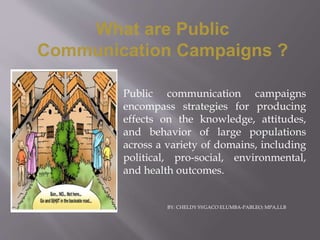
Public communication campaigns
encompass strategies for producing
effects on the knowledge, attitudes,
and behavior of large populations
across a variety of domains, including
political, pro-social, environmental,
and health outcomes.
What are Public
Communication Campaigns ?
BY: CHELDY SYGACO ELUMBA-PABLEO; MPA,LLB
Public communication campaigns can be
broadly defined as purposive attempts to
inform, persuade, or motivate behavior
changes in a relatively well-defined and
large audience, generally for non-
commercial benefits to the individuals
and/or society at large, typically within a
given time period, by means of organized
communication activities involving mass
and online/interactive media, and often
complemented by interpersonal support.
What are Public Communication
Campaigns ?
BY: CHELDY SYGACO ELUMBA-PABLEO; MPA,LLB
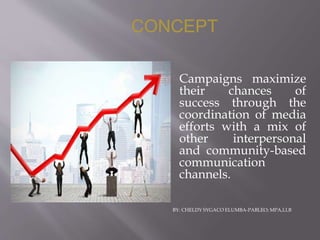
Campaigns maximize
their chances of
success through the
coordination of media
efforts with a mix of
other interpersonal
and community-based
communication
channels.
CONCEPT
BY: CHELDY SYGACO ELUMBA-PABLEO; MPA,LLB
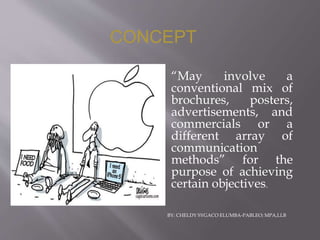
“May involve a
conventional mix of
brochures, posters,
advertisements, and
commercials or a
different array of
communication
methods” for the
purpose of achieving
certain objectives.
CONCEPT
BY: CHELDY SYGACO ELUMBA-PABLEO; MPA,LLB
CONCEPT
Communications
campaigns use a variety of
techniques and strategies in
hopes of improving
individual lives and
making the world a better
place.
BY: CHELDY SYGACO ELUMBA-PABLEO; MPA,LLB
TWO MAIN TYPES OF
CAMPAIGNS:
try to change in individuals
the behaviors that lead to
social problems or promote
behaviors that lead to
improved individual or social
well-being.
BY: CHELDY SYGACO ELUMBA-PABLEO; MPA,LLB
TWO MAIN TYPES OF
CAMPAIGNS:
attempt to mobilize public
action for policy change. A
public will campaign attempts
to legitimize or raise the
importance of a social problem
in the public eye as the
motivation for policy action or
change
EVALUATE EFFECTIVENESS
BY: CHELDY SYGACO ELUMBA-PABLEO; MPA,LLB
KNOWLEDGE VERSUS BEHAVIOR
With some limited
exceptions, people already
know what they should be
doing
Simply telling them what
to do rarely creates change
Behavior is shaped by
factors such as:
available range of choices
social reinforcement and
approval (norms)
rules (laws and policies)
ease/difficulty (benefits and
barriers)
cost (economic and
otherwise)
BY: CHELDY SYGACO ELUMBA-PABLEO; MPA,LLB
COMMUNICATION
CAMPAIGNS THEORIES
a given behavior is
primarily determined by
the intention to perform
that behavior.
Action defines the intention
BY: CHELDY SYGACO ELUMBA-PABLEO; MPA,LLB
COMMUNICATION
CAMPAIGNS THEORIES
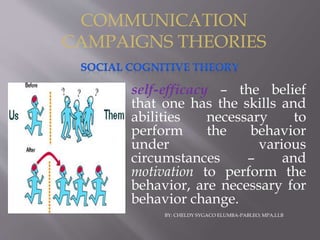
self-efficacy – the belief
that one has the skills and
abilities necessary to
perform the behavior
under various
circumstances – and
motivation to perform the
behavior, are necessary for
behavior change.
BY: CHELDY SYGACO ELUMBA-PABLEO; MPA,LLB
COMMUNICATION CAMPAIGNS
THEORIES
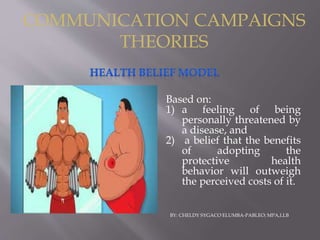
Based on:
1) a feeling of being
personally threatened by
a disease, and
2) a belief that the benefits
of adopting the
protective health
behavior will outweigh
the perceived costs of it.
BY: CHELDY SYGACO ELUMBA-PABLEO; MPA,LLB
This model views
behavior change as a
sequence of actions or
events.
COMMUNICATION CAMPAIGNS
THEORIES
BY: CHELDY SYGACO ELUMBA-PABLEO; MPA,LLB
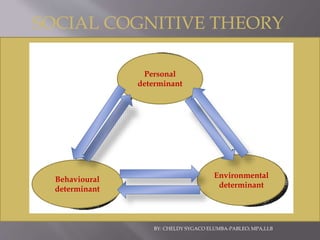
SOCIAL COGNITIVE THEORY
Personal
determinant
Behavioural
determinant
Environmental
determinant
BY: CHELDY SYGACO ELUMBA-PABLEO; MPA,LLB
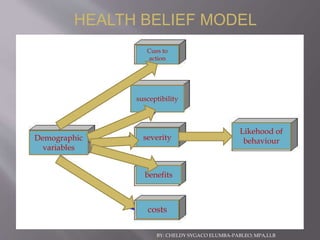
Cues to
action
susceptibility
Likehood of
behaviourseverity
benefits
costs
Demographic
variables
HEALTH BELIEF MODEL
BY: CHELDY SYGACO ELUMBA-PABLEO; MPA,LLB
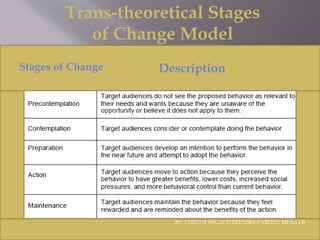
DescriptionStages of Change
Trans-theoretical Stages
of Change Model
BY: CHELDY SYGACO ELUMBA-PABLEO; MPA,LLB
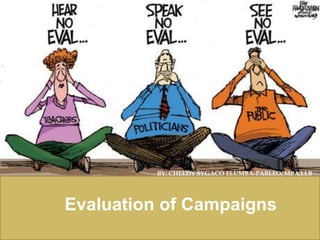
Evaluation of Campaigns
BY: CHELDY SYGACO ELUMBA-PABLEO; MPA,LLB
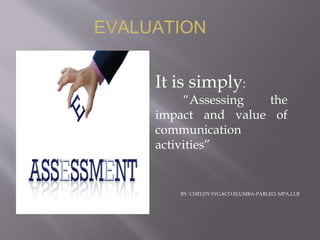
It is simply:
“Assessing the
impact and value of
communication
activities”
EVALUATION
BY: CHELDY SYGACO ELUMBA-PABLEO; MPA,LLB
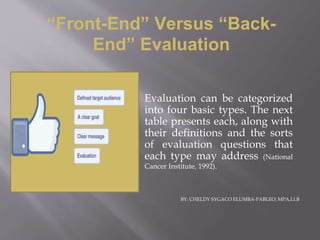
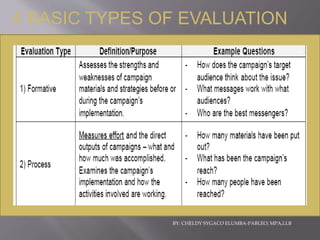
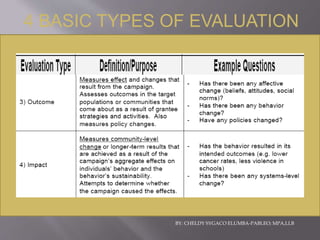
Evaluation can be categorized
into four basic types. The next
table presents each, along with
their definitions and the sorts
of evaluation questions that
each type may address (National
Cancer Institute, 1992).
“Front-End” Versus “Back-
End” Evaluation
BY: CHELDY SYGACO ELUMBA-PABLEO; MPA,LLB
4 BASIC TYPES OF EVALUATION
BY: CHELDY SYGACO ELUMBA-PABLEO; MPA,LLB
4 BASIC TYPES OF EVALUATION
BY: CHELDY SYGACO ELUMBA-PABLEO; MPA,LLB
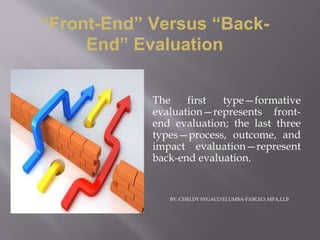
The first type—formative
evaluation—represents front-
end evaluation; the last three
types—process, outcome, and
impact evaluation—represent
back-end evaluation.
“Front-End” Versus “Back-
End” Evaluation
BY: CHELDY SYGACO ELUMBA-PABLEO; MPA,LLB
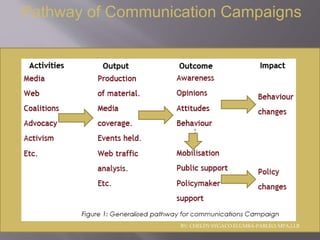
Pathway of Communication Campaigns
BY: CHELDY SYGACO ELUMBA-PABLEO; MPA,LLB
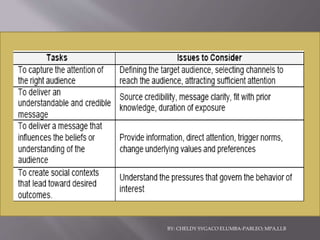
CHARACTERISTICS OF
EFFECTIVE CAMPAIGNS
BY: CHELDY SYGACO ELUMBA-PABLEO; MPA,LLB
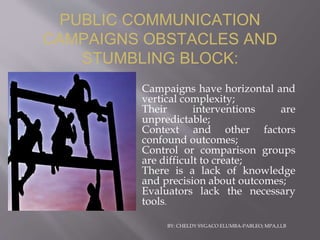
• Campaigns have horizontal and
vertical complexity;
• Their interventions are
unpredictable;
• Context and other factors
confound outcomes;
• Control or comparison groups
are difficult to create;
• There is a lack of knowledge
and precision about outcomes;
• Evaluators lack the necessary
tools.
PUBLIC COMMUNICATION
CAMPAIGNS OBSTACLES AND
STUMBLING BLOCK:
BY: CHELDY SYGACO ELUMBA-PABLEO; MPA,LLB
Ambiguity between goals and actions
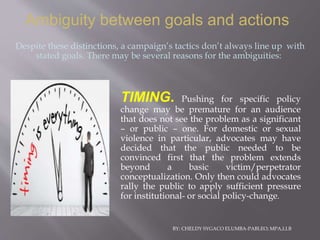
TIMING. Pushing for specific policy
change may be premature for an audience
that does not see the problem as a significant
– or public – one. For domestic or sexual
violence in particular, advocates may have
decided that the public needed to be
convinced first that the problem extends
beyond a basic victim/perpetrator
conceptualization. Only then could advocates
rally the public to apply sufficient pressure
for institutional- or social policy-change.
Despite these distinctions, a campaign’s tactics don’t always line up with
stated goals. There may be several reasons for the ambiguities:
BY: CHELDY SYGACO ELUMBA-PABLEO; MPA,LLB
MIXED GOALS. A
campaign may have both
individual change- and public
policy-oriented goals. Given
the relative scarcity of full-time
public will or policy campaigns,
any public policy component
may be enough to land a
campaign on the policy side of
the continuum
Ambiguity between goals and actions
BY: CHELDY SYGACO ELUMBA-PABLEO; MPA,LLB
Working behind the
scenes. A campaign may
indeed have a policy change
emphasis – it just may not be
public. That is, the public face
of the campaign may stress
individual behavior change
while advocates work behind
the scenes to change policy.
Ambiguity between goals and actions
BY: CHELDY SYGACO ELUMBA-PABLEO; MPA,LLB
UNIVERSAL APPROACH. Lastly, researchers may
tend to characterize a campaign as “public will” simply
because it takes a universal approach to a problem. If the
campaign never makes the leap to institutional or policy
change, it probably shouldn’t be classified as such.
Ambiguity between goals and actions
THANK YOU FOR READING!
CHELDHAYE

Public communication campaign

  • 1.
    BY: CHELDY SYGACOELUMBA-PABLEO; MPA,LLB
  • 2.
    What are PublicCommunication Campaigns ? Public communications campaigns impart ideas for a strategic purpose. They are an attempt to shape behavior toward desirable social outcomes. BY: CHELDY SYGACO ELUMBA-PABLEO; MPA,LLB
  • 3.
    Public communication campaigns encompassstrategies for producing effects on the knowledge, attitudes, and behavior of large populations across a variety of domains, including political, pro-social, environmental, and health outcomes. What are Public Communication Campaigns ? BY: CHELDY SYGACO ELUMBA-PABLEO; MPA,LLB
  • 4.
    Public communication campaignscan be broadly defined as purposive attempts to inform, persuade, or motivate behavior changes in a relatively well-defined and large audience, generally for non- commercial benefits to the individuals and/or society at large, typically within a given time period, by means of organized communication activities involving mass and online/interactive media, and often complemented by interpersonal support. What are Public Communication Campaigns ? BY: CHELDY SYGACO ELUMBA-PABLEO; MPA,LLB
  • 5.
    Campaigns maximize their chancesof success through the coordination of media efforts with a mix of other interpersonal and community-based communication channels. CONCEPT BY: CHELDY SYGACO ELUMBA-PABLEO; MPA,LLB
  • 6.
    “May involve a conventionalmix of brochures, posters, advertisements, and commercials or a different array of communication methods” for the purpose of achieving certain objectives. CONCEPT BY: CHELDY SYGACO ELUMBA-PABLEO; MPA,LLB
  • 7.
    CONCEPT Communications campaigns use avariety of techniques and strategies in hopes of improving individual lives and making the world a better place. BY: CHELDY SYGACO ELUMBA-PABLEO; MPA,LLB
  • 8.
    BY: CHELDY SYGACOELUMBA-PABLEO; MPA,LLB
  • 9.
    TWO MAIN TYPESOF CAMPAIGNS: try to change in individuals the behaviors that lead to social problems or promote behaviors that lead to improved individual or social well-being. BY: CHELDY SYGACO ELUMBA-PABLEO; MPA,LLB
  • 10.
    TWO MAIN TYPESOF CAMPAIGNS: attempt to mobilize public action for policy change. A public will campaign attempts to legitimize or raise the importance of a social problem in the public eye as the motivation for policy action or change EVALUATE EFFECTIVENESS BY: CHELDY SYGACO ELUMBA-PABLEO; MPA,LLB
  • 11.
    KNOWLEDGE VERSUS BEHAVIOR Withsome limited exceptions, people already know what they should be doing Simply telling them what to do rarely creates change Behavior is shaped by factors such as: available range of choices social reinforcement and approval (norms) rules (laws and policies) ease/difficulty (benefits and barriers) cost (economic and otherwise) BY: CHELDY SYGACO ELUMBA-PABLEO; MPA,LLB
  • 12.
    COMMUNICATION CAMPAIGNS THEORIES a givenbehavior is primarily determined by the intention to perform that behavior. Action defines the intention BY: CHELDY SYGACO ELUMBA-PABLEO; MPA,LLB
  • 13.
    COMMUNICATION CAMPAIGNS THEORIES self-efficacy –the belief that one has the skills and abilities necessary to perform the behavior under various circumstances – and motivation to perform the behavior, are necessary for behavior change. BY: CHELDY SYGACO ELUMBA-PABLEO; MPA,LLB
  • 14.
    COMMUNICATION CAMPAIGNS THEORIES Based on: 1)a feeling of being personally threatened by a disease, and 2) a belief that the benefits of adopting the protective health behavior will outweigh the perceived costs of it. BY: CHELDY SYGACO ELUMBA-PABLEO; MPA,LLB
  • 15.
    This model views behaviorchange as a sequence of actions or events. COMMUNICATION CAMPAIGNS THEORIES BY: CHELDY SYGACO ELUMBA-PABLEO; MPA,LLB
  • 16.
  • 17.
  • 18.
    DescriptionStages of Change Trans-theoreticalStages of Change Model BY: CHELDY SYGACO ELUMBA-PABLEO; MPA,LLB
  • 19.
    Evaluation of Campaigns BY:CHELDY SYGACO ELUMBA-PABLEO; MPA,LLB
  • 20.
    BY: CHELDY SYGACOELUMBA-PABLEO; MPA,LLB It is simply: “Assessing the impact and value of communication activities” EVALUATION
  • 21.
    BY: CHELDY SYGACOELUMBA-PABLEO; MPA,LLB Evaluation can be categorized into four basic types. The next table presents each, along with their definitions and the sorts of evaluation questions that each type may address (National Cancer Institute, 1992). “Front-End” Versus “Back- End” Evaluation
  • 22.
    BY: CHELDY SYGACOELUMBA-PABLEO; MPA,LLB 4 BASIC TYPES OF EVALUATION
  • 23.
    BY: CHELDY SYGACOELUMBA-PABLEO; MPA,LLB 4 BASIC TYPES OF EVALUATION
  • 24.
    BY: CHELDY SYGACOELUMBA-PABLEO; MPA,LLB The first type—formative evaluation—represents front- end evaluation; the last three types—process, outcome, and impact evaluation—represent back-end evaluation. “Front-End” Versus “Back- End” Evaluation
  • 25.
    BY: CHELDY SYGACOELUMBA-PABLEO; MPA,LLB Pathway of Communication Campaigns BY: CHELDY SYGACO ELUMBA-PABLEO; MPA,LLB
  • 26.
    CHARACTERISTICS OF EFFECTIVE CAMPAIGNS BY:CHELDY SYGACO ELUMBA-PABLEO; MPA,LLB
  • 27.
    BY: CHELDY SYGACOELUMBA-PABLEO; MPA,LLB
  • 28.
    BY: CHELDY SYGACOELUMBA-PABLEO; MPA,LLB • Campaigns have horizontal and vertical complexity; • Their interventions are unpredictable; • Context and other factors confound outcomes; • Control or comparison groups are difficult to create; • There is a lack of knowledge and precision about outcomes; • Evaluators lack the necessary tools. PUBLIC COMMUNICATION CAMPAIGNS OBSTACLES AND STUMBLING BLOCK:
  • 29.
    BY: CHELDY SYGACOELUMBA-PABLEO; MPA,LLB Ambiguity between goals and actions TIMING. Pushing for specific policy change may be premature for an audience that does not see the problem as a significant – or public – one. For domestic or sexual violence in particular, advocates may have decided that the public needed to be convinced first that the problem extends beyond a basic victim/perpetrator conceptualization. Only then could advocates rally the public to apply sufficient pressure for institutional- or social policy-change. Despite these distinctions, a campaign’s tactics don’t always line up with stated goals. There may be several reasons for the ambiguities:
  • 30.
    BY: CHELDY SYGACOELUMBA-PABLEO; MPA,LLB MIXED GOALS. A campaign may have both individual change- and public policy-oriented goals. Given the relative scarcity of full-time public will or policy campaigns, any public policy component may be enough to land a campaign on the policy side of the continuum Ambiguity between goals and actions
  • 31.
    BY: CHELDY SYGACOELUMBA-PABLEO; MPA,LLB Working behind the scenes. A campaign may indeed have a policy change emphasis – it just may not be public. That is, the public face of the campaign may stress individual behavior change while advocates work behind the scenes to change policy. Ambiguity between goals and actions
  • 32.
    BY: CHELDY SYGACOELUMBA-PABLEO; MPA,LLB UNIVERSAL APPROACH. Lastly, researchers may tend to characterize a campaign as “public will” simply because it takes a universal approach to a problem. If the campaign never makes the leap to institutional or policy change, it probably shouldn’t be classified as such. Ambiguity between goals and actions
  • 33.
    THANK YOU FORREADING! CHELDHAYE