Jacqueline Lambiase, Ph.D.Texas Christian UniversityFor May 2011 DFW NonprofitCommunicators conferenceCrisis Communication:A crash course that leadsto developing a crisis plan
Crisis Management(Yes, this term may sound like an oxymoron …)Determine your audience’s awareness of the problem:For media relations, find out what or who is the journalist’s source. This will help with your own research and response.For community relations, this means rumors, secondhand information, and news media. This will help you craft your messages.For employee relations, employees need a clear version of the company’s side, from management (works for fans/opinion leaders).
Put the public first …Develop a realistic (and reassuring) message, based on audience’s concernsKeep informationbrief, but use enough detail to resolve basic questionsRefrain from commenting on your oppositionTell your side of the story simply, honestlySpeak directly to volunteers, clients, employees, opinion leaders, news media, social media
Other things to do:Identify constituencies (maybe just media; maybe just opinion leaders)Establish credibility with fast honestyFollow up with messages of reassuranceRelease bad news yourselfEvaluate when things are quietGet approvals ahead of time for some “boilerplate” messaging, information bulletins, safety warnings, and apologies
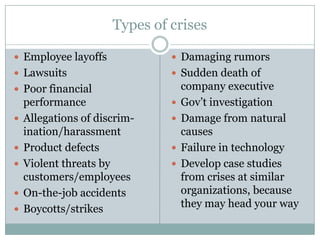
Types of crisesEmployee layoffsLawsuitsPoor financial performanceAllegations of discrim-ination/harassment Product defectsViolent threats by customers/employeesOn-the-job accidentsBoycotts/strikesDamaging rumorsSudden death of company executiveGov’t investigationDamage from natural causesFailure in technologyDevelop case studies from crises at similar organizations, because they may head your way
True (a) or False (b)Many organizations remain unprepared for crises and their consequences, based on surveys of executives.Answer: True (CIRI/FH survey, reported in O’Dwyer’s, May 2011)
True (a) or False (b)A crisis is a commonplace occurrence and fairly predictable.Answer: False; it’s important to distinguish between a problem (commonplace and predictable) and a crisis, so that you don’t turn a problem into a crisis.
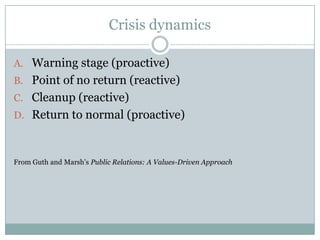
Crisis dynamicsWarning stage (proactive)Point of no return (reactive)Cleanup (reactive)Return to normal (proactive)From Guth and Marsh’s Public Relations: A Values-Driven Approach
Don’t speculate and other top tips:Don’t speculate!Find a fact-based pathway of releasing some information immediately, followed by updates, based again on facts as they become availableTalk to important people personally, when you are able (old-fashioned phone tree works)Use social media to push people to your official messages, if situation is seriousBecome attuned to pre-crisis information, and use your imagination
Crisis management team includes:Crisis manager (that’s you and/or executive director)Board members may provide: PR counsel, legal counsel, financial counsel, technical expertise as neededCommunications and media monitoringReceptionist and security, if neededRumor control/researchAdministrative supportMake sure team includes manager/director/   executive who can approve messaging
Putting together a crisis comm planMake a list of all potential communicatorswho will be on your team, with phone numbers (and alternative phone numbers) and email addresses.  You could have a surprise “drill” with these communicators, bringing them in to deal with a faux crisis and to develop the plan more fully, after that exercise. Develop a list of the five most likely and most devastating crises.Craft an initial statement for each of these crises that would be suitable as a first statement, and then for each, develop a list of other information that would be needed after that initial statement.
Putting together the planPlan for this group of communicators to meet twice a year, to update the contact listings, to review the five most likely and most devastating crises that spring from your imagination, and at each meeting, start adding to this list, until you have a top 10 list, or a top 20 list.Scan the environment for crises that are happening in your community or in similar organizations to your own.Collect information, and on a monthly or bi-monthly basis, write up a short “lessons learned” from these case studies to share with the team.
Apologies and crisis comm messagingStep away from defense mode, gather information, and first offer basic information before apologies.It’s OK to be a brand defender, but be ready to apologize if necessary. Effective apologies: are delivered from the heart, put the public first, accept responsibility, and use words of regret.Don’t speculate when deciding on whether to apologize. You may quickly realize that your organization owes the public an apology, but wait until all the facts are in so that you can do it well.If someone dies at your event or on your premises, you should always quickly offer regret that someone has lost his or her life, regardless of responsibility. This can be done immediately, before facts are in.**See “Expanding the Philosophical Base for Ethical PR Practice” in the Western Journal of Communication (July-September 2010; pp. 436-455) by Fuse, Land, & Lambiase, for discussion of what happens when an organization doesn’t offer condolences or apologies, but takes the ultimate defensive position supposedly to contain liability at the San Francisco Zoo. Needless to say, liability was not contained and the zoo also lost in the court of public opinion, resulting in low attendance.

Crisiscomm for nonprofits

  • 1.
    Jacqueline Lambiase, Ph.D.TexasChristian UniversityFor May 2011 DFW NonprofitCommunicators conferenceCrisis Communication:A crash course that leadsto developing a crisis plan
  • 2.
    Crisis Management(Yes, thisterm may sound like an oxymoron …)Determine your audience’s awareness of the problem:For media relations, find out what or who is the journalist’s source. This will help with your own research and response.For community relations, this means rumors, secondhand information, and news media. This will help you craft your messages.For employee relations, employees need a clear version of the company’s side, from management (works for fans/opinion leaders).
  • 3.
    Put the publicfirst …Develop a realistic (and reassuring) message, based on audience’s concernsKeep informationbrief, but use enough detail to resolve basic questionsRefrain from commenting on your oppositionTell your side of the story simply, honestlySpeak directly to volunteers, clients, employees, opinion leaders, news media, social media
  • 4.
    Other things todo:Identify constituencies (maybe just media; maybe just opinion leaders)Establish credibility with fast honestyFollow up with messages of reassuranceRelease bad news yourselfEvaluate when things are quietGet approvals ahead of time for some “boilerplate” messaging, information bulletins, safety warnings, and apologies
  • 5.
    Types of crisesEmployeelayoffsLawsuitsPoor financial performanceAllegations of discrim-ination/harassment Product defectsViolent threats by customers/employeesOn-the-job accidentsBoycotts/strikesDamaging rumorsSudden death of company executiveGov’t investigationDamage from natural causesFailure in technologyDevelop case studies from crises at similar organizations, because they may head your way
  • 6.
    True (a) orFalse (b)Many organizations remain unprepared for crises and their consequences, based on surveys of executives.Answer: True (CIRI/FH survey, reported in O’Dwyer’s, May 2011)
  • 7.
    True (a) orFalse (b)A crisis is a commonplace occurrence and fairly predictable.Answer: False; it’s important to distinguish between a problem (commonplace and predictable) and a crisis, so that you don’t turn a problem into a crisis.
  • 8.
    Crisis dynamicsWarning stage(proactive)Point of no return (reactive)Cleanup (reactive)Return to normal (proactive)From Guth and Marsh’s Public Relations: A Values-Driven Approach
  • 9.
    Don’t speculate andother top tips:Don’t speculate!Find a fact-based pathway of releasing some information immediately, followed by updates, based again on facts as they become availableTalk to important people personally, when you are able (old-fashioned phone tree works)Use social media to push people to your official messages, if situation is seriousBecome attuned to pre-crisis information, and use your imagination
  • 10.
    Crisis management teamincludes:Crisis manager (that’s you and/or executive director)Board members may provide: PR counsel, legal counsel, financial counsel, technical expertise as neededCommunications and media monitoringReceptionist and security, if neededRumor control/researchAdministrative supportMake sure team includes manager/director/ executive who can approve messaging
  • 11.
    Putting together acrisis comm planMake a list of all potential communicatorswho will be on your team, with phone numbers (and alternative phone numbers) and email addresses. You could have a surprise “drill” with these communicators, bringing them in to deal with a faux crisis and to develop the plan more fully, after that exercise. Develop a list of the five most likely and most devastating crises.Craft an initial statement for each of these crises that would be suitable as a first statement, and then for each, develop a list of other information that would be needed after that initial statement.
  • 12.
    Putting together theplanPlan for this group of communicators to meet twice a year, to update the contact listings, to review the five most likely and most devastating crises that spring from your imagination, and at each meeting, start adding to this list, until you have a top 10 list, or a top 20 list.Scan the environment for crises that are happening in your community or in similar organizations to your own.Collect information, and on a monthly or bi-monthly basis, write up a short “lessons learned” from these case studies to share with the team.
  • 13.
    Apologies and crisiscomm messagingStep away from defense mode, gather information, and first offer basic information before apologies.It’s OK to be a brand defender, but be ready to apologize if necessary. Effective apologies: are delivered from the heart, put the public first, accept responsibility, and use words of regret.Don’t speculate when deciding on whether to apologize. You may quickly realize that your organization owes the public an apology, but wait until all the facts are in so that you can do it well.If someone dies at your event or on your premises, you should always quickly offer regret that someone has lost his or her life, regardless of responsibility. This can be done immediately, before facts are in.**See “Expanding the Philosophical Base for Ethical PR Practice” in the Western Journal of Communication (July-September 2010; pp. 436-455) by Fuse, Land, & Lambiase, for discussion of what happens when an organization doesn’t offer condolences or apologies, but takes the ultimate defensive position supposedly to contain liability at the San Francisco Zoo. Needless to say, liability was not contained and the zoo also lost in the court of public opinion, resulting in low attendance.