Revision of the main issues
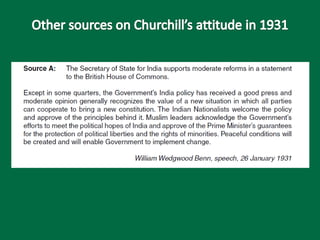
• “India is a geographical term. It is no more a united nation
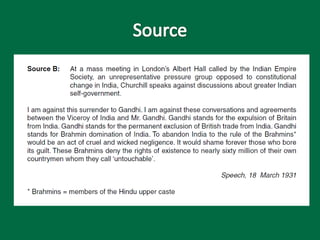
than the equator”. Speech at Royal Albert Hall, London (18
March 1931)
• “It is alarming and also nauseating to see Mr. Gandhi, a
seditious Middle Temple lawyer of the type well-known in
the East, now posing as a fakir, striding half naked up the
steps of the Viceregal palace to parley on equal terms with
the representative of the King-Emperor”. Comment on
Gandhi's meeting with the Viceroy of India, addressing the
Council of the West Essex Unionist Association (23 February
1931); as quoted in "Mr Churchill on India" in The Times (24
February 1931)
• In an entry for September 1942 in Leo Amery :
Diaries (1988), edited John Barnes and David
Nicholson, p. 832: ‘During my talk with
Winston he burst out with: "I hate Indians.
They are a beastly people with a beastly
religion.“’
• Indian independence movement was led by
Gandhi (leader of the Indian Congress Party) and
his programme of ‘civil disobedience’. Actions had
Gandhi’s ‘March to the Sea’ (leading thousands in
protest at a tax on salt) and hunger strikes.
• Churchill had opposed the Round Table
Conference (1931) on the issue of whether or not
India should be given Dominion status. Churchill
particularly objected to the fact that Gandhi
should be present.
• It didn’t help Churchill’s relationship with Baldwin that
Churchill’s meeting at which he said these things came
at the time of a Conservative by-election in
Westminster.
• By being at this meeting, Churchill was flouting party
policy and encouraging others to do the same.
• This was very unwise of Churchill: especially as
Churchill was disassociating himself from all three
political parties by doing so: as the Conservatives,
Labour and the Liberals had come together to try to
iron out India.
• Churchill was taking on the entire political
establishment.
• Lobbying organisation against concessions to
the Indians on the subject of the Empire.
• Highly unrepresentative of British opinion.
• 1933: Government white paper proposed an elected
federal government for India.
• India Defence League, founded by Churchill and
supported by 57 Conservative MPs and the Daily Mail
and the Morning Post.
• Little popular enthusiasm: despite Churchill trying to
persuade the Lancashire public that more Indian
independence would lead to India imposing
restrictions on Lancashire cotton imports.
• 1935: Randolph Churchill (son of Churchill) stood as an
independent Conservative on the India platform in a
by-election, but he split the Conservative vote and the
Labour candidate was elected. Despite Churchill’s
opposition to his son’s standing, he still lost popularity
further.
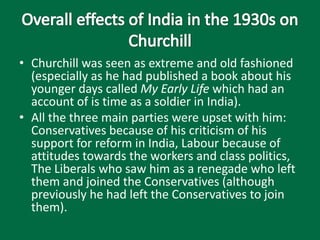
• Churchill was seen as extreme and old fashioned
(especially as he had published a book about his
younger days called My Early Life which had an
account of is time as a soldier in India).
• All the three main parties were upset with him:
Conservatives because of his criticism of his
support for reform in India, Labour because of
attitudes towards the workers and class politics,
The Liberals who saw him as a renegade who left
them and joined the Conservatives (although
previously he had left the Conservatives to join
them).
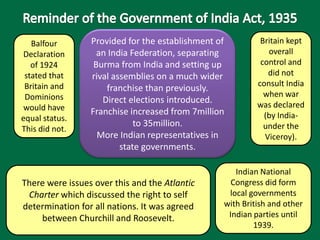
Provided for the establishment of
an India Federation, separating
Burma from India and setting up
rival assemblies on a much wider
franchise than previously.
Direct elections introduced.
Franchise increased from 7million
to 35million.
More Indian representatives in
state governments.
Balfour
Declaration
of 1924
stated that
Britain and
Dominions
would have
equal status.
This did not.
Britain kept
overall
control and
did not
consult India
when war
was declared
(by India-
under the
Viceroy).
There were issues over this and the Atlantic
Charter which discussed the right to self
determination for all nations. It was agreed
between Churchill and Roosevelt.
Indian National
Congress did form
local governments
with British and other
Indian parties until
1939.
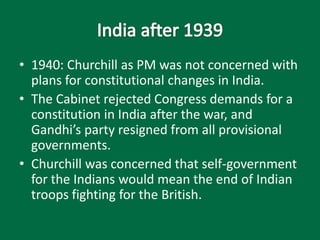
• 1940: Churchill as PM was not concerned with
plans for constitutional changes in India.
• The Cabinet rejected Congress demands for a
constitution in India after the war, and
Gandhi’s party resigned from all provisional
governments.
• Churchill was concerned that self-government
for the Indians would mean the end of Indian
troops fighting for the British.
• 1942 required concessions Attlee (Deputy PM) proposed a
post war constitution to stop a revolt in India and please
America.
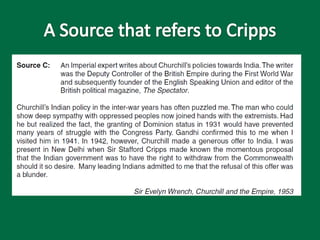
• Churchill sent Sir Stafford Cripps over to discuss giving
control of most of the administration of India to the
Indians. Churchill didn’t support Cripps views, however, and
got the Cabinet to reject an agreement negotiated by
Cripps about Indian control of defence (although Cripps had
refused to concede to the Indians control over the military).
• Congress took up a “Quit India” campaign, and were
rewarded by being made illegal, Gandhi being arrested,
unrest and civil disobedience requiring substantial British
military presence.
• Churchill’s view was that there should be “no apology, no
quitting, no idea of weakening or scuttling”
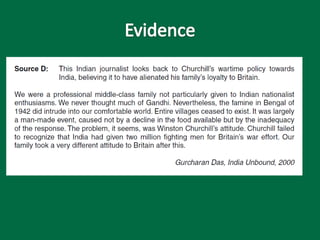
• Bad harvests, fungus, a cyclone, a scorched earth policy
(the Japanese were in Burma and might attack Bengal),
and an influx of Burmese refugees combined to create
the famine. 3 million lives lost.
• Wavell (Viceroy), Leo Amery (Secretary of State for
India) were critical of the Churchill government’s
failure to send enough relief.
• Some blamed the administration in Bengal itself, others
said people in Bengal were hoarding grain and still
others claimed there was plenty of food available and
people should share it.
• Churchill was criticised for being indifferent to the
famine.
• The Battle of the Atlantic was at its peak from mid-
1942 to mid-1943, with submarine wolf packs sinking
so many ships that the Allies were on the verge of
defeat, so shipping could not be spared for India. Also,
the Japanese were covering the Bay of Bengal, railways
were overstretched sending men and equipment to
war zones (Burma) and not set up for sending stocks of
food anyway.
• By August 1943 Churchill refused to release shipping to
send food to India. Initially during the famine he was
more concerned with the civilians of Nazi occupied
Greece (who were also suffering from a famine)
compared with the Bengalis.
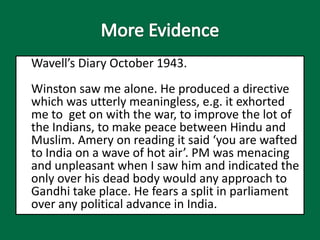
Wavell’s Diary October 1943.
Winston saw me alone. He produced a directive
which was utterly meaningless, e.g. it exhorted
me to get on with the war, to improve the lot of
the Indians, to make peace between Hindu and
Muslim. Amery on reading it said ‘you are wafted
to India on a wave of hot air’. PM was menacing
and unpleasant when I saw him and indicated the
only over his dead body would any approach to
Gandhi take place. He fears a split in parliament
over any political advance in India.
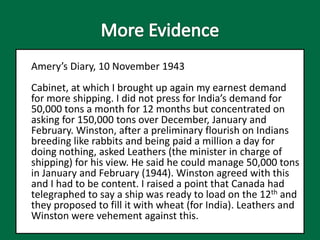
Amery’s Diary, 10 November 1943
Cabinet, at which I brought up again my earnest demand
for more shipping. I did not press for India’s demand for
50,000 tons a month for 12 months but concentrated on
asking for 150,000 tons over December, January and
February. Winston, after a preliminary flourish on Indians
breeding like rabbits and being paid a million a day for
doing nothing, asked Leathers (the minister in charge of
shipping) for his view. He said he could manage 50,000 tons
in January and February (1944). Winston agreed with this
and I had to be content. I raised a point that Canada had
telegraphed to say a ship was ready to load on the 12th and
they proposed to fill it with wheat (for India). Leathers and
Winston were vehement against this.

Churchill and india

  • 1.
    Revision of themain issues
  • 2.
    • “India isa geographical term. It is no more a united nation than the equator”. Speech at Royal Albert Hall, London (18 March 1931) • “It is alarming and also nauseating to see Mr. Gandhi, a seditious Middle Temple lawyer of the type well-known in the East, now posing as a fakir, striding half naked up the steps of the Viceregal palace to parley on equal terms with the representative of the King-Emperor”. Comment on Gandhi's meeting with the Viceroy of India, addressing the Council of the West Essex Unionist Association (23 February 1931); as quoted in "Mr Churchill on India" in The Times (24 February 1931)
  • 3.
    • In anentry for September 1942 in Leo Amery : Diaries (1988), edited John Barnes and David Nicholson, p. 832: ‘During my talk with Winston he burst out with: "I hate Indians. They are a beastly people with a beastly religion.“’
  • 4.
    • Indian independencemovement was led by Gandhi (leader of the Indian Congress Party) and his programme of ‘civil disobedience’. Actions had Gandhi’s ‘March to the Sea’ (leading thousands in protest at a tax on salt) and hunger strikes. • Churchill had opposed the Round Table Conference (1931) on the issue of whether or not India should be given Dominion status. Churchill particularly objected to the fact that Gandhi should be present.
  • 6.
    • It didn’thelp Churchill’s relationship with Baldwin that Churchill’s meeting at which he said these things came at the time of a Conservative by-election in Westminster. • By being at this meeting, Churchill was flouting party policy and encouraging others to do the same. • This was very unwise of Churchill: especially as Churchill was disassociating himself from all three political parties by doing so: as the Conservatives, Labour and the Liberals had come together to try to iron out India. • Churchill was taking on the entire political establishment.
  • 7.
    • Lobbying organisationagainst concessions to the Indians on the subject of the Empire. • Highly unrepresentative of British opinion.
  • 8.
    • 1933: Governmentwhite paper proposed an elected federal government for India. • India Defence League, founded by Churchill and supported by 57 Conservative MPs and the Daily Mail and the Morning Post. • Little popular enthusiasm: despite Churchill trying to persuade the Lancashire public that more Indian independence would lead to India imposing restrictions on Lancashire cotton imports. • 1935: Randolph Churchill (son of Churchill) stood as an independent Conservative on the India platform in a by-election, but he split the Conservative vote and the Labour candidate was elected. Despite Churchill’s opposition to his son’s standing, he still lost popularity further.
  • 11.
    • Churchill wasseen as extreme and old fashioned (especially as he had published a book about his younger days called My Early Life which had an account of is time as a soldier in India). • All the three main parties were upset with him: Conservatives because of his criticism of his support for reform in India, Labour because of attitudes towards the workers and class politics, The Liberals who saw him as a renegade who left them and joined the Conservatives (although previously he had left the Conservatives to join them).
  • 12.
    Provided for theestablishment of an India Federation, separating Burma from India and setting up rival assemblies on a much wider franchise than previously. Direct elections introduced. Franchise increased from 7million to 35million. More Indian representatives in state governments. Balfour Declaration of 1924 stated that Britain and Dominions would have equal status. This did not. Britain kept overall control and did not consult India when war was declared (by India- under the Viceroy). There were issues over this and the Atlantic Charter which discussed the right to self determination for all nations. It was agreed between Churchill and Roosevelt. Indian National Congress did form local governments with British and other Indian parties until 1939.
  • 13.
    • 1940: Churchillas PM was not concerned with plans for constitutional changes in India. • The Cabinet rejected Congress demands for a constitution in India after the war, and Gandhi’s party resigned from all provisional governments. • Churchill was concerned that self-government for the Indians would mean the end of Indian troops fighting for the British.
  • 14.
    • 1942 requiredconcessions Attlee (Deputy PM) proposed a post war constitution to stop a revolt in India and please America. • Churchill sent Sir Stafford Cripps over to discuss giving control of most of the administration of India to the Indians. Churchill didn’t support Cripps views, however, and got the Cabinet to reject an agreement negotiated by Cripps about Indian control of defence (although Cripps had refused to concede to the Indians control over the military). • Congress took up a “Quit India” campaign, and were rewarded by being made illegal, Gandhi being arrested, unrest and civil disobedience requiring substantial British military presence. • Churchill’s view was that there should be “no apology, no quitting, no idea of weakening or scuttling”
  • 16.
    • Bad harvests,fungus, a cyclone, a scorched earth policy (the Japanese were in Burma and might attack Bengal), and an influx of Burmese refugees combined to create the famine. 3 million lives lost. • Wavell (Viceroy), Leo Amery (Secretary of State for India) were critical of the Churchill government’s failure to send enough relief. • Some blamed the administration in Bengal itself, others said people in Bengal were hoarding grain and still others claimed there was plenty of food available and people should share it. • Churchill was criticised for being indifferent to the famine.
  • 17.
    • The Battleof the Atlantic was at its peak from mid- 1942 to mid-1943, with submarine wolf packs sinking so many ships that the Allies were on the verge of defeat, so shipping could not be spared for India. Also, the Japanese were covering the Bay of Bengal, railways were overstretched sending men and equipment to war zones (Burma) and not set up for sending stocks of food anyway. • By August 1943 Churchill refused to release shipping to send food to India. Initially during the famine he was more concerned with the civilians of Nazi occupied Greece (who were also suffering from a famine) compared with the Bengalis.
  • 19.
    Wavell’s Diary October1943. Winston saw me alone. He produced a directive which was utterly meaningless, e.g. it exhorted me to get on with the war, to improve the lot of the Indians, to make peace between Hindu and Muslim. Amery on reading it said ‘you are wafted to India on a wave of hot air’. PM was menacing and unpleasant when I saw him and indicated the only over his dead body would any approach to Gandhi take place. He fears a split in parliament over any political advance in India.
  • 20.
    Amery’s Diary, 10November 1943 Cabinet, at which I brought up again my earnest demand for more shipping. I did not press for India’s demand for 50,000 tons a month for 12 months but concentrated on asking for 150,000 tons over December, January and February. Winston, after a preliminary flourish on Indians breeding like rabbits and being paid a million a day for doing nothing, asked Leathers (the minister in charge of shipping) for his view. He said he could manage 50,000 tons in January and February (1944). Winston agreed with this and I had to be content. I raised a point that Canada had telegraphed to say a ship was ready to load on the 12th and they proposed to fill it with wheat (for India). Leathers and Winston were vehement against this.