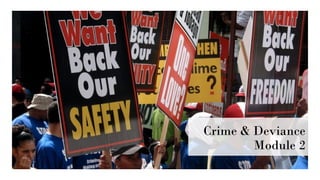
Crime & Deviance
Module 2
Presentation title 2
Terms To Know:
• Social Order: Refers to when shared rules and laws within a society are accepted and
upheld by individuals within it as their part of the social contract.
• Social Control: The enforcement of conformity by society upon its members, either
by law or by social pressure.
• Delinquency: Criminal behaviour, especially that carried out by a juvenile. It refers to
conduct that does not conform to the legal or moral standards of society and, were
they to be performed by an adult, would be termed criminal. Note; some crimes
(such as murder) will be termed criminal despite the age of the perpetrator.
• Profiling: The activity of collecting information about someone, especially a criminal,
in order to give a description of them. Though it is intended to be unbiased, quite
often profiling becomes racist as it relies on the individual compiling the
information.
• Recidivism: Relapsing to criminal behaviour, particularly after incarceration.
20XX
3
Crime. Deviance.
What’s the difference?
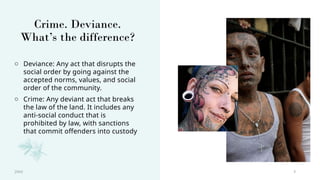
o Deviance: Any act that disrupts the
social order by going against the
accepted norms, values, and social
order of the community.
o Crime: Any deviant act that breaks
the law of the land. It includes any
anti-social conduct that is
prohibited by law, with sanctions
that commit offenders into custody
20XX
Presentation title 4
What is the point
of Deviance?
Why tolerate it?
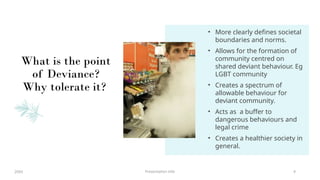
• More clearly defines societal
boundaries and norms.
• Allows for the formation of
community centred on
shared deviant behaviour. Eg
LGBT community
• Creates a spectrum of
allowable behaviour for
deviant community.
• Acts as a buffer to
dangerous behaviours and
legal crime
• Creates a healthier society in
general.
20XX
5
Crime: Intolerable. Why?
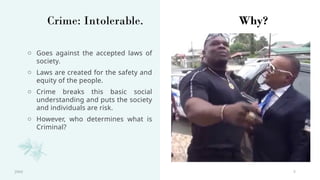
o Goes against the accepted laws of
society.
o Laws are created for the safety and
equity of the people.
o Crime breaks this basic social
understanding and puts the society
and individuals are risk.
o However, who determines what is
Criminal?
20XX
6
Types of Crime
• Violent Crime: A crime in which a person is harmed or threatened.
• Property Crime: Involves criminal activity that does not do bodily harm to a person, but rather
focuses on private property.
• White-Collar Crime: The name for acts of fraud committed by businessmen. Violent behavior is
typically not associated with white-collar crime. Rather, these types of crimes are committed to
gain or avoid losing money or property.
• Organized Crime: Criminal activity committed by an organized group of individuals at a local,
regional, national, or international level.
• Consensual or Victimless Crime: Crimes that do not directly harm other individuals or property.
Rather, individuals choose to participate in risky behaviors that may be considered against the law.
20XX
7
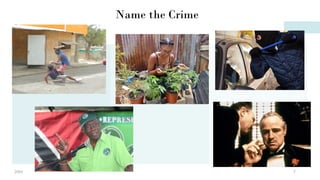
Name the Crime
20XX

Crime and Deviance.powerpoint for school

  • 1.
  • 2.
    Presentation title 2 TermsTo Know: • Social Order: Refers to when shared rules and laws within a society are accepted and upheld by individuals within it as their part of the social contract. • Social Control: The enforcement of conformity by society upon its members, either by law or by social pressure. • Delinquency: Criminal behaviour, especially that carried out by a juvenile. It refers to conduct that does not conform to the legal or moral standards of society and, were they to be performed by an adult, would be termed criminal. Note; some crimes (such as murder) will be termed criminal despite the age of the perpetrator. • Profiling: The activity of collecting information about someone, especially a criminal, in order to give a description of them. Though it is intended to be unbiased, quite often profiling becomes racist as it relies on the individual compiling the information. • Recidivism: Relapsing to criminal behaviour, particularly after incarceration. 20XX
  • 3.
    3 Crime. Deviance. What’s thedifference? o Deviance: Any act that disrupts the social order by going against the accepted norms, values, and social order of the community. o Crime: Any deviant act that breaks the law of the land. It includes any anti-social conduct that is prohibited by law, with sanctions that commit offenders into custody 20XX
  • 4.
    Presentation title 4 Whatis the point of Deviance? Why tolerate it? • More clearly defines societal boundaries and norms. • Allows for the formation of community centred on shared deviant behaviour. Eg LGBT community • Creates a spectrum of allowable behaviour for deviant community. • Acts as a buffer to dangerous behaviours and legal crime • Creates a healthier society in general. 20XX
  • 5.
    5 Crime: Intolerable. Why? oGoes against the accepted laws of society. o Laws are created for the safety and equity of the people. o Crime breaks this basic social understanding and puts the society and individuals are risk. o However, who determines what is Criminal? 20XX
  • 6.
    6 Types of Crime •Violent Crime: A crime in which a person is harmed or threatened. • Property Crime: Involves criminal activity that does not do bodily harm to a person, but rather focuses on private property. • White-Collar Crime: The name for acts of fraud committed by businessmen. Violent behavior is typically not associated with white-collar crime. Rather, these types of crimes are committed to gain or avoid losing money or property. • Organized Crime: Criminal activity committed by an organized group of individuals at a local, regional, national, or international level. • Consensual or Victimless Crime: Crimes that do not directly harm other individuals or property. Rather, individuals choose to participate in risky behaviors that may be considered against the law. 20XX
  • 7.