Welcome!
  Welcome!
Welcome!
The Collaborative Team

         Presented by
      The TEAM Approach
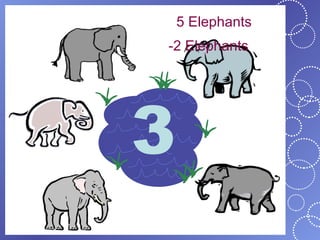
5 Elephants
-2 Elephants


3
Objectives


1. Problem Solving Process
2. Stimulate Creativity
3. Have some fun
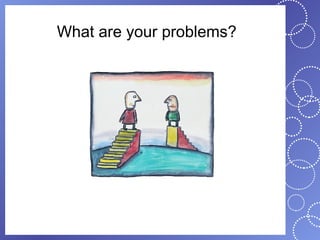
What are your problems?
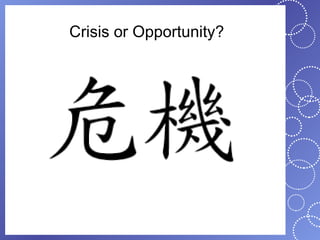
Crisis or Opportunity?
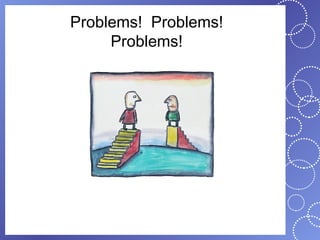
Problems! Problems!
     Problems!
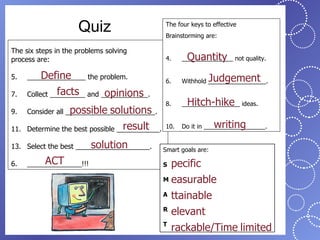
Quiz                    The four keys to effective
                                             Brainstorming are:

The six steps in the problems solving
process are:                                 4.      Quantity
                                                   _______________ not quality.


5.       Define
     _______________ the problem.
                                             6.             Judgement
                                                   Withhold _________________.

7.             facts        opinions
     Collect _________ and ____________.
                                             8.      Hitch-hike
                                                   _________________ ideas.
9.                 possible solutions
     Consider all _______________________.

                                  result
11. Determine the best possible ___________. 10.                writing
                                                   Do it in __________________.


                        solution
13. Select the best ___________________.     Smart goals are:

6.        ACT
     ______________!!!                       S pecific
                                             M easurable

                                             A ttainable

                                             R
                                               elevant
                                             T
                                               rackable/Time limited
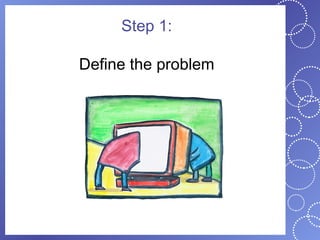
Step 1:

Define the problem
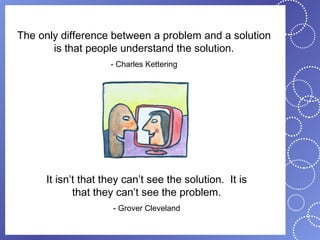
The only difference between a problem and a solution
       is that people understand the solution.
                    - Charles Kettering


     It isn’t that they can’t see the solution. It is
            that they can’t see the problem.
                    - Grover Cleveland
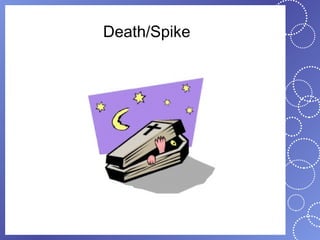
Death/Spike
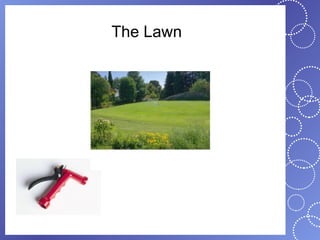
The Lawn
Rules
1.   You are not permitted to exchange cards or to show your cards to
     anyone else.
2.   All data statements must be communicated orally and may be
     repeated as often as the team feels is necessary.
3.   If all members of the team feel that a data statement is not relevant
     to the definition of the problem, the card bearing that statement is to
     be placed face down and its information not repeated.
4.   The team members may not take notes during the process.
5.   At the end of the time limit each team will be asked to write their
     definition of the problem and only one definition may be submitted.


 At the end of the time period each team gets a 3x5 card and is asked to
 write their definition of the problem - a spokesperson reads the definition
            and reports on how the team arrived at the definition.
T h e r e a l p r o b le m :


   How to rid the lawn of grubs.
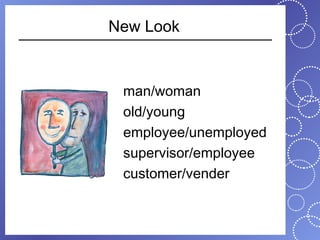
New Look


 man/woman
 old/young
 employee/unemployed
 supervisor/employee
 customer/vender
Step 2:

Collect facts and opinions
          of others
Step 3
Consider all solutions
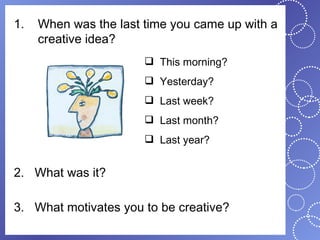
1.   When was the last time you came up with a
     creative idea?
                        This morning?
                        Yesterday?
                        Last week?
                        Last month?
                        Last year?


2. What was it?

3. What motivates you to be creative?
Brainstorming

1.   Quantity, not quality
2.   Withhold judgment
3.   Hitchhike ideas
4.   Put it in writing
Creativity

Discovery consists of looking at the
 same thing as everyone else and
   thinking something different.
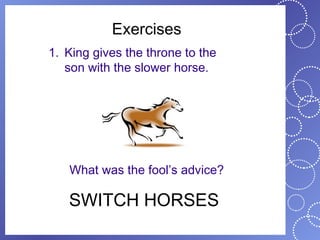
Exercises
1. King gives the throne to the
   son with the slower horse.


   What was the fool’s advice?

   SWITCH HORSES
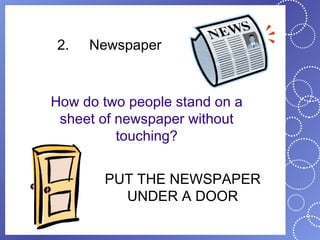
2.   Newspaper


How do two people stand on a
 sheet of newspaper without
          touching?


       PUT THE NEWSPAPER
         UNDER A DOOR
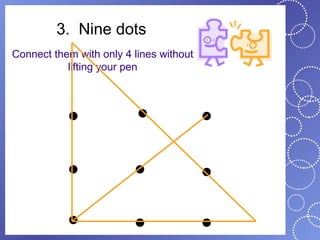
3. Nine dots
Connect them with only 4 lines without
           lifting your pen
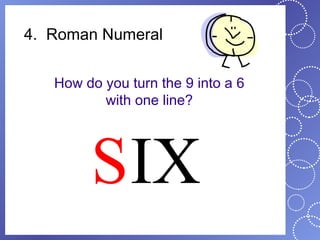
4. Roman Numeral


   How do you turn the 9 into a 6
          with one line?


        SIX
Why don’t we?
We have to unlearn!
1. The Right Answer

• Children enter school as question
  marks and leave as periods.
• By the time they finish college - they will
  have taken 2,600 tests, quizzes, and
  exams.
• We loose 90% of our creativity between
  ages five and seven.
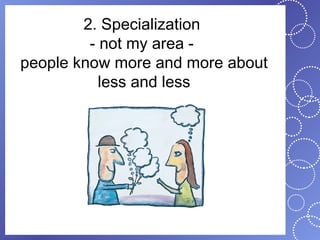
2. Specialization
         - not my area -
people know more and more about
           less and less
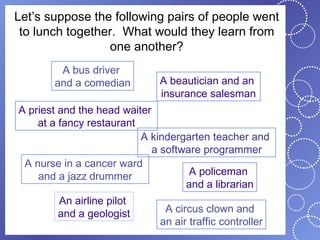
Let’s suppose the following pairs of people went
 to lunch together. What would they learn from
                 one another?
        A bus driver
       and a comedian        A beautician and an
                             insurance salesman
A priest and the head waiter
    at a fancy restaurant
                          A kindergarten teacher and
                             a software programmer
 A nurse in a cancer ward
    and a jazz drummer               A policeman
                                    and a librarian
        An airline pilot
        and a geologist       A circus clown and
                             an air traffic controller
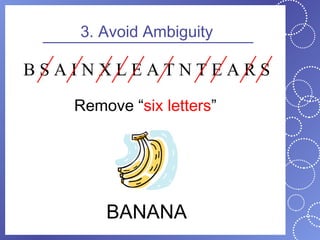
3. Avoid Ambiguity

BSAINXLEATNTEARS

   Remove “six letters”


       BANANA
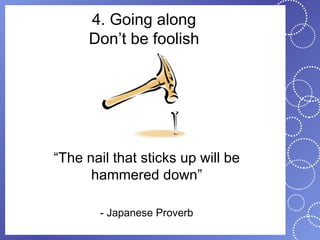
4. Going along
      Don’t be foolish


“The nail that sticks up will be
      hammered down”

        - Japanese Proverb
5. To Err is Wrong


School grading system
Step 4:

Determine the best possible result
Step 5:

Pick the best solution
Lost on the Moon
Step 6:

        ACT!


Why don’t people act?
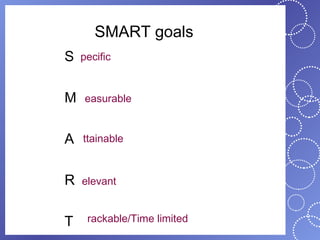
SMART goals
S   pecific


M   easurable


A   ttainable


R   elevant


T    rackable/Time limited
End of course test

Creative Problem Solving

  • 1.
    Welcome! Welcome! Welcome! TheCollaborative Team Presented by The TEAM Approach
  • 2.
  • 3.
    Objectives 1. Problem SolvingProcess 2. Stimulate Creativity 3. Have some fun
  • 4.
    What are yourproblems?
  • 5.
  • 6.
  • 7.
    Quiz The four keys to effective Brainstorming are: The six steps in the problems solving process are: 4. Quantity _______________ not quality. 5. Define _______________ the problem. 6. Judgement Withhold _________________. 7. facts opinions Collect _________ and ____________. 8. Hitch-hike _________________ ideas. 9. possible solutions Consider all _______________________. result 11. Determine the best possible ___________. 10. writing Do it in __________________. solution 13. Select the best ___________________. Smart goals are: 6. ACT ______________!!! S pecific M easurable A ttainable R elevant T rackable/Time limited
  • 8.
  • 9.
    The only differencebetween a problem and a solution is that people understand the solution. - Charles Kettering It isn’t that they can’t see the solution. It is that they can’t see the problem. - Grover Cleveland
  • 10.
  • 11.
  • 12.
    Rules 1. You are not permitted to exchange cards or to show your cards to anyone else. 2. All data statements must be communicated orally and may be repeated as often as the team feels is necessary. 3. If all members of the team feel that a data statement is not relevant to the definition of the problem, the card bearing that statement is to be placed face down and its information not repeated. 4. The team members may not take notes during the process. 5. At the end of the time limit each team will be asked to write their definition of the problem and only one definition may be submitted. At the end of the time period each team gets a 3x5 card and is asked to write their definition of the problem - a spokesperson reads the definition and reports on how the team arrived at the definition.
  • 13.
    T h er e a l p r o b le m : How to rid the lawn of grubs.
  • 14.
    New Look man/woman old/young employee/unemployed supervisor/employee customer/vender
  • 15.
    Step 2: Collect factsand opinions of others
  • 16.
  • 17.
    1. When was the last time you came up with a creative idea?  This morning?  Yesterday?  Last week?  Last month?  Last year? 2. What was it? 3. What motivates you to be creative?
  • 18.
    Brainstorming 1. Quantity, not quality 2. Withhold judgment 3. Hitchhike ideas 4. Put it in writing
  • 19.
    Creativity Discovery consists oflooking at the same thing as everyone else and thinking something different.
  • 20.
    Exercises 1. King givesthe throne to the son with the slower horse. What was the fool’s advice? SWITCH HORSES
  • 21.
    2. Newspaper How do two people stand on a sheet of newspaper without touching? PUT THE NEWSPAPER UNDER A DOOR
  • 22.
    3. Nine dots Connectthem with only 4 lines without lifting your pen
  • 23.
    4. Roman Numeral How do you turn the 9 into a 6 with one line? SIX
  • 24.
    Why don’t we? Wehave to unlearn!
  • 25.
    1. The RightAnswer • Children enter school as question marks and leave as periods. • By the time they finish college - they will have taken 2,600 tests, quizzes, and exams. • We loose 90% of our creativity between ages five and seven.
  • 26.
    2. Specialization - not my area - people know more and more about less and less
  • 27.
    Let’s suppose thefollowing pairs of people went to lunch together. What would they learn from one another? A bus driver and a comedian A beautician and an insurance salesman A priest and the head waiter at a fancy restaurant A kindergarten teacher and a software programmer A nurse in a cancer ward and a jazz drummer A policeman and a librarian An airline pilot and a geologist A circus clown and an air traffic controller
  • 28.
    3. Avoid Ambiguity BSAINXLEATNTEARS Remove “six letters” BANANA
  • 29.
    4. Going along Don’t be foolish “The nail that sticks up will be hammered down” - Japanese Proverb
  • 30.
    5. To Erris Wrong School grading system
  • 31.
    Step 4: Determine thebest possible result
  • 32.
    Step 5: Pick thebest solution
  • 33.
  • 34.
    Step 6: ACT! Why don’t people act?
  • 35.
    SMART goals S pecific M easurable A ttainable R elevant T rackable/Time limited
  • 36.

Editor's Notes

  • #3 Five elephants at a waterhole - all five drinking water. Two finish drinking and leave. How many elephants at the waterhole? Many solutions are simple - look for the obvious.
  • #5 Give participants a blank piece of paper. Ask them to list all their problems in the time alllowed - three minutes. Wuiet individual expercise. No problem is too big or too small. Want all problems listed - work, family, etc. Tell them they will get a chance to air them later. At the end of three minutes ask everyone to stand and hold their paper. On the count of three everyone reads their list out loud - all together. When you are finished ready your list you must sit down. Tell them there will be a prize at the end - the longest list or the most emotional - you will make the decision when you see it play out. Award the prize - a bottle of aspirin. The point is that it is not our problems that cause the anxiety but our attitute towards them and our ability to solve them. This program will help produce a more positive problem solving attitude.
  • #6 Chinese symbol for CRISIS - Opportunity riding the winds of danger. Need to start by looking at problems in new ways. Many will hold opportunites.
  • #7 Hand out a simple problem - two girls wanting the same bedroom. Use the handout from AIA. Ask the groups to read the problem and discuss how they will handle the situation. Walk around the room and listen in a bit. Most groups will jump right into suggesting the right solution. Almost no one asks the question - what is the problem?
  • #8 This program makes the assumption that the participants have heard much of this before. So we start by finding out what they already know. Hand out the quiz at each table and ask them to complete it first as individuals. As they finish they should stand. As the next person stands they form a dyad and compare answers. Finally they go back to their table group and compare answers. The handout does not have SMART goals on it - this slide just introduces it to see if they are aware of it. The handout could be changed to include this. Review the answers briefly.
  • #9 Ask - what has been your experience? Do most people spend time on this step?
  • #10 Highlight these quotes
  • #11 An example from history of two approaches to defining a problem. Several centuries ago in Lituania there appeared a curious and deadly plague. Many people died from it but many also recovered. Before death or recovery, the victim would enter a death like coma. It was very difficult to tell who was dead or alive. To their horror, the village people discovered that they had buried some people while they were still alive. They met to discuss how to prevent this from happening. Some suggsted putting food and water in the casket and a tube for air. Finally, one group suggested putting a spike in the coffin lid centered over the person’s heart. When the lid was closed they could be sure the person was dead. Two definitions of the problem: How can we be sure we do not bury someone alive or How do we be certain that the people we bury are dead?
  • #12 Introduce the lawn exercise.
  • #14 Questons for the group How did you approach it? Difficulty separating irrelevant from relevant How did verbal communication affect the exercise How to differentiate causes and symptoms.
  • #15 Go back to the original problem (two girls) Come up with as many statements of the problem as you can. Would your perspective affect the definition as noted in this slide Other questions: Is it the real problem? How do I know? Why is is a problem? Is the situation the problem or is it my reaction to it? Is there more than one problem?
  • #16 Return to original problem - what facts and opiinions could be gained. It is important to lable each as a Fact or Opinion (lawn exercise) Other questions Is the source reliable Am I being objective, impersonal All the facts or only those that point to a pre-conceived solution.
  • #17 Introduce the issue of creativity
  • #18 Discuss this in small groups
  • #19 Brainstorming exercise - each group gets an object. Brainstorm as many ways to use the object as possible - write list on flip chart paper. Each group present their list and facilitator point out hitchhiking. Ask if any group experienced withholding judgement.
  • #21 Brainteasers handout to talk about creativity.
  • #26 Look for the second right answer
  • #28 Small group exercise. Each group picks one and comes up with a list of ideas.
  • #29 Look for ambiguity The tyranny of reason
  • #30 Candid camera illustrations
  • #31 School grading system - ABCDF Go back to original problem (two girls) Brainstorm new solutions to any of the problem definitions you choose.
  • #32 What results are expected from solving the problem Without applying any solutions, determine the best possible results that would be achieved by solving the problem Possibilities vs Probabilities Original problem - suggest a best possible result (small group exercise)
  • #33 Which solution from step 3 would be most likely to produce the results identified in step 4.
  • #34 Collaboration exercise Three minutes for individual rating 10 minutes for team rating 3 minutes to show NASSA rating Process for 5 minutes - discuss collaboration in problem solving process
  • #35 Suggest behavioral style implications
  • #36 Turn the solution into a goal whenever possible.
  • #37 Handout and discuss