
Creativity and
Innovation
Prem Kumar Soni
14-08-20171 Prem Kumar Soni
Prem Kumar Soni
SYLLABUS
Creativity and Innovation: Creativity, Exercises on
Creativity, Source of New Idea, Ideas into
Opportunities.
Creative problem solving: Heuristics,
Brainstorming, Synectics, Value Analysis
Innovation and Entrepreneurship: Profits and
Innovation, Globalization, Modules of Innovation,
Sources and Transfer of Innovation, Why Innovate,
What Innovation, How to Innovate, Who Innovates
14-08-20172
Prem Kumar Soni
CREATIVITY
 Creativity is any act, idea, idea or product that
changes an existing domain or that transforms an
existing domain into new one.
 Creativity can be described as the discovery of
something that is novel but also useful or relevant or
economical , valuable.
14-08-20173
Prem Kumar Soni
TYPES OF CREATIVITY
 Primary creativity : deals with spontaneous
creations.
Secondary creativity : is more deliberate and
skilled as in the application of ideas and insight to
inventions.
Technical creativity : aims at finding out
improvement in a process so as to improve
efficiency.
Inventive creativity : aims at making or devising
new combination of ingredients
14-08-20174
Prem Kumar Soni
Innovative creativity : it involves for reaching
application of more basic ideas such as
management application of principles of psychology
to develop a much more effective system for
motivating staff.
Emergentive creativity : it consist of new
revolutionary principles for an art or science such as
psycho- analytical concepts of Freud.
14-08-20175
Prem Kumar Soni
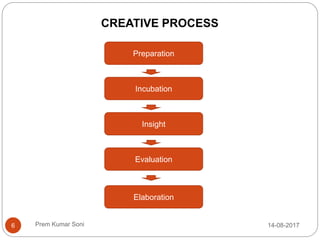
CREATIVE PROCESS
Preparation
Incubation
Insight
Evaluation
Elaboration
14-08-20176
Prem Kumar Soni
CREATIVE PROCESS
Preparation : successful creations are preceded by
investigation and information gathering. It can be
achieved by gathering information from journals,
attending meeting seminars etc.
Incubation : creative person allows their sub
consciousness mind to dwell over tremendous
amount of ideas and information accumulated during
the preparation phase.
Insight : this is the moment when the person is able
to locate solution to their problems. Generally in
most of the cases ideas comes to person in
incremental way. The person improves on solution
slowly and steadily.
14-08-20177
Prem Kumar Soni
Evaluation : this phase is regarded as the most
emotional trying part, when one feels uncertain and
insecure and thinks about reaction of other people.
Elaboration : this is the most difficult step of
creativity endeavour and requires great self
discipline, dedication and perseverance.
14-08-20178
Prem Kumar Soni
BARRIERS TO CREATIVITY
 Resistance to change : people just get used to
doing a particular work in customized manner and
they are just opposed to any new idea or change.
Lack of initiative : organizational managers from
top to bottom are just opposed to giving initiative to
their subordinates fearing that it will undermine their
authority.
Restriction on interaction : a free and open
environment provides members an opportunity to
interact with members of their own and other groups.
Such interaction facilitates exchange of ideas and
information required for creative work where as in
restricted environment creativity is adversely
effected. 14-08-20179
Prem Kumar Soni
Fear of something going wrong : many new ideas
may go wrong or prove impractical. Whenever
creative work is to be undertaken the possibility of
success or failure is always there.
Lack of recognition : failure to recognize or reward
creativity acts as de motivating factor. Hard work put
in by creative people must be compensated with
adequate financial and non financial rewards.
Resource constraints : creativity demands
sufficient availability of resources. Absence of
adequate resources may dampen the spirit of
creativity.
14-08-201710
Prem Kumar Soni
SOURCES OF NEW IDEAS
 Basic research : all firms are engaged in some kind
of basic research and development , which can lead
to development of new product ideas that have
already passed the initial screening stage.
Production stage : workers actively engaged in the
production of products can suggest certain
modifications and improvements. These workers can
provide ideas aimed at improving quality , cost and
performance of potential product.
Sales force : sales representative are directly in
touch with the customers and are thus better
equipped to take note of customer needs by this
they can provide better product development idea.
14-08-201711
Prem Kumar Soni
Management : management team based on their
knowledge, skill and experience can come out with
new ideas for product development.
Magazines and trade journal : useful ideas about
new products can be obtained from these magazines
and trade journals.
Competitors : in order to survive in present day
competitive environment, it is in the interest of the
entrepreneur to keep a eye on activities of his rivals.
14-08-201712
Prem Kumar Soni
Buyers : an entrepreneur while keeping track of the
requirements of the consumers can definitely get
useful ideas aimed at developing a better product.
Sellers : can provide idea for new product
development as they act as link between producers
and consumers and are better equipped to provide
required information.
Overseas market : a producer interested in taking
care of foreign market can do it in better manner by
getting right ideas aimed at improving product
acceptability in these markets.
14-08-201713
Prem Kumar Soni
IDEAS INTO OPPORTUNITIES
New
product
idea
Idea
screening
Concept
developm
ent
Potential
analysis
Product
developm
ent
Test
marketing
Commerc
ialization
14-08-201714
Prem Kumar Soni
IDEAS INTO OPPORTUNITIES
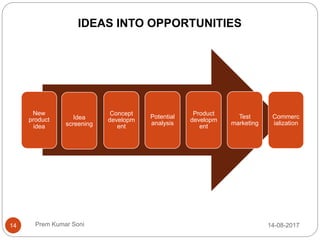
 New product idea : an attempt is made to visualize
the product. An in depth study may be undertaken to
anticipate features of the proposed product. Ideas
may be contributed by scientists, professional
designers, rivals, customers, sales force etc.
Idea screening : under this step detailed
investigation of various ideas is carried on. Those
ideas which offer less scope are dropped. Most
promising ideas are chosen for product
development.
Concept development and testing : all ideas
chosen after preliminary screening are subjected to
in depth study. These ideas are developed into
mature product concepts. 14-08-201715
Prem Kumar Soni
Business potential analysis : after choosing best
product idea, detailed investigation is carried out to
find its market potential, gestation period, capital
investment, and expected rate of return.
Product development : after clearing business
potential analysis tests concrete steps are taken for
giving practical shapes to the proposed product.
Test marketing : test marketing involves placing
fully developed new product for sale and observing
its actual performance under propose marketing
plan.
Commercialization : is the actual introduction of the
product into market place with all the related
decisions and resources commitment.
14-08-201716
Prem Kumar Soni
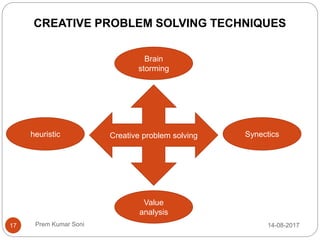
CREATIVE PROBLEM SOLVING TECHNIQUES
Creative problem solving
Brain
storming
heuristic Synectics
Value
analysis
14-08-201717
Prem Kumar Soni
Heuristic : is an adjective for experience based
techniques that help in problem solving , learning
and discovery. This method is used to rapidly come
to an solution that is hoped to be close to best
possible answer. Heuristics stands for strategies
using, readily accessible, though loosely applicable,
information to control problem solving in human
beings and machines. Although the solution quality
may not be the best, often they work well in
generalized situation.
14-08-201718
Prem Kumar Soni
BASIC HEURISTICS DIRECTED TOWARDS
CREATIVITY
Make it habit to purposely pause and notice things.
Focus on your creative energies on just few topic
areas that you genuinely create about and work on
these purposeful.
Avoid being too narrow in the way you define your
problem or topic.
Try to come up with original and useful ideas by
making novel associations among what you already
know.
When you need creative ideas , remember attention
escape and movement.
14-08-201719
Prem Kumar Soni
Pause and carefully examine ideas that make you
laugh the first time hear them.
Recognize that your streams of thought and patterns
of judgement are inherently right or wrong, they are
just what you think now based on primarily on
patterns from your past.
Make a deliberate effort to harvest, develop and
implement at least a few of the ideas you generate.
14-08-201720
Prem Kumar Soni
Brain storming : in this group members or
individuals are encouraged to spell out maximum
number of possible solutions of a specific or stated
problem. Under brain storming more emphasis is laid
on the number of possible solutions or ideas.
14-08-201721
Prem Kumar Soni
CHARACTERISTICS OF BRAIN STORMING
This technique is not suitable where the problem has
a unique solution which can be found through
analysis or evaluation.
brain storming can take place only when there is
specific topic.
Brain storming results in generation of numerous
ideas out of which a few ideas are chosen for in
depth investigation.
Brain storming provides ample opportunities to
participants to put forth various suggestions for
solving specific problems.
Brain storming enables participation to freely share
different ideas.
14-08-201722
Prem Kumar Soni
PRINCIPLES OF BRAIN STORMING
 During the generation phase of ideas, evaluation
process is deferred.
The second principle is based on ‘quantity begets
quality’ right environment must be provided for
generating maximum number of ideas.
Brain storming brings forth novel and different ideas.
Novels ideas in certain cases may not appear to be
practical ideas.
It is better to appreciate ideas of others as well as
ones own previous ideas.
14-08-201723
Prem Kumar Soni
Synectics : has been adopted by the Greek word
synecticos incorporating diverse elements. synectics
is applied in finding innovative practices to a number
of in traceable technical problems. Major analogies
under this technique are :
 Direct analogy : it involves discussing analogy of
the problem situation from very different field. It
involves direct comparison under discussion with
some other similar phenomenon.
14-08-201724
Prem Kumar Soni
 Personal analogy : under this problem solver is
expected to project himself into situation and report
back his experience of the particular situation like
what he feels, sees, hears, thinks etc.
 Fantasy analogy : under this concerned person is
asked to release his imagination from real life
constraints. Group members are used to fantasize
some perfect solutions even if it is contrary to known
scientific principles.
 Symbolic analogy : it requires group members to
poetic or paradoxical phrases for situation. The
leader is expected to take key word or even
undertake some decisions and ask the group
members to come up with short proactive phrases
that capture word under discussion. 14-08-201725
Prem Kumar Soni
Value analysis is important approach to improving
the value of product or process by understanding its
constitutes components and their associated costs.
Value analysis is a cost reduction and problem
solving technique that analyzes an existing product
or service in order to reduce or eliminate any costs
that do not contribute to value of performance.
14-08-201726
Prem Kumar Soni
COMPONENTS OF VALUE CHAIN ANALYSIS
Value : the ratio between function for customer
satisfaction and the cost of that function.
Function : the effect produced by a product or by
one of its elements , in order to satisfy customer
needs.
Value analysis : methodology to increase the value
of an object to object to be analyzed could be an
existing or new product or process and it is usually
accomplished by a team following work plan.
Need : something that is necessary or desired by the
customer.
14-08-201727
Prem Kumar Soni
VALUE ANALYSIS PROCESS
 Orientation / preparation : refers to collecting the
basic information required for the process and
various stages at which value addition is possible in
process.
Information : collection of data in detail in relation to
every step in value addition process.
Analysis : of various options of value addition
 Innovation and creativity : refers to implementing
new or improved way of performing every step in the
process.
Evaluation : understanding effectiveness of change
implemented in process.
Implementation and monitoring : refers to after
screening of improvised method it is to be
implemented and monitored for its working as per
expectation.
14-08-201728
Prem Kumar Soni
PROFITS AND INNOVATION
Entrepreneur is one who always searches for
changes and responds to it and exploits it as an
opportunity. Innovation is treated as an instrument of
entrepreneurship. An entrepreneur innovates and
creates resources until someone finds a use for it
and endows economic value to it.
14-08-201729
Prem Kumar Soni
ROLE OF ENTREPRENEURS
An entrepreneur must be an innovator as well as
leader.
He must be capable of analyzing and exploiting the
opportunities.
An entrepreneur should innovate for the present
period and not for the future.
Innovation must be easy to understand otherwise it
may not give the desired result.
An entrepreneur must posses the knowledge,
ingenuity, diligence, persistence, and commitment to
innovation.
An entrepreneur must mobilize resources and
allocate them to make a commercial gains from the
opportunities indentified.
14-08-201730
Innovative Thinking
8/14/201731 Prem Kumar Soni
1. INNOVATORS HAVE THEIR EGO
IN CHECK
Emotional intelligent people have their egos under
control and are open to other people’s ideas. They
don’t think their ideas are always the best. As a result
of their openness to other ideas, they are able to
accumulate a larger source of data from which to draw
from. They are also less likely to fall into the trap of
following up on ideas and prospects that are only
popular and then receiving kudos for them.
8/14/201732 Prem Kumar Soni
2. EMOTIONALLY INTELLIGENT
PEOPLE ARE CONFIDENT, NOT
ARROGANT
Even though they may not think their ideas are always spot
on, there is always a belief in their craft and innovate
accordingly. They see failures as temporary setbacks. By
failing, this will uncover a way that doesn’t work,
bringing them closer to a way that will. Great innovators
such as Edison, failed countless times before achieving a
breakthrough that led to success. A common factor in all
innovators is they see failures and setbacks as temporary
and do not take them personally.
8/14/201733 Prem Kumar Soni
3. THEY ARE CONTINUALLY
CURIOUS
Emotionally intelligent people are curious about people,
concepts, and issues. They’re open to new information
always on the lookout for new ideas that can be put
into practice. Being avid readers, forever seeking out
new ideas, and expanding their knowledge base
increases their repertoire of tools for future use.
Noticing every opportunity, a random meeting with a
stranger, conversation, or an event they are attending is
always an occasion to learn something new. Every
person they talk to is seen as possessing some
knowledge that may be beneficial to them.
8/14/201734 Prem Kumar Soni
4. THEY ARE GOOD LISTENERS
Emotionally intelligent people pick up on information and are
able to sit back and take it in, and are adept at processing
information that makes them excellent listeners. When
someone is speaking, most people are formulating a
response in their minds instead of just focusing upon what
the person talking is saying. Good listeners are able to
focus not only on the words that are being spoken, but are
aware of the tone of the words, the body language
expressed, and the emotions behind them. This allows the
individual to not only absorb valuable information but
develop strong relationships with others. We all have a
strong desire to be heard and are attracted to those we feel
have taken the time and effort to hear us.
8/14/201735 Prem Kumar Soni
5. THEY DON’T LET THEIR EMOTIONS
AFFECT THEIR INNOVATION EFFORTS
Emotionally intelligent people see failure as a process—
this takes them one step closer to being their best self.
They don’t have to defend an idea that is proven to be
wrong as they’re seeking to advance themselves
personally and are looking to advance their ideas.
Emotionally intelligent people just love to create
because this fills their soul and life purpose.
8/14/201736 Prem Kumar Soni
6. THEY CAN TAKE DIRECTION
Emotionally intelligent people have a keen sense of
awareness. They can express their emotions in a way
that isn’t confrontational. They can be assertive
without being aggressive. One must be able to take
direction in order to give direction.
8/14/201737 Prem Kumar Soni
7. THEY EMPATHIZE WITH CO-
WORKERS AND CUSTOMERS
Being emotionally intelligent allows people to feel
comfortable around you. To truly understand a
customers’ needs you have to have empathy. It’s not
just about the product. It’s about the people. As Maya
Angelou said: “You may not remember what someone
said to you, but you will remember how they made you
feel.”
8/14/201738 Prem Kumar Soni
Prem Kumar Soni
MODULES OF INNOVATION
Innovation : it is the production of totally new
product service or process so far untried.
Extension : it involves new use or application of an
already existing product, service or process.
Duplication : it is the replication of an already
existing product, service or process. It is not merely
copying but adding something new with creative
touch to enhance or improve the existing concept.
Synthesis : it is the combination of existing concepts
and ideas and devising a way so that together they
may form a new application.
14-08-201739
Prem Kumar Soni
SOURCES AND TRANSFER OF INNOVATION
 Unexpected occurrences : sometimes unexpected
success or failure prove to be a major innovative
surprise for the enterprise. These happenings are
normally anticipated and unplanned.
Incongruities : these occurs whenever a gap or
difference exists between the expectations and
reality. The gap motivates the entrepreneur to
innovate with all the more vigour.
Process needs : these needs are created whenever
situation and surrounding circumstances generate
demand for the innovation. Entrepreneurs are
prompted to innovate to satisfy the requirement of
process needs.
14-08-201740
Prem Kumar Soni
Industry and market changes :changes in
consumer tastes, fashions, advancement in
technology result in change in structure and design
of product. These changes generate tremendous
opportunities for innovation and improvements.
Demographic changes : like changes in population,
education, occupation, urbanisation etc, create
entrepreneurial opportunities.
Perceptual change : it is reflected in the change in
peoples attitude, feelings, interpretation. Change in
perception does not change, the object or fact, but
changes the meaning or attitude towards the
particular concept.
Knowledge based concept : these are basis for the
development and creation of new products and
market. These are time consuming as these need
testing and modifications.
14-08-201741
Prem Kumar Soni
HOW TO INNOVATE
Organise for paid experimentation : examine,
revamp entrenched routines, organizational
boundaries and incentives to encourage rapid
experimentation.
Fail early and often but avoid mistakes : embrace
failures that occur early in the development process
and advance knowledge significantly.
Anticipate exploit early information :recognize the
full value of front loading, identifying problems up
stream, where they are easier and cheaper to solve.
Combine new and traditional technologies : do
not assume that new technology will necessarily
replace and established one. New and traditional
technologies are best used in concept.
14-08-201742
Prem Kumar Soni
WHO INNOVATES
 Educated individuals
Higher in social standing
Less dogmatic
Better equipped to deal with abstraction
More receptive to risk in general
Higher in achievement motivation
Higher in social participation
More cosmopolitan
More often engaged in interpersonal communication
Active information seeker
14-08-201743
Prem Kumar Soni
GLOBALIZATION
Globalization is the system of interaction among the
countries of the world in order to develop the global
economy. Globalization refers to the integration of
economics and societies all over the world.
Globalization involves technological, economic,
political, and cultural exchanges made possible
largely by advances in communication,
transportation, and infrastructure.
14-08-201744
Prem Kumar Soni
ADVANTAGES OF GLOBALIZATION
 Power of the WTO, IMF, and WB. According to
experts, another effect of globalization is the
strengthening power and influence of international
institutions such as the World Trade Organization
(WTO), International Monetary Fund (IMF), and
World Bank (WB).
Greater Mobility of Human Resources across
Countries. Globalization allows countries to source
their manpower in countries with cheap labour.
Greater Outsourcing of Business Processes to
Other Countries. China, India, and the Philippines
are tremendously benefiting from this trend of global
business outsourcing. Global companies in the US
and Europe take advantage of the cheaper labour
and highly-skilled workers that countries like India
and the Philippines can offer.
14-08-201745
Prem Kumar Soni
 7. Civil Society. An important trend in globalization is
the increasing influence and broadening scope of the
global civil society. Civil society often refers to NGOs
(nongovernment organizations). There are
institutions in a country that are established and run
by citizens. The family, being an institution, is part of
the society. In globalization, global civil society refers
to organizations that advocate certain issue or cause
14-08-201746
Prem Kumar Soni
Improvement of International Trade. Because of
globalization, the number of countries where
products can be sold or purchased has increased
dramatically.
Technological Progress. Because of the need to
compete and be competitive globally, governments
have upgraded their level of technology.
14-08-201747
Prem Kumar Soni
DISADVANTAGES OF GLOBALIZATION
Developed countries can stifle development of
undeveloped and under-developed countries.
Economic depression in one country can trigger
adverse reaction across the globe.
Companies face much greater competition. This can
put smaller companies, at a disadvantage as they do
not have resources to compete at global scale
Another major damage of globalization is that some
cultures are getting lost. The cultures of the countries
that have more economic power are more dominant
than others. Because, wealthy countries produce
many things that can affect cultures, for example,
clothes, movies and technologic products
14-08-201748
Prem Kumar Soni
THANK YOU
14-08-201749

Creativity and innovation

  • 1.
    Creativity and Innovation Prem KumarSoni 14-08-20171 Prem Kumar Soni
  • 2.
    Prem Kumar Soni SYLLABUS Creativityand Innovation: Creativity, Exercises on Creativity, Source of New Idea, Ideas into Opportunities. Creative problem solving: Heuristics, Brainstorming, Synectics, Value Analysis Innovation and Entrepreneurship: Profits and Innovation, Globalization, Modules of Innovation, Sources and Transfer of Innovation, Why Innovate, What Innovation, How to Innovate, Who Innovates 14-08-20172
  • 3.
    Prem Kumar Soni CREATIVITY Creativity is any act, idea, idea or product that changes an existing domain or that transforms an existing domain into new one.  Creativity can be described as the discovery of something that is novel but also useful or relevant or economical , valuable. 14-08-20173
  • 4.
    Prem Kumar Soni TYPESOF CREATIVITY  Primary creativity : deals with spontaneous creations. Secondary creativity : is more deliberate and skilled as in the application of ideas and insight to inventions. Technical creativity : aims at finding out improvement in a process so as to improve efficiency. Inventive creativity : aims at making or devising new combination of ingredients 14-08-20174
  • 5.
    Prem Kumar Soni Innovativecreativity : it involves for reaching application of more basic ideas such as management application of principles of psychology to develop a much more effective system for motivating staff. Emergentive creativity : it consist of new revolutionary principles for an art or science such as psycho- analytical concepts of Freud. 14-08-20175
  • 6.
    Prem Kumar Soni CREATIVEPROCESS Preparation Incubation Insight Evaluation Elaboration 14-08-20176
  • 7.
    Prem Kumar Soni CREATIVEPROCESS Preparation : successful creations are preceded by investigation and information gathering. It can be achieved by gathering information from journals, attending meeting seminars etc. Incubation : creative person allows their sub consciousness mind to dwell over tremendous amount of ideas and information accumulated during the preparation phase. Insight : this is the moment when the person is able to locate solution to their problems. Generally in most of the cases ideas comes to person in incremental way. The person improves on solution slowly and steadily. 14-08-20177
  • 8.
    Prem Kumar Soni Evaluation: this phase is regarded as the most emotional trying part, when one feels uncertain and insecure and thinks about reaction of other people. Elaboration : this is the most difficult step of creativity endeavour and requires great self discipline, dedication and perseverance. 14-08-20178
  • 9.
    Prem Kumar Soni BARRIERSTO CREATIVITY  Resistance to change : people just get used to doing a particular work in customized manner and they are just opposed to any new idea or change. Lack of initiative : organizational managers from top to bottom are just opposed to giving initiative to their subordinates fearing that it will undermine their authority. Restriction on interaction : a free and open environment provides members an opportunity to interact with members of their own and other groups. Such interaction facilitates exchange of ideas and information required for creative work where as in restricted environment creativity is adversely effected. 14-08-20179
  • 10.
    Prem Kumar Soni Fearof something going wrong : many new ideas may go wrong or prove impractical. Whenever creative work is to be undertaken the possibility of success or failure is always there. Lack of recognition : failure to recognize or reward creativity acts as de motivating factor. Hard work put in by creative people must be compensated with adequate financial and non financial rewards. Resource constraints : creativity demands sufficient availability of resources. Absence of adequate resources may dampen the spirit of creativity. 14-08-201710
  • 11.
    Prem Kumar Soni SOURCESOF NEW IDEAS  Basic research : all firms are engaged in some kind of basic research and development , which can lead to development of new product ideas that have already passed the initial screening stage. Production stage : workers actively engaged in the production of products can suggest certain modifications and improvements. These workers can provide ideas aimed at improving quality , cost and performance of potential product. Sales force : sales representative are directly in touch with the customers and are thus better equipped to take note of customer needs by this they can provide better product development idea. 14-08-201711
  • 12.
    Prem Kumar Soni Management: management team based on their knowledge, skill and experience can come out with new ideas for product development. Magazines and trade journal : useful ideas about new products can be obtained from these magazines and trade journals. Competitors : in order to survive in present day competitive environment, it is in the interest of the entrepreneur to keep a eye on activities of his rivals. 14-08-201712
  • 13.
    Prem Kumar Soni Buyers: an entrepreneur while keeping track of the requirements of the consumers can definitely get useful ideas aimed at developing a better product. Sellers : can provide idea for new product development as they act as link between producers and consumers and are better equipped to provide required information. Overseas market : a producer interested in taking care of foreign market can do it in better manner by getting right ideas aimed at improving product acceptability in these markets. 14-08-201713
  • 14.
    Prem Kumar Soni IDEASINTO OPPORTUNITIES New product idea Idea screening Concept developm ent Potential analysis Product developm ent Test marketing Commerc ialization 14-08-201714
  • 15.
    Prem Kumar Soni IDEASINTO OPPORTUNITIES  New product idea : an attempt is made to visualize the product. An in depth study may be undertaken to anticipate features of the proposed product. Ideas may be contributed by scientists, professional designers, rivals, customers, sales force etc. Idea screening : under this step detailed investigation of various ideas is carried on. Those ideas which offer less scope are dropped. Most promising ideas are chosen for product development. Concept development and testing : all ideas chosen after preliminary screening are subjected to in depth study. These ideas are developed into mature product concepts. 14-08-201715
  • 16.
    Prem Kumar Soni Businesspotential analysis : after choosing best product idea, detailed investigation is carried out to find its market potential, gestation period, capital investment, and expected rate of return. Product development : after clearing business potential analysis tests concrete steps are taken for giving practical shapes to the proposed product. Test marketing : test marketing involves placing fully developed new product for sale and observing its actual performance under propose marketing plan. Commercialization : is the actual introduction of the product into market place with all the related decisions and resources commitment. 14-08-201716
  • 17.
    Prem Kumar Soni CREATIVEPROBLEM SOLVING TECHNIQUES Creative problem solving Brain storming heuristic Synectics Value analysis 14-08-201717
  • 18.
    Prem Kumar Soni Heuristic: is an adjective for experience based techniques that help in problem solving , learning and discovery. This method is used to rapidly come to an solution that is hoped to be close to best possible answer. Heuristics stands for strategies using, readily accessible, though loosely applicable, information to control problem solving in human beings and machines. Although the solution quality may not be the best, often they work well in generalized situation. 14-08-201718
  • 19.
    Prem Kumar Soni BASICHEURISTICS DIRECTED TOWARDS CREATIVITY Make it habit to purposely pause and notice things. Focus on your creative energies on just few topic areas that you genuinely create about and work on these purposeful. Avoid being too narrow in the way you define your problem or topic. Try to come up with original and useful ideas by making novel associations among what you already know. When you need creative ideas , remember attention escape and movement. 14-08-201719
  • 20.
    Prem Kumar Soni Pauseand carefully examine ideas that make you laugh the first time hear them. Recognize that your streams of thought and patterns of judgement are inherently right or wrong, they are just what you think now based on primarily on patterns from your past. Make a deliberate effort to harvest, develop and implement at least a few of the ideas you generate. 14-08-201720
  • 21.
    Prem Kumar Soni Brainstorming : in this group members or individuals are encouraged to spell out maximum number of possible solutions of a specific or stated problem. Under brain storming more emphasis is laid on the number of possible solutions or ideas. 14-08-201721
  • 22.
    Prem Kumar Soni CHARACTERISTICSOF BRAIN STORMING This technique is not suitable where the problem has a unique solution which can be found through analysis or evaluation. brain storming can take place only when there is specific topic. Brain storming results in generation of numerous ideas out of which a few ideas are chosen for in depth investigation. Brain storming provides ample opportunities to participants to put forth various suggestions for solving specific problems. Brain storming enables participation to freely share different ideas. 14-08-201722
  • 23.
    Prem Kumar Soni PRINCIPLESOF BRAIN STORMING  During the generation phase of ideas, evaluation process is deferred. The second principle is based on ‘quantity begets quality’ right environment must be provided for generating maximum number of ideas. Brain storming brings forth novel and different ideas. Novels ideas in certain cases may not appear to be practical ideas. It is better to appreciate ideas of others as well as ones own previous ideas. 14-08-201723
  • 24.
    Prem Kumar Soni Synectics: has been adopted by the Greek word synecticos incorporating diverse elements. synectics is applied in finding innovative practices to a number of in traceable technical problems. Major analogies under this technique are :  Direct analogy : it involves discussing analogy of the problem situation from very different field. It involves direct comparison under discussion with some other similar phenomenon. 14-08-201724
  • 25.
    Prem Kumar Soni Personal analogy : under this problem solver is expected to project himself into situation and report back his experience of the particular situation like what he feels, sees, hears, thinks etc.  Fantasy analogy : under this concerned person is asked to release his imagination from real life constraints. Group members are used to fantasize some perfect solutions even if it is contrary to known scientific principles.  Symbolic analogy : it requires group members to poetic or paradoxical phrases for situation. The leader is expected to take key word or even undertake some decisions and ask the group members to come up with short proactive phrases that capture word under discussion. 14-08-201725
  • 26.
    Prem Kumar Soni Valueanalysis is important approach to improving the value of product or process by understanding its constitutes components and their associated costs. Value analysis is a cost reduction and problem solving technique that analyzes an existing product or service in order to reduce or eliminate any costs that do not contribute to value of performance. 14-08-201726
  • 27.
    Prem Kumar Soni COMPONENTSOF VALUE CHAIN ANALYSIS Value : the ratio between function for customer satisfaction and the cost of that function. Function : the effect produced by a product or by one of its elements , in order to satisfy customer needs. Value analysis : methodology to increase the value of an object to object to be analyzed could be an existing or new product or process and it is usually accomplished by a team following work plan. Need : something that is necessary or desired by the customer. 14-08-201727
  • 28.
    Prem Kumar Soni VALUEANALYSIS PROCESS  Orientation / preparation : refers to collecting the basic information required for the process and various stages at which value addition is possible in process. Information : collection of data in detail in relation to every step in value addition process. Analysis : of various options of value addition  Innovation and creativity : refers to implementing new or improved way of performing every step in the process. Evaluation : understanding effectiveness of change implemented in process. Implementation and monitoring : refers to after screening of improvised method it is to be implemented and monitored for its working as per expectation. 14-08-201728
  • 29.
    Prem Kumar Soni PROFITSAND INNOVATION Entrepreneur is one who always searches for changes and responds to it and exploits it as an opportunity. Innovation is treated as an instrument of entrepreneurship. An entrepreneur innovates and creates resources until someone finds a use for it and endows economic value to it. 14-08-201729
  • 30.
    Prem Kumar Soni ROLEOF ENTREPRENEURS An entrepreneur must be an innovator as well as leader. He must be capable of analyzing and exploiting the opportunities. An entrepreneur should innovate for the present period and not for the future. Innovation must be easy to understand otherwise it may not give the desired result. An entrepreneur must posses the knowledge, ingenuity, diligence, persistence, and commitment to innovation. An entrepreneur must mobilize resources and allocate them to make a commercial gains from the opportunities indentified. 14-08-201730
  • 31.
  • 32.
    1. INNOVATORS HAVETHEIR EGO IN CHECK Emotional intelligent people have their egos under control and are open to other people’s ideas. They don’t think their ideas are always the best. As a result of their openness to other ideas, they are able to accumulate a larger source of data from which to draw from. They are also less likely to fall into the trap of following up on ideas and prospects that are only popular and then receiving kudos for them. 8/14/201732 Prem Kumar Soni
  • 33.
    2. EMOTIONALLY INTELLIGENT PEOPLEARE CONFIDENT, NOT ARROGANT Even though they may not think their ideas are always spot on, there is always a belief in their craft and innovate accordingly. They see failures as temporary setbacks. By failing, this will uncover a way that doesn’t work, bringing them closer to a way that will. Great innovators such as Edison, failed countless times before achieving a breakthrough that led to success. A common factor in all innovators is they see failures and setbacks as temporary and do not take them personally. 8/14/201733 Prem Kumar Soni
  • 34.
    3. THEY ARECONTINUALLY CURIOUS Emotionally intelligent people are curious about people, concepts, and issues. They’re open to new information always on the lookout for new ideas that can be put into practice. Being avid readers, forever seeking out new ideas, and expanding their knowledge base increases their repertoire of tools for future use. Noticing every opportunity, a random meeting with a stranger, conversation, or an event they are attending is always an occasion to learn something new. Every person they talk to is seen as possessing some knowledge that may be beneficial to them. 8/14/201734 Prem Kumar Soni
  • 35.
    4. THEY AREGOOD LISTENERS Emotionally intelligent people pick up on information and are able to sit back and take it in, and are adept at processing information that makes them excellent listeners. When someone is speaking, most people are formulating a response in their minds instead of just focusing upon what the person talking is saying. Good listeners are able to focus not only on the words that are being spoken, but are aware of the tone of the words, the body language expressed, and the emotions behind them. This allows the individual to not only absorb valuable information but develop strong relationships with others. We all have a strong desire to be heard and are attracted to those we feel have taken the time and effort to hear us. 8/14/201735 Prem Kumar Soni
  • 36.
    5. THEY DON’TLET THEIR EMOTIONS AFFECT THEIR INNOVATION EFFORTS Emotionally intelligent people see failure as a process— this takes them one step closer to being their best self. They don’t have to defend an idea that is proven to be wrong as they’re seeking to advance themselves personally and are looking to advance their ideas. Emotionally intelligent people just love to create because this fills their soul and life purpose. 8/14/201736 Prem Kumar Soni
  • 37.
    6. THEY CANTAKE DIRECTION Emotionally intelligent people have a keen sense of awareness. They can express their emotions in a way that isn’t confrontational. They can be assertive without being aggressive. One must be able to take direction in order to give direction. 8/14/201737 Prem Kumar Soni
  • 38.
    7. THEY EMPATHIZEWITH CO- WORKERS AND CUSTOMERS Being emotionally intelligent allows people to feel comfortable around you. To truly understand a customers’ needs you have to have empathy. It’s not just about the product. It’s about the people. As Maya Angelou said: “You may not remember what someone said to you, but you will remember how they made you feel.” 8/14/201738 Prem Kumar Soni
  • 39.
    Prem Kumar Soni MODULESOF INNOVATION Innovation : it is the production of totally new product service or process so far untried. Extension : it involves new use or application of an already existing product, service or process. Duplication : it is the replication of an already existing product, service or process. It is not merely copying but adding something new with creative touch to enhance or improve the existing concept. Synthesis : it is the combination of existing concepts and ideas and devising a way so that together they may form a new application. 14-08-201739
  • 40.
    Prem Kumar Soni SOURCESAND TRANSFER OF INNOVATION  Unexpected occurrences : sometimes unexpected success or failure prove to be a major innovative surprise for the enterprise. These happenings are normally anticipated and unplanned. Incongruities : these occurs whenever a gap or difference exists between the expectations and reality. The gap motivates the entrepreneur to innovate with all the more vigour. Process needs : these needs are created whenever situation and surrounding circumstances generate demand for the innovation. Entrepreneurs are prompted to innovate to satisfy the requirement of process needs. 14-08-201740
  • 41.
    Prem Kumar Soni Industryand market changes :changes in consumer tastes, fashions, advancement in technology result in change in structure and design of product. These changes generate tremendous opportunities for innovation and improvements. Demographic changes : like changes in population, education, occupation, urbanisation etc, create entrepreneurial opportunities. Perceptual change : it is reflected in the change in peoples attitude, feelings, interpretation. Change in perception does not change, the object or fact, but changes the meaning or attitude towards the particular concept. Knowledge based concept : these are basis for the development and creation of new products and market. These are time consuming as these need testing and modifications. 14-08-201741
  • 42.
    Prem Kumar Soni HOWTO INNOVATE Organise for paid experimentation : examine, revamp entrenched routines, organizational boundaries and incentives to encourage rapid experimentation. Fail early and often but avoid mistakes : embrace failures that occur early in the development process and advance knowledge significantly. Anticipate exploit early information :recognize the full value of front loading, identifying problems up stream, where they are easier and cheaper to solve. Combine new and traditional technologies : do not assume that new technology will necessarily replace and established one. New and traditional technologies are best used in concept. 14-08-201742
  • 43.
    Prem Kumar Soni WHOINNOVATES  Educated individuals Higher in social standing Less dogmatic Better equipped to deal with abstraction More receptive to risk in general Higher in achievement motivation Higher in social participation More cosmopolitan More often engaged in interpersonal communication Active information seeker 14-08-201743
  • 44.
    Prem Kumar Soni GLOBALIZATION Globalizationis the system of interaction among the countries of the world in order to develop the global economy. Globalization refers to the integration of economics and societies all over the world. Globalization involves technological, economic, political, and cultural exchanges made possible largely by advances in communication, transportation, and infrastructure. 14-08-201744
  • 45.
    Prem Kumar Soni ADVANTAGESOF GLOBALIZATION  Power of the WTO, IMF, and WB. According to experts, another effect of globalization is the strengthening power and influence of international institutions such as the World Trade Organization (WTO), International Monetary Fund (IMF), and World Bank (WB). Greater Mobility of Human Resources across Countries. Globalization allows countries to source their manpower in countries with cheap labour. Greater Outsourcing of Business Processes to Other Countries. China, India, and the Philippines are tremendously benefiting from this trend of global business outsourcing. Global companies in the US and Europe take advantage of the cheaper labour and highly-skilled workers that countries like India and the Philippines can offer. 14-08-201745
  • 46.
    Prem Kumar Soni 7. Civil Society. An important trend in globalization is the increasing influence and broadening scope of the global civil society. Civil society often refers to NGOs (nongovernment organizations). There are institutions in a country that are established and run by citizens. The family, being an institution, is part of the society. In globalization, global civil society refers to organizations that advocate certain issue or cause 14-08-201746
  • 47.
    Prem Kumar Soni Improvementof International Trade. Because of globalization, the number of countries where products can be sold or purchased has increased dramatically. Technological Progress. Because of the need to compete and be competitive globally, governments have upgraded their level of technology. 14-08-201747
  • 48.
    Prem Kumar Soni DISADVANTAGESOF GLOBALIZATION Developed countries can stifle development of undeveloped and under-developed countries. Economic depression in one country can trigger adverse reaction across the globe. Companies face much greater competition. This can put smaller companies, at a disadvantage as they do not have resources to compete at global scale Another major damage of globalization is that some cultures are getting lost. The cultures of the countries that have more economic power are more dominant than others. Because, wealthy countries produce many things that can affect cultures, for example, clothes, movies and technologic products 14-08-201748
  • 49.
    Prem Kumar Soni THANKYOU 14-08-201749