CREATIV TY
CREATIV TY
CREATIV TY
21st Century Skills
Mentors:
DR Neelu Verma
Dr Priya Pillai
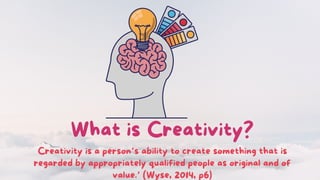
What is Creativity?
Creativity is a person’s ability to create something that is
regarded by appropriately qualified people as original and of
value.’ (Wyse, 2014, p6)
Definition of creativity is different for all, for some teachers’
creativity is letting children do their homework in a different way,
for some it means through different art forms like dance, song,
skit. Creativity can also help in having an approaching nature
towards any difficulties and not backing out of the problems.
Definition
Body
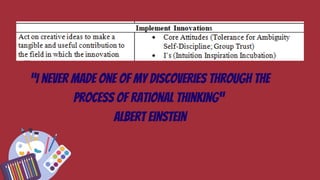
“I never made one of my discoveries through the
process of rational thinking”
Albert Einstein
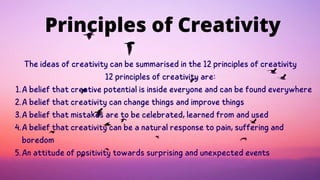
A belief that creative potential is inside everyone and can be found everywhere
A belief that creativity can change things and improve things
A belief that mistakes are to be celebrated, learned from and used
A belief that creativity can be a natural response to pain, suffering and
boredom
An attitude of positivity towards surprising and unexpected events
The ideas of creativity can be summarised in the 12 principles of creativity
12 principles of creativity are:
1.
2.
3.
4.
5.
Principles of Creativity
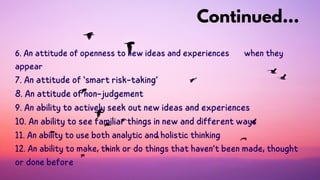
6. An attitude of openness to new ideas and experiences when they
appear
7. An attitude of ‘smart risk-taking’
8. An attitude of non-judgement
9. An ability to actively seek out new ideas and experiences
10. An ability to see familiar things in new and different ways
11. An ability to use both analytic and holistic thinking
12. An ability to make, think or do things that haven’t been made, thought
or done before
Continued...
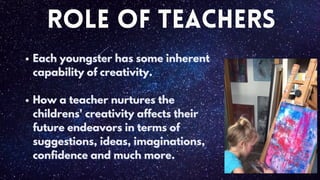
Role of Teachers
Each youngster has some inherent
capability of creativity.
How a teacher nurtures the
childrens' creativity affects their
future endeavors in terms of
suggestions
suggestions,
, ideas
ideas,
, imaginations
imaginations,
,
confidence
confidence and much more.
and much more.
1) Provide Private Space.
2) Provide Materials.
3) Encourage and room for
self-evaluation.
4) Value their work.
5) Practice what you preach.
6) Allow Child to be 'odd'.
7) Regular practice and discipline.
Effective ways to sustain
creativity
Put on your creative clips!
Paper Clip TesT
Find as many uses
for paper clips,
apart from holding
papers.
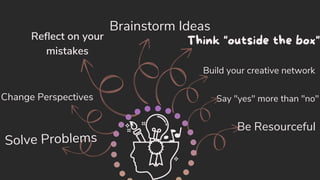
Change Perspectives
Solve Problems
Build your creative network
Say "yes" more than "no"
Brainstorm Ideas
Think "outside the box"
Be Resourceful
Reflect on your
mistakes
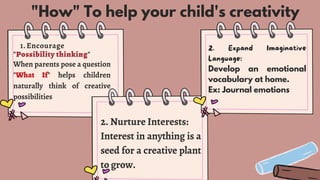
"How" To help your child's creativity
Encourage
1.
"Possibility thinking"
When parents pose a question
"What If" helps children
naturally think of creative
possibilities
2. Nurture Interests:
Interest in anything is a
seed for a creative plant
to grow.
2. Expand Imaginative
Language:
Develop an emotional
vocabulary at home.
Ex: Journal emotions
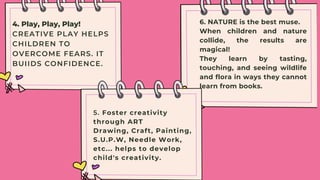
4. Play, Play, Play!
CREATIVE PLAY HELPS
CHILDREN TO
OVERCOME FEARS. IT
BUIIDS CONFIDENCE.
6. NATURE is the best muse.
When children and nature
collide, the results are
magical!
They learn by tasting,
touching, and seeing wildlife
and flora in ways they cannot
learn from books.
5. Foster creativity
through ART
Drawing, Craft, Painting,
S.U.P.W, Needle Work,
etc... helps to develop
child's creativity.
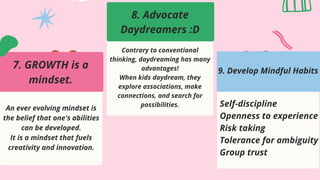
7. GROWTH is a
mindset.
An ever evolving mindset is
the belief that one's abilities
can be developed.
It is a mindset that fuels
creativity and innovation.
8. Advocate
Daydreamers :D
Contrary to conventional
thinking, daydreaming has many
advantages!
When kids daydream, they
explore associations, make
connections, and search for
possibilities.
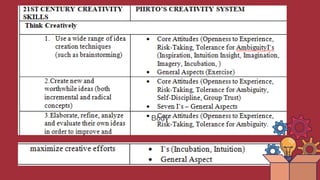
9. Develop Mindful Habits
Self-discipline
Openness to experience
Risk taking
Tolerance for ambiguity
Group trust
10.RECOGNIZE CREATIVITY AS A
SOURCE OF JOY.
When families value and
recognize creativity as a source
of inner joy, children learn to
appreciate their natural,
creative gifts as human beings.
GENERAL PHYSICAL
PRACTICES IN
CREATIVE PROCESS
ASPECTS AND APPARANTS FOR
CREATIVE PROCESS
1} Meditation
3} The need for solitude
3} Quest for silence
4} Exercise, specially walking
• It opens your mind in the direction of new
idea.
• Restarts your mind
• It nutures courage, which is important in case
of setbacks and failures happen.
MEDITATION
The Need for Solitude
• Solitude is not lonliness
• Not being able to achieve solitude
frustates many creative people.
• In the state of solitude, the puzzling thing
becomes easier with clearer mind and space
THE QUEST FOR SILENCE
• Quest for silence is not really quest for
complete silence, but quest for removal of
certain kinds of noise.
• Complete silence is almost impossible, thus
omnipresent noise is helpful for
concentration.
EXERCISE, SPECIALLY WALKING
Examples from Creators:
• Psychologist Erik Erikson walked from his hometown,
Germany to Florence, Italy. He later said that he
didn’t or wouldn't trust any creative ideas that
hadn’t occurred while walking.
• Up until the 20th century, certain European males
went on walking, what was called the year of
wandering, whereby the young male would seek to
find them- selves.
• Wordsworth liked to walk on a straight gravel
sidewalk back and forth, and his sister, Dorothy taking
notes while Wordsworth spun out words and images.
Continued...
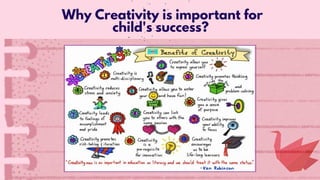
Increases curiosity & develops self motivation.
Realization of different perspectives
Better attention span
Develops one's Mental Ability i.e. Cognitive
Skills-Critical Thinking, Decision Making,
Problem Solving, etc...
Confident booster
Child becomes a wanderer & a confident
explorer.
Why Creativity is important for
child's success?
Why Creativity is important for
child's success?
Creative Thinking In Various Form
COIN
T-SHIRT LIFT BUTTON
THANK YOU
Roll no - 12, Payal
Jagda
Roll No- 49, Hitaa Valecha
Roll no - 2, Aamatullah Bagasrawala
Roll No -22,
Neelu Mishra
Roll No-29, Misbah Patel
Roll no-32, Chaitra Putran

CREATIVITY - 21st Century skills

  • 1.
    CREATIV TY CREATIV TY CREATIVTY 21st Century Skills Mentors: DR Neelu Verma Dr Priya Pillai
  • 2.
    What is Creativity? Creativityis a person’s ability to create something that is regarded by appropriately qualified people as original and of value.’ (Wyse, 2014, p6)
  • 3.
    Definition of creativityis different for all, for some teachers’ creativity is letting children do their homework in a different way, for some it means through different art forms like dance, song, skit. Creativity can also help in having an approaching nature towards any difficulties and not backing out of the problems. Definition
  • 4.
  • 6.
    “I never madeone of my discoveries through the process of rational thinking” Albert Einstein
  • 7.
    A belief thatcreative potential is inside everyone and can be found everywhere A belief that creativity can change things and improve things A belief that mistakes are to be celebrated, learned from and used A belief that creativity can be a natural response to pain, suffering and boredom An attitude of positivity towards surprising and unexpected events The ideas of creativity can be summarised in the 12 principles of creativity 12 principles of creativity are: 1. 2. 3. 4. 5. Principles of Creativity
  • 8.
    6. An attitudeof openness to new ideas and experiences when they appear 7. An attitude of ‘smart risk-taking’ 8. An attitude of non-judgement 9. An ability to actively seek out new ideas and experiences 10. An ability to see familiar things in new and different ways 11. An ability to use both analytic and holistic thinking 12. An ability to make, think or do things that haven’t been made, thought or done before Continued...
  • 9.
    Role of Teachers Eachyoungster has some inherent Each youngster has some inherent capability of creativity. capability of creativity. How a teacher nurtures the How a teacher nurtures the childrens' creativity affects their childrens' creativity affects their future endeavors in terms of future endeavors in terms of suggestions suggestions, , ideas ideas, , imaginations imaginations, , confidence confidence and much more. and much more.
  • 10.
    1) Provide PrivateSpace. 2) Provide Materials. 3) Encourage and room for self-evaluation. 4) Value their work. 5) Practice what you preach. 6) Allow Child to be 'odd'. 7) Regular practice and discipline. Effective ways to sustain creativity
  • 11.
    Put on yourcreative clips! Paper Clip TesT Find as many uses for paper clips, apart from holding papers.
  • 12.
    Change Perspectives Solve Problems Buildyour creative network Say "yes" more than "no" Brainstorm Ideas Think "outside the box" Be Resourceful Reflect on your mistakes
  • 13.
    "How" To helpyour child's creativity Encourage 1. "Possibility thinking" When parents pose a question "What If" helps children naturally think of creative possibilities 2. Nurture Interests: Interest in anything is a seed for a creative plant to grow. 2. Expand Imaginative Language: Develop an emotional vocabulary at home. Ex: Journal emotions
  • 14.
    4. Play, Play,Play! CREATIVE PLAY HELPS CHILDREN TO OVERCOME FEARS. IT BUIIDS CONFIDENCE. 6. NATURE is the best muse. When children and nature collide, the results are magical! They learn by tasting, touching, and seeing wildlife and flora in ways they cannot learn from books. 5. Foster creativity through ART Drawing, Craft, Painting, S.U.P.W, Needle Work, etc... helps to develop child's creativity.
  • 15.
    7. GROWTH isa mindset. An ever evolving mindset is the belief that one's abilities can be developed. It is a mindset that fuels creativity and innovation. 8. Advocate Daydreamers :D Contrary to conventional thinking, daydreaming has many advantages! When kids daydream, they explore associations, make connections, and search for possibilities. 9. Develop Mindful Habits Self-discipline Openness to experience Risk taking Tolerance for ambiguity Group trust
  • 16.
    10.RECOGNIZE CREATIVITY ASA SOURCE OF JOY. When families value and recognize creativity as a source of inner joy, children learn to appreciate their natural, creative gifts as human beings.
  • 17.
  • 18.
    ASPECTS AND APPARANTSFOR CREATIVE PROCESS 1} Meditation 3} The need for solitude 3} Quest for silence 4} Exercise, specially walking
  • 19.
    • It opensyour mind in the direction of new idea. • Restarts your mind • It nutures courage, which is important in case of setbacks and failures happen. MEDITATION
  • 20.
    The Need forSolitude • Solitude is not lonliness • Not being able to achieve solitude frustates many creative people. • In the state of solitude, the puzzling thing becomes easier with clearer mind and space
  • 21.
    THE QUEST FORSILENCE • Quest for silence is not really quest for complete silence, but quest for removal of certain kinds of noise. • Complete silence is almost impossible, thus omnipresent noise is helpful for concentration.
  • 22.
    EXERCISE, SPECIALLY WALKING Examplesfrom Creators: • Psychologist Erik Erikson walked from his hometown, Germany to Florence, Italy. He later said that he didn’t or wouldn't trust any creative ideas that hadn’t occurred while walking. • Up until the 20th century, certain European males went on walking, what was called the year of wandering, whereby the young male would seek to find them- selves.
  • 23.
    • Wordsworth likedto walk on a straight gravel sidewalk back and forth, and his sister, Dorothy taking notes while Wordsworth spun out words and images. Continued...
  • 24.
    Increases curiosity &develops self motivation. Realization of different perspectives Better attention span Develops one's Mental Ability i.e. Cognitive Skills-Critical Thinking, Decision Making, Problem Solving, etc... Confident booster Child becomes a wanderer & a confident explorer. Why Creativity is important for child's success?
  • 25.
    Why Creativity isimportant for child's success?
  • 26.
    Creative Thinking InVarious Form COIN T-SHIRT LIFT BUTTON
  • 27.
    THANK YOU Roll no- 12, Payal Jagda Roll No- 49, Hitaa Valecha Roll no - 2, Aamatullah Bagasrawala Roll No -22, Neelu Mishra Roll No-29, Misbah Patel Roll no-32, Chaitra Putran