TUESDAYS
4:00 – 4:40 PM
DepEd ETUlay
DepEd ETUlay
Quarter 4
CREATIVE NONFICTION
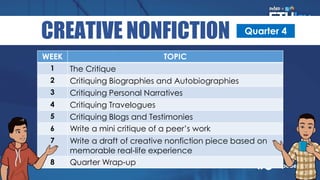
WEEK TOPIC
1 The Critique
2 Critiquing Biographies and Autobiographies
3 Critiquing Personal Narratives
4 Critiquing Travelogues
5 Critiquing Blogs and Testimonies
6 Write a mini critique of a peer’s work
7 Write a draft of creative nonfiction piece based on
memorable real-life experience
8 Quarter Wrap-up
Quarter 4
• Decide whether you like the
following items or not.
• In the comments section, type in one
to two sentences telling the reason
why you like the object or not.
ITLOG NA PULA
DURIAN
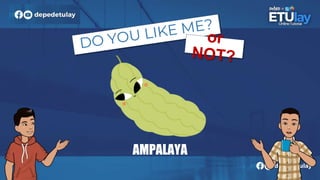
AMPALAYA
THE CRITIQUE
The What, Why, and How
WHAT IS A CRITIQUE?
NOUN: An analysis and evaluation of a
subject, situation, literary work, etc.
VERB: To analyze and evaluate a subject,
situation, literary work, etc.
(Webster’s New World College Dictionary, 4th Edition)
WHAT IS A CRITIQUE?
A critique is an opinion, supported by
evidence, about the themes, setting,
symbols, and other elements of a
nonfiction piece.
(libguides.dickinson.edu)
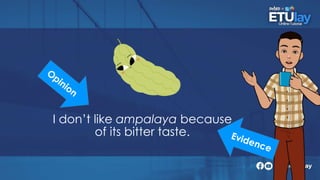
I don’t like ampalaya because
of its bitter taste.
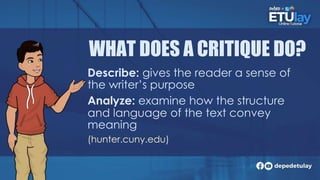
WHAT DOES A CRITIQUE DO?
Describe: gives the reader a sense of
the writer’s purpose
Analyze: examine how the structure
and language of the text convey
meaning
(hunter.cuny.edu)
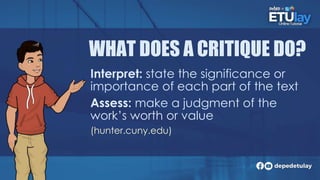
WHAT DOES A CRITIQUE DO?
Interpret: state the significance or
importance of each part of the text
Assess: make a judgment of the
work’s worth or value
(hunter.cuny.edu)
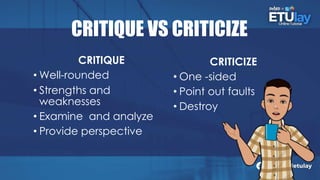
CRITIQUE VS CRITICIZE
CRITIQUE
• Well-rounded
• Strengths and
weaknesses
• Examine and analyze
• Provide perspective
CRITICIZE
• One -sided
• Point out faults
• Destroy
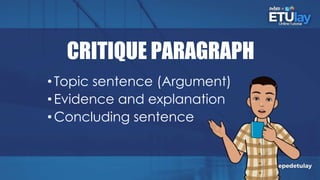
CRITIQUE PARAGRAPH
• Topic sentence (Argument)
• Evidence and explanation
• Concluding sentence
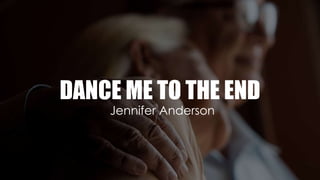
DANCE ME TO THE END
Jennifer Anderson
DANCE ME TO THE END
Four o’clock on a Friday afternoon. My
grandmother slumps against the arm of the
sofa, eyes half-closed, sinking down, down,
down. The tips of her fingers graze the floor,
and she moves them about, grasping at some
hidden thing she keeps secret.
Jennifer Anderson, 2019. Brevitymag.com
DANCE ME TO THE END
Today is no different. She has just turned
ninety. The dementia, the vision and hearing
loss have made her close in on herself. She
seldom speaks unless prompted. Her
responses are brief. Yes. No. I suppose.
Jennifer Anderson, 2019. Brevitymag.com
DANCE ME TO THE END
Some days she parts her lips as if to talk.
Gulping air, a terrible fish. She cannot find the
words at all.
It’s time for bed.
Jennifer Anderson, 2019. Brevitymag.com
DANCE ME TO THE END
She wraps her arms around me and rests her
head on my shoulder. Dean Martin sings
another standard, and we begin to sway. I rub
her back, the sharp wings of her shoulders.
She presses her cheek against the pulse in my
throat.
Jennifer Anderson, 2019. Brevitymag.com
DANCE ME TO THE END
My baby, she murmurs. Beside us, there is a
mirror on the bureau. I don’t need to look. We
lean into each other, my grandmother and I,
as if we have always moved together this
way, holding each other so tight that we
become one.
Jennifer Anderson, 2019. Brevitymag.com
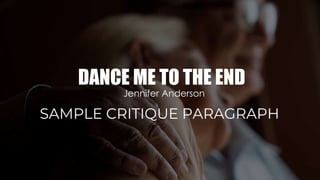
DANCE ME TO THE END
Jennifer Anderson
SAMPLE CRITIQUE PARAGRAPH
Jennifer Anderson’s “Dance me to the End”
explores the theme of love defying old age.
Throughout the story, the grandmother is
depicted as helpless and has difficulty
speaking beyond “Yes. No. I suppose.” The
author describes her as a “terrible fish” gulping
for air, her old age restricting her speech.
SAMPLE CRITIQUE PARAGRAPH
However, towards the end, the
grandmother expressed her affection
towards the author with the endearment,
"my baby” as they held each other tight
and danced. The grandmother defied the
limitations of old age to express her love.
CRITIQUE PARAGRAPH
• Topic sentence (Argument)
• Evidence and explanation
• Concluding sentence
TOPIC SENTENCE
•States your argument for the entire
paragraph.
•It could be a description, analysis,
interpretation, or assessment of the work.
•Begins with the author’s name and the title
of the work.
TOPIC SENTENCE IDEAS
•What did you like about the story?
•What do you think is the theme of the
story?
•What do you think about the character/s?
•What imagery or symbols stood out to
you?
Jennifer Anderson’s “Dance me to the End”
explores the theme of love defying old age.
Throughout the story, the grandmother is
depicted as helpless and has difficulty
speaking beyond “Yes. No. I suppose.” The
author describes her as a “terrible fish” gulping
for air, her old age restricting her speech.
EVIDENCE and EXPLANATION
•Parts of the story that prove your point.
•You may use in-text citations or summaries
as pieces of evidence
•Make sure to explain the importance of
your evidence after presenting it
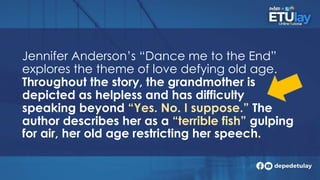
Jennifer Anderson’s “Dance me to the End”
explores the theme of love defying old age.
Throughout the story, the grandmother is
depicted as helpless and has difficulty
speaking beyond “Yes. No. I suppose.” The
author describes her as a “terrible fish” gulping
for air, her old age restricting her speech.
CONCLUDING SENTENCE
•Reinforces your topic sentence
•Reminds your readers about the
argument you are trying to prove
•Provides the closure we all need
However, towards the end, the
grandmother expressed her affection
towards the author with the endearment,
"my baby” as they held each other tight
and danced. The grandmother defied the
limitations of old age to express her love.
CHECKPOINT
• Determine which part of a
critique paragraph the
following descriptions are
referring to.
• Write your answers in the
comments section.
CHECKPOINT
A. Topic Sentence
B. Evidence and Explanation
C. Concluding Sentence
CHECKPOINT
A. Topic Sentence
B. Evidence and Explanation
C. Concluding Sentence
1. Begins with the
author’s name and the
title of the work.
CHECKPOINT
A. Topic Sentence
B. Evidence and Explanation
C. Concluding Sentence
2. Reminds your readers
about the argument
you are trying to prove
CHECKPOINT
A. Topic Sentence
B. Evidence and Explanation
C. Concluding Sentence
3. You may use in-text
citations or summaries
as pieces of evidence
WE USED TO BE
Kit Nadado
WE USED TO BE
He was sitting at the last bench on the last row
of the humid church building. I did not make
eye contact. I never tried. He would not
either. I’m sure.
However, I see him in my peripheral vision, his
expression somber.
Kit Nadado, 2019
WE USED TO BE
He looked tired. Three-days old worth of
mustache and scruff. His hair disheveled, a
little different than what he used to have.
He had great hair. I would tell him that. He
used to smile from across the building.
Kit Nadado, 2019
WE USED TO BE
We were really close. Like brothers. Best
friends, I think. At least from before.
I turned left towards the restrooms.
He was there.
Kit Nadado, 2019
WE USED TO BE
It was a narrow corridor. I couldn’t have
avoided him. I did not. We made eye
contact.
“Ui, kapatid,” I said.
“Kuya.”
Kit Nadado, 2019
WE USED TO BE
The hug was tentative. It was so fast it felt like
a blur. It was more of an obligation. Like he
did not have a choice. Like it never
happened.
He left and I kept walking.
I never looked back since.
Kit Nadado, 2019
WE USED TO BE
Kit Nadado
SAMPLE CRITIQUE PARAGRAPH
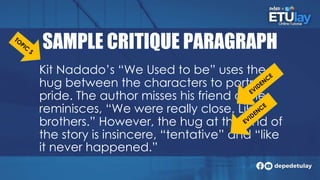
Kit Nadado’s “We Used to be” uses the
hug between the characters to portray
pride. The author misses his friend as he
reminisces, “We were really close. Like
brothers.” However, the hug at the end of
the story is insincere, “tentative” and “like
it never happened.”
SAMPLE CRITIQUE PARAGRAPH
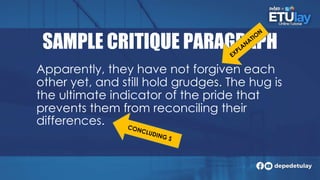
Apparently, they have not forgiven each
other yet, and still hold grudges. The hug is
the ultimate indicator of the pride that
prevents them from reconciling their
differences.
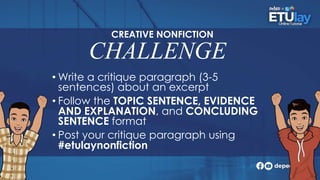
CHALLENGE
• Write a critique paragraph (3-5
sentences) about an excerpt
• Follow the TOPIC SENTENCE, EVIDENCE
AND EXPLANATION, and CONCLUDING
SENTENCE format
• Post your critique paragraph using
#etulaynonfiction
CREATIVE NONFICTION
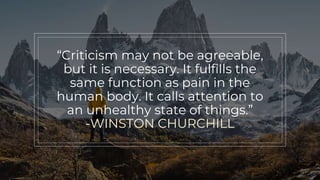
“Criticism may not be agreeable,
but it is necessary. It fulfills the
same function as pain in the
human body. It calls attention to
an unhealthy state of things.”
-WINSTON CHURCHILL
Creative-Nonfiction-Quarter 4- Session 1.pptx

Creative-Nonfiction-Quarter 4- Session 1.pptx

  • 3.
    TUESDAYS 4:00 – 4:40PM DepEd ETUlay DepEd ETUlay Quarter 4
  • 4.
    CREATIVE NONFICTION WEEK TOPIC 1The Critique 2 Critiquing Biographies and Autobiographies 3 Critiquing Personal Narratives 4 Critiquing Travelogues 5 Critiquing Blogs and Testimonies 6 Write a mini critique of a peer’s work 7 Write a draft of creative nonfiction piece based on memorable real-life experience 8 Quarter Wrap-up Quarter 4
  • 6.
    • Decide whetheryou like the following items or not. • In the comments section, type in one to two sentences telling the reason why you like the object or not.
  • 7.
  • 8.
  • 9.
  • 10.
  • 11.
    WHAT IS ACRITIQUE? NOUN: An analysis and evaluation of a subject, situation, literary work, etc. VERB: To analyze and evaluate a subject, situation, literary work, etc. (Webster’s New World College Dictionary, 4th Edition)
  • 12.
    WHAT IS ACRITIQUE? A critique is an opinion, supported by evidence, about the themes, setting, symbols, and other elements of a nonfiction piece. (libguides.dickinson.edu)
  • 13.
    I don’t likeampalaya because of its bitter taste.
  • 14.
    WHAT DOES ACRITIQUE DO? Describe: gives the reader a sense of the writer’s purpose Analyze: examine how the structure and language of the text convey meaning (hunter.cuny.edu)
  • 15.
    WHAT DOES ACRITIQUE DO? Interpret: state the significance or importance of each part of the text Assess: make a judgment of the work’s worth or value (hunter.cuny.edu)
  • 16.
    CRITIQUE VS CRITICIZE CRITIQUE •Well-rounded • Strengths and weaknesses • Examine and analyze • Provide perspective CRITICIZE • One -sided • Point out faults • Destroy
  • 17.
    CRITIQUE PARAGRAPH • Topicsentence (Argument) • Evidence and explanation • Concluding sentence
  • 18.
    DANCE ME TOTHE END Jennifer Anderson
  • 19.
    DANCE ME TOTHE END Four o’clock on a Friday afternoon. My grandmother slumps against the arm of the sofa, eyes half-closed, sinking down, down, down. The tips of her fingers graze the floor, and she moves them about, grasping at some hidden thing she keeps secret. Jennifer Anderson, 2019. Brevitymag.com
  • 20.
    DANCE ME TOTHE END Today is no different. She has just turned ninety. The dementia, the vision and hearing loss have made her close in on herself. She seldom speaks unless prompted. Her responses are brief. Yes. No. I suppose. Jennifer Anderson, 2019. Brevitymag.com
  • 21.
    DANCE ME TOTHE END Some days she parts her lips as if to talk. Gulping air, a terrible fish. She cannot find the words at all. It’s time for bed. Jennifer Anderson, 2019. Brevitymag.com
  • 22.
    DANCE ME TOTHE END She wraps her arms around me and rests her head on my shoulder. Dean Martin sings another standard, and we begin to sway. I rub her back, the sharp wings of her shoulders. She presses her cheek against the pulse in my throat. Jennifer Anderson, 2019. Brevitymag.com
  • 23.
    DANCE ME TOTHE END My baby, she murmurs. Beside us, there is a mirror on the bureau. I don’t need to look. We lean into each other, my grandmother and I, as if we have always moved together this way, holding each other so tight that we become one. Jennifer Anderson, 2019. Brevitymag.com
  • 24.
    DANCE ME TOTHE END Jennifer Anderson SAMPLE CRITIQUE PARAGRAPH
  • 25.
    SAMPLE CRITIQUE PARAGRAPH JenniferAnderson’s “Dance me to the End” explores the theme of love defying old age. Throughout the story, the grandmother is depicted as helpless and has difficulty speaking beyond “Yes. No. I suppose.” The author describes her as a “terrible fish” gulping for air, her old age restricting her speech.
  • 26.
    SAMPLE CRITIQUE PARAGRAPH However,towards the end, the grandmother expressed her affection towards the author with the endearment, "my baby” as they held each other tight and danced. The grandmother defied the limitations of old age to express her love.
  • 27.
    CRITIQUE PARAGRAPH • Topicsentence (Argument) • Evidence and explanation • Concluding sentence
  • 28.
    TOPIC SENTENCE •States yourargument for the entire paragraph. •It could be a description, analysis, interpretation, or assessment of the work. •Begins with the author’s name and the title of the work.
  • 29.
    TOPIC SENTENCE IDEAS •Whatdid you like about the story? •What do you think is the theme of the story? •What do you think about the character/s? •What imagery or symbols stood out to you?
  • 30.
    Jennifer Anderson’s “Danceme to the End” explores the theme of love defying old age. Throughout the story, the grandmother is depicted as helpless and has difficulty speaking beyond “Yes. No. I suppose.” The author describes her as a “terrible fish” gulping for air, her old age restricting her speech.
  • 31.
    EVIDENCE and EXPLANATION •Partsof the story that prove your point. •You may use in-text citations or summaries as pieces of evidence •Make sure to explain the importance of your evidence after presenting it
  • 32.
    Jennifer Anderson’s “Danceme to the End” explores the theme of love defying old age. Throughout the story, the grandmother is depicted as helpless and has difficulty speaking beyond “Yes. No. I suppose.” The author describes her as a “terrible fish” gulping for air, her old age restricting her speech.
  • 33.
    CONCLUDING SENTENCE •Reinforces yourtopic sentence •Reminds your readers about the argument you are trying to prove •Provides the closure we all need
  • 34.
    However, towards theend, the grandmother expressed her affection towards the author with the endearment, "my baby” as they held each other tight and danced. The grandmother defied the limitations of old age to express her love.
  • 37.
    CHECKPOINT • Determine whichpart of a critique paragraph the following descriptions are referring to. • Write your answers in the comments section.
  • 38.
    CHECKPOINT A. Topic Sentence B.Evidence and Explanation C. Concluding Sentence
  • 39.
    CHECKPOINT A. Topic Sentence B.Evidence and Explanation C. Concluding Sentence 1. Begins with the author’s name and the title of the work.
  • 40.
    CHECKPOINT A. Topic Sentence B.Evidence and Explanation C. Concluding Sentence 2. Reminds your readers about the argument you are trying to prove
  • 41.
    CHECKPOINT A. Topic Sentence B.Evidence and Explanation C. Concluding Sentence 3. You may use in-text citations or summaries as pieces of evidence
  • 42.
    WE USED TOBE Kit Nadado
  • 43.
    WE USED TOBE He was sitting at the last bench on the last row of the humid church building. I did not make eye contact. I never tried. He would not either. I’m sure. However, I see him in my peripheral vision, his expression somber. Kit Nadado, 2019
  • 44.
    WE USED TOBE He looked tired. Three-days old worth of mustache and scruff. His hair disheveled, a little different than what he used to have. He had great hair. I would tell him that. He used to smile from across the building. Kit Nadado, 2019
  • 45.
    WE USED TOBE We were really close. Like brothers. Best friends, I think. At least from before. I turned left towards the restrooms. He was there. Kit Nadado, 2019
  • 46.
    WE USED TOBE It was a narrow corridor. I couldn’t have avoided him. I did not. We made eye contact. “Ui, kapatid,” I said. “Kuya.” Kit Nadado, 2019
  • 47.
    WE USED TOBE The hug was tentative. It was so fast it felt like a blur. It was more of an obligation. Like he did not have a choice. Like it never happened. He left and I kept walking. I never looked back since. Kit Nadado, 2019
  • 48.
    WE USED TOBE Kit Nadado
  • 49.
    SAMPLE CRITIQUE PARAGRAPH KitNadado’s “We Used to be” uses the hug between the characters to portray pride. The author misses his friend as he reminisces, “We were really close. Like brothers.” However, the hug at the end of the story is insincere, “tentative” and “like it never happened.”
  • 50.
    SAMPLE CRITIQUE PARAGRAPH Apparently,they have not forgiven each other yet, and still hold grudges. The hug is the ultimate indicator of the pride that prevents them from reconciling their differences.
  • 51.
    CHALLENGE • Write acritique paragraph (3-5 sentences) about an excerpt • Follow the TOPIC SENTENCE, EVIDENCE AND EXPLANATION, and CONCLUDING SENTENCE format • Post your critique paragraph using #etulaynonfiction CREATIVE NONFICTION
  • 52.
    “Criticism may notbe agreeable, but it is necessary. It fulfills the same function as pain in the human body. It calls attention to an unhealthy state of things.” -WINSTON CHURCHILL