


Creative Leadership: A
Western Perspective
International Summit Forum
Development of Creative Leadership
Talents in the Process of Globalization
Shanghai Jiao Tong University
• 15 June 2014
• Donald C. Menzel, Ph.D
Creative Leadership:
A Western Perspective
Donald C. Menzel, Ph.D.
2005-06
President
American Society for Public
Administration
What, Why, How?
• What is creative leadership?
• Why is creative leadership important?
• How is creative leadership achieved?
Big Questions
• Can creativity be learned?
• Can leadership be learned?
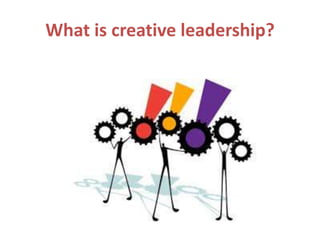
What is creative leadership?
• Creative
– Doing something different?
– Doing something better?
– Doing something no other has dared to do?
• Leadership
– Motivating others?
– Realizing a vision?
– Getting the job done?
Creativity
• Creativity and creative thinking have become
an essential life skill.
• Creativity is about more than imagination,
diversity in thought, or simply standing out as
different.
• Creativity is the ability to produce original
ideas that serve some value or solve some
problem.
“Creativity is intelligence having fun.” Albert Einstein
Creativity
• True creativity involves three ingredients—
novelty, usefulness and realization.
• Thus there is a close conceptual relationship
between creativity and problem solving.
• Leaders need to be creative problem solvers.
• Creativity and innovation are widely viewed as
fundamental to professional success.
Basics
• Leaders
• Managers
• Leaders vs Managers
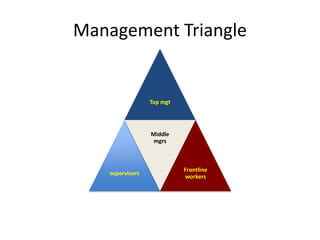
Management Triangle
Top mgt
supervisors
Middle
mgrs
Frontline
workers
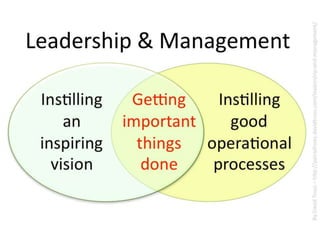
Managers as Leaders
• The manager does things right; the leader
does the right thing;
• The manager administers; the leader
innovates;
• The manager relies on control; the leader
inspires trust.
Why is creative leadership important?
• We are in an era of an unprecedented pace of
change that is innovation heavy.
• In the last 200 years there have been a total of 25
inventions, both social and technical, that have
qualitatively altered our lives—it took more than
3,000 years before 1800 to achieve the same
number of life-altering inventions.
• To deal successfully with complex and turbulent
times—Mastering complexity is key to creative
leadership.
Creative Work
• In 1900 less than 10% of the United States
population worked in what are considered
“creative” jobs, i.e., work that requires higher
order thinking and imagination. One hundred
years later this figure increased to 30%.
• Content on the worldwide web doubles every
18 months which has led to ubiquitous
availability of information.
Social Networking
• In the 20th century the term “social networking”
had no meaning—today, it’s mind boggling—with
Twitter, LinkedIn, Facebook, Instagram, Tumblr,
Flickr, Youtube, Pinterest
• Facebook has ~1.3 billion monthly active users
Confounding Factors
• Globalization & Revolution in Information
Technology
• Blurring of boundaries (private/public)
• End of Hierarchy
• Diversity
– Cultural
– Religious
– Race/Gender
• Situational/contextual
. . . More confounding factors
• Interdependency & networking
• Internet
• Individualism—empowerment
• Organizational complexity
What is creative leadership?
Types/Styles of Leadership
• Transactional—Henry Ford (Model-T)
• Transformational—Steve Jobs (Apple)
• Entrepreneurial—Bill Gates (Microsoft)/Mark
Zuckerberg (Facebook)
• Transcendent—Mohandas Gandhi & Nelson
Mandela
• Charismatic—Ronald Reagan (USA President)/Bill
Clinton (USA President)
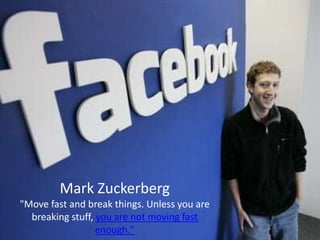
• Creative--??Mark Zuckerberg
"Move fast and break things. Unless you are
breaking stuff, you are not moving fast
enough."
Creative Leadership
• Creative leadership is highly relational,
grounded in process, utilizes diversity, requires
self-reflection and is focused on accomplishing
positive change
• Resides between transformational and
transcendent approaches
• More than individuals with vision
Creative Leadership
• . . . is the combination of creativity (the
ability to generate ideas) with leadership (the
ability to execute them through the actions
of others).
• Is the ability to deliberately engage one’s
imagination to define and guide a group
towards a novel goal—a direction that is new
for the group.
Creative Leadership
• Draws together three distinct but
interconnected constructs—creativity,
leadership, and innovation
• Creativity is believed to be the “catalyst to
innovation.”
• Is an improvisational and experimental art
How is creative leadership
achieved?
Leadership Development Programs
How is creative leadership achieved?
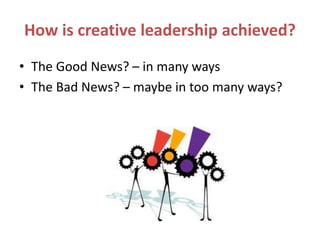
• The Good News? – in many ways
• The Bad News? – maybe in too many ways?
Basics
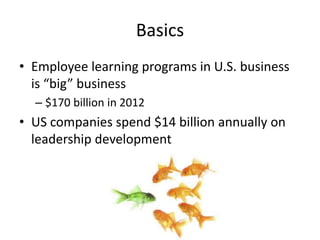
• Employee learning programs in U.S. business
is “big” business
– $170 billion in 2012
• US companies spend $14 billion annually on
leadership development
Creative Leaders
• What separates creative leaders from non-
creative leaders is their ability to generate and
execute innovative ideas.
• Traditional leaders tend to execute “tried-and-
true” strategies such as cost-cutting or
product extensions, but they rarely disrupt
their industries or create new product
categories.
Creative Leaders are . . .
• Humble yet visionary
• Able to recognize mistakes and transcend
them
• A master at empowering members of his/her
team to greater leadership
Qualities and Skills
• Tolerance for ambiguity
• Ability to assess and be comfortable with risk
• Ability to quickly and effectively assess an
individual
• Ability to balance passion and objectivity
• Ability to change
• Creative leaders are comfortable with
ambiguity and experimentation
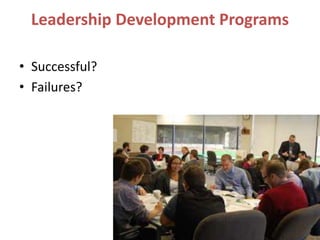
Leadership Development Programs
• Successful?
• Failures?
Successful Programs?
We just don’t know!!
Why do leadership development
programs fail?
1. Training – development is not equivalent to
training
2. Training focuses on best practices;
development focuses on next practices.
3. Training is often a rote, one size fits all
4. Training usually occurs within a vacuum
driven by past experience, not by future
needs
Why leadership development
programs fail?
• Training focuses on maintenance;
development focuses on growth
• Training encourages compliance; development
emphasizes performance
• Training places people in a box; development
fees them from the box
• Training places people in a comfort zone;
development moves people beyond comfort
zones
Four Common Mistakes
1. Overlooking context—a brilliant leader in one
situation does not necessarily perform well in
another.
2. Decoupling reflection from real work
– Onsite vs off-site programs
3. Underestimating mind-sets
– Changing behavior means changing mind-sets
4. Failing to measure results
– Begins and ends with participant feedback (not sufficient)
– Monitor participants’ career development after the
training
Creative Leadership:
A Western Perspective
Donald C. Menzel, Ph.D.
2005-06
President
American Society for Public
Administration
Sources
• David C. Bauman, “Leadership and the Three Faces of Integrity” The
Leadership Quarterly 24 (2013) 414-426.
• Nicholas Clarke, “Model of Complexity Leadership Development.”
Human Resource Development International 2013. 16:2 (135-150).
• David V. Day, John W. Fleenor, Leanne E. Atwater, Rachel E. Sturm,
Rob A. McKee, “Advances in leaders and leadership development: A
review of 25 years of research and theory” The Leadership
Quarterly 25 (2014): 63-82.
• Jessica E. Dinh, Robert G. Lord, William L. Gardner, Jeremy D.
Meuser, Robert C. Liden, Jinyu Hu “Leadership Theory and Research
in the New Millennium: Current Theoretical Trends and Changing
Perspectives” The Leadership Quarterly 25 (2014): 36-62.
Sources
• Doug Guthrie, “Creative Leadership: Managing
Complexity to Achieve Alignment” Forbes
5/24/2012
• Gerard J. Puccio, Marie Mance, Jeffrey Zacko-
Smith, “Creative Leadership: Its Meaning and
Value for Science, Technology and Innovation.”
https://www.academia.edu/Documents/in/Creati
ve_Leadership
• Pierre Gurdjian, Thomas Halbeisen, and Kevin
Lane, “Why leadership-development programs
fail.” McKinsey Quarterly (January 2014)
Sources
• Mike Myatt, “The #1 Reason Leadership
Development Fails”
http://www.forbes.com/sites/mikemyatt/2012
/12/19/the-1-reason-leadership-
development-fails/
• Mike Myatt. “leadership Basics—5 Keys to
Success”
http://www.n2growth.com/blog/leadership-
basics/

Creative leadership: A Western Perspective

  • 1.
    Creative Leadership: A WesternPerspective International Summit Forum Development of Creative Leadership Talents in the Process of Globalization Shanghai Jiao Tong University • 15 June 2014 • Donald C. Menzel, Ph.D
  • 2.
    Creative Leadership: A WesternPerspective Donald C. Menzel, Ph.D. 2005-06 President American Society for Public Administration
  • 3.
    What, Why, How? •What is creative leadership? • Why is creative leadership important? • How is creative leadership achieved?
  • 4.
    Big Questions • Cancreativity be learned? • Can leadership be learned?
  • 5.
    What is creativeleadership? • Creative – Doing something different? – Doing something better? – Doing something no other has dared to do? • Leadership – Motivating others? – Realizing a vision? – Getting the job done?
  • 6.
    Creativity • Creativity andcreative thinking have become an essential life skill. • Creativity is about more than imagination, diversity in thought, or simply standing out as different. • Creativity is the ability to produce original ideas that serve some value or solve some problem.
  • 8.
    “Creativity is intelligencehaving fun.” Albert Einstein
  • 9.
    Creativity • True creativityinvolves three ingredients— novelty, usefulness and realization. • Thus there is a close conceptual relationship between creativity and problem solving. • Leaders need to be creative problem solvers. • Creativity and innovation are widely viewed as fundamental to professional success.
  • 10.
  • 11.
  • 12.
    Managers as Leaders •The manager does things right; the leader does the right thing; • The manager administers; the leader innovates; • The manager relies on control; the leader inspires trust.
  • 14.
    Why is creativeleadership important? • We are in an era of an unprecedented pace of change that is innovation heavy. • In the last 200 years there have been a total of 25 inventions, both social and technical, that have qualitatively altered our lives—it took more than 3,000 years before 1800 to achieve the same number of life-altering inventions. • To deal successfully with complex and turbulent times—Mastering complexity is key to creative leadership.
  • 15.
    Creative Work • In1900 less than 10% of the United States population worked in what are considered “creative” jobs, i.e., work that requires higher order thinking and imagination. One hundred years later this figure increased to 30%. • Content on the worldwide web doubles every 18 months which has led to ubiquitous availability of information.
  • 16.
    Social Networking • Inthe 20th century the term “social networking” had no meaning—today, it’s mind boggling—with Twitter, LinkedIn, Facebook, Instagram, Tumblr, Flickr, Youtube, Pinterest • Facebook has ~1.3 billion monthly active users
  • 17.
    Confounding Factors • Globalization& Revolution in Information Technology • Blurring of boundaries (private/public) • End of Hierarchy • Diversity – Cultural – Religious – Race/Gender • Situational/contextual
  • 18.
    . . .More confounding factors • Interdependency & networking • Internet • Individualism—empowerment • Organizational complexity
  • 19.
    What is creativeleadership?
  • 20.
    Types/Styles of Leadership •Transactional—Henry Ford (Model-T) • Transformational—Steve Jobs (Apple) • Entrepreneurial—Bill Gates (Microsoft)/Mark Zuckerberg (Facebook) • Transcendent—Mohandas Gandhi & Nelson Mandela • Charismatic—Ronald Reagan (USA President)/Bill Clinton (USA President) • Creative--??Mark Zuckerberg "Move fast and break things. Unless you are breaking stuff, you are not moving fast enough."
  • 21.
    Creative Leadership • Creativeleadership is highly relational, grounded in process, utilizes diversity, requires self-reflection and is focused on accomplishing positive change • Resides between transformational and transcendent approaches • More than individuals with vision
  • 22.
    Creative Leadership • .. . is the combination of creativity (the ability to generate ideas) with leadership (the ability to execute them through the actions of others). • Is the ability to deliberately engage one’s imagination to define and guide a group towards a novel goal—a direction that is new for the group.
  • 23.
    Creative Leadership • Drawstogether three distinct but interconnected constructs—creativity, leadership, and innovation • Creativity is believed to be the “catalyst to innovation.” • Is an improvisational and experimental art
  • 24.
    How is creativeleadership achieved? Leadership Development Programs
  • 25.
    How is creativeleadership achieved? • The Good News? – in many ways • The Bad News? – maybe in too many ways?
  • 26.
    Basics • Employee learningprograms in U.S. business is “big” business – $170 billion in 2012 • US companies spend $14 billion annually on leadership development
  • 27.
    Creative Leaders • Whatseparates creative leaders from non- creative leaders is their ability to generate and execute innovative ideas. • Traditional leaders tend to execute “tried-and- true” strategies such as cost-cutting or product extensions, but they rarely disrupt their industries or create new product categories.
  • 28.
    Creative Leaders are. . . • Humble yet visionary • Able to recognize mistakes and transcend them • A master at empowering members of his/her team to greater leadership
  • 29.
    Qualities and Skills •Tolerance for ambiguity • Ability to assess and be comfortable with risk • Ability to quickly and effectively assess an individual • Ability to balance passion and objectivity • Ability to change • Creative leaders are comfortable with ambiguity and experimentation
  • 30.
    Leadership Development Programs •Successful? • Failures?
  • 31.
  • 32.
    Why do leadershipdevelopment programs fail? 1. Training – development is not equivalent to training 2. Training focuses on best practices; development focuses on next practices. 3. Training is often a rote, one size fits all 4. Training usually occurs within a vacuum driven by past experience, not by future needs
  • 33.
    Why leadership development programsfail? • Training focuses on maintenance; development focuses on growth • Training encourages compliance; development emphasizes performance • Training places people in a box; development fees them from the box • Training places people in a comfort zone; development moves people beyond comfort zones
  • 34.
    Four Common Mistakes 1.Overlooking context—a brilliant leader in one situation does not necessarily perform well in another. 2. Decoupling reflection from real work – Onsite vs off-site programs 3. Underestimating mind-sets – Changing behavior means changing mind-sets 4. Failing to measure results – Begins and ends with participant feedback (not sufficient) – Monitor participants’ career development after the training
  • 35.
    Creative Leadership: A WesternPerspective Donald C. Menzel, Ph.D. 2005-06 President American Society for Public Administration
  • 36.
    Sources • David C.Bauman, “Leadership and the Three Faces of Integrity” The Leadership Quarterly 24 (2013) 414-426. • Nicholas Clarke, “Model of Complexity Leadership Development.” Human Resource Development International 2013. 16:2 (135-150). • David V. Day, John W. Fleenor, Leanne E. Atwater, Rachel E. Sturm, Rob A. McKee, “Advances in leaders and leadership development: A review of 25 years of research and theory” The Leadership Quarterly 25 (2014): 63-82. • Jessica E. Dinh, Robert G. Lord, William L. Gardner, Jeremy D. Meuser, Robert C. Liden, Jinyu Hu “Leadership Theory and Research in the New Millennium: Current Theoretical Trends and Changing Perspectives” The Leadership Quarterly 25 (2014): 36-62.
  • 37.
    Sources • Doug Guthrie,“Creative Leadership: Managing Complexity to Achieve Alignment” Forbes 5/24/2012 • Gerard J. Puccio, Marie Mance, Jeffrey Zacko- Smith, “Creative Leadership: Its Meaning and Value for Science, Technology and Innovation.” https://www.academia.edu/Documents/in/Creati ve_Leadership • Pierre Gurdjian, Thomas Halbeisen, and Kevin Lane, “Why leadership-development programs fail.” McKinsey Quarterly (January 2014)
  • 38.
    Sources • Mike Myatt,“The #1 Reason Leadership Development Fails” http://www.forbes.com/sites/mikemyatt/2012 /12/19/the-1-reason-leadership- development-fails/ • Mike Myatt. “leadership Basics—5 Keys to Success” http://www.n2growth.com/blog/leadership- basics/