


SURROUNDED BYGENIUS
PRACTICAL ADVICE ON CREATIVE LEADERSHIP
INTERACTIVE STRATEGIES 2015 | KELSEY RUGER #IS2015 #CREATIVELEADERSHIP
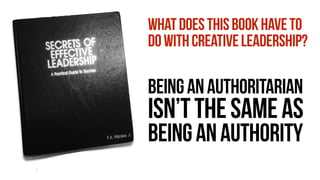
BEINGANAUTHORITARIAN
Isn’tthesameas
BEINGANAUTHORITY
WHATDOESTHISBOOKHAVETO
DOWITHCREATIVELEADERSHIP?
THERE ARE LEADERS AND THERE ARE THOSE
WHO LEAD. LEADERS HOLD A POSITION OF
POWER OR AUTHORITY, THOSE WHO LEAD
INSPIRE US. - SIMON SINEK
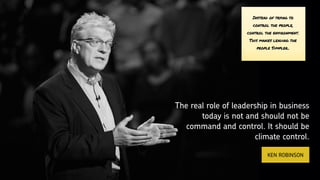
The real role of leadership in business
today is not and should not be
command and control. It should be
climate control.
KEN ROBINSON
Instead of trying to
control the people,
control the environment.
This makes leading the
people Simpler..
WHEN THE CLIMATE IS RIGHT, PEOPLE THRIVE & GROW.
You can’t force growth.
You can only create the
conditions where growth
can happen.
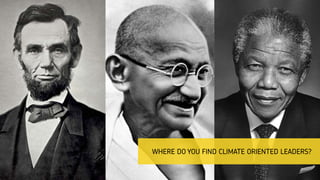
WHERE DO YOU FIND CLIMATE ORIENTED LEADERS?
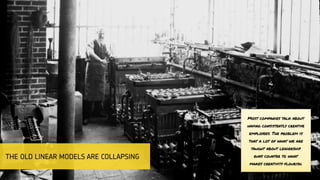
Most companies talk about
having consistently creative
employees. The problem is
that a lot of what we are
taught about leadership
runs counter to what
makes creativity flourish.
THE OLD LINEAR MODELS ARE COLLAPSING
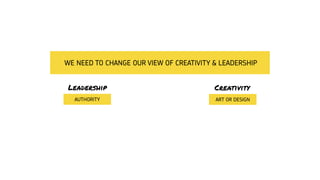
WE NEED TO CHANGE OUR VIEW OF CREATIVITY & LEADERSHIP
Leadership Creativity
WE NEED TO CHANGE OUR VIEW OF CREATIVITY & LEADERSHIP
Leadership Creativity
AUTHORITY ART OR DESIGN
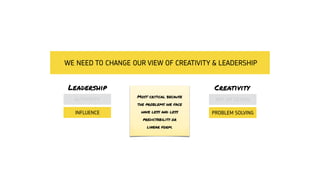
WE NEED TO CHANGE OUR VIEW OF CREATIVITY & LEADERSHIP
Leadership Creativity
AUTHORITY ART OR DESIGN
INFLUENCE PROBLEM SOLVING
Most critical because
the problems we face
have less and less
predictability or
linear form.
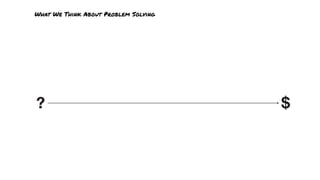
What We Think About Problem Solving
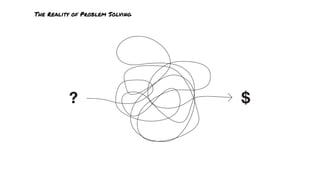
The Reality of Problem Solving
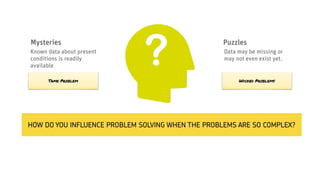
HOW DO YOU INFLUENCE PROBLEM SOLVING WHEN THE PROBLEMS ARE SO COMPLEX?
Mysteries
Known data about present
conditions is readily
available
Tame Problem
Puzzles
Data may be missing or
may not even exist yet.
Wicked Problems
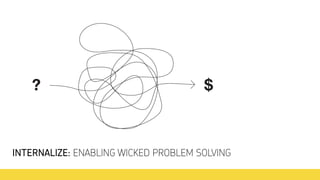
INTERNALIZE: ENABLING WICKED PROBLEM SOLVING
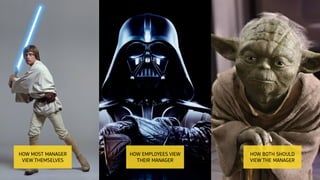
HOW MOST MANAGERS
VIEW THEMSELVES
HOW EMPLOYEES VIEW
THEIR MANAGER
HOW BOTH SHOULD
VIEW THE MANAGER
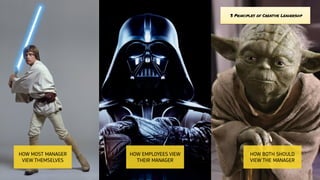
HOW MOST MANAGER
VIEW THEMSELVES
HOW EMPLOYEES VIEW
THEIR MANAGER
HOW BOTH SHOULD
VIEW THE MANAGER
3 Principles of Creative Leadership
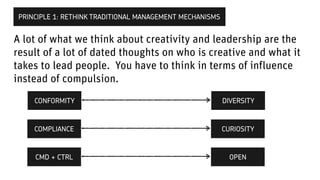
A lot of what we think about creativity and leadership are the
result of a lot of dated thoughts on who is creative and what it
takes to lead people. You have to think in terms of influence
instead of compulsion.
PRINCIPLE 1: RETHINK TRADITIONAL MANAGEMENT MECHANISMS
CONFORMITY
Why would you not do this
DIVERSITY
COMPLIANCE CURIOSITY
Why would you not do this
CMD + CTRL OPEN
Good process helps increase talent productivity. We avoid
replacing good management and communication with rules &
processes that cover up a problem instead of addressing it
directly. Instead we focus on processes that help talented
people get their work done.
PRINCIPLE 1: RETHINK TRADITIONAL MANAGEMENT MECHANISMS
Processes for the work, Leadership for the people
Just as process isn’t intended to replace the work that only a
manager can do, don’t use control where context would
produce a better result.
PRINCIPLE 1: RETHINK TRADITIONAL MANAGEMENT MECHANISMS
Drive Performance Through Context, Not Control
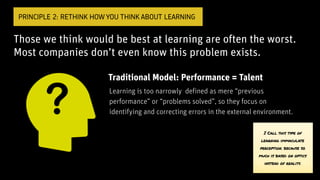
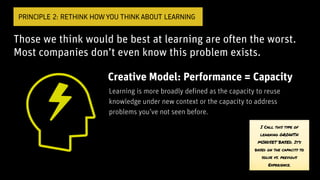
Those we think would be best at learning are often the worst.
Most companies don’t even know this problem exists.
PRINCIPLE 2: RETHINK HOW YOU THINK ABOUT LEARNING
Traditional Model: Performance = Talent
Learning is too narrowly defined as mere “previous
performance” or “problems solved”, so they focus on
identifying and correcting errors in the external environment.
I Call this type of
learning immaculate
perception. because so
much is based on optics
instead of reality.
Those we think would be best at learning are often the worst.
Most companies don’t even know this problem exists.
PRINCIPLE 2: RETHINK HOW YOU THINK ABOUT LEARNING
Creative Model: Performance = Capacity
Learning is more broadly defined as the capacity to reuse
knowledge under new context or the capacity to address
problems you’ve not seen before.
I Call this type of
learning GROWTH
MINDSET BASED. It’s
based on the capacity to
solve vs. previous
Experience.
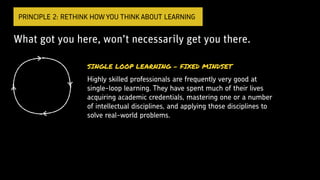
What got you here, won’t necessarily get you there.
PRINCIPLE 2: RETHINK HOW YOU THINK ABOUT LEARNING
SINGLE LOOP LEARNING - FIXED MINDSET
Highly skilled professionals are frequently very good at
single-loop learning. They have spent much of their lives
acquiring academic credentials, mastering one or a number
of intellectual disciplines, and applying those disciplines to
solve real-world problems.
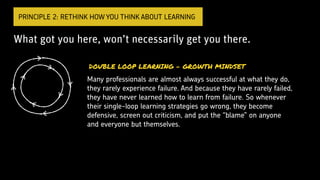
What got you here, won’t necessarily get you there.
PRINCIPLE 2: RETHINK HOW YOU THINK ABOUT LEARNING
DOUBLE LOOP LEARNING - GROWTH MINDSET
Many professionals are almost always successful at what they do,
they rarely experience failure. And because they have rarely failed,
they have never learned how to learn from failure. So whenever
their single-loop learning strategies go wrong, they become
defensive, screen out criticism, and put the “blame” on anyone
and everyone but themselves.
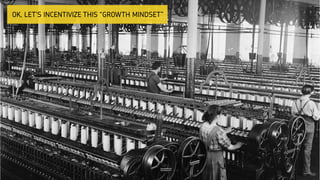
OK, LET’S INCENTIVIZE THIS “GROWTH MINDSET”
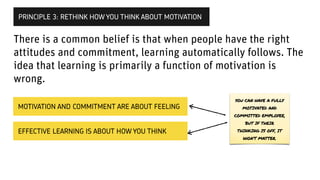
There is a common belief is that when people have the right
attitudes and commitment, learning automatically follows. The
idea that learning is primarily a function of motivation is
wrong.
PRINCIPLE 3: RETHINK HOW YOU THINK ABOUT MOTIVATION
MOTIVATION AND COMMITMENT ARE ABOUT FEELING
EFFECTIVE LEARNING IS ABOUT HOW YOU THINK
YOU CAN HAVE A FULLY
MOTIVATED AND
COMMITTED EMPLOYEE,
BUT IF THEIR
THINKING IS OFF, IT
WON’T MATTER.
CREATIVITY ISN’T ABOUT WHO YOU ARE IT’S
ABOUT WHAT YOU DO. MORE SPECIFICALLY,
HOW YOU THINK
EXTERNALIZE: PRINCIPLES TO BUILD A CLIMATE FOR CREATIVITY
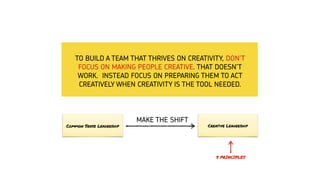
TO BUILD A TEAM THAT THRIVES ON CREATIVITY, DON’T
FOCUS ON MAKING PEOPLE CREATIVE. THAT DOESN’T
WORK. INSTEAD FOCUS ON PREPARING THEM TO ACT
CREATIVELY WHEN CREATIVITY IS THE TOOL NEEDED.
Common Sense Leadership Creative Leadership
MAKE THE SHIFT
5 PRINCIPLES
PRINCIPLE 1: TEMPORARY INCONVENIENCE FOR PERMANENT IMPROVEMENT
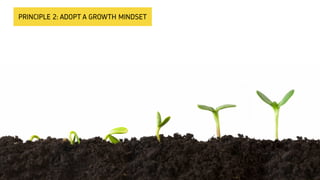
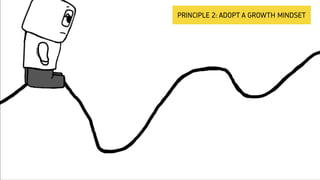
PRINCIPLE 2: ADOPT A GROWTH MINDSET
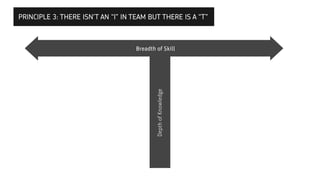
PRINCIPLE 3: THERE ISN’T AN “I” IN TEAM BUT THERE IS A “T”
DepthofKnowledge
Breadth of Skill
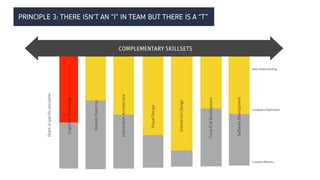
PRINCIPLE 3: THERE ISN’T AN “I” IN TEAM BUT THERE IS A “T”
Front-EndDevelopment
SoftwareDevelopment
VisualDesign
InteractionDesign
COMPLEMENTARY SKILLSETS
CognitivePsychology
DomainExpertise
InformationArchitecture
Depthofspecificdiscipline
Basic Understanding
Competent Application
Complete Mastery
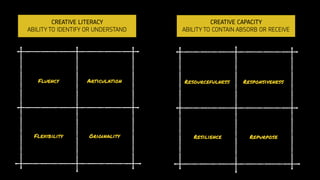
PRINCIPLE 4: INCREASE YOUR CREATIVE LITERACY & CAPACITY
ArticulationFluency
Flexibility Originality
ResponsivenessResourcefulness
Resilience Repurpose
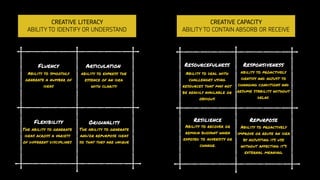
CREATIVE CAPACITY
ABILITY TO CONTAIN ABSORB OR RECEIVE
CREATIVE LITERACY
ABILITY TO IDENTIFY OR UNDERSTAND
ability to express the
essence of an idea
with clarity
Ability to smoothly
generate a number of
ideas
The ability to generate
ideas across a variety
of different disciplines
The ability to generate
and/or repurpose ideas
so that they are unique
CREATIVE CAPACITY
ABILITY TO CONTAIN ABSORB OR RECEIVE
ability to proactively
identify and adjust to
changing conditions and
resume stability without
delay.
Ability to deal with
challenges using
resources that may not
be readily available or
obvious
Ability to recover or
remain buoyant when
exposed to adversity or
change.
Ability to proactively
improve or reuse an idea
by adjusting its use
without affecting it’s
external meaning.
CREATIVE LITERACY
ABILITY TO IDENTIFY OR UNDERSTAND
ArticulationFluency
Flexibility Originality
ResponsivenessResourcefulness
Resilience Repurpose
Surrounded By Genius: Practical Advice On Creative Leadership

Surrounded By Genius: Practical Advice On Creative Leadership

  • 1.
    SURROUNDED BYGENIUS PRACTICAL ADVICEON CREATIVE LEADERSHIP INTERACTIVE STRATEGIES 2015 | KELSEY RUGER #IS2015 #CREATIVELEADERSHIP
  • 2.
  • 3.
    THERE ARE LEADERSAND THERE ARE THOSE WHO LEAD. LEADERS HOLD A POSITION OF POWER OR AUTHORITY, THOSE WHO LEAD INSPIRE US. - SIMON SINEK
  • 4.
    The real roleof leadership in business today is not and should not be command and control. It should be climate control. KEN ROBINSON Instead of trying to control the people, control the environment. This makes leading the people Simpler..
  • 5.
    WHEN THE CLIMATEIS RIGHT, PEOPLE THRIVE & GROW. You can’t force growth. You can only create the conditions where growth can happen.
  • 6.
    WHERE DO YOUFIND CLIMATE ORIENTED LEADERS?
  • 7.
    Most companies talkabout having consistently creative employees. The problem is that a lot of what we are taught about leadership runs counter to what makes creativity flourish. THE OLD LINEAR MODELS ARE COLLAPSING
  • 8.
    WE NEED TOCHANGE OUR VIEW OF CREATIVITY & LEADERSHIP Leadership Creativity
  • 9.
    WE NEED TOCHANGE OUR VIEW OF CREATIVITY & LEADERSHIP Leadership Creativity AUTHORITY ART OR DESIGN
  • 10.
    WE NEED TOCHANGE OUR VIEW OF CREATIVITY & LEADERSHIP Leadership Creativity AUTHORITY ART OR DESIGN INFLUENCE PROBLEM SOLVING Most critical because the problems we face have less and less predictability or linear form.
  • 11.
    What We ThinkAbout Problem Solving
  • 12.
    The Reality ofProblem Solving
  • 13.
    HOW DO YOUINFLUENCE PROBLEM SOLVING WHEN THE PROBLEMS ARE SO COMPLEX? Mysteries Known data about present conditions is readily available Tame Problem Puzzles Data may be missing or may not even exist yet. Wicked Problems
  • 14.
  • 15.
    HOW MOST MANAGERS VIEWTHEMSELVES HOW EMPLOYEES VIEW THEIR MANAGER HOW BOTH SHOULD VIEW THE MANAGER
  • 16.
    HOW MOST MANAGER VIEWTHEMSELVES HOW EMPLOYEES VIEW THEIR MANAGER HOW BOTH SHOULD VIEW THE MANAGER 3 Principles of Creative Leadership
  • 17.
    A lot ofwhat we think about creativity and leadership are the result of a lot of dated thoughts on who is creative and what it takes to lead people. You have to think in terms of influence instead of compulsion. PRINCIPLE 1: RETHINK TRADITIONAL MANAGEMENT MECHANISMS CONFORMITY Why would you not do this DIVERSITY COMPLIANCE CURIOSITY Why would you not do this CMD + CTRL OPEN
  • 18.
    Good process helpsincrease talent productivity. We avoid replacing good management and communication with rules & processes that cover up a problem instead of addressing it directly. Instead we focus on processes that help talented people get their work done. PRINCIPLE 1: RETHINK TRADITIONAL MANAGEMENT MECHANISMS Processes for the work, Leadership for the people
  • 19.
    Just as processisn’t intended to replace the work that only a manager can do, don’t use control where context would produce a better result. PRINCIPLE 1: RETHINK TRADITIONAL MANAGEMENT MECHANISMS Drive Performance Through Context, Not Control
  • 20.
    Those we thinkwould be best at learning are often the worst. Most companies don’t even know this problem exists. PRINCIPLE 2: RETHINK HOW YOU THINK ABOUT LEARNING Traditional Model: Performance = Talent Learning is too narrowly defined as mere “previous performance” or “problems solved”, so they focus on identifying and correcting errors in the external environment. I Call this type of learning immaculate perception. because so much is based on optics instead of reality.
  • 21.
    Those we thinkwould be best at learning are often the worst. Most companies don’t even know this problem exists. PRINCIPLE 2: RETHINK HOW YOU THINK ABOUT LEARNING Creative Model: Performance = Capacity Learning is more broadly defined as the capacity to reuse knowledge under new context or the capacity to address problems you’ve not seen before. I Call this type of learning GROWTH MINDSET BASED. It’s based on the capacity to solve vs. previous Experience.
  • 22.
    What got youhere, won’t necessarily get you there. PRINCIPLE 2: RETHINK HOW YOU THINK ABOUT LEARNING SINGLE LOOP LEARNING - FIXED MINDSET Highly skilled professionals are frequently very good at single-loop learning. They have spent much of their lives acquiring academic credentials, mastering one or a number of intellectual disciplines, and applying those disciplines to solve real-world problems.
  • 23.
    What got youhere, won’t necessarily get you there. PRINCIPLE 2: RETHINK HOW YOU THINK ABOUT LEARNING DOUBLE LOOP LEARNING - GROWTH MINDSET Many professionals are almost always successful at what they do, they rarely experience failure. And because they have rarely failed, they have never learned how to learn from failure. So whenever their single-loop learning strategies go wrong, they become defensive, screen out criticism, and put the “blame” on anyone and everyone but themselves.
  • 24.
    OK, LET’S INCENTIVIZETHIS “GROWTH MINDSET”
  • 25.
    There is acommon belief is that when people have the right attitudes and commitment, learning automatically follows. The idea that learning is primarily a function of motivation is wrong. PRINCIPLE 3: RETHINK HOW YOU THINK ABOUT MOTIVATION MOTIVATION AND COMMITMENT ARE ABOUT FEELING EFFECTIVE LEARNING IS ABOUT HOW YOU THINK YOU CAN HAVE A FULLY MOTIVATED AND COMMITTED EMPLOYEE, BUT IF THEIR THINKING IS OFF, IT WON’T MATTER.
  • 26.
    CREATIVITY ISN’T ABOUTWHO YOU ARE IT’S ABOUT WHAT YOU DO. MORE SPECIFICALLY, HOW YOU THINK
  • 27.
    EXTERNALIZE: PRINCIPLES TOBUILD A CLIMATE FOR CREATIVITY
  • 28.
    TO BUILD ATEAM THAT THRIVES ON CREATIVITY, DON’T FOCUS ON MAKING PEOPLE CREATIVE. THAT DOESN’T WORK. INSTEAD FOCUS ON PREPARING THEM TO ACT CREATIVELY WHEN CREATIVITY IS THE TOOL NEEDED. Common Sense Leadership Creative Leadership MAKE THE SHIFT 5 PRINCIPLES
  • 29.
    PRINCIPLE 1: TEMPORARYINCONVENIENCE FOR PERMANENT IMPROVEMENT
  • 30.
    PRINCIPLE 2: ADOPTA GROWTH MINDSET
  • 31.
    PRINCIPLE 2: ADOPTA GROWTH MINDSET
  • 32.
    PRINCIPLE 3: THEREISN’T AN “I” IN TEAM BUT THERE IS A “T” DepthofKnowledge Breadth of Skill
  • 33.
    PRINCIPLE 3: THEREISN’T AN “I” IN TEAM BUT THERE IS A “T” Front-EndDevelopment SoftwareDevelopment VisualDesign InteractionDesign COMPLEMENTARY SKILLSETS CognitivePsychology DomainExpertise InformationArchitecture Depthofspecificdiscipline Basic Understanding Competent Application Complete Mastery
  • 34.
    PRINCIPLE 4: INCREASEYOUR CREATIVE LITERACY & CAPACITY
  • 35.
    ArticulationFluency Flexibility Originality ResponsivenessResourcefulness Resilience Repurpose CREATIVECAPACITY ABILITY TO CONTAIN ABSORB OR RECEIVE CREATIVE LITERACY ABILITY TO IDENTIFY OR UNDERSTAND
  • 36.
    ability to expressthe essence of an idea with clarity Ability to smoothly generate a number of ideas The ability to generate ideas across a variety of different disciplines The ability to generate and/or repurpose ideas so that they are unique CREATIVE CAPACITY ABILITY TO CONTAIN ABSORB OR RECEIVE ability to proactively identify and adjust to changing conditions and resume stability without delay. Ability to deal with challenges using resources that may not be readily available or obvious Ability to recover or remain buoyant when exposed to adversity or change. Ability to proactively improve or reuse an idea by adjusting its use without affecting it’s external meaning. CREATIVE LITERACY ABILITY TO IDENTIFY OR UNDERSTAND ArticulationFluency Flexibility Originality ResponsivenessResourcefulness Resilience Repurpose