Topic 4
Leadership: Intelligence
and Creativity
How do Intelligence and
Creativity Affect Leadership?
Cognitive Ability and
Knowledge of Business
 Leaders need to have cognitive
ability to formulate suitable
strategies, solve problems, and
make correct decisions
 Effective leaders have
knowledge about the company,
industry, and technical matters
SUPER
Intelligence
 Intelligence is a person’s all-
around effectiveness in activities
directed by thought.
 Intelligence is relatively difficult to
change.
 Intelligence can be and is modified
through education and experience.
Intelligence and Leadership
 Intelligent leaders:
 Are faster learners.
 Make better assumptions, deductions, and
inferences.
 Are better at creating a compelling vision and
developing strategies to make their vision a reality.
 Can develop better solutions to problems.
 Can see more of the primary and secondary
implications of their decisions.
 Are quicker on their feet than leaders who are less
intelligent.
Theories assessing the nature
of intelligence:
 Intelligence is a unitary ability.
 Intelligence involves a collection of
related mental abilities.
 Intelligence is based more on the
process by which people do complex
work rather than the number of mental
abilities.
The unitary view
 The unitary view is founded on
findings early in this century that
individuals’ scores on different
types of intelligence were all
positively correlated – a person
doing well on a vocabulary test was
likely to do well on a memory or
numeric reasoning test and vice
versa.
The multiple
intelligence’s view
 The multiple intelligence’s view is
based on common observations of
people and finds that every person
possesses linguistic, musical, logical-
mathematical, spatial, bodily-
kinesthetic, intrapersonal, and
interpersonal intelligence.
Sternberg’s Triarchic Theory
of Intelligence
 Analytic Intelligence
 Practical Intelligence
 Creative Intelligence
Cognitive Resource Theory
Concerns
 The apparent dichotomy between intelligence and
experience:
 Research showed not only that many leaders were
both intelligent and experienced, but also that they
would fall back on their experience in stressful
situations and use their intelligence to solve group
problems in less-stressful situations.
 The leader’s ability to tolerate stress:
 Leaders may do well in high-stress situations even
when they lack experience because of their inherent
ability to handle stress.
Copyright © Houghton Mifflin Company. All rights reserved. 2–11
Cognitive Factors
 Cognition refers to the mental process or
faculty by which knowledge is gathered
 Leaders must have problem-solving and
intellectual skills to effectively gather,
process, and store essential information
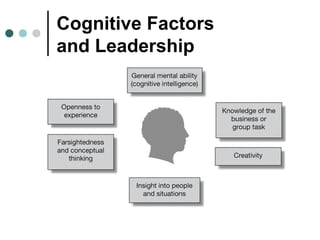
 Six cognitive factors related to leadership
effectiveness have been identified
Cognitive Factors
and Leadership
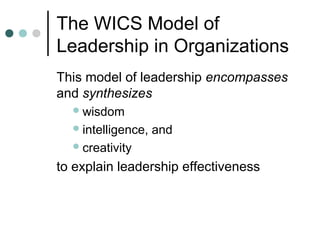
The WICS Model of
Leadership in Organizations
This model of leadership encompasses
and synthesizes
wisdom
intelligence, and
creativity
to explain leadership effectiveness
Copyright © Houghton Mifflin Company. All rights reserved. 2–14
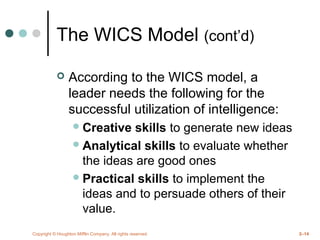
The WICS Model (cont’d)
 According to the WICS model, a
leader needs the following for the
successful utilization of intelligence:
Creative skills to generate new ideas
Analytical skills to evaluate whether
the ideas are good ones
Practical skills to implement the
ideas and to persuade others of their
value.
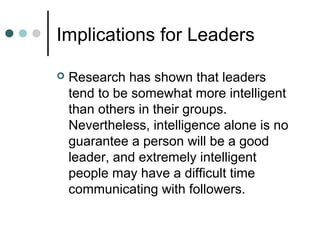
Implications for Leaders
 Research has shown that leaders
tend to be somewhat more intelligent
than others in their groups.
Nevertheless, intelligence alone is no
guarantee a person will be a good
leader, and extremely intelligent
people may have a difficult time
communicating with followers.
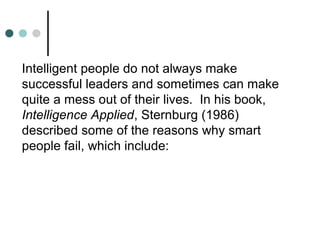
Intelligent people do not always make
successful leaders and sometimes can make
quite a mess out of their lives. In his book,
Intelligence Applied, Sternburg (1986)
described some of the reasons why smart
people fail, which include:
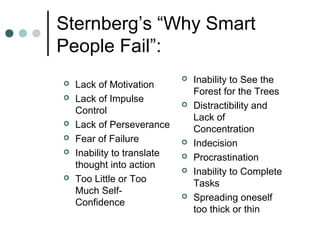
Sternberg’s “Why Smart
People Fail”:
 Lack of Motivation
 Lack of Impulse
Control
 Lack of Perseverance
 Fear of Failure
 Inability to translate
thought into action
 Too Little or Too
Much Self-
Confidence
 Inability to See the
Forest for the Trees
 Distractibility and
Lack of
Concentration
 Indecision
 Procrastination
 Inability to Complete
Tasks
 Spreading oneself
too thick or thin
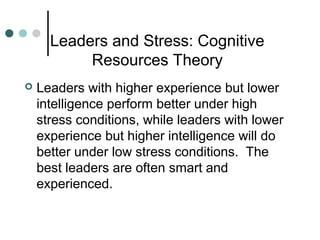
Leaders and Stress: Cognitive
Resources Theory
 Leaders with higher experience but lower
intelligence perform better under high
stress conditions, while leaders with lower
experience but higher intelligence will do
better under low stress conditions. The
best leaders are often smart and
experienced.
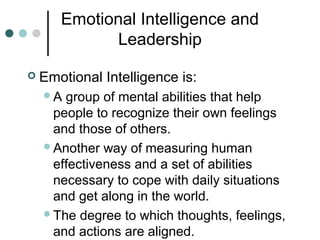
Emotional Intelligence and
Leadership
 Emotional Intelligence is:
A group of mental abilities that help
people to recognize their own feelings
and those of others.
Another way of measuring human
effectiveness and a set of abilities
necessary to cope with daily situations
and get along in the world.
The degree to which thoughts, feelings,
and actions are aligned.
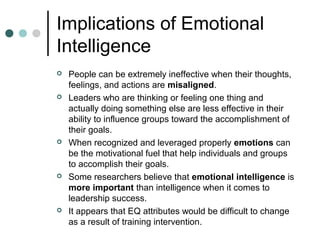
Implications of Emotional
Intelligence
 People can be extremely ineffective when their thoughts,
feelings, and actions are misaligned.
 Leaders who are thinking or feeling one thing and
actually doing something else are less effective in their
ability to influence groups toward the accomplishment of
their goals.
 When recognized and leveraged properly emotions can
be the motivational fuel that help individuals and groups
to accomplish their goals.
 Some researchers believe that emotional intelligence is
more important than intelligence when it comes to
leadership success.
 It appears that EQ attributes would be difficult to change
as a result of training intervention.
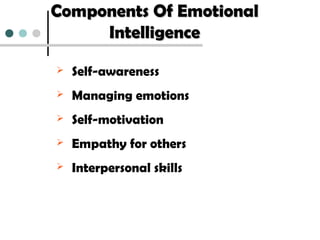
Components Of EmotionalComponents Of Emotional
IntelligenceIntelligence
 Self-awareness
 Managing emotions
 Self-motivation
 Empathy for others
 Interpersonal skills
Emotional Intelligence
What’s your Emotional Quotient?
EQ
Handout
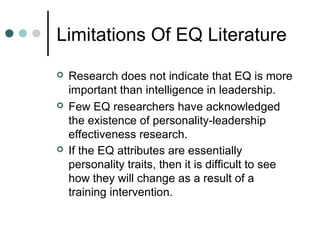
Limitations Of EQ Literature
 Research does not indicate that EQ is more
important than intelligence in leadership.
 Few EQ researchers have acknowledged
the existence of personality-leadership
effectiveness research.
 If the EQ attributes are essentially
personality traits, then it is difficult to see
how they will change as a result of a
training intervention.
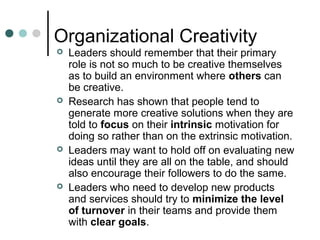
Organizational Creativity
 Leaders should remember that their primary
role is not so much to be creative themselves
as to build an environment where others can
be creative.
 Research has shown that people tend to
generate more creative solutions when they are
told to focus on their intrinsic motivation for
doing so rather than on the extrinsic motivation.
 Leaders may want to hold off on evaluating new
ideas until they are all on the table, and should
also encourage their followers to do the same.
 Leaders who need to develop new products
and services should try to minimize the level
of turnover in their teams and provide them
with clear goals.
Creativity and Leadership
 Organizations not only solve problems
which require the use of proven
procedures; they must apply
innovative solutions to unexpected
situations.
What is Creativity?
 Also known as divergent thinking,
creativity involves seeing things from
a new perspective. Intelligence is a
necessary but not sufficient condition
for creativity. Tests of creativity have
many possible answers and have no
hard and fast standards for judging
responses.
The Components of
Creativity
 Creativity is composed of expertise
(knowledge base from which to
generate solutions), imaginative
thinking (ability to recognize new
connections or patterns), and intrinsic
motivation (interest or satisfaction in
solving the problem for its own sake).
Blocks to Creativity
 Lack of technical expertise ,concern
about evaluation of ideas, focus on
extrinsic motivation, and lack of
autonomy may stifle creativity.
Steps for Improving
Creativity
 Look at things from as many
perspectives as possible. Use
analogies (synectics technique) or
pictures. Use power relationships
constructively to enhance creativity.
Be receptive to new ideas, encourage
open expression, reward successes,
and empower followers. Form diverse
problem solving groups.
Implications for Leaders
 Being a good leader in today’s
dynamic environment means being
creative or at least stimulating and
nurturing creativity in others. A clear
vision of the goal or goals is needed in
managing creativity.
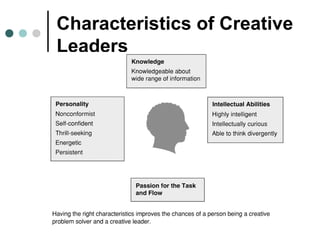
Characteristics Of Creative LeadersCharacteristics Of Creative Leaders
Perseverance when facing
obstacles
Self-confidence
Willingness to take risks
Willingness to grow and openness
to new experiences
Tolerance for ambiguity
Creativity and Innovation
 Creativity is the production of novel and
useful ideas
 Innovation refers to the creation of new
ideas and their implementation
 Organizational creativity is the creation of a
valuable, useful new product, service, idea,
procedure, or process by individuals
working together in a complex social system
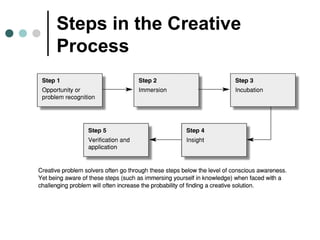
Steps in the Creative
Process
Characteristics of Creative
Leaders
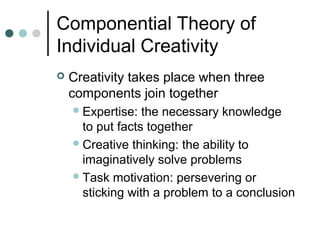
Componential Theory of
Individual Creativity
 Creativity takes place when three
components join together
Expertise: the necessary knowledge
to put facts together
Creative thinking: the ability to
imaginatively solve problems
Task motivation: persevering or
sticking with a problem to a conclusion
Outside the Box Thinking
A box in this sense is a category that
confines and restricts thinking. A creative
person is not confined to a box, but sees
opportunities outside the box.
A box in this sense is a category that
confines and restricts thinking. A creative
person is not confined to a box, but sees
opportunities outside the box.
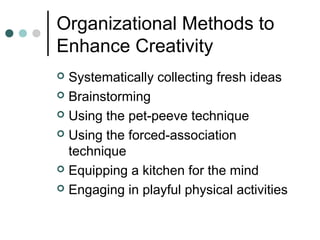
Organizational Methods to
Enhance Creativity
 Systematically collecting fresh ideas
 Brainstorming
 Using the pet-peeve technique
 Using the forced-association
technique
 Equipping a kitchen for the mind
 Engaging in playful physical activities
Leadership Practices for
Enhancing Creativity
1. Intellectual challenge
2. Freedom to choose the method
3. Ample supply of the right resources
4. Effective design of work groups
5. Supervisory encouragement
6. Organizational support
7. Having favorable exchanges with creative
workers
8. Leaders as talent magnets
Methods of Managing
Creative Workers
 Give creative people tools and resources
that allow their work to stand out
 Give creative people flexibility and a
minimum amount of structure
 Give gentle feedback when turning down an
idea
 Employ creative people to manage and
evaluate creative workers
Leadership Initiatives to
Enhance Innovation
 Continually pursue innovation
 Take risks and encourage risk taking
 Acquire innovative companies
 Avoid innovation for its own sake
 Loose-tight leadership enhances creativity
and innovation
 Integrate development and production
 Encourage people across divisions to share
ideas
Summary
 A creative leader brings forth ideas for
things that did not exist previously
 The creative process involves five
steps: opportunity or problem
recognition, immersion, incubation,
insight, and verification and
application
Summary (cont’d)
 Creative people have five distinguishing
characteristics: knowledge, intellectual
ability, personality, and passion for the task
and the experience of flow
 Creativity requires overcoming traditional
thinking
 There are several organizational and self-
help techniques to enhance creative
thinking and problem-solving
Summary (cont’d)
 Effective leadership requires
establishing a climate conducive to
creative problem-solving
 Special attention should be paid to
managing creative workers
 Leaders can enhance innovation
through several initiatives

باوردی

  • 1.
  • 2.
    How do Intelligenceand Creativity Affect Leadership?
  • 3.
    Cognitive Ability and Knowledgeof Business  Leaders need to have cognitive ability to formulate suitable strategies, solve problems, and make correct decisions  Effective leaders have knowledge about the company, industry, and technical matters SUPER
  • 4.
    Intelligence  Intelligence isa person’s all- around effectiveness in activities directed by thought.  Intelligence is relatively difficult to change.  Intelligence can be and is modified through education and experience.
  • 5.
    Intelligence and Leadership Intelligent leaders:  Are faster learners.  Make better assumptions, deductions, and inferences.  Are better at creating a compelling vision and developing strategies to make their vision a reality.  Can develop better solutions to problems.  Can see more of the primary and secondary implications of their decisions.  Are quicker on their feet than leaders who are less intelligent.
  • 6.
    Theories assessing thenature of intelligence:  Intelligence is a unitary ability.  Intelligence involves a collection of related mental abilities.  Intelligence is based more on the process by which people do complex work rather than the number of mental abilities.
  • 7.
    The unitary view The unitary view is founded on findings early in this century that individuals’ scores on different types of intelligence were all positively correlated – a person doing well on a vocabulary test was likely to do well on a memory or numeric reasoning test and vice versa.
  • 8.
    The multiple intelligence’s view The multiple intelligence’s view is based on common observations of people and finds that every person possesses linguistic, musical, logical- mathematical, spatial, bodily- kinesthetic, intrapersonal, and interpersonal intelligence.
  • 9.
    Sternberg’s Triarchic Theory ofIntelligence  Analytic Intelligence  Practical Intelligence  Creative Intelligence
  • 10.
    Cognitive Resource Theory Concerns The apparent dichotomy between intelligence and experience:  Research showed not only that many leaders were both intelligent and experienced, but also that they would fall back on their experience in stressful situations and use their intelligence to solve group problems in less-stressful situations.  The leader’s ability to tolerate stress:  Leaders may do well in high-stress situations even when they lack experience because of their inherent ability to handle stress.
  • 11.
    Copyright © HoughtonMifflin Company. All rights reserved. 2–11 Cognitive Factors  Cognition refers to the mental process or faculty by which knowledge is gathered  Leaders must have problem-solving and intellectual skills to effectively gather, process, and store essential information  Six cognitive factors related to leadership effectiveness have been identified
  • 12.
  • 13.
    The WICS Modelof Leadership in Organizations This model of leadership encompasses and synthesizes wisdom intelligence, and creativity to explain leadership effectiveness
  • 14.
    Copyright © HoughtonMifflin Company. All rights reserved. 2–14 The WICS Model (cont’d)  According to the WICS model, a leader needs the following for the successful utilization of intelligence: Creative skills to generate new ideas Analytical skills to evaluate whether the ideas are good ones Practical skills to implement the ideas and to persuade others of their value.
  • 15.
    Implications for Leaders Research has shown that leaders tend to be somewhat more intelligent than others in their groups. Nevertheless, intelligence alone is no guarantee a person will be a good leader, and extremely intelligent people may have a difficult time communicating with followers.
  • 16.
    Intelligent people donot always make successful leaders and sometimes can make quite a mess out of their lives. In his book, Intelligence Applied, Sternburg (1986) described some of the reasons why smart people fail, which include:
  • 17.
    Sternberg’s “Why Smart PeopleFail”:  Lack of Motivation  Lack of Impulse Control  Lack of Perseverance  Fear of Failure  Inability to translate thought into action  Too Little or Too Much Self- Confidence  Inability to See the Forest for the Trees  Distractibility and Lack of Concentration  Indecision  Procrastination  Inability to Complete Tasks  Spreading oneself too thick or thin
  • 18.
    Leaders and Stress:Cognitive Resources Theory  Leaders with higher experience but lower intelligence perform better under high stress conditions, while leaders with lower experience but higher intelligence will do better under low stress conditions. The best leaders are often smart and experienced.
  • 19.
    Emotional Intelligence and Leadership Emotional Intelligence is: A group of mental abilities that help people to recognize their own feelings and those of others. Another way of measuring human effectiveness and a set of abilities necessary to cope with daily situations and get along in the world. The degree to which thoughts, feelings, and actions are aligned.
  • 20.
    Implications of Emotional Intelligence People can be extremely ineffective when their thoughts, feelings, and actions are misaligned.  Leaders who are thinking or feeling one thing and actually doing something else are less effective in their ability to influence groups toward the accomplishment of their goals.  When recognized and leveraged properly emotions can be the motivational fuel that help individuals and groups to accomplish their goals.  Some researchers believe that emotional intelligence is more important than intelligence when it comes to leadership success.  It appears that EQ attributes would be difficult to change as a result of training intervention.
  • 21.
    Components Of EmotionalComponentsOf Emotional IntelligenceIntelligence  Self-awareness  Managing emotions  Self-motivation  Empathy for others  Interpersonal skills
  • 22.
    Emotional Intelligence What’s yourEmotional Quotient? EQ Handout
  • 23.
    Limitations Of EQLiterature  Research does not indicate that EQ is more important than intelligence in leadership.  Few EQ researchers have acknowledged the existence of personality-leadership effectiveness research.  If the EQ attributes are essentially personality traits, then it is difficult to see how they will change as a result of a training intervention.
  • 24.
    Organizational Creativity  Leadersshould remember that their primary role is not so much to be creative themselves as to build an environment where others can be creative.  Research has shown that people tend to generate more creative solutions when they are told to focus on their intrinsic motivation for doing so rather than on the extrinsic motivation.  Leaders may want to hold off on evaluating new ideas until they are all on the table, and should also encourage their followers to do the same.  Leaders who need to develop new products and services should try to minimize the level of turnover in their teams and provide them with clear goals.
  • 25.
    Creativity and Leadership Organizations not only solve problems which require the use of proven procedures; they must apply innovative solutions to unexpected situations.
  • 26.
    What is Creativity? Also known as divergent thinking, creativity involves seeing things from a new perspective. Intelligence is a necessary but not sufficient condition for creativity. Tests of creativity have many possible answers and have no hard and fast standards for judging responses.
  • 27.
    The Components of Creativity Creativity is composed of expertise (knowledge base from which to generate solutions), imaginative thinking (ability to recognize new connections or patterns), and intrinsic motivation (interest or satisfaction in solving the problem for its own sake).
  • 28.
    Blocks to Creativity Lack of technical expertise ,concern about evaluation of ideas, focus on extrinsic motivation, and lack of autonomy may stifle creativity.
  • 29.
    Steps for Improving Creativity Look at things from as many perspectives as possible. Use analogies (synectics technique) or pictures. Use power relationships constructively to enhance creativity. Be receptive to new ideas, encourage open expression, reward successes, and empower followers. Form diverse problem solving groups.
  • 30.
    Implications for Leaders Being a good leader in today’s dynamic environment means being creative or at least stimulating and nurturing creativity in others. A clear vision of the goal or goals is needed in managing creativity.
  • 31.
    Characteristics Of CreativeLeadersCharacteristics Of Creative Leaders Perseverance when facing obstacles Self-confidence Willingness to take risks Willingness to grow and openness to new experiences Tolerance for ambiguity
  • 32.
    Creativity and Innovation Creativity is the production of novel and useful ideas  Innovation refers to the creation of new ideas and their implementation  Organizational creativity is the creation of a valuable, useful new product, service, idea, procedure, or process by individuals working together in a complex social system
  • 33.
    Steps in theCreative Process
  • 34.
  • 35.
    Componential Theory of IndividualCreativity  Creativity takes place when three components join together Expertise: the necessary knowledge to put facts together Creative thinking: the ability to imaginatively solve problems Task motivation: persevering or sticking with a problem to a conclusion
  • 36.
    Outside the BoxThinking A box in this sense is a category that confines and restricts thinking. A creative person is not confined to a box, but sees opportunities outside the box. A box in this sense is a category that confines and restricts thinking. A creative person is not confined to a box, but sees opportunities outside the box.
  • 37.
    Organizational Methods to EnhanceCreativity  Systematically collecting fresh ideas  Brainstorming  Using the pet-peeve technique  Using the forced-association technique  Equipping a kitchen for the mind  Engaging in playful physical activities
  • 38.
    Leadership Practices for EnhancingCreativity 1. Intellectual challenge 2. Freedom to choose the method 3. Ample supply of the right resources 4. Effective design of work groups 5. Supervisory encouragement 6. Organizational support 7. Having favorable exchanges with creative workers 8. Leaders as talent magnets
  • 39.
    Methods of Managing CreativeWorkers  Give creative people tools and resources that allow their work to stand out  Give creative people flexibility and a minimum amount of structure  Give gentle feedback when turning down an idea  Employ creative people to manage and evaluate creative workers
  • 40.
    Leadership Initiatives to EnhanceInnovation  Continually pursue innovation  Take risks and encourage risk taking  Acquire innovative companies  Avoid innovation for its own sake  Loose-tight leadership enhances creativity and innovation  Integrate development and production  Encourage people across divisions to share ideas
  • 41.
    Summary  A creativeleader brings forth ideas for things that did not exist previously  The creative process involves five steps: opportunity or problem recognition, immersion, incubation, insight, and verification and application
  • 42.
    Summary (cont’d)  Creativepeople have five distinguishing characteristics: knowledge, intellectual ability, personality, and passion for the task and the experience of flow  Creativity requires overcoming traditional thinking  There are several organizational and self- help techniques to enhance creative thinking and problem-solving
  • 43.
    Summary (cont’d)  Effectiveleadership requires establishing a climate conducive to creative problem-solving  Special attention should be paid to managing creative workers  Leaders can enhance innovation through several initiatives