The latest trend of entrepreneurial
education- How to encourage
entrepreneurial
Intention (and more)
Are we moving the needle in
entrepreneurship education?
How would we know?
Changing the deep beliefs in the
entrepreneurial mindset
Norris Krueger, PhD
Senior Research Fellow, Center for Management &
Entrepreneurship
School of Advanced Studies, University of Phoenix
How can I help YOU to help grow
a more entrepreneurial Japan?
Norris.krueger[at]gmail.com
@entrep_thinking
Facebook
LinkedIn
+1 208 440 3747 / WeChat / WhatsApp /Skype
• WHO are we changing?
– Target audience/learners
• WHAT are we trying to change?
– What IS this “mindset” anyway?
– How do we measure it?
• HOW do we make that happen?
– From learning about entrepreneurship to
BEING entrepreneurial?
“From learning about entrepreneurship
to learning to be entrepreneurial?”
Nothing less than a Copernican
revolution in entrepreneurial learning is
unfolding before us.
To those who want to really make a
difference:
• We know how to teach individuals (and
organizations and communities) to think
more entrepreneurially.
• We now understand why and how.
• How can we translate these insights into
helping communities worldwide?
Best programs in the world?
What do THEY do?
• Virtually none are university-based but…
– Chalmers, Stanford, Aalto…
– Venture creation programs
• Don’t incubate, accelerate?
– Startup Weekend
– Lean startup
– TechStars, et al. /Global Accelerator Network
– Y-Combinator /500 Startups /etc.
VET: www.NACCE.com
High School: http://steveblank.com/2013/02/28/the-lean-
launchpad-goes-to-high-school/
Key Premises
• #1. We assume that the “mindset” reflects
deep cognitive phenomena, particularly deep
beliefs and assumptions.
• #2. These only change through transformative
learning experiences.
• #3. We believe that a useful way to view
mindset-change is helping learners move from
a more novice mindset toward a more expert
mindset.
• Oversimplifying “slightly”, transformative learning
follows the constructivistic model of learning that
focuses on changing how we structure the
knowledge we have and acquire (versus the
behavioristic model that focuses on acquiring
factual knowledge.
• Note, however, that deep cognitive changes are
quite difficult to measure directly.
• But promising research has begun to assess
mindset change pre/post (wish me luck)
Find the Right Frame:
One Size Does Not Fit All
• Research evidence in EE is scary…
• Lack of theory
• Lack of education theory
• Theory gives us frameworks…
–Impact = f(Pedagogy, Learners, Instructors
and Context.. Including Stage)
–Inputs  Throughputs  Outputs
Outputs
• Issue 1: How is “entrepreneurial mindset” defined?
Can we provide a rigorous definition?
• Issue 2: How is “mindset” measured? Do we need
to develop a protocol for assessment?
• Issue 2a: Is “entrepreneurial mindset” measured at
all? (and… does “one size fit all”??)
• The “HOW”?
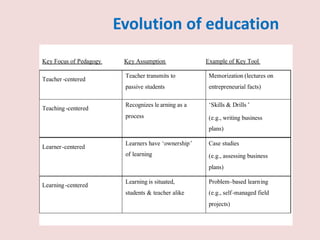
Evolution of education
Key Focus of Pedagogy Key Assumption Example of Key Tool
Teacher -centered
Teacher transmits to
passive students
Memorization (lectures on
entrepreneurial facts)
Teaching -centered
Recognizes le arning as a
process
‘Skills & Drills ’
(e.g., writing business
plans)
Learner-centered
Learners have ‘ownership’
of learning
Case studies
(e.g., assessing business
plans)
Learning-centered
Learning is situated,
students & teacher alike
Problem-based learning
(e.g., self-managed field
projects)
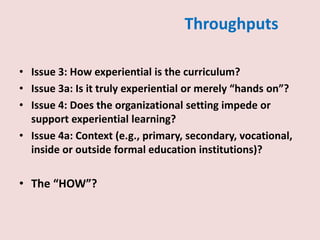
Throughputs
• Issue 3: How experiential is the curriculum?
• Issue 3a: Is it truly experiential or merely “hands on”?
• Issue 4: Does the organizational setting impede or
support experiential learning?
• Issue 4a: Context (e.g., primary, secondary, vocational,
inside or outside formal education institutions)?
• The “HOW”?
Inputs
• Issue 5: How skilled/experienced are the
instructors?
• Issue 5a: Do they need to share the entrepreneurial
mindset (or deeply understand it)?
• Issue 6: Are learners already “entrepreneurial”?
And are programs taking those differences into
explicit consideration?
• Issue 6a: Again, does the institutional setting (and
norms) matter?
• The “HOW”?
So what IS this
“entrepreneurial mindset”?
• Learning ABOUT entrepreneurship (content)
Versus?
• Learning to BE/THINK entrepreneurial
(mindset)
ANY Mindset….
• Deep cognitive structures – deep anchoring
assumptions
• Intent, yes, but potential
• Novice -> Expert
Behaviorism vs
Constructivism
• Yeats?
• Behaviorism?
• Epictetus??
• Social learning
• Situated learning
• Existential learning
Keys to constructivistic learning
• Authentic Questions; Big Questions
• Co-Learning
• Personal reflection
• Peer support (peer mentoring)
• Expert mentoring (need a chess master!)
• Skilled facilitator
• Immersion in experience
• Co-immersion in ecosystem
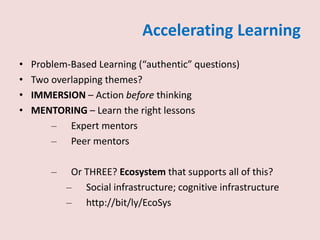
Accelerating Learning
• Problem-Based Learning (“authentic” questions)
• Two overlapping themes?
• IMMERSION – Action before thinking
• MENTORING – Learn the right lessons
– Expert mentors
– Peer mentors
– Or THREE? Ecosystem that supports all of this?
– Social infrastructure; cognitive infrastructure
– http://bit/ly/EcoSys
“Greatest Hits” of Educational Research
• Humans like to learn; humans are good at it!
• Lesson Plans Help  [think I->T->O]
• Action Changes Brains… with the right support
• Cooperative Learning
– “Jigsaw”
• Flipped/inverted
• Authentic Questions
• You Get What You Measure
• Mindset not Surface Knowledge
– Critical developmental experiences
– Problem-based learning
– Non-cognitive >> cognitive
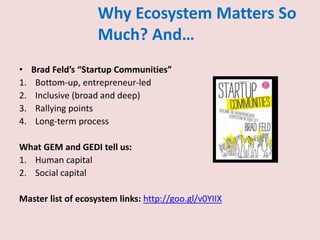
Why Ecosystem Matters So
Much? And…
• Brad Feld’s “Startup Communities”
1. Bottom-up, entrepreneur-led
2. Inclusive (broad and deep)
3. Rallying points
4. Long-term process
What GEM and GEDI tell us:
1. Human capital
2. Social capital
Master list of ecosystem links: http://goo.gl/v0YIIX
Entrepreneurial
Thinking?
Specific
Desirabilities
Perceived
Self-efficacy
Perceived
Desirabilities
Propensity to Act Intentions
Perceived
Feasibility
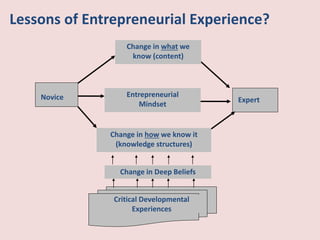
Novice  Expert
Novice Expert
Entrepreneurial
Mindset
Critical Developmental
Experiences
Change in what we
know (content)
Change in how we know it
(knowledge structures)
Change in Deep Beliefs
Lessons of Entrepreneurial Experience?
So what IS this “entrepreneurial mindset” anyway?
• Thoughts? Which are the hardest to change?
– (More important for here... what can we measure?)
Seeing opportunities?
• Innovativeness (presumably discontinuous)
• Resilience to adversity/optimism
• Persistence at goal-directed behaviors
• Domain-specific self-efficacy (possibly general self-efficacy)
• Role identity (mental prototypes)
• Entrepreneurial intensity
• Tolerance for ambiguity and uncertainty; Risk-aversion (lower)
• Future orientation (ability to delay gratification?)
• Entrepreneurial behaviors (not just launching a venture)
• Entrepreneurial intentions
• Value creation (versus opportunism) / Market orientation
• (Can we go deeper? Working memory? Cognitive complexity? Etc.)
• But what about…. Narcissism? Other ‘dark side’ issues?
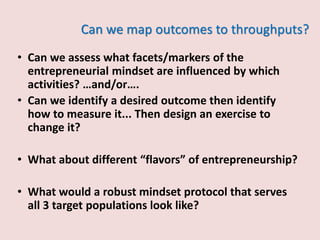
Can we map outcomes to throughputs?
• Can we assess what facets/markers of the
entrepreneurial mindset are influenced by which
activities? …and/or….
• Can we identify a desired outcome then identify
how to measure it... Then design an exercise to
change it?
• What about different “flavors” of entrepreneurship?
• What would a robust mindset protocol that serves
all 3 target populations look like?
Critical Implications
• For teaching? For training?
• For practice?
• For public policy?
• (and... for research?)
Implications: Teaching
• Need to be constructivistic
• Need to understand entrepreneurial
thinking
• Need to understand expert thinking
• Need to address deep beliefs
• Instructor MUST understand – or share-
the expert mindset.
Implications: Public Policy
• Entrepreneurial Potential = F(quantity and
quality of potential entrepreneurs)
• Promote educational activities that nurture
expert entrepreneurial thinking .
• Support similar mechanisms for growing an
entrepreneurial community
• Program leaders MUST understand – or
share- the expert mindset.
Implications: for Entrepreneurs
• Work toward expert thinking – lifelong process?
• Understand their own deep beliefs
• Good entrepreneurs are good at dot-connecting; great
entrepreneurs...
• Make sure your advisors understand the “Entrepreneur
Mind”(tm).
If you want to get involved in projects...
• Norris Krueger:
–norris.krueger@gmail.com
–@entrep_thinking
–Facebook
–LinkedIn
More mindset links:
http://goo.gl/ERpjEa
Implications: Research
• Focus on expert entrepreneurial thinking
• Focus on emotions
• Focus on cognitive change
• Focus on deep cognitive change
• Take advantage of:
– Multi-disciplinary approaches
– New tools – theory & method
• Take advantage of... us
Research Agenda:
Antecedents & Consequences
• Antecedents
– Impact of teaching/training methods
– Impact of instructor characteristics (e.g., mental models)
– Impact of context (including students)
– Developmental experiences?
Research Agenda:
Antecedents & Consequences
• Consequences
– Change in intent (Informed intent?)
– Change in knowledge content?
– Change in knowledge structure?
– Change in deep beliefs?
– How will we know?
• Better dot-connecting?
• Amygdala lights up differently?
Again…
How can I help YOU to help grow
a more entrepreneurial Japan?
Norris.krueger[at]gmail.com
@entrep_thinking
Facebook
LinkedIn
+1 208 440 3747 / WeChat / WhatsApp /Skype
My (Other) Burning Questions
• ???
https://www.youtub
e.com/watch?v=HM-
E2H1ChJM

Tokyo talk

  • 1.
    The latest trendof entrepreneurial education- How to encourage entrepreneurial Intention (and more)
  • 2.
    Are we movingthe needle in entrepreneurship education? How would we know? Changing the deep beliefs in the entrepreneurial mindset Norris Krueger, PhD Senior Research Fellow, Center for Management & Entrepreneurship School of Advanced Studies, University of Phoenix
  • 3.
    How can Ihelp YOU to help grow a more entrepreneurial Japan? Norris.krueger[at]gmail.com @entrep_thinking Facebook LinkedIn +1 208 440 3747 / WeChat / WhatsApp /Skype
  • 4.
    • WHO arewe changing? – Target audience/learners • WHAT are we trying to change? – What IS this “mindset” anyway? – How do we measure it? • HOW do we make that happen? – From learning about entrepreneurship to BEING entrepreneurial?
  • 6.
    “From learning aboutentrepreneurship to learning to be entrepreneurial?” Nothing less than a Copernican revolution in entrepreneurial learning is unfolding before us.
  • 7.
    To those whowant to really make a difference: • We know how to teach individuals (and organizations and communities) to think more entrepreneurially. • We now understand why and how. • How can we translate these insights into helping communities worldwide?
  • 8.
    Best programs inthe world? What do THEY do? • Virtually none are university-based but… – Chalmers, Stanford, Aalto… – Venture creation programs • Don’t incubate, accelerate? – Startup Weekend – Lean startup – TechStars, et al. /Global Accelerator Network – Y-Combinator /500 Startups /etc. VET: www.NACCE.com High School: http://steveblank.com/2013/02/28/the-lean- launchpad-goes-to-high-school/
  • 9.
    Key Premises • #1.We assume that the “mindset” reflects deep cognitive phenomena, particularly deep beliefs and assumptions. • #2. These only change through transformative learning experiences. • #3. We believe that a useful way to view mindset-change is helping learners move from a more novice mindset toward a more expert mindset.
  • 10.
    • Oversimplifying “slightly”,transformative learning follows the constructivistic model of learning that focuses on changing how we structure the knowledge we have and acquire (versus the behavioristic model that focuses on acquiring factual knowledge. • Note, however, that deep cognitive changes are quite difficult to measure directly. • But promising research has begun to assess mindset change pre/post (wish me luck)
  • 11.
    Find the RightFrame: One Size Does Not Fit All • Research evidence in EE is scary… • Lack of theory • Lack of education theory • Theory gives us frameworks… –Impact = f(Pedagogy, Learners, Instructors and Context.. Including Stage) –Inputs  Throughputs  Outputs
  • 12.
    Outputs • Issue 1:How is “entrepreneurial mindset” defined? Can we provide a rigorous definition? • Issue 2: How is “mindset” measured? Do we need to develop a protocol for assessment? • Issue 2a: Is “entrepreneurial mindset” measured at all? (and… does “one size fit all”??) • The “HOW”?
  • 13.
    Evolution of education KeyFocus of Pedagogy Key Assumption Example of Key Tool Teacher -centered Teacher transmits to passive students Memorization (lectures on entrepreneurial facts) Teaching -centered Recognizes le arning as a process ‘Skills & Drills ’ (e.g., writing business plans) Learner-centered Learners have ‘ownership’ of learning Case studies (e.g., assessing business plans) Learning-centered Learning is situated, students & teacher alike Problem-based learning (e.g., self-managed field projects)
  • 14.
    Throughputs • Issue 3:How experiential is the curriculum? • Issue 3a: Is it truly experiential or merely “hands on”? • Issue 4: Does the organizational setting impede or support experiential learning? • Issue 4a: Context (e.g., primary, secondary, vocational, inside or outside formal education institutions)? • The “HOW”?
  • 15.
    Inputs • Issue 5:How skilled/experienced are the instructors? • Issue 5a: Do they need to share the entrepreneurial mindset (or deeply understand it)? • Issue 6: Are learners already “entrepreneurial”? And are programs taking those differences into explicit consideration? • Issue 6a: Again, does the institutional setting (and norms) matter? • The “HOW”?
  • 16.
    So what ISthis “entrepreneurial mindset”? • Learning ABOUT entrepreneurship (content) Versus? • Learning to BE/THINK entrepreneurial (mindset) ANY Mindset…. • Deep cognitive structures – deep anchoring assumptions • Intent, yes, but potential • Novice -> Expert
  • 17.
    Behaviorism vs Constructivism • Yeats? •Behaviorism? • Epictetus?? • Social learning • Situated learning • Existential learning
  • 18.
    Keys to constructivisticlearning • Authentic Questions; Big Questions • Co-Learning • Personal reflection • Peer support (peer mentoring) • Expert mentoring (need a chess master!) • Skilled facilitator • Immersion in experience • Co-immersion in ecosystem
  • 19.
    Accelerating Learning • Problem-BasedLearning (“authentic” questions) • Two overlapping themes? • IMMERSION – Action before thinking • MENTORING – Learn the right lessons – Expert mentors – Peer mentors – Or THREE? Ecosystem that supports all of this? – Social infrastructure; cognitive infrastructure – http://bit/ly/EcoSys
  • 20.
    “Greatest Hits” ofEducational Research • Humans like to learn; humans are good at it! • Lesson Plans Help  [think I->T->O] • Action Changes Brains… with the right support • Cooperative Learning – “Jigsaw” • Flipped/inverted • Authentic Questions • You Get What You Measure • Mindset not Surface Knowledge – Critical developmental experiences – Problem-based learning – Non-cognitive >> cognitive
  • 21.
    Why Ecosystem MattersSo Much? And… • Brad Feld’s “Startup Communities” 1. Bottom-up, entrepreneur-led 2. Inclusive (broad and deep) 3. Rallying points 4. Long-term process What GEM and GEDI tell us: 1. Human capital 2. Social capital Master list of ecosystem links: http://goo.gl/v0YIIX
  • 22.
  • 23.
  • 24.
    Novice Expert Entrepreneurial Mindset Critical Developmental Experiences Changein what we know (content) Change in how we know it (knowledge structures) Change in Deep Beliefs Lessons of Entrepreneurial Experience?
  • 25.
    So what ISthis “entrepreneurial mindset” anyway? • Thoughts? Which are the hardest to change? – (More important for here... what can we measure?) Seeing opportunities? • Innovativeness (presumably discontinuous) • Resilience to adversity/optimism • Persistence at goal-directed behaviors • Domain-specific self-efficacy (possibly general self-efficacy) • Role identity (mental prototypes) • Entrepreneurial intensity • Tolerance for ambiguity and uncertainty; Risk-aversion (lower) • Future orientation (ability to delay gratification?) • Entrepreneurial behaviors (not just launching a venture) • Entrepreneurial intentions • Value creation (versus opportunism) / Market orientation • (Can we go deeper? Working memory? Cognitive complexity? Etc.) • But what about…. Narcissism? Other ‘dark side’ issues?
  • 26.
    Can we mapoutcomes to throughputs? • Can we assess what facets/markers of the entrepreneurial mindset are influenced by which activities? …and/or…. • Can we identify a desired outcome then identify how to measure it... Then design an exercise to change it? • What about different “flavors” of entrepreneurship? • What would a robust mindset protocol that serves all 3 target populations look like?
  • 27.
    Critical Implications • Forteaching? For training? • For practice? • For public policy? • (and... for research?)
  • 28.
    Implications: Teaching • Needto be constructivistic • Need to understand entrepreneurial thinking • Need to understand expert thinking • Need to address deep beliefs • Instructor MUST understand – or share- the expert mindset.
  • 29.
    Implications: Public Policy •Entrepreneurial Potential = F(quantity and quality of potential entrepreneurs) • Promote educational activities that nurture expert entrepreneurial thinking . • Support similar mechanisms for growing an entrepreneurial community • Program leaders MUST understand – or share- the expert mindset.
  • 30.
    Implications: for Entrepreneurs •Work toward expert thinking – lifelong process? • Understand their own deep beliefs • Good entrepreneurs are good at dot-connecting; great entrepreneurs... • Make sure your advisors understand the “Entrepreneur Mind”(tm).
  • 31.
    If you wantto get involved in projects... • Norris Krueger: –norris.krueger@gmail.com –@entrep_thinking –Facebook –LinkedIn More mindset links: http://goo.gl/ERpjEa
  • 32.
    Implications: Research • Focuson expert entrepreneurial thinking • Focus on emotions • Focus on cognitive change • Focus on deep cognitive change • Take advantage of: – Multi-disciplinary approaches – New tools – theory & method • Take advantage of... us
  • 33.
    Research Agenda: Antecedents &Consequences • Antecedents – Impact of teaching/training methods – Impact of instructor characteristics (e.g., mental models) – Impact of context (including students) – Developmental experiences?
  • 34.
    Research Agenda: Antecedents &Consequences • Consequences – Change in intent (Informed intent?) – Change in knowledge content? – Change in knowledge structure? – Change in deep beliefs? – How will we know? • Better dot-connecting? • Amygdala lights up differently?
  • 35.
    Again… How can Ihelp YOU to help grow a more entrepreneurial Japan? Norris.krueger[at]gmail.com @entrep_thinking Facebook LinkedIn +1 208 440 3747 / WeChat / WhatsApp /Skype
  • 36.
    My (Other) BurningQuestions • ???
  • 37.