
Creative, Dynamic ELT Materials
for Teaching English
to Diverse Groups of Learners
“How to prepare multi-modal
EFL class materials to motivate
and meet the needs, interests,
and intelligences in diverse
groups of EFL learners”
Presented by:
Prof. Larry M. Lynch
Santiago de Cali University
http://bettereflteacher.blogspot.com/
lynchlarrym@gmail.com
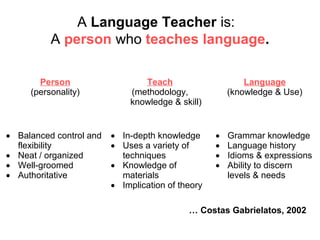
A Language Teacher is:
A person who teaches language.
Person
(personality)
Teach
(methodology,
knowledge & skill)
Language
(knowledge & Use)
• Balanced control and
flexibility
• Neat / organized
• Well-groomed
• Authoritative
• In-depth knowledge
• Uses a variety of
techniques
• Knowledge of
materials
• Implication of theory
• Grammar knowledge
• Language history
• Idioms & expressions
• Ability to discern
levels & needs
… Costas Gabrielatos, 2002
COUNTRIES / LOCATIONS with
SPANISH as the Official L1
Colombia Panama Ecuador
Venezuela Peru Puerto Rico
Mexico El Salvador Guatemala
Chile Honduras Argentina
Dominican Republic Uruguay Spain
Paraguay Nicaragua Bolivia
Costa Rica Cuba Equatorial New
Guinea
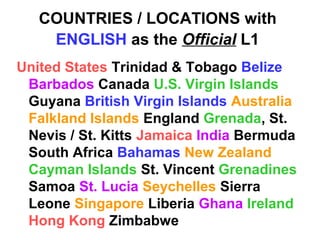
COUNTRIES / LOCATIONS with
ENGLISH as the Official L1
United States Trinidad & Tobago Belize
Barbados Canada U.S. Virgin Islands
Guyana British Virgin Islands Australia
Falkland Islands England Grenada, St.
Nevis / St. Kitts Jamaica India Bermuda
South Africa Bahamas New Zealand
Cayman Islands St. Vincent Grenadines
Samoa St. Lucia Seychelles Sierra
Leone Singapore Liberia Ghana Ireland
Hong Kong Zimbabwe
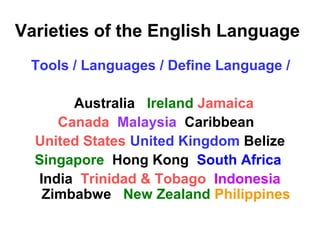
Varieties of the English Language
Tools / Languages / Define Language /
Australia Ireland Jamaica
Canada Malaysia Caribbean
United States United Kingdom Belize
Singapore Hong Kong South Africa
India Trinidad & Tobago Indonesia
Zimbabwe New Zealand Philippines
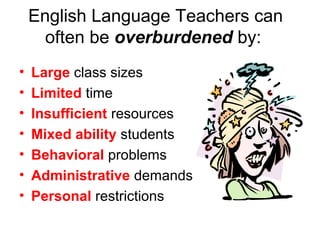
English Language Teachers can
often be overburdened by:
• Large class sizes
• Limited time
• Insufficient resources
• Mixed ability students
• Behavioral problems
• Administrative demands
• Personal restrictions
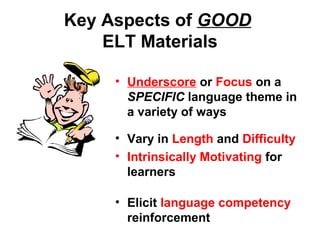
Key Aspects of GOOD
ELT Materials
• Underscore or Focus on a
SPECIFIC language theme in
a variety of ways
• Vary in Length and Difficulty
• Intrinsically Motivating for
learners
• Elicit language competency
reinforcement
• Multi-modal and Diversified
• Cost-effective to produce and
Utilize
• Accessible in multiple learning
environments
• Provide for Allocation of
Learner Resources
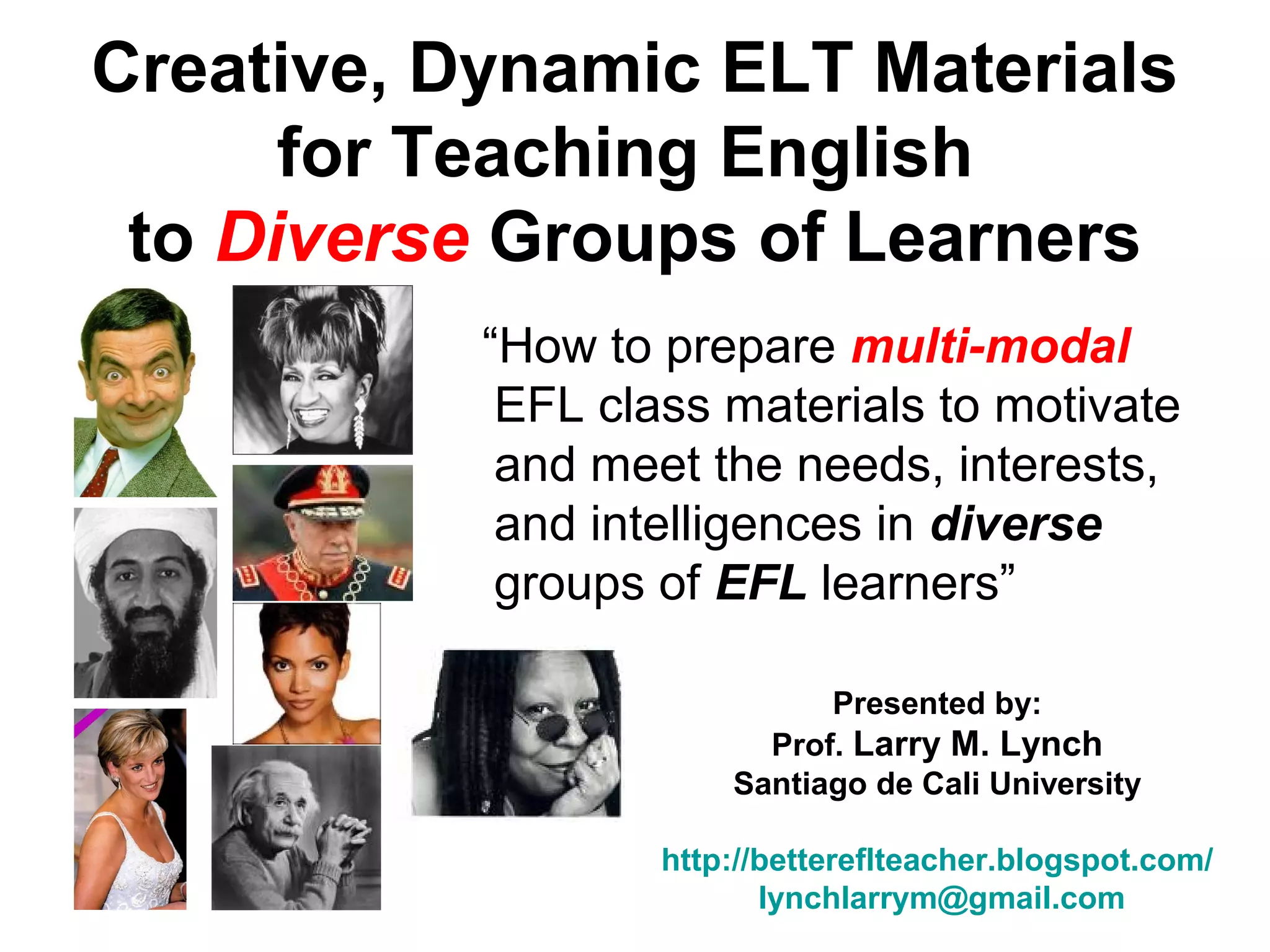
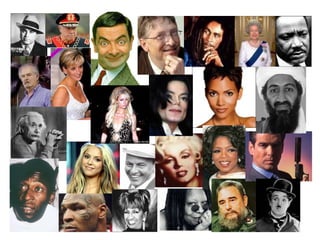
Let’s Meet the Language Learners:
• 10 Americans
• 3 Brits
• 5 Latinos
• 9 Blacks
• 9 Women
• 16 Men
• 7 Elderly
• 1 Muslim (Arabic)
• 6 violent or criminals
• 26 Total
• Chile
• Spain
• Germany (German)
• USA
• Brazil (Portuguese)
• UK
• Jamaica
• France (French)
• Italy (Italian)
• Cuba
How could you Successfully teach
English to this widely diverse group?
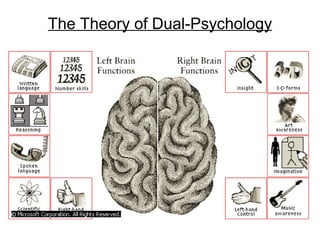
• Theory of Dual Psychology (P. MacClean)
• Provide an Enriched Learning Environment
(M. Diamond)
• Apply Multiple Intelligences Theory
(H. Gardner)
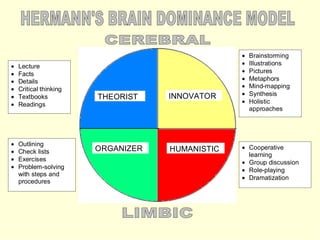
• Use Hermann’s Brain Dominance Model
(N. Hermann)
• Identify & Use Learner-Preferred Activities
(D. Lazear)
The Theory of Dual-Psychology
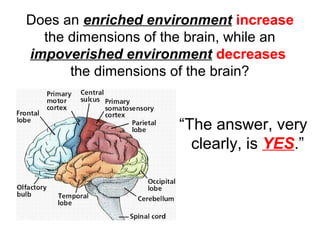
Does an enriched environment increase
the dimensions of the brain, while an
impoverished environment decreases
the dimensions of the brain?
“The answer, very
clearly, is YES.”
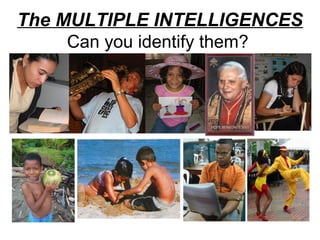
The MULTIPLE INTELLIGENCES
Can you identify them?
THEORIST INNOVATOR
S
ORGANIZER HUMANISTIC
• Lecture
• Facts
• Details
• Critical thinking
• Textbooks
• Readings
• Outlining
• Check lists
• Exercises
• Problem-solving
with steps and
procedures
• Brainstorming
• Illustrations
• Pictures
• Metaphors
• Mind-mapping
• Synthesis
• Holistic
approaches
• Cooperative
learning
• Group discussion
• Role-playing
• Dramatization
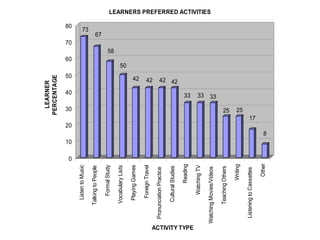
73
67
58
50
42 42 42 42
33 33 33
25 25
17
8
0
10
20
30
40
50
60
70
80
LEARNER
PERCENTAGE
ListentoMusic
TalkingtoPeople
FormalStudy
VocabularyLists
PlayingGames
ForeignTravel
PronunciationPractice
CulturalStudies
Reading
WatchingTV
WatchingMovies/Videos
TeachingOthers
Writing
ListeningtoCassettes
Other
ACTIVITY TYPE
LEARNERS PREFERRED ACTIVITIES
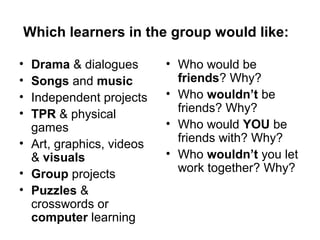
Which learners in the group would like:
• Drama & dialogues
• Songs and music
• Independent projects
• TPR & physical
games
• Art, graphics, videos
& visuals
• Group projects
• Puzzles &
crosswords or
computer learning
• Who would be
friends? Why?
• Who wouldn’t be
friends? Why?
• Who would YOU be
friends with? Why?
• Who wouldn’t you let
work together? Why?
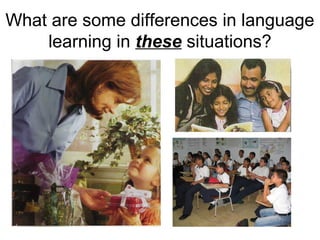
What are some differences in language
learning in these situations?
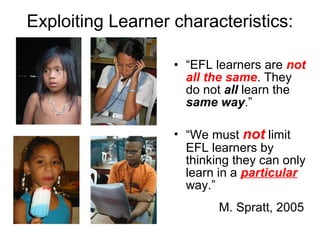
Exploiting Learner characteristics:
• “EFL learners are not
all the same. They
do not all learn the
same way.”
• “We must not limit
EFL learners by
thinking they can only
learn in a particular
way.”
M. Spratt, 2005
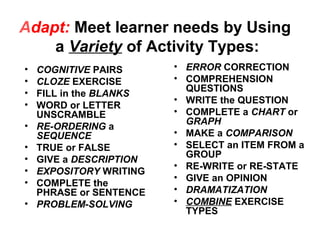
Adapt: Meet learner needs by Using
a Variety of Activity Types:
• COGNITIVE PAIRS
• CLOZE EXERCISE
• FILL in the BLANKS
• WORD or LETTER
UNSCRAMBLE
• RE-ORDERING a
SEQUENCE
• TRUE or FALSE
• GIVE a DESCRIPTION
• EXPOSITORY WRITING
• COMPLETE the
PHRASE or SENTENCE
• PROBLEM-SOLVING
• ERROR CORRECTION
• COMPREHENSION
QUESTIONS
• WRITE the QUESTION
• COMPLETE a CHART or
GRAPH
• MAKE a COMPARISON
• SELECT an ITEM FROM a
GROUP
• RE-WRITE or RE-STATE
• GIVE an OPINION
• DRAMATIZATION
• COMBINE EXERCISE
TYPES
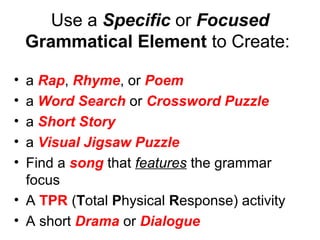
Use a Specific or Focused
Grammatical Element to Create:
• a Rap, Rhyme, or Poem
• a Word Search or Crossword Puzzle
• a Short Story
• a Visual Jigsaw Puzzle
• Find a song that features the grammar
focus
• A TPR (Total Physical Response) activity
• A short Drama or Dialogue
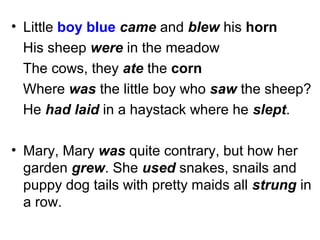
• Little boy blue came and blew his horn
His sheep were in the meadow
The cows, they ate the corn
Where was the little boy who saw the sheep?
He had laid in a haystack where he slept.
• Mary, Mary was quite contrary, but how her
garden grew. She used snakes, snails and
puppy dog tails with pretty maids all strung in
a row.
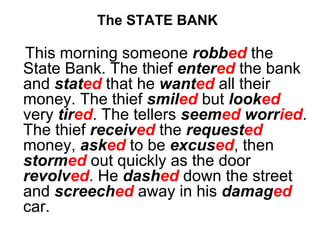
The STATE BANK
This morning someone robbed the
State Bank. The thief entered the bank
and stated that he wanted all their
money. The thief smiled but looked
very tired. The tellers seemed worried.
The thief received the requested
money, asked to be excused, then
stormed out quickly as the door
revolved. He dashed down the street
and screeched away in his damaged
car.
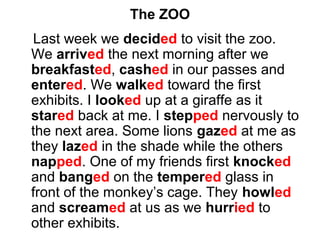
The ZOO
Last week we decided to visit the zoo.
We arrived the next morning after we
breakfasted, cashed in our passes and
entered. We walked toward the first
exhibits. I looked up at a giraffe as it
stared back at me. I stepped nervously to
the next area. Some lions gazed at me as
they lazed in the shade while the others
napped. One of my friends first knocked
and banged on the tempered glass in
front of the monkey’s cage. They howled
and screamed at us as we hurried to
other exhibits.
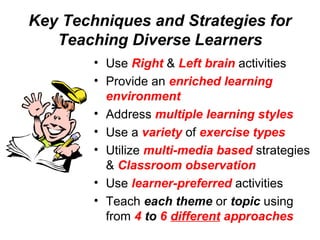
Key Techniques and Strategies for
Teaching Diverse Learners
• Use Right & Left brain activities
• Provide an enriched learning
environment
• Address multiple learning styles
• Use a variety of exercise types
• Utilize multi-media based strategies
& Classroom observation
• Use learner-preferred activities
• Teach each theme or topic using
from 4 to 6 different approaches
For more FREE information on
producing creative, dynamic ELT
materials, EFL classroom teaching
and learning techniques, informative
TESOL articles, please go to:
“Becoming a Better EFL Teacher”
online at:
http://bettereflteacher.blogspot.com/
or E-mail Prof. Larry M. Lynch at:
proflmlynch@gmail.com
THANK YOU Teachers and Attendees!!!
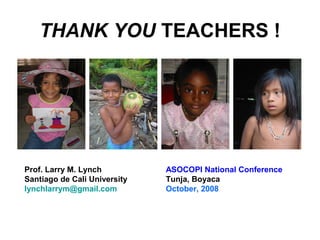
THANK YOU TEACHERS !
For your attendance and attention
Prof. Larry M. Lynch
Santiago de Cali University
lynchlarrym@gmail.com
ASOCOPI National Conference
Tunja, Boyaca
October, 2008
THANK YOU TEACHERS !
Prof. Larry M. Lynch
Santiago de Cali University
lynchlarrym@gmail.com
ASOCOPI National Conference
Tunja, Boyaca
October, 2008

Creative, dynamic elt materials for teaching english

  • 1.
    Creative, Dynamic ELTMaterials for Teaching English to Diverse Groups of Learners “How to prepare multi-modal EFL class materials to motivate and meet the needs, interests, and intelligences in diverse groups of EFL learners” Presented by: Prof. Larry M. Lynch Santiago de Cali University http://bettereflteacher.blogspot.com/ lynchlarrym@gmail.com
  • 2.
    A Language Teacheris: A person who teaches language. Person (personality) Teach (methodology, knowledge & skill) Language (knowledge & Use) • Balanced control and flexibility • Neat / organized • Well-groomed • Authoritative • In-depth knowledge • Uses a variety of techniques • Knowledge of materials • Implication of theory • Grammar knowledge • Language history • Idioms & expressions • Ability to discern levels & needs … Costas Gabrielatos, 2002
  • 3.
    COUNTRIES / LOCATIONSwith SPANISH as the Official L1 Colombia Panama Ecuador Venezuela Peru Puerto Rico Mexico El Salvador Guatemala Chile Honduras Argentina Dominican Republic Uruguay Spain Paraguay Nicaragua Bolivia Costa Rica Cuba Equatorial New Guinea
  • 4.
    COUNTRIES / LOCATIONSwith ENGLISH as the Official L1 United States Trinidad & Tobago Belize Barbados Canada U.S. Virgin Islands Guyana British Virgin Islands Australia Falkland Islands England Grenada, St. Nevis / St. Kitts Jamaica India Bermuda South Africa Bahamas New Zealand Cayman Islands St. Vincent Grenadines Samoa St. Lucia Seychelles Sierra Leone Singapore Liberia Ghana Ireland Hong Kong Zimbabwe
  • 5.
    Varieties of theEnglish Language Tools / Languages / Define Language / Australia Ireland Jamaica Canada Malaysia Caribbean United States United Kingdom Belize Singapore Hong Kong South Africa India Trinidad & Tobago Indonesia Zimbabwe New Zealand Philippines
  • 6.
    English Language Teacherscan often be overburdened by: • Large class sizes • Limited time • Insufficient resources • Mixed ability students • Behavioral problems • Administrative demands • Personal restrictions
  • 7.
    Key Aspects ofGOOD ELT Materials • Underscore or Focus on a SPECIFIC language theme in a variety of ways • Vary in Length and Difficulty • Intrinsically Motivating for learners • Elicit language competency reinforcement
  • 8.
    • Multi-modal andDiversified • Cost-effective to produce and Utilize • Accessible in multiple learning environments • Provide for Allocation of Learner Resources
  • 9.
    Let’s Meet theLanguage Learners: • 10 Americans • 3 Brits • 5 Latinos • 9 Blacks • 9 Women • 16 Men • 7 Elderly • 1 Muslim (Arabic) • 6 violent or criminals • 26 Total • Chile • Spain • Germany (German) • USA • Brazil (Portuguese) • UK • Jamaica • France (French) • Italy (Italian) • Cuba
  • 11.
    How could youSuccessfully teach English to this widely diverse group? • Theory of Dual Psychology (P. MacClean) • Provide an Enriched Learning Environment (M. Diamond) • Apply Multiple Intelligences Theory (H. Gardner) • Use Hermann’s Brain Dominance Model (N. Hermann) • Identify & Use Learner-Preferred Activities (D. Lazear)
  • 12.
    The Theory ofDual-Psychology
  • 13.
    Does an enrichedenvironment increase the dimensions of the brain, while an impoverished environment decreases the dimensions of the brain? “The answer, very clearly, is YES.”
  • 14.
  • 15.
    THEORIST INNOVATOR S ORGANIZER HUMANISTIC •Lecture • Facts • Details • Critical thinking • Textbooks • Readings • Outlining • Check lists • Exercises • Problem-solving with steps and procedures • Brainstorming • Illustrations • Pictures • Metaphors • Mind-mapping • Synthesis • Holistic approaches • Cooperative learning • Group discussion • Role-playing • Dramatization
  • 16.
    73 67 58 50 42 42 4242 33 33 33 25 25 17 8 0 10 20 30 40 50 60 70 80 LEARNER PERCENTAGE ListentoMusic TalkingtoPeople FormalStudy VocabularyLists PlayingGames ForeignTravel PronunciationPractice CulturalStudies Reading WatchingTV WatchingMovies/Videos TeachingOthers Writing ListeningtoCassettes Other ACTIVITY TYPE LEARNERS PREFERRED ACTIVITIES
  • 17.
    Which learners inthe group would like: • Drama & dialogues • Songs and music • Independent projects • TPR & physical games • Art, graphics, videos & visuals • Group projects • Puzzles & crosswords or computer learning • Who would be friends? Why? • Who wouldn’t be friends? Why? • Who would YOU be friends with? Why? • Who wouldn’t you let work together? Why?
  • 18.
    What are somedifferences in language learning in these situations?
  • 20.
    Exploiting Learner characteristics: •“EFL learners are not all the same. They do not all learn the same way.” • “We must not limit EFL learners by thinking they can only learn in a particular way.” M. Spratt, 2005
  • 21.
    Adapt: Meet learnerneeds by Using a Variety of Activity Types: • COGNITIVE PAIRS • CLOZE EXERCISE • FILL in the BLANKS • WORD or LETTER UNSCRAMBLE • RE-ORDERING a SEQUENCE • TRUE or FALSE • GIVE a DESCRIPTION • EXPOSITORY WRITING • COMPLETE the PHRASE or SENTENCE • PROBLEM-SOLVING • ERROR CORRECTION • COMPREHENSION QUESTIONS • WRITE the QUESTION • COMPLETE a CHART or GRAPH • MAKE a COMPARISON • SELECT an ITEM FROM a GROUP • RE-WRITE or RE-STATE • GIVE an OPINION • DRAMATIZATION • COMBINE EXERCISE TYPES
  • 22.
    Use a Specificor Focused Grammatical Element to Create: • a Rap, Rhyme, or Poem • a Word Search or Crossword Puzzle • a Short Story • a Visual Jigsaw Puzzle • Find a song that features the grammar focus • A TPR (Total Physical Response) activity • A short Drama or Dialogue
  • 23.
    • Little boyblue came and blew his horn His sheep were in the meadow The cows, they ate the corn Where was the little boy who saw the sheep? He had laid in a haystack where he slept. • Mary, Mary was quite contrary, but how her garden grew. She used snakes, snails and puppy dog tails with pretty maids all strung in a row.
  • 24.
    The STATE BANK Thismorning someone robbed the State Bank. The thief entered the bank and stated that he wanted all their money. The thief smiled but looked very tired. The tellers seemed worried. The thief received the requested money, asked to be excused, then stormed out quickly as the door revolved. He dashed down the street and screeched away in his damaged car.
  • 25.
    The ZOO Last weekwe decided to visit the zoo. We arrived the next morning after we breakfasted, cashed in our passes and entered. We walked toward the first exhibits. I looked up at a giraffe as it stared back at me. I stepped nervously to the next area. Some lions gazed at me as they lazed in the shade while the others napped. One of my friends first knocked and banged on the tempered glass in front of the monkey’s cage. They howled and screamed at us as we hurried to other exhibits.
  • 26.
    Key Techniques andStrategies for Teaching Diverse Learners • Use Right & Left brain activities • Provide an enriched learning environment • Address multiple learning styles • Use a variety of exercise types • Utilize multi-media based strategies & Classroom observation • Use learner-preferred activities • Teach each theme or topic using from 4 to 6 different approaches
  • 27.
    For more FREEinformation on producing creative, dynamic ELT materials, EFL classroom teaching and learning techniques, informative TESOL articles, please go to: “Becoming a Better EFL Teacher” online at: http://bettereflteacher.blogspot.com/ or E-mail Prof. Larry M. Lynch at: proflmlynch@gmail.com THANK YOU Teachers and Attendees!!!
  • 28.
    THANK YOU TEACHERS! For your attendance and attention Prof. Larry M. Lynch Santiago de Cali University lynchlarrym@gmail.com ASOCOPI National Conference Tunja, Boyaca October, 2008
  • 29.
    THANK YOU TEACHERS! Prof. Larry M. Lynch Santiago de Cali University lynchlarrym@gmail.com ASOCOPI National Conference Tunja, Boyaca October, 2008