DEVELOPING SPEAKING
SKILLS FOR GCSE
Steve Smith
frenchteacher.net
frenchteachernet.blogspot.co.uk
@spsmith45
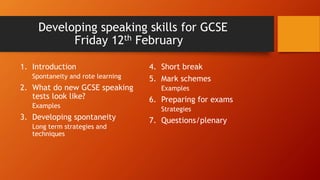
Developing speaking skills for GCSE
Friday 12th February
1. Introduction
Spontaneity and rote learning
2. What do new GCSE speaking
tests look like?
Examples
3. Developing spontaneity
Long term strategies and
techniques
4. Short break
5. Mark schemes
Examples
6. Preparing for exams
Strategies
7. Questions/plenary
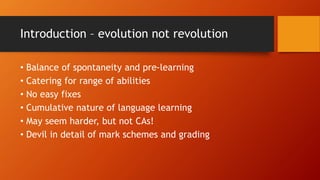
Introduction – evolution not revolution
• Balance of spontaneity and pre-learning
• Catering for range of abilities
• No easy fixes
• Cumulative nature of language learning
• May seem harder, but not CAs!
• Devil in detail of mark schemes and grading
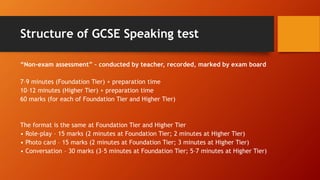
Structure of GCSE Speaking test
“Non-exam assessment” – conducted by teacher, recorded, marked by exam board
7–9 minutes (Foundation Tier) + preparation time
10–12 minutes (Higher Tier) + preparation time
60 marks (for each of Foundation Tier and Higher Tier)
The format is the same at Foundation Tier and Higher Tier
• Role-play – 15 marks (2 minutes at Foundation Tier; 2 minutes at Higher Tier)
• Photo card – 15 marks (2 minutes at Foundation Tier; 3 minutes at Higher Tier)
• Conversation – 30 marks (3–5 minutes at Foundation Tier; 5–7 minutes at Higher Tier)
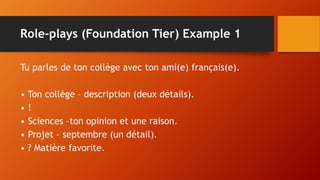
Role-plays (Foundation Tier) Example 1
Tu parles de ton collège avec ton ami(e) français(e).
• Ton collège – description (deux détails).
• !
• Sciences –ton opinion et une raison.
• Projet – septembre (un détail).
• ? Matière favorite.
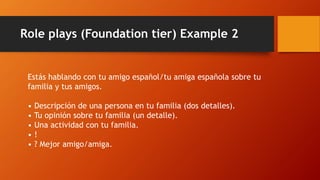
Role plays (Foundation tier) Example 2
Estás hablando con tu amigo español/tu amiga española sobre tu
familia y tus amigos.
• Descripción de una persona en tu familia (dos detalles).
• Tu opinión sobre tu familia (un detalle).
• Una actividad con tu familia.
• !
• ? Mejor amigo/amiga.
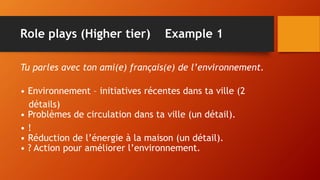
Role plays (Higher tier) Example 1
Tu parles avec ton ami(e) français(e) de l’environnement.
• Environnement – initiatives récentes dans ta ville (2
détails)
• Problèmes de circulation dans ta ville (un détail).
• !
• Réduction de l’énergie à la maison (un détail).
• ? Action pour améliorer l’environnement.
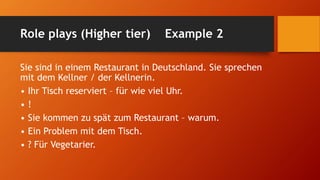
Role plays (Higher tier) Example 2
Sie sind in einem Restaurant in Deutschland. Sie sprechen
mit dem Kellner / der Kellnerin.
• Ihr Tisch reserviert – für wie viel Uhr.
• !
• Sie kommen zu spät zum Restaurant – warum.
• Ein Problem mit dem Tisch.
• ? Für Vegetarier.
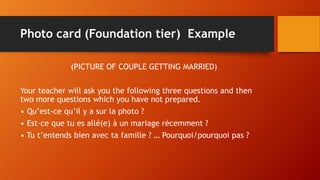
Photo card (Foundation tier) Example
(PICTURE OF COUPLE GETTING MARRIED)
Your teacher will ask you the following three questions and then
two more questions which you have not prepared.
• Qu’est-ce qu’il y a sur la photo ?
• Est-ce que tu es allé(e) à un mariage récemment ?
• Tu t’entends bien avec ta famille ? … Pourquoi/pourquoi pas ?
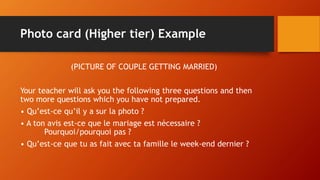
Photo card (Higher tier) Example
(PICTURE OF COUPLE GETTING MARRIED)
Your teacher will ask you the following three questions and then
two more questions which you have not prepared.
• Qu’est-ce qu’il y a sur la photo ?
• A ton avis est-ce que le mariage est nécessaire ?
Pourquoi/pourquoi pas ?
• Qu’est-ce que tu as fait avec ta famille le week-end dernier ?
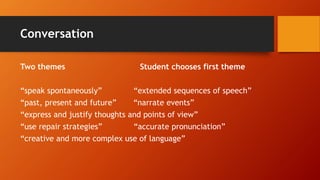
Conversation
Two themes Student chooses first theme
“speak spontaneously” “extended sequences of speech”
“past, present and future” “narrate events”
“express and justify thoughts and points of view”
“use repair strategies” “accurate pronunciation”
“creative and more complex use of language”
Developing spontaneous talk
Key elements
• Comprehensible input (TL) over several years
• Opportunities for interaction
• Practice, practice, practice – from controlled to free
Developing spontaneous talk
Target language input
All research from applied
linguistics shows that
meaningful input is a minimum
requirement for acquisition
Departmental policy needed
Alison Chase
A Target Language Toolkit
Not about “phrases on the wall”
Developing spontaneous talk
• Full repertoire of teacher-student interactions
• Questioning Teacher gives answer, pupils question
• True/false Phonics
• Either/or Lexical work (synonyms, antonyms etc)
• Giving false statements
• Aural gap-fill
Question types
• Yes/No - is this a dog or a cat?
• True/false - he's going to the cinema, true or false?
• Either/or - is he going to the cinema or the theatre?
• Choice of more options - is she playing golf, tennis or football?
• Closed question word questions - where is the station? who is he?
• Open question word questions - what is she doing? what do you
think about...?
Developing spontaneous talk
• Controlled to free (PPP model)
• Grammar in use, not just explained
• Communicative approach strategies (pairs/information gaps)
• Limit tasks which may waste time – time is short
• Recycling – “spacing effect” – maximise potential of homework
Developing spontaneous talk – top tips (1)
• Teach lots of vocabulary
• Lots of TL input, especially listening
• Provide immersion opportunities
• Build in opportunities for spontaneous talk in SoW e.g. tests
• “Spontaneous speech activity cards” Try Word Wheel.
• Use tech wisely e.g. recording presentations, “talking to
Siri/Google Now”, input-based tasks – not time-consuming
production of “artefacts”
• Use literacy mats
Developing spontaneous talk – top tips (2)
• Build spontaneity into routines
• Be as demanding as you can be – tell pupils why – let them into
your secret
• Reward use of spontaneous speech, bravery, risk-taking
• Reward fluency more than accuracy
• Do lots of compositional writing to encourage creative use of
language
• Do plenty of homework. Set speaking for homework
• Masses of listening, including “micro-listening” tasks
A departmental approach
• 4-5 year plan
• Policy on TL use e.g. from Alison Chase Target Language Toolkit (2015) –
two approaches
• 1. Teachers of languages should remain in L2 at all times but may use
the occasional single word of L1 to avoid unnecessary confusion. Where
students speak L1 their contributions will be acknowledged but they
will then be helped to word these contributions in L2.
• 2. Teachers of languages should use L2 whenever it is beneficial to
students’ language learning and L1 should only be used in limited
situations where it is common sense to do so.
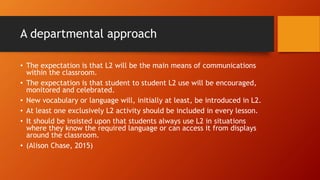
A departmental approach
• The expectation is that L2 will be the main means of communications
within the classroom.
• The expectation is that student to student L2 use will be encouraged,
monitored and celebrated.
• New vocabulary or language will, initially at least, be introduced in L2.
• At least one exclusively L2 activity should be included in every lesson.
• It should be insisted upon that students always use L2 in situations
where they know the required language or can access it from displays
around the classroom.
• (Alison Chase, 2015)
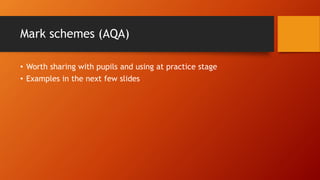
Mark schemes (AQA)
• Worth sharing with pupils and using at practice stage
• Examples in the next few slides
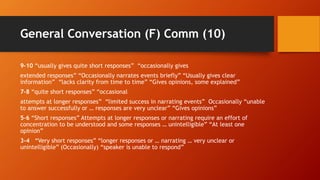
General Conversation (F) Comm (10)
9–10 “usually gives quite short responses” “occasionally gives
extended responses” “Occasionally narrates events briefly” “Usually gives clear
information” “lacks clarity from time to time” “Gives opinions, some explained”
7–8 “quite short responses” “occasional
attempts at longer responses” “limited success in narrating events” Occasionally “unable
to answer successfully or … responses are very unclear” “Gives opinions”
5–6 “Short responses” Attempts at longer responses or narrating require an effort of
concentration to be understood and some responses … unintelligible” “At least one
opinion”
3-4 “Very short responses” “longer responses or … narrating … very unclear or
unintelligible” (Occasionally) “speaker is unable to respond”
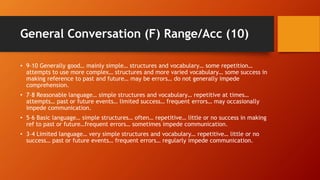
General Conversation (F) Range/Acc (10)
• 9–10 Generally good… mainly simple… structures and vocabulary… some repetition…
attempts to use more complex… structures and more varied vocabulary… some success in
making reference to past and future… may be errors… do not generally impede
comprehension.
• 7–8 Reasonable language… simple structures and vocabulary… repetitive at times…
attempts… past or future events… limited success… frequent errors… may occasionally
impede communication.
• 5–6 Basic language… simple structures… often… repetitive… little or no success in making
ref to past or future…frequent errors… sometimes impede communication.
• 3–4 Limited language… very simple structures and vocabulary… repetitive… little or no
success… past or future events… frequent errors… regularly impede communication.
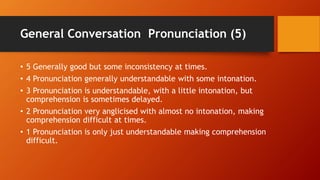
General Conversation Pronunciation (5)
• 5 Generally good but some inconsistency at times.
• 4 Pronunciation generally understandable with some intonation.
• 3 Pronunciation is understandable, with a little intonation, but
comprehension is sometimes delayed.
• 2 Pronunciation very anglicised with almost no intonation, making
comprehension difficult at times.
• 1 Pronunciation is only just understandable making comprehension
difficult.
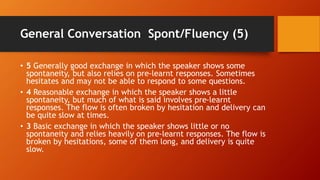
General Conversation Spont/Fluency (5)
• 5 Generally good exchange in which the speaker shows some
spontaneity, but also relies on pre-learnt responses. Sometimes
hesitates and may not be able to respond to some questions.
• 4 Reasonable exchange in which the speaker shows a little
spontaneity, but much of what is said involves pre-learnt
responses. The flow is often broken by hesitation and delivery can
be quite slow at times.
• 3 Basic exchange in which the speaker shows little or no
spontaneity and relies heavily on pre-learnt responses. The flow is
broken by hesitations, some of them long, and delivery is quite
slow.
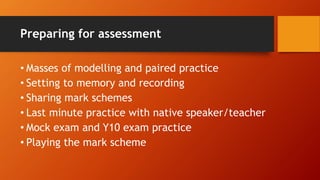
Preparing for assessment
• Masses of modelling and paired practice
• Setting to memory and recording
• Sharing mark schemes
• Last minute practice with native speaker/teacher
• Mock exam and Y10 exam practice
• Playing the mark scheme
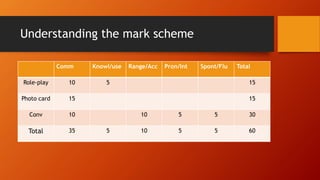
Understanding the mark scheme
Comm Knowl/use Range/Acc Pron/Int Spont/Flu Total
Role-play 10 5 15
Photo card 15 15
Conv 10 10 5 5 30
Total 35 5 10 5 5 60
References
• The Language Teacher Toolkit, Steve Smith and Gianfranco Conti
(2016)
• The Target Language Toolkit, Alison Chase (2015)
• AQA GCSE specification, first teaching 2016, first exam 2018

GCSE speaking ppt

  • 1.
    DEVELOPING SPEAKING SKILLS FORGCSE Steve Smith frenchteacher.net frenchteachernet.blogspot.co.uk @spsmith45
  • 2.
    Developing speaking skillsfor GCSE Friday 12th February 1. Introduction Spontaneity and rote learning 2. What do new GCSE speaking tests look like? Examples 3. Developing spontaneity Long term strategies and techniques 4. Short break 5. Mark schemes Examples 6. Preparing for exams Strategies 7. Questions/plenary
  • 3.
    Introduction – evolutionnot revolution • Balance of spontaneity and pre-learning • Catering for range of abilities • No easy fixes • Cumulative nature of language learning • May seem harder, but not CAs! • Devil in detail of mark schemes and grading
  • 4.
    Structure of GCSESpeaking test “Non-exam assessment” – conducted by teacher, recorded, marked by exam board 7–9 minutes (Foundation Tier) + preparation time 10–12 minutes (Higher Tier) + preparation time 60 marks (for each of Foundation Tier and Higher Tier) The format is the same at Foundation Tier and Higher Tier • Role-play – 15 marks (2 minutes at Foundation Tier; 2 minutes at Higher Tier) • Photo card – 15 marks (2 minutes at Foundation Tier; 3 minutes at Higher Tier) • Conversation – 30 marks (3–5 minutes at Foundation Tier; 5–7 minutes at Higher Tier)
  • 5.
    Role-plays (Foundation Tier)Example 1 Tu parles de ton collège avec ton ami(e) français(e). • Ton collège – description (deux détails). • ! • Sciences –ton opinion et une raison. • Projet – septembre (un détail). • ? Matière favorite.
  • 6.
    Role plays (Foundationtier) Example 2 Estás hablando con tu amigo español/tu amiga española sobre tu familia y tus amigos. • Descripción de una persona en tu familia (dos detalles). • Tu opinión sobre tu familia (un detalle). • Una actividad con tu familia. • ! • ? Mejor amigo/amiga.
  • 7.
    Role plays (Highertier) Example 1 Tu parles avec ton ami(e) français(e) de l’environnement. • Environnement – initiatives récentes dans ta ville (2 détails) • Problèmes de circulation dans ta ville (un détail). • ! • Réduction de l’énergie à la maison (un détail). • ? Action pour améliorer l’environnement.
  • 8.
    Role plays (Highertier) Example 2 Sie sind in einem Restaurant in Deutschland. Sie sprechen mit dem Kellner / der Kellnerin. • Ihr Tisch reserviert – für wie viel Uhr. • ! • Sie kommen zu spät zum Restaurant – warum. • Ein Problem mit dem Tisch. • ? Für Vegetarier.
  • 9.
    Photo card (Foundationtier) Example (PICTURE OF COUPLE GETTING MARRIED) Your teacher will ask you the following three questions and then two more questions which you have not prepared. • Qu’est-ce qu’il y a sur la photo ? • Est-ce que tu es allé(e) à un mariage récemment ? • Tu t’entends bien avec ta famille ? … Pourquoi/pourquoi pas ?
  • 10.
    Photo card (Highertier) Example (PICTURE OF COUPLE GETTING MARRIED) Your teacher will ask you the following three questions and then two more questions which you have not prepared. • Qu’est-ce qu’il y a sur la photo ? • A ton avis est-ce que le mariage est nécessaire ? Pourquoi/pourquoi pas ? • Qu’est-ce que tu as fait avec ta famille le week-end dernier ?
  • 11.
    Conversation Two themes Studentchooses first theme “speak spontaneously” “extended sequences of speech” “past, present and future” “narrate events” “express and justify thoughts and points of view” “use repair strategies” “accurate pronunciation” “creative and more complex use of language”
  • 12.
    Developing spontaneous talk Keyelements • Comprehensible input (TL) over several years • Opportunities for interaction • Practice, practice, practice – from controlled to free
  • 13.
    Developing spontaneous talk Targetlanguage input All research from applied linguistics shows that meaningful input is a minimum requirement for acquisition Departmental policy needed Alison Chase A Target Language Toolkit Not about “phrases on the wall”
  • 14.
    Developing spontaneous talk •Full repertoire of teacher-student interactions • Questioning Teacher gives answer, pupils question • True/false Phonics • Either/or Lexical work (synonyms, antonyms etc) • Giving false statements • Aural gap-fill
  • 15.
    Question types • Yes/No- is this a dog or a cat? • True/false - he's going to the cinema, true or false? • Either/or - is he going to the cinema or the theatre? • Choice of more options - is she playing golf, tennis or football? • Closed question word questions - where is the station? who is he? • Open question word questions - what is she doing? what do you think about...?
  • 16.
    Developing spontaneous talk •Controlled to free (PPP model) • Grammar in use, not just explained • Communicative approach strategies (pairs/information gaps) • Limit tasks which may waste time – time is short • Recycling – “spacing effect” – maximise potential of homework
  • 17.
    Developing spontaneous talk– top tips (1) • Teach lots of vocabulary • Lots of TL input, especially listening • Provide immersion opportunities • Build in opportunities for spontaneous talk in SoW e.g. tests • “Spontaneous speech activity cards” Try Word Wheel. • Use tech wisely e.g. recording presentations, “talking to Siri/Google Now”, input-based tasks – not time-consuming production of “artefacts” • Use literacy mats
  • 18.
    Developing spontaneous talk– top tips (2) • Build spontaneity into routines • Be as demanding as you can be – tell pupils why – let them into your secret • Reward use of spontaneous speech, bravery, risk-taking • Reward fluency more than accuracy • Do lots of compositional writing to encourage creative use of language • Do plenty of homework. Set speaking for homework • Masses of listening, including “micro-listening” tasks
  • 19.
    A departmental approach •4-5 year plan • Policy on TL use e.g. from Alison Chase Target Language Toolkit (2015) – two approaches • 1. Teachers of languages should remain in L2 at all times but may use the occasional single word of L1 to avoid unnecessary confusion. Where students speak L1 their contributions will be acknowledged but they will then be helped to word these contributions in L2. • 2. Teachers of languages should use L2 whenever it is beneficial to students’ language learning and L1 should only be used in limited situations where it is common sense to do so.
  • 20.
    A departmental approach •The expectation is that L2 will be the main means of communications within the classroom. • The expectation is that student to student L2 use will be encouraged, monitored and celebrated. • New vocabulary or language will, initially at least, be introduced in L2. • At least one exclusively L2 activity should be included in every lesson. • It should be insisted upon that students always use L2 in situations where they know the required language or can access it from displays around the classroom. • (Alison Chase, 2015)
  • 21.
    Mark schemes (AQA) •Worth sharing with pupils and using at practice stage • Examples in the next few slides
  • 22.
    General Conversation (F)Comm (10) 9–10 “usually gives quite short responses” “occasionally gives extended responses” “Occasionally narrates events briefly” “Usually gives clear information” “lacks clarity from time to time” “Gives opinions, some explained” 7–8 “quite short responses” “occasional attempts at longer responses” “limited success in narrating events” Occasionally “unable to answer successfully or … responses are very unclear” “Gives opinions” 5–6 “Short responses” Attempts at longer responses or narrating require an effort of concentration to be understood and some responses … unintelligible” “At least one opinion” 3-4 “Very short responses” “longer responses or … narrating … very unclear or unintelligible” (Occasionally) “speaker is unable to respond”
  • 23.
    General Conversation (F)Range/Acc (10) • 9–10 Generally good… mainly simple… structures and vocabulary… some repetition… attempts to use more complex… structures and more varied vocabulary… some success in making reference to past and future… may be errors… do not generally impede comprehension. • 7–8 Reasonable language… simple structures and vocabulary… repetitive at times… attempts… past or future events… limited success… frequent errors… may occasionally impede communication. • 5–6 Basic language… simple structures… often… repetitive… little or no success in making ref to past or future…frequent errors… sometimes impede communication. • 3–4 Limited language… very simple structures and vocabulary… repetitive… little or no success… past or future events… frequent errors… regularly impede communication.
  • 24.
    General Conversation Pronunciation(5) • 5 Generally good but some inconsistency at times. • 4 Pronunciation generally understandable with some intonation. • 3 Pronunciation is understandable, with a little intonation, but comprehension is sometimes delayed. • 2 Pronunciation very anglicised with almost no intonation, making comprehension difficult at times. • 1 Pronunciation is only just understandable making comprehension difficult.
  • 25.
    General Conversation Spont/Fluency(5) • 5 Generally good exchange in which the speaker shows some spontaneity, but also relies on pre-learnt responses. Sometimes hesitates and may not be able to respond to some questions. • 4 Reasonable exchange in which the speaker shows a little spontaneity, but much of what is said involves pre-learnt responses. The flow is often broken by hesitation and delivery can be quite slow at times. • 3 Basic exchange in which the speaker shows little or no spontaneity and relies heavily on pre-learnt responses. The flow is broken by hesitations, some of them long, and delivery is quite slow.
  • 26.
    Preparing for assessment •Masses of modelling and paired practice • Setting to memory and recording • Sharing mark schemes • Last minute practice with native speaker/teacher • Mock exam and Y10 exam practice • Playing the mark scheme
  • 27.
    Understanding the markscheme Comm Knowl/use Range/Acc Pron/Int Spont/Flu Total Role-play 10 5 15 Photo card 15 15 Conv 10 10 5 5 30 Total 35 5 10 5 5 60
  • 28.
    References • The LanguageTeacher Toolkit, Steve Smith and Gianfranco Conti (2016) • The Target Language Toolkit, Alison Chase (2015) • AQA GCSE specification, first teaching 2016, first exam 2018