By –
Dikshya Mahapatra
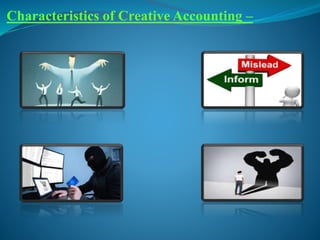
Characteristics of Creative Accounting –
Reasons for Creative Accounting –
 Income Soothing
 Survive from Bankruptcy
 More Profit
 Pay Less Tax
 Boost the Share Price
 To increase (fake) transaction
 To Attract Investor
 Boost Assets to avoid Takeover
Creative Accounting Practices –
 Allow company to choose between different accounting
methods such as writing off development costs or amortising
it.
 Certain entries in the account involve unavoidable degree
of estimation, judgement and prediction.
 Artificial transactions can be used to manipulate balance
sheet and move profits between accounting periods.
 Genuine transactions can be timed to give desired
impression in the accounts.
Off – balance sheet financing – Leasing, higher purchases,
share buyback, special purpose vehicle, tools used to arrange
finance.
 Overstatements of Assets – Can be done for various assets
like inventory, cash, plant and equipment, investments and
other Current Assets.
 Some other Accounting Practices –
o Follow-up of matching concept
o Adjustment in the capital employed
o Movement in inventory
o Manipulating the value of goodwill and intangibles
Creative Accounting examples –
1. Invoicing
2. Service contracts
3. Property values
4. Loans
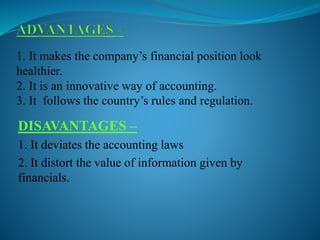
DISAVANTAGES –
1. It deviates the accounting laws
2. It distort the value of information given by
financials.
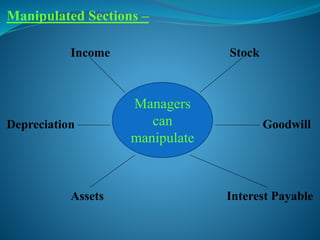
Manipulated Sections –
Income Stock
Depreciation Goodwill
Assets Interest Payable
Managers
can
manipulate
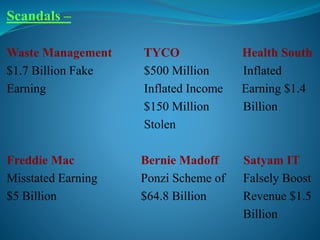
Scandals –
Waste Management TYCO Health South
$1.7 Billion Fake $500 Million Inflated
Earning Inflated Income Earning $1.4
$150 Million Billion
Stolen
Freddie Mac Bernie Madoff Satyam IT
Misstated Earning Ponzi Scheme of Falsely Boost
$5 Billion $64.8 Billion Revenue $1.5
Billion
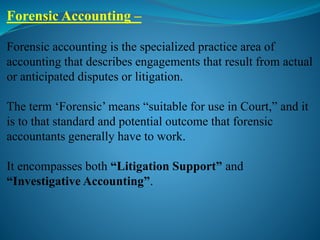
Forensic Accounting –
Forensic accounting is the specialized practice area of
accounting that describes engagements that result from actual
or anticipated disputes or litigation.
The term ‘Forensic’ means “suitable for use in Court,” and it
is to that standard and potential outcome that forensic
accountants generally have to work.
It encompasses both “Litigation Support” and
“Investigative Accounting”.
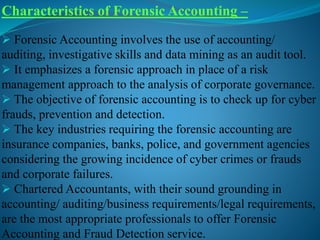
Characteristics of Forensic Accounting –
 Forensic Accounting involves the use of accounting/
auditing, investigative skills and data mining as an audit tool.
 It emphasizes a forensic approach in place of a risk
management approach to the analysis of corporate governance.
 The objective of forensic accounting is to check up for cyber
frauds, prevention and detection.
 The key industries requiring the forensic accounting are
insurance companies, banks, police, and government agencies
considering the growing incidence of cyber crimes or frauds
and corporate failures.
 Chartered Accountants, with their sound grounding in
accounting/ auditing/business requirements/legal requirements,
are the most appropriate professionals to offer Forensic
Accounting and Fraud Detection service.
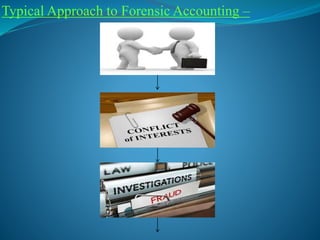
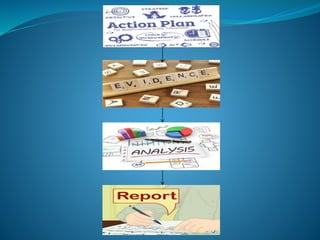
Typical Approach to Forensic Accounting –
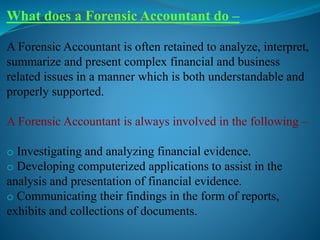
What does a Forensic Accountant do –
A Forensic Accountant is often retained to analyze, interpret,
summarize and present complex financial and business
related issues in a manner which is both understandable and
properly supported.
A Forensic Accountant is always involved in the following –
o Investigating and analyzing financial evidence.
o Developing computerized applications to assist in the
analysis and presentation of financial evidence.
o Communicating their findings in the form of reports,
exhibits and collections of documents.
o Assisting in legal proceedings, including testifying in court
as an expert witness and preparing visual aids to support trial
evidence.
Assignments performed by a Forensic Accountant –
o Criminal Investigation
o Shareholder’s and Partnership’s Disputes
o Personal Inquiry Claims/Motor Vehicle Accidents
o Business Interruptions/Other types of Insurance Claims
o Business/ Employee Fraud Investigations
o Matrimonial Disputes
o Business Economic Losses
o Professional Negligence
o Mediation and Arbitration
Scope of Forensic Accounting –
Under litigation support, forensic accountant assist in –
o Obtaining document necessary to support or refute a claim.
o Reviewing of the relevant documentation to form an initial
assessment of the case in an identified area of loss.
o Examination for discovering, including the formulation of
the act regarding the financial residence.
o Attendance at the examination for discovery to review the
testimony, assist with understanding the financial issues and
to formulate additional questions to be asked.
Investigative accountant on the other hand –
o Reviews factual situation and provides suggestions
regarding possible courses of action.
o Assist with the protection and recovery of assets.
o Co-ordinate other experts.
Skill Requirement of Forensic Accountant –
 Curiosity
 Persistence
 Creativity
 Discretion
 Organization
 Confidence
 Sound Professional Judgement
A Forensic Accountant must be open to consider all
alternatives, scrutinize the fine details and at the same time
see the big picture. In addition, a Forensic Accountant must
be able to listen effectively and communicate clearly and
concisely.
Advantages –
 It helps solve financial crimes.
 It helps monitor professionals.
 It helps businesses with their finances.
Disadvantages –
 It takes a lot of time.
 It can be expensive.
 It can be distracting.
 It can affect employee morale.
Creative Accounting and Forensic Accounting

Creative Accounting and Forensic Accounting

  • 1.
  • 4.
  • 5.
    Reasons for CreativeAccounting –  Income Soothing  Survive from Bankruptcy  More Profit  Pay Less Tax  Boost the Share Price  To increase (fake) transaction  To Attract Investor  Boost Assets to avoid Takeover
  • 6.
    Creative Accounting Practices–  Allow company to choose between different accounting methods such as writing off development costs or amortising it.  Certain entries in the account involve unavoidable degree of estimation, judgement and prediction.  Artificial transactions can be used to manipulate balance sheet and move profits between accounting periods.  Genuine transactions can be timed to give desired impression in the accounts.
  • 7.
    Off – balancesheet financing – Leasing, higher purchases, share buyback, special purpose vehicle, tools used to arrange finance.  Overstatements of Assets – Can be done for various assets like inventory, cash, plant and equipment, investments and other Current Assets.  Some other Accounting Practices – o Follow-up of matching concept o Adjustment in the capital employed o Movement in inventory o Manipulating the value of goodwill and intangibles
  • 8.
    Creative Accounting examples– 1. Invoicing 2. Service contracts 3. Property values 4. Loans
  • 9.
    DISAVANTAGES – 1. Itdeviates the accounting laws 2. It distort the value of information given by financials.
  • 10.
    Manipulated Sections – IncomeStock Depreciation Goodwill Assets Interest Payable Managers can manipulate
  • 11.
    Scandals – Waste ManagementTYCO Health South $1.7 Billion Fake $500 Million Inflated Earning Inflated Income Earning $1.4 $150 Million Billion Stolen Freddie Mac Bernie Madoff Satyam IT Misstated Earning Ponzi Scheme of Falsely Boost $5 Billion $64.8 Billion Revenue $1.5 Billion
  • 13.
    Forensic Accounting – Forensicaccounting is the specialized practice area of accounting that describes engagements that result from actual or anticipated disputes or litigation. The term ‘Forensic’ means “suitable for use in Court,” and it is to that standard and potential outcome that forensic accountants generally have to work. It encompasses both “Litigation Support” and “Investigative Accounting”.
  • 16.
    Characteristics of ForensicAccounting –  Forensic Accounting involves the use of accounting/ auditing, investigative skills and data mining as an audit tool.  It emphasizes a forensic approach in place of a risk management approach to the analysis of corporate governance.  The objective of forensic accounting is to check up for cyber frauds, prevention and detection.  The key industries requiring the forensic accounting are insurance companies, banks, police, and government agencies considering the growing incidence of cyber crimes or frauds and corporate failures.  Chartered Accountants, with their sound grounding in accounting/ auditing/business requirements/legal requirements, are the most appropriate professionals to offer Forensic Accounting and Fraud Detection service.
  • 17.
    Typical Approach toForensic Accounting –
  • 19.
    What does aForensic Accountant do – A Forensic Accountant is often retained to analyze, interpret, summarize and present complex financial and business related issues in a manner which is both understandable and properly supported. A Forensic Accountant is always involved in the following – o Investigating and analyzing financial evidence. o Developing computerized applications to assist in the analysis and presentation of financial evidence. o Communicating their findings in the form of reports, exhibits and collections of documents.
  • 20.
    o Assisting inlegal proceedings, including testifying in court as an expert witness and preparing visual aids to support trial evidence. Assignments performed by a Forensic Accountant – o Criminal Investigation o Shareholder’s and Partnership’s Disputes o Personal Inquiry Claims/Motor Vehicle Accidents o Business Interruptions/Other types of Insurance Claims o Business/ Employee Fraud Investigations o Matrimonial Disputes o Business Economic Losses o Professional Negligence o Mediation and Arbitration
  • 21.
    Scope of ForensicAccounting – Under litigation support, forensic accountant assist in – o Obtaining document necessary to support or refute a claim. o Reviewing of the relevant documentation to form an initial assessment of the case in an identified area of loss. o Examination for discovering, including the formulation of the act regarding the financial residence. o Attendance at the examination for discovery to review the testimony, assist with understanding the financial issues and to formulate additional questions to be asked.
  • 22.
    Investigative accountant onthe other hand – o Reviews factual situation and provides suggestions regarding possible courses of action. o Assist with the protection and recovery of assets. o Co-ordinate other experts.
  • 23.
    Skill Requirement ofForensic Accountant –  Curiosity  Persistence  Creativity  Discretion  Organization  Confidence  Sound Professional Judgement A Forensic Accountant must be open to consider all alternatives, scrutinize the fine details and at the same time see the big picture. In addition, a Forensic Accountant must be able to listen effectively and communicate clearly and concisely.
  • 24.
    Advantages –  Ithelps solve financial crimes.  It helps monitor professionals.  It helps businesses with their finances. Disadvantages –  It takes a lot of time.  It can be expensive.  It can be distracting.  It can affect employee morale.