the Evolution of Scholarly Communications at
Binghamton University
Elizabeth Brown
Scholarly Communications Officer
Binghamton University Libraries
Western NewYork/Ontario ACRL Meeting
May 7, 2010
 Why is Scholarly Communications Important?
 Scholarly Communications Committee
 Scholarly Communications Officer Position
 Scholarly Communications Program:
Services, Programs, Publishing, Preservation
 Campus and Library Roles
 Challenges
 What’s Coming?
5/7/2010 2
 Publishing models are changing
 Copyright law and perceptions of ownership
are changing
 Funding agency mandates require
researchers to post work online
 Social Networking tools allow peers to rapidly
share and distribute information
1/30/2015 3
 US scholarly communication practices are
not the global benchmark
 Need to inform researchers how changes will
affect their research and publishing
 Library policies and collections planning will
need adjustment, refinement, or review
5/7/2010 4
 Copyright and intellectual property rights more
important
 Publicly funded research should be available to
all
 Authors should maintain rights to distribute and
share their research
 Creation of institutional repositories with local
electronic collections
 Permanent archives necessary for electronic
materials
5/7/2010 5
 Institutional and Subject Repositories
 DigitizedCollections
 Copyright and Intellectual Property
 Social Networks
 Publishing models and distribution
 Technology tools
 Policies and Documentation
 Peer Review
 Tenure and Promotion
5/7/2010 6
Open Source software
Open Standards
Open Data
Open Educational Resources
Open Access
Open Notebook Science
http://scienceblogs.com/bookoftrogool/2010/03/battle_of_the_opens.php
5/7/2010 7
5/7/2010 8
 Formed in spring 2005
 Charge
1. Stay abreast of changes in the scholarly
communications environment by monitoring
SPARC, open source initiatives, etc.
2. To share developments with library staff and
develop a plan for educating our campus on these
issues.
3. To monitor intellectual property issues, including
copyright restrictions, regarding e-reserves, etc.
4. To make recommendations to library staff on issues
of copyright compliance.
1/30/2015 9
 Members from all members of the Libraries
 LongTerm-Goals:
1. Form institutional repository for BU, Libraries
serves as partner in the creation and
preservation of materials
2. Investigate creating and publishing an in-house
journal related to scholarly communications
3. Provide mechanisms to archive post-prints
4. Create partnerships with local publishers and
scholarly publications produced on campus.
5/7/2010 10
 Accomplishments:
 Joined SPARC in early 2006
 SPARC presentation to Faculty Senate Library
Committee
 Information-sharing with library staff
5/7/2010 11
 Verdict:
Committee structure not conducive to
creating and sustaining momentum on
activities
 Recommendation:
Current staff member assume responsibility for
scholarly communications as part of their position
5/7/2010 12
 FullTitle
Scholarly Communications and Library
Grants Officer
 Coordinates scholarly communications and
intellectual property activities for the
Libraries
 Leads a scholarly communications program
 Educates the university community about
intellectual property issues and impact on
scholarly inquiry and instruction
1/30/2015 13
 Read a lot of reports and articles
 Interpret, discuss and create program pieces
from new developments
 Share info with campus faculty and
administrators
 Create and organize programs to share
information
 Ensure new models are infused into library
practice
5/7/2010 14
 Created in 2008
 Build upon the earlier committee charge
 Complementary activities: collections, grants
coordination
 Higher profile within Libraries
 Less emphasis on operational issues
 More emphasis on intellectual issues
1/30/2015 15
 NIH PubMedCentral 3rd party submittals
 Author Addenda for copyright transfer
agreements
 Google Book Search and Settlement
information
 Copyright and Intellectual Property
assistance
1/30/2015 16
 Open Access Day, October 14, 2008
 2009 Provost Interdisciplinary/
Multidisciplinary Symposia Award
New Approaches to Scholarly Communication
and Publishing, April 15-16, 2009
 Chemistry Department Colloquia talk
Chemistry andWeb 2.0: NewWays to Find
Chemical Information, Professor Martin
Walker, February 5, 2010
1/30/2015 17
 Met with Fernand Braudel Center for options
to migrate content to electronic and web
formats, June 2009
 Met with Gary Dunham, PhD, Executive
director, SUNY Press, August 2009
 Campus publishing workshop for graduate
students and faculty, December 11, 2009
1/30/2015 18
 Portico Membership, 2006 – date
 LOCKSS Recommendations, 2008
 Local Digital Repository, 2008
 Eprints
 Library faculty and internal submissions
1/30/2015 19
http://portal.unesco.org/geography/es/ev.php-URL_ID=6007&URL_DO=DO_TOPIC&URL_SECTION=201.html
 SUNY Conversations in the Disciplines Award for
2010-2011:
Publishing Promoting and Preserving Scholarship
@ SUNY
November 12, 2010 (tent.)
Binghamton University
 SciVal Spotlight (Elsevier)
 Copyright Materials review
 Scholarly Communications Strategic Plan
 Define preservation scope, efforts
5/7/2010 20
 Faculty member
 Administrator
 Writer / Grant Creator
 Editor / Grant Coordinator
 Collections Management
 Department Liaison
 Reference Librarian
1/30/2015 21
http://www.google.com/imgres?imgurl=http://www.istockphoto.com/file_thumbview_approve/5204676/2/istockphoto_5204676-
business-woman-balancing-life-having-to-wear-too-many-hats.jpg&imgrefurl=http://www.istockphoto.com/stock-photo-5204676-
business-woman-balancing-life-having-to-wear-too-many-hats.php&usg=__palN0vkKuwoG8PS-
EfP44DvQy7I=&h=253&w=380&sz=30&hl=en&start=2&itbs=1&tbnid=Eo3BjbyBNUxbzM:&tbnh=82&tbnw=123&prev=/images%3Fq%3Dw
earing%2Bmany%2Bhats%26hl%3Den%26gbv%3D2%26tbs%3Disch:1
 Roles change with situation
 Services affected by new legislation and
mandates
 Identifying best programs for a target
audience is difficult
 Publishing activity varies among programs
and researchers
 Campus administration may change
1/30/2015 22
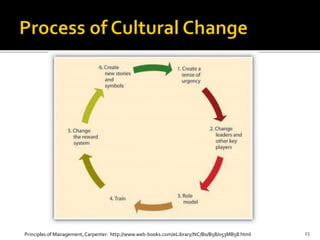
23Principles of Management, Carpenter: http://www.web-books.com/eLibrary/NC/B0/B58/053MB58.html
 Standards for preservation and federating
content (OAI-ORE, OAI-PMH) not embedded
in all databases
 High preservation costs that require a long-
term commitment
 Program funding
 Policies for scholarship are evolving
 One size does not fit all for programs
 Information and databases are in silos
5/7/2010 24
 Scanning is messy
 Who controls information?
 The Author/Creator?
 The Publisher?
 The Distributor/Database Provider?
 The Scanner?
 Who sets, controls, and enforces policies?
 Libraries may need to respond to a policy
with little or no input (Google Book Search)
5/7/2010 25
 Economy:
 Tighter budgets will push models forward faster
 Publishing: Further growth in
 Open Access publishing
 User-Generated content
 Self Publishing
 Print on Demand for books
 Publishing: Additional/Expanded
 Author deposit mandate policies: NSF, NEH
 Use of Author Addenda for publishing articles
 Use of alternative citation metrics to measure prestige and
value of research
 Publishing: Creative Commons use will expand
1/30/2015 26
 Technology
 More open source applications
 Greater system interoperability
 Greater emphasis on usability, design
 Increased use of Repositories: Subject,
Institutional (Digital)
 Digital projects, preservation, standards
 Continued large scale scanning projects
5/7/2010 27
 Merging/integration of library content and
 Social networking tools
 Subject repository culture and tools
28
 Scholarly Communications and Library Grants Officer:
http://www.arl.org/bm~doc/eab-position-decription-6-12-08.pdf
 BU Scholarly CommunicationsWebsite:
http://library.binghamton.edu/services/scholarly/index.html
 A Season of Change: How Science Librarians Can
Remain Relevant with Open Access and Scholarly
Communications Initiatives , ISTL Fall 2009,
http://www.istl.org/09-fall/article2.html
 Support for the Research Process:An Academic Library
Manifesto, RLG/OCLC, 2009,
http://www.oclc.org/research/publications/library/2009/2009-
07.pdf
1/30/2015 29
 John M Meador, Jr,. Director of Libraries
 BU Scholarly Communications Committee
 BU Provost’s Symposia Program
 BU Faculty Senate Library Committee
 Slide 1 Photo: http://www.mccollumenterprisesllc.com/
1/30/2015 30
 Slideshare link:
 Email: ebrown@binghamton.edu
 Twitter, Friendfeed: eabrown25
 Linked In:
http://www.linkedin.com/pub/elizabeth-brown/11/21b/69b
1/30/2015 31

Promoting Scholarship with Services, Programs and Publishing

  • 1.
    the Evolution ofScholarly Communications at Binghamton University Elizabeth Brown Scholarly Communications Officer Binghamton University Libraries Western NewYork/Ontario ACRL Meeting May 7, 2010
  • 2.
     Why isScholarly Communications Important?  Scholarly Communications Committee  Scholarly Communications Officer Position  Scholarly Communications Program: Services, Programs, Publishing, Preservation  Campus and Library Roles  Challenges  What’s Coming? 5/7/2010 2
  • 3.
     Publishing modelsare changing  Copyright law and perceptions of ownership are changing  Funding agency mandates require researchers to post work online  Social Networking tools allow peers to rapidly share and distribute information 1/30/2015 3
  • 4.
     US scholarlycommunication practices are not the global benchmark  Need to inform researchers how changes will affect their research and publishing  Library policies and collections planning will need adjustment, refinement, or review 5/7/2010 4
  • 5.
     Copyright andintellectual property rights more important  Publicly funded research should be available to all  Authors should maintain rights to distribute and share their research  Creation of institutional repositories with local electronic collections  Permanent archives necessary for electronic materials 5/7/2010 5
  • 6.
     Institutional andSubject Repositories  DigitizedCollections  Copyright and Intellectual Property  Social Networks  Publishing models and distribution  Technology tools  Policies and Documentation  Peer Review  Tenure and Promotion 5/7/2010 6
  • 7.
    Open Source software OpenStandards Open Data Open Educational Resources Open Access Open Notebook Science http://scienceblogs.com/bookoftrogool/2010/03/battle_of_the_opens.php 5/7/2010 7
  • 8.
  • 9.
     Formed inspring 2005  Charge 1. Stay abreast of changes in the scholarly communications environment by monitoring SPARC, open source initiatives, etc. 2. To share developments with library staff and develop a plan for educating our campus on these issues. 3. To monitor intellectual property issues, including copyright restrictions, regarding e-reserves, etc. 4. To make recommendations to library staff on issues of copyright compliance. 1/30/2015 9
  • 10.
     Members fromall members of the Libraries  LongTerm-Goals: 1. Form institutional repository for BU, Libraries serves as partner in the creation and preservation of materials 2. Investigate creating and publishing an in-house journal related to scholarly communications 3. Provide mechanisms to archive post-prints 4. Create partnerships with local publishers and scholarly publications produced on campus. 5/7/2010 10
  • 11.
     Accomplishments:  JoinedSPARC in early 2006  SPARC presentation to Faculty Senate Library Committee  Information-sharing with library staff 5/7/2010 11
  • 12.
     Verdict: Committee structurenot conducive to creating and sustaining momentum on activities  Recommendation: Current staff member assume responsibility for scholarly communications as part of their position 5/7/2010 12
  • 13.
     FullTitle Scholarly Communicationsand Library Grants Officer  Coordinates scholarly communications and intellectual property activities for the Libraries  Leads a scholarly communications program  Educates the university community about intellectual property issues and impact on scholarly inquiry and instruction 1/30/2015 13
  • 14.
     Read alot of reports and articles  Interpret, discuss and create program pieces from new developments  Share info with campus faculty and administrators  Create and organize programs to share information  Ensure new models are infused into library practice 5/7/2010 14
  • 15.
     Created in2008  Build upon the earlier committee charge  Complementary activities: collections, grants coordination  Higher profile within Libraries  Less emphasis on operational issues  More emphasis on intellectual issues 1/30/2015 15
  • 16.
     NIH PubMedCentral3rd party submittals  Author Addenda for copyright transfer agreements  Google Book Search and Settlement information  Copyright and Intellectual Property assistance 1/30/2015 16
  • 17.
     Open AccessDay, October 14, 2008  2009 Provost Interdisciplinary/ Multidisciplinary Symposia Award New Approaches to Scholarly Communication and Publishing, April 15-16, 2009  Chemistry Department Colloquia talk Chemistry andWeb 2.0: NewWays to Find Chemical Information, Professor Martin Walker, February 5, 2010 1/30/2015 17
  • 18.
     Met withFernand Braudel Center for options to migrate content to electronic and web formats, June 2009  Met with Gary Dunham, PhD, Executive director, SUNY Press, August 2009  Campus publishing workshop for graduate students and faculty, December 11, 2009 1/30/2015 18
  • 19.
     Portico Membership,2006 – date  LOCKSS Recommendations, 2008  Local Digital Repository, 2008  Eprints  Library faculty and internal submissions 1/30/2015 19 http://portal.unesco.org/geography/es/ev.php-URL_ID=6007&URL_DO=DO_TOPIC&URL_SECTION=201.html
  • 20.
     SUNY Conversationsin the Disciplines Award for 2010-2011: Publishing Promoting and Preserving Scholarship @ SUNY November 12, 2010 (tent.) Binghamton University  SciVal Spotlight (Elsevier)  Copyright Materials review  Scholarly Communications Strategic Plan  Define preservation scope, efforts 5/7/2010 20
  • 21.
     Faculty member Administrator  Writer / Grant Creator  Editor / Grant Coordinator  Collections Management  Department Liaison  Reference Librarian 1/30/2015 21 http://www.google.com/imgres?imgurl=http://www.istockphoto.com/file_thumbview_approve/5204676/2/istockphoto_5204676- business-woman-balancing-life-having-to-wear-too-many-hats.jpg&imgrefurl=http://www.istockphoto.com/stock-photo-5204676- business-woman-balancing-life-having-to-wear-too-many-hats.php&usg=__palN0vkKuwoG8PS- EfP44DvQy7I=&h=253&w=380&sz=30&hl=en&start=2&itbs=1&tbnid=Eo3BjbyBNUxbzM:&tbnh=82&tbnw=123&prev=/images%3Fq%3Dw earing%2Bmany%2Bhats%26hl%3Den%26gbv%3D2%26tbs%3Disch:1
  • 22.
     Roles changewith situation  Services affected by new legislation and mandates  Identifying best programs for a target audience is difficult  Publishing activity varies among programs and researchers  Campus administration may change 1/30/2015 22
  • 23.
    23Principles of Management,Carpenter: http://www.web-books.com/eLibrary/NC/B0/B58/053MB58.html
  • 24.
     Standards forpreservation and federating content (OAI-ORE, OAI-PMH) not embedded in all databases  High preservation costs that require a long- term commitment  Program funding  Policies for scholarship are evolving  One size does not fit all for programs  Information and databases are in silos 5/7/2010 24
  • 25.
     Scanning ismessy  Who controls information?  The Author/Creator?  The Publisher?  The Distributor/Database Provider?  The Scanner?  Who sets, controls, and enforces policies?  Libraries may need to respond to a policy with little or no input (Google Book Search) 5/7/2010 25
  • 26.
     Economy:  Tighterbudgets will push models forward faster  Publishing: Further growth in  Open Access publishing  User-Generated content  Self Publishing  Print on Demand for books  Publishing: Additional/Expanded  Author deposit mandate policies: NSF, NEH  Use of Author Addenda for publishing articles  Use of alternative citation metrics to measure prestige and value of research  Publishing: Creative Commons use will expand 1/30/2015 26
  • 27.
     Technology  Moreopen source applications  Greater system interoperability  Greater emphasis on usability, design  Increased use of Repositories: Subject, Institutional (Digital)  Digital projects, preservation, standards  Continued large scale scanning projects 5/7/2010 27
  • 28.
     Merging/integration oflibrary content and  Social networking tools  Subject repository culture and tools 28
  • 29.
     Scholarly Communicationsand Library Grants Officer: http://www.arl.org/bm~doc/eab-position-decription-6-12-08.pdf  BU Scholarly CommunicationsWebsite: http://library.binghamton.edu/services/scholarly/index.html  A Season of Change: How Science Librarians Can Remain Relevant with Open Access and Scholarly Communications Initiatives , ISTL Fall 2009, http://www.istl.org/09-fall/article2.html  Support for the Research Process:An Academic Library Manifesto, RLG/OCLC, 2009, http://www.oclc.org/research/publications/library/2009/2009- 07.pdf 1/30/2015 29
  • 30.
     John MMeador, Jr,. Director of Libraries  BU Scholarly Communications Committee  BU Provost’s Symposia Program  BU Faculty Senate Library Committee  Slide 1 Photo: http://www.mccollumenterprisesllc.com/ 1/30/2015 30
  • 31.
     Slideshare link: Email: ebrown@binghamton.edu  Twitter, Friendfeed: eabrown25  Linked In: http://www.linkedin.com/pub/elizabeth-brown/11/21b/69b 1/30/2015 31