Creating the
Constitution
• Republic- a government where people elect
their representatives.
• Some patriots wanted people to have more
power over government.
• More conservative patriots did not want
common people having that much power.
Rejecting executive power
• Unicameral legislature- a single house,
whose members were elected by the people.
• Pennsylvania and Georgia adopted this style.
Colonial Traditions
• Bicameral legislature- law making body with
two houses, a Senate, and a House of
Representatives.
• House of Reps- For the common voters
• Senate- For the wealthy and well educated
gentleman.
Who could vote?
• democratic patriots wanted equal rights for
ALMOST all free men.
• little or no property.
• must be 21.
• Conservative Patriots wanted property
requirements.
• allowing poor men to vote will “ confound and
destroy all distinctions, and prostrate all ranks to
the common level.” - John Adams
**Articles of Confederation
• In 1777, the Continental Congress drafted the
original constitution for the Union of the
states.
• no strong and centralized nation.
• reflected the principles of the Declaration of
Independence.
Structure of the New
National Government
• Federal- a government consisted of a
congress of delegates, chosen by state
legislatures rather than voters.
• states could send 7 delegates but every state
had 1 vote.
The Power
• declare and conduct war!!!
• foreign affairs.
• Indian relations.
Problems
• no taxes.
• minor issues 7 out of 13 states.
• major issues 9 out of 13 states.
• amending Articles 13 out of 13.
• Ratifying the Articles in 1781
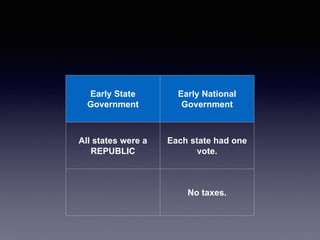
Early State
Government
Early National
Government
All states were a
REPUBLIC
Each state had one
vote.
No taxes.
The Westside
The Westside
• Northwest Territory- north of the Ohio River
and west of the Penn. to the Mississippi
River.
• Land Ordinance of 1785- Congress designed
a system for distributing the public lands.
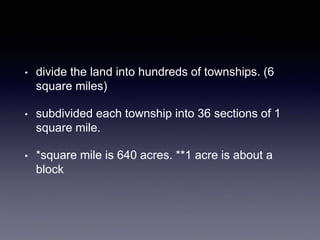
• divide the land into hundreds of townships. (6
square miles)
• subdivided each township into 36 sections of 1
square mile.
• *square mile is 640 acres. **1 acre is about a
block
• This ORDINANCE favored the wealthy.
• Sometimes Congress broke the rules to benefit
wealthy speculators.
Governing the Western
lands.
• Northwest Ordinance of 1787- provided a
government for the western territory based
on Jefferson’s ideas.
• a governor, a secretary, and three judges.
• 5,000 citizens= elected assembly
• 60,000= admission into the Union.
The Northwest Territory
• Ohio, Indiana, Illinois, Michigan, Wisconsin, and
part of Minnesota.
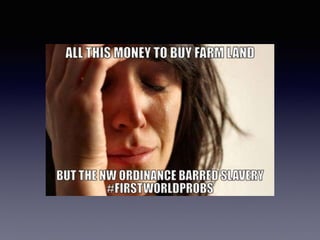
• Northwest Ordinance says no to slavery.
Creating the constitution full

Creating the constitution full

  • 1.
  • 2.
    • Republic- agovernment where people elect their representatives. • Some patriots wanted people to have more power over government. • More conservative patriots did not want common people having that much power.
  • 3.
    Rejecting executive power •Unicameral legislature- a single house, whose members were elected by the people. • Pennsylvania and Georgia adopted this style.
  • 4.
    Colonial Traditions • Bicamerallegislature- law making body with two houses, a Senate, and a House of Representatives. • House of Reps- For the common voters • Senate- For the wealthy and well educated gentleman.
  • 6.
    Who could vote? •democratic patriots wanted equal rights for ALMOST all free men. • little or no property. • must be 21.
  • 7.
    • Conservative Patriotswanted property requirements. • allowing poor men to vote will “ confound and destroy all distinctions, and prostrate all ranks to the common level.” - John Adams
  • 8.
    **Articles of Confederation •In 1777, the Continental Congress drafted the original constitution for the Union of the states. • no strong and centralized nation. • reflected the principles of the Declaration of Independence.
  • 9.
    Structure of theNew National Government • Federal- a government consisted of a congress of delegates, chosen by state legislatures rather than voters. • states could send 7 delegates but every state had 1 vote.
  • 10.
    The Power • declareand conduct war!!! • foreign affairs. • Indian relations.
  • 11.
    Problems • no taxes. •minor issues 7 out of 13 states. • major issues 9 out of 13 states. • amending Articles 13 out of 13. • Ratifying the Articles in 1781
  • 12.
    Early State Government Early National Government Allstates were a REPUBLIC Each state had one vote. No taxes.
  • 13.
  • 14.
    The Westside • NorthwestTerritory- north of the Ohio River and west of the Penn. to the Mississippi River. • Land Ordinance of 1785- Congress designed a system for distributing the public lands.
  • 16.
    • divide theland into hundreds of townships. (6 square miles) • subdivided each township into 36 sections of 1 square mile. • *square mile is 640 acres. **1 acre is about a block
  • 18.
    • This ORDINANCEfavored the wealthy. • Sometimes Congress broke the rules to benefit wealthy speculators.
  • 20.
    Governing the Western lands. •Northwest Ordinance of 1787- provided a government for the western territory based on Jefferson’s ideas. • a governor, a secretary, and three judges. • 5,000 citizens= elected assembly • 60,000= admission into the Union.
  • 21.
    The Northwest Territory •Ohio, Indiana, Illinois, Michigan, Wisconsin, and part of Minnesota. • Northwest Ordinance says no to slavery.