Creating ePortfolios at PacificTAFE at The University of the
SouthPacific- creating spaces for students to demonstrate
competencies intheir profession
IreneYee Chief, Mojito Jione and
RajneelTotaram
1
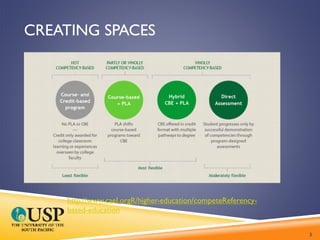
CREATING SPACES
http://www.cael.orgR/higher-education/competeReferency-
based-education
2
PARTNERSHIP
 The mission of PacificTAFE (PacificTechnical and Further Education),
The University of the South Pacific (USP) provides high quality Skills
Based Qualifications (SBQ’s), Foundation and Preliminary studies.
 This presentation will focus on Skill Based Qualifications in one
programme: Certificate IV in Hospitality Operations. The
programme has 8 courses and we will be focusing on CE48-Hospitality
Workplace Practicum, the culminating practicum.
3
COMPETENCY BASED EDUCATION
 Competency-based assessment (or CBA) involves 'the gathering
and judging of evidence in order to decide whether a person has
achieved a standard of competence'. Assessors work with the candidate
to collect a range of evidence using the appropriate nationally endorsed
industry competency standards as benchmarks (TAFE, New South
Wales, 2008).
4
EPORTFOLIOS?
 provides the space for learners to apply, analyze, evaluate and create
 Collaborative partnership -Centre for Flexible Learning (CFL) + Pacific
TAFE
 Awarded a Research Grant at USP
 Creating digital components and gathering technology tools to enable final year
students to complete their practicum across the Fiji Islands.
 600 hours within 6 month period to assess their knowledge and
competencies for learners
 The process is built on the existing logbook + staff of PacificTAFE
5
STRATEGIC PLAN USP
 The focus was on the following priorities
 Priority 5: Regional and Community Development
 Objective 18: to extend the reach at USP through the inclusion of other countries
 Objective 19: strengthen and expand communications and partnerships with
stakeholders in government, CROP agencies, industry media, non state actors and the
community.
 Priority Area 1: Learning andTeaching
 Transform USP’s pedagogy and curriculum, -accelerate staff development and
effective application of new pedagogies and technologies
6
EPORTFOLIO CONTINUE
 With this grant, we will look at development at two levels:
 Creating digital and format for mobility(Roberts, P., Maor, D., & Herrington, J.(2016)
 at the course and programme level
 institution level
 Why ePortfolios are relevant for Pacific Islanders?Why create
the space?
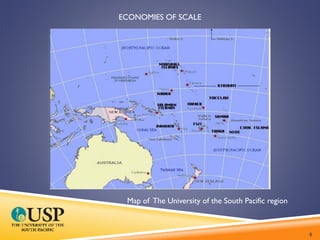
Pragmatic approach- 12 countries (and 14 campuses) across the
Pacific Ocean
7
ECONOMIES OF SCALE
Map of The University of the South Pacific region
8
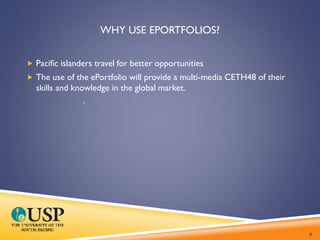
WHY USE EPORTFOLIOS?
 Pacific islanders travel for better opportunities
 The use of the ePortfolio will provide a multi-media CETH48 of their
skills and knowledge in the global market.
.
9
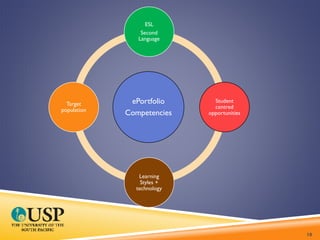
ePortfolio
Competencies
ESL
Second
Language
Student
centred
opportunities
Learning
Styles +
technology
Target
population
10
EPORTFOLIOS- WHY- CONTINUE
 Creativity- evolving, also space for reflection (Schon,1983)
 Sharing- Allowing learners to share with one another, in the virtual
space or face to face.
 Demonstrate wider abilities (Cameron, 2012)
 Alignment of industry with the university( USP)- to strengthen
opportunities for employability.
11
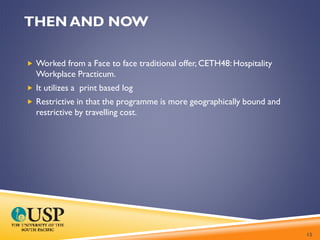
THEN AND NOW
 Worked from a Face to face traditional offer, CETH48: Hospitality
Workplace Practicum.
 It utilizes a print based log
 Restrictive in that the programme is more geographically bound and
restrictive by travelling cost.
12
NOW
 Access for students across the USP region. Mahara is incorporated/
embedded into the present Learning Management System (Moodle at
USP)
 The provision of a USP Mahara Guide was built for adult learners as
some customization of Moodle had to be explained.
 The creation of an ePortfolio guide for learners.
 Creation of aToolkit so that learners in the course are able to use
technology to create their artifacts to demonstrate evidence.
 Incorporate a variety of digital media for assessment and evidence of achievement
aginst industry competency standards (Moran,Vozzo, Reid, Pietsch & Hatton, 2013)
13
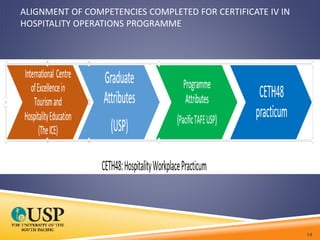
ALIGNMENT OF COMPETENCIES COMPLETED FOR CERTIFICATE IV IN
HOSPITALITY OPERATIONS PROGRAMME
14
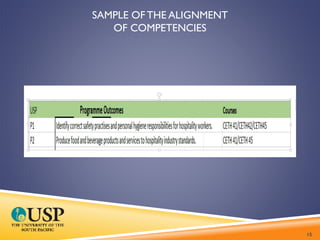
SAMPLE OF THE ALIGNMENT
OF COMPETENCIES
15
FUTURE
 Train for trainers (TOT) [validity and reliability]
 Student training to use ePortfolio (is in progress)
 At the institutional level
 Translate this creation/practice across the USP region
 Certificate IV in Hospitality Operations across the USP
region.
 PacificTAFE is planning to adopting this model across its
programmes
 Enable PacificTAFE to work closely with industries and to have
closer alignment in workforce development.
 Research into our practices in the USP region and fulfilling our strategic
plan priorities.
16
REFERENCES
 Cameron, R. (2012). Recognising workplace learning: the emerging practices of e‐RPL and e‐PR. Journal
ofWorkplace Learning, 24(2), 85-104. http://dx.doi.org/10.1108/13665621211201689
 Competency-Based Education:A PowerfulWay to Link Learning and theWorkplace. (2017, February
06). Retrieved April 01, 2017, from http://evolllution.com/programming/applied-and-experiential-
learning/competency-based-education-a-powerful-way-to-link-learning-and-the-workplace/
 DePaul, K. (n.d.). Competency Based Education gains momentum [Web log post]. Retrieved March 22,
2017, from https://er.educause.edu/blogs/2017/2/competency-based-education-gains-momentum
 http://the-ice.org/
 Moran,W.,Vozzo, L., Reid, J-A., Pietsch, M., & Hatton, C. (2013). How can technology make this work?
Preservice teachers, off-campus learning and digital portfolios. Australian Journal ofTeacher Education,
38(5), 116-130, http://dx.doi.org/10.14221/ajte.2013v38n5.9
 Roberts, P., Maor, D., & Herrington, J.(2016). ePortfolio-Based Learning Environments:
Recommendations for Effective Scaffolding of Reflective Thinking in Higher Education. Education
Technology & Society, 19(4), 22-33, http://www.ifets.info/journals/19_4/3.pdf
 Revised Bloom’sTaxonomy. (n.d.). Retrieved April 01, 2017, from
http://www.celt.iastate.edu/teaching/effective-teaching-practices/revised-blooms-taxonomy
17

Creating spaces for students to demonstrate competencies in their profession

  • 1.
    Creating ePortfolios atPacificTAFE at The University of the SouthPacific- creating spaces for students to demonstrate competencies intheir profession IreneYee Chief, Mojito Jione and RajneelTotaram 1
  • 2.
  • 3.
    PARTNERSHIP  The missionof PacificTAFE (PacificTechnical and Further Education), The University of the South Pacific (USP) provides high quality Skills Based Qualifications (SBQ’s), Foundation and Preliminary studies.  This presentation will focus on Skill Based Qualifications in one programme: Certificate IV in Hospitality Operations. The programme has 8 courses and we will be focusing on CE48-Hospitality Workplace Practicum, the culminating practicum. 3
  • 4.
    COMPETENCY BASED EDUCATION Competency-based assessment (or CBA) involves 'the gathering and judging of evidence in order to decide whether a person has achieved a standard of competence'. Assessors work with the candidate to collect a range of evidence using the appropriate nationally endorsed industry competency standards as benchmarks (TAFE, New South Wales, 2008). 4
  • 5.
    EPORTFOLIOS?  provides thespace for learners to apply, analyze, evaluate and create  Collaborative partnership -Centre for Flexible Learning (CFL) + Pacific TAFE  Awarded a Research Grant at USP  Creating digital components and gathering technology tools to enable final year students to complete their practicum across the Fiji Islands.  600 hours within 6 month period to assess their knowledge and competencies for learners  The process is built on the existing logbook + staff of PacificTAFE 5
  • 6.
    STRATEGIC PLAN USP The focus was on the following priorities  Priority 5: Regional and Community Development  Objective 18: to extend the reach at USP through the inclusion of other countries  Objective 19: strengthen and expand communications and partnerships with stakeholders in government, CROP agencies, industry media, non state actors and the community.  Priority Area 1: Learning andTeaching  Transform USP’s pedagogy and curriculum, -accelerate staff development and effective application of new pedagogies and technologies 6
  • 7.
    EPORTFOLIO CONTINUE  Withthis grant, we will look at development at two levels:  Creating digital and format for mobility(Roberts, P., Maor, D., & Herrington, J.(2016)  at the course and programme level  institution level  Why ePortfolios are relevant for Pacific Islanders?Why create the space? Pragmatic approach- 12 countries (and 14 campuses) across the Pacific Ocean 7
  • 8.
    ECONOMIES OF SCALE Mapof The University of the South Pacific region 8
  • 9.
    WHY USE EPORTFOLIOS? Pacific islanders travel for better opportunities  The use of the ePortfolio will provide a multi-media CETH48 of their skills and knowledge in the global market. . 9
  • 10.
  • 11.
    EPORTFOLIOS- WHY- CONTINUE Creativity- evolving, also space for reflection (Schon,1983)  Sharing- Allowing learners to share with one another, in the virtual space or face to face.  Demonstrate wider abilities (Cameron, 2012)  Alignment of industry with the university( USP)- to strengthen opportunities for employability. 11
  • 12.
    THEN AND NOW Worked from a Face to face traditional offer, CETH48: Hospitality Workplace Practicum.  It utilizes a print based log  Restrictive in that the programme is more geographically bound and restrictive by travelling cost. 12
  • 13.
    NOW  Access forstudents across the USP region. Mahara is incorporated/ embedded into the present Learning Management System (Moodle at USP)  The provision of a USP Mahara Guide was built for adult learners as some customization of Moodle had to be explained.  The creation of an ePortfolio guide for learners.  Creation of aToolkit so that learners in the course are able to use technology to create their artifacts to demonstrate evidence.  Incorporate a variety of digital media for assessment and evidence of achievement aginst industry competency standards (Moran,Vozzo, Reid, Pietsch & Hatton, 2013) 13
  • 14.
    ALIGNMENT OF COMPETENCIESCOMPLETED FOR CERTIFICATE IV IN HOSPITALITY OPERATIONS PROGRAMME 14
  • 15.
    SAMPLE OF THEALIGNMENT OF COMPETENCIES 15
  • 16.
    FUTURE  Train fortrainers (TOT) [validity and reliability]  Student training to use ePortfolio (is in progress)  At the institutional level  Translate this creation/practice across the USP region  Certificate IV in Hospitality Operations across the USP region.  PacificTAFE is planning to adopting this model across its programmes  Enable PacificTAFE to work closely with industries and to have closer alignment in workforce development.  Research into our practices in the USP region and fulfilling our strategic plan priorities. 16
  • 17.
    REFERENCES  Cameron, R.(2012). Recognising workplace learning: the emerging practices of e‐RPL and e‐PR. Journal ofWorkplace Learning, 24(2), 85-104. http://dx.doi.org/10.1108/13665621211201689  Competency-Based Education:A PowerfulWay to Link Learning and theWorkplace. (2017, February 06). Retrieved April 01, 2017, from http://evolllution.com/programming/applied-and-experiential- learning/competency-based-education-a-powerful-way-to-link-learning-and-the-workplace/  DePaul, K. (n.d.). Competency Based Education gains momentum [Web log post]. Retrieved March 22, 2017, from https://er.educause.edu/blogs/2017/2/competency-based-education-gains-momentum  http://the-ice.org/  Moran,W.,Vozzo, L., Reid, J-A., Pietsch, M., & Hatton, C. (2013). How can technology make this work? Preservice teachers, off-campus learning and digital portfolios. Australian Journal ofTeacher Education, 38(5), 116-130, http://dx.doi.org/10.14221/ajte.2013v38n5.9  Roberts, P., Maor, D., & Herrington, J.(2016). ePortfolio-Based Learning Environments: Recommendations for Effective Scaffolding of Reflective Thinking in Higher Education. Education Technology & Society, 19(4), 22-33, http://www.ifets.info/journals/19_4/3.pdf  Revised Bloom’sTaxonomy. (n.d.). Retrieved April 01, 2017, from http://www.celt.iastate.edu/teaching/effective-teaching-practices/revised-blooms-taxonomy 17