#UEDASummit

#UEDASummit
Economic Development
through Online Education

Ian Tebbett, PhD
University of Florida
On Line Forensic Programs


MS Programs







Forensic Toxicology
Drug Chemistry
DNA & Serology
Forensic Science
Pharm. Chem
Clinical Toxicology




6 Graduate Certificates
Two non credit (CE) courses
Forensic program growth








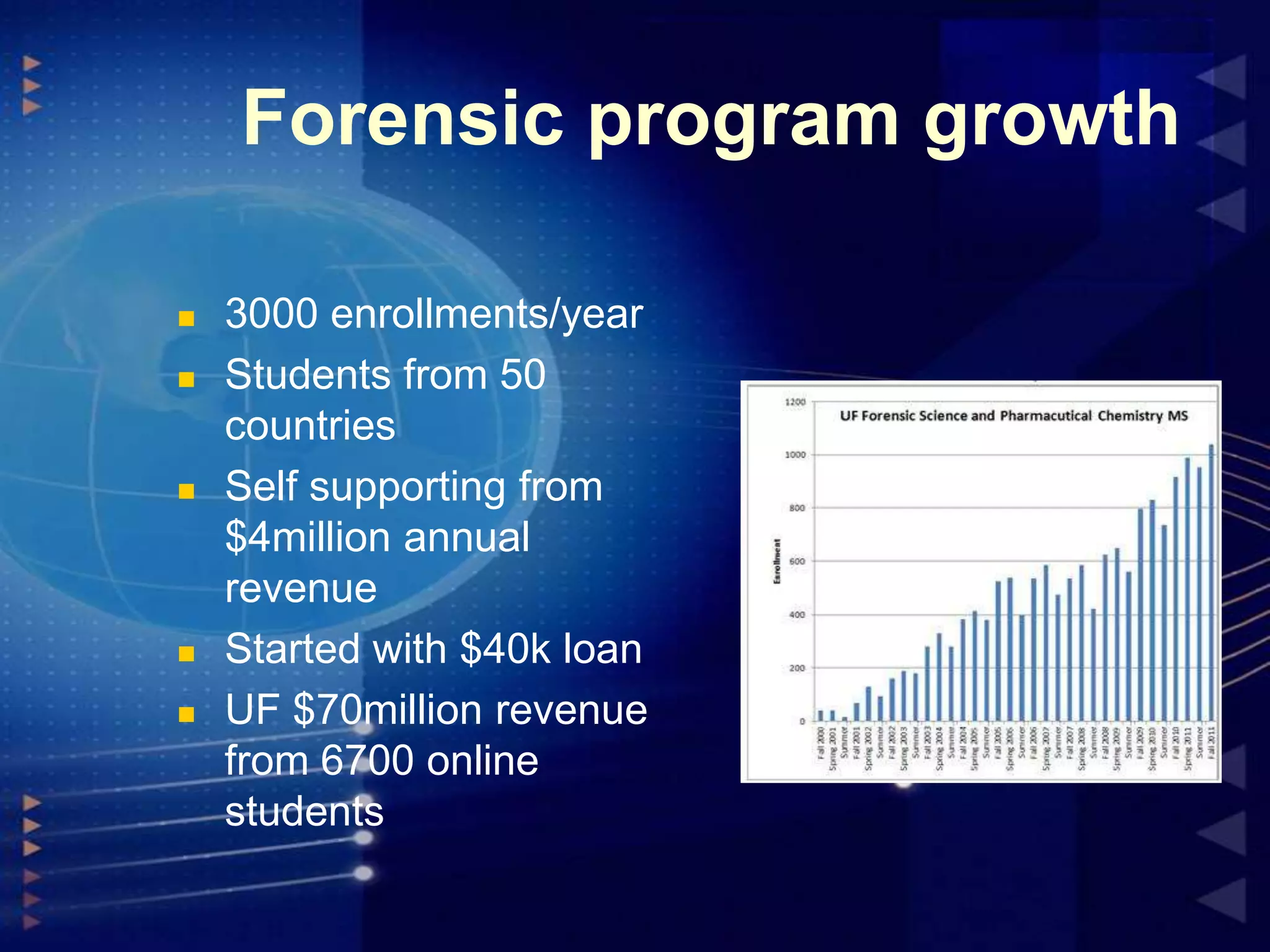
3000 enrollments/year
Students from 50
countries
Self supporting from
$4million annual
revenue
Started with $40k loan
UF $70million revenue
from 6700 online
students
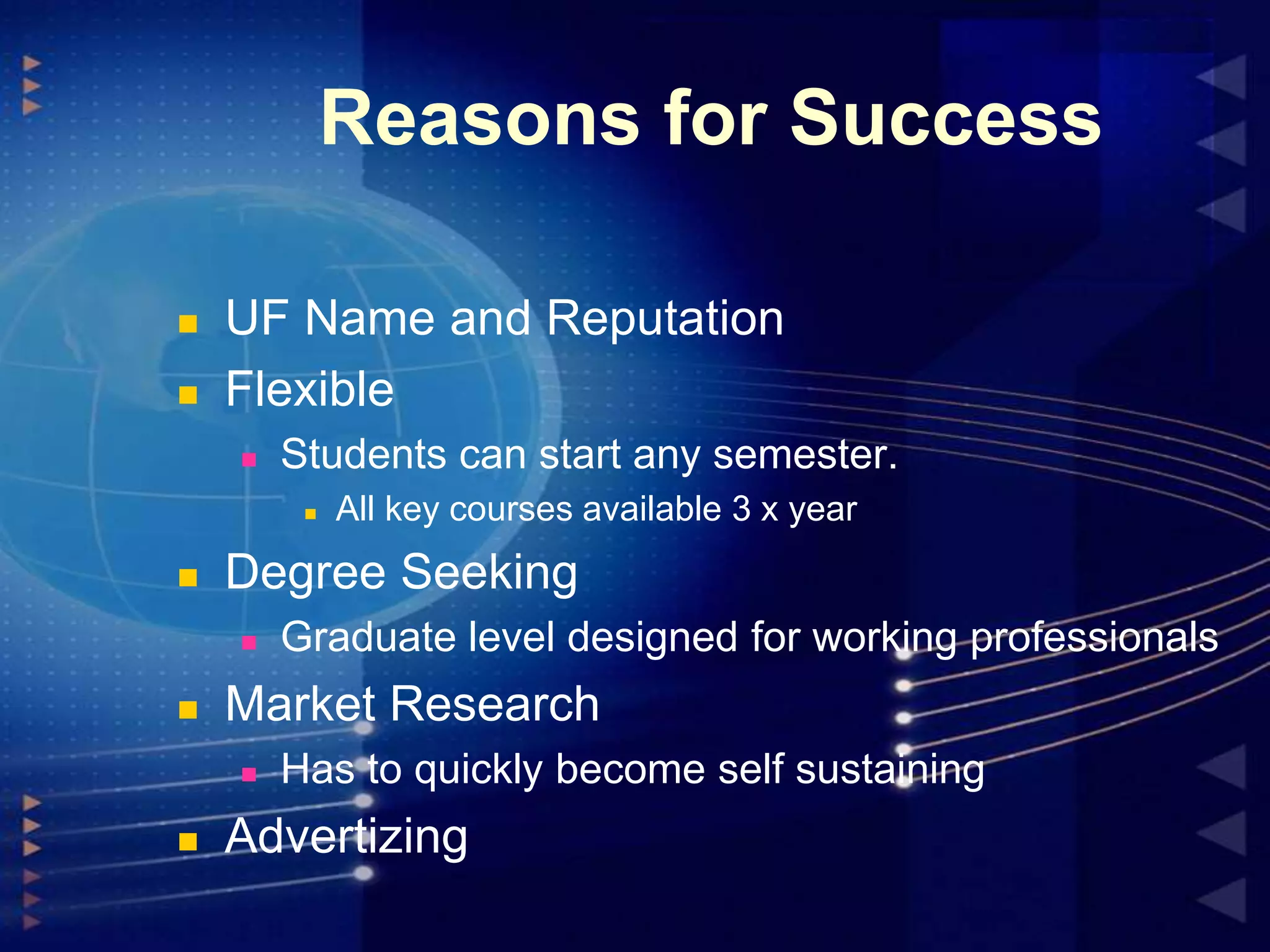
Reasons for Success




UF Name and Reputation
Flexible


Students can start any semester.




Degree Seeking




Graduate level designed for working professionals

Market Research




All key courses available 3 x year

Has to quickly become self sustaining

Advertizing
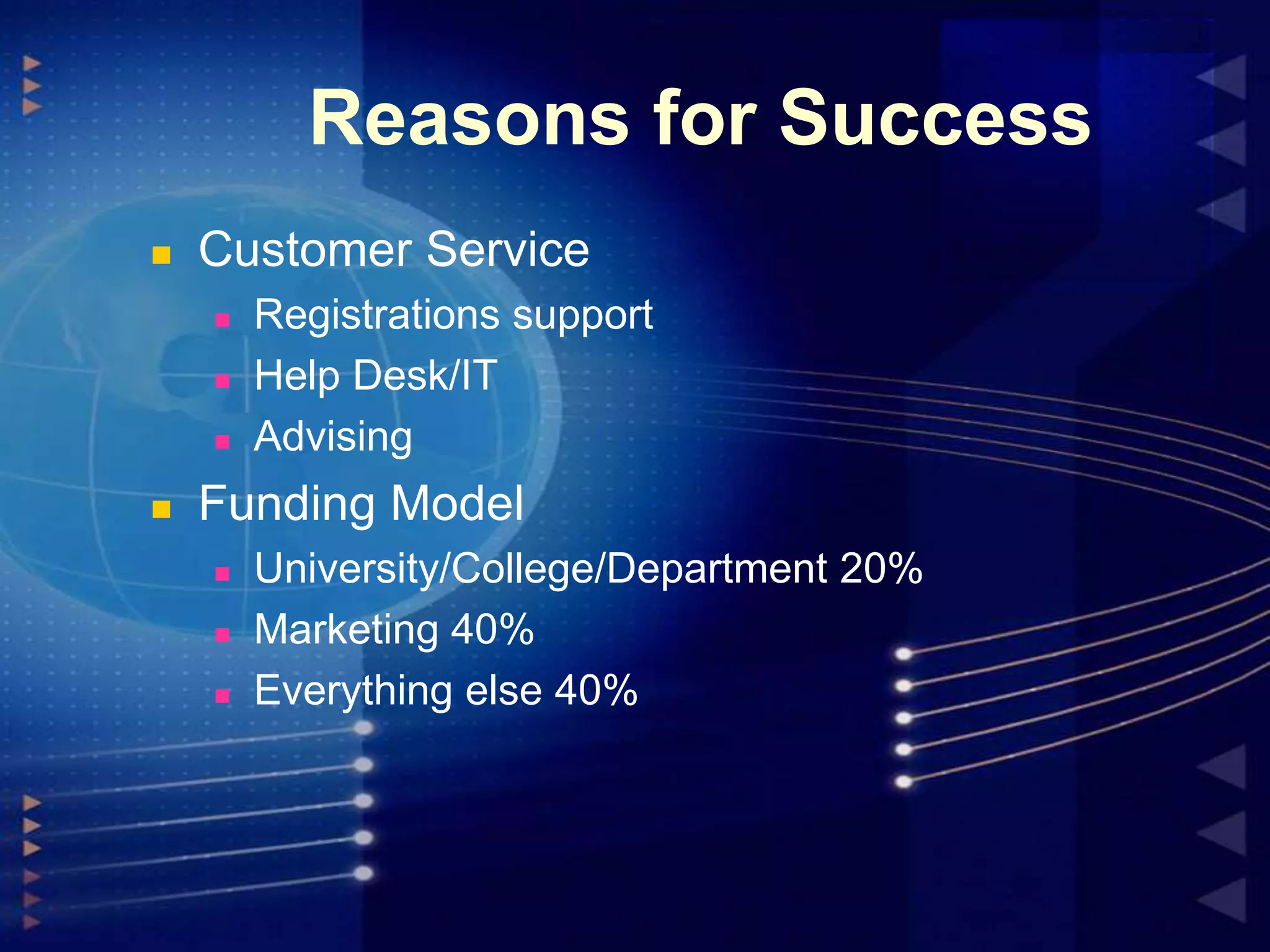
Reasons for Success


Customer Service






Registrations support
Help Desk/IT
Advising

Funding Model




University/College/Department 20%
Marketing 40%
Everything else 40%
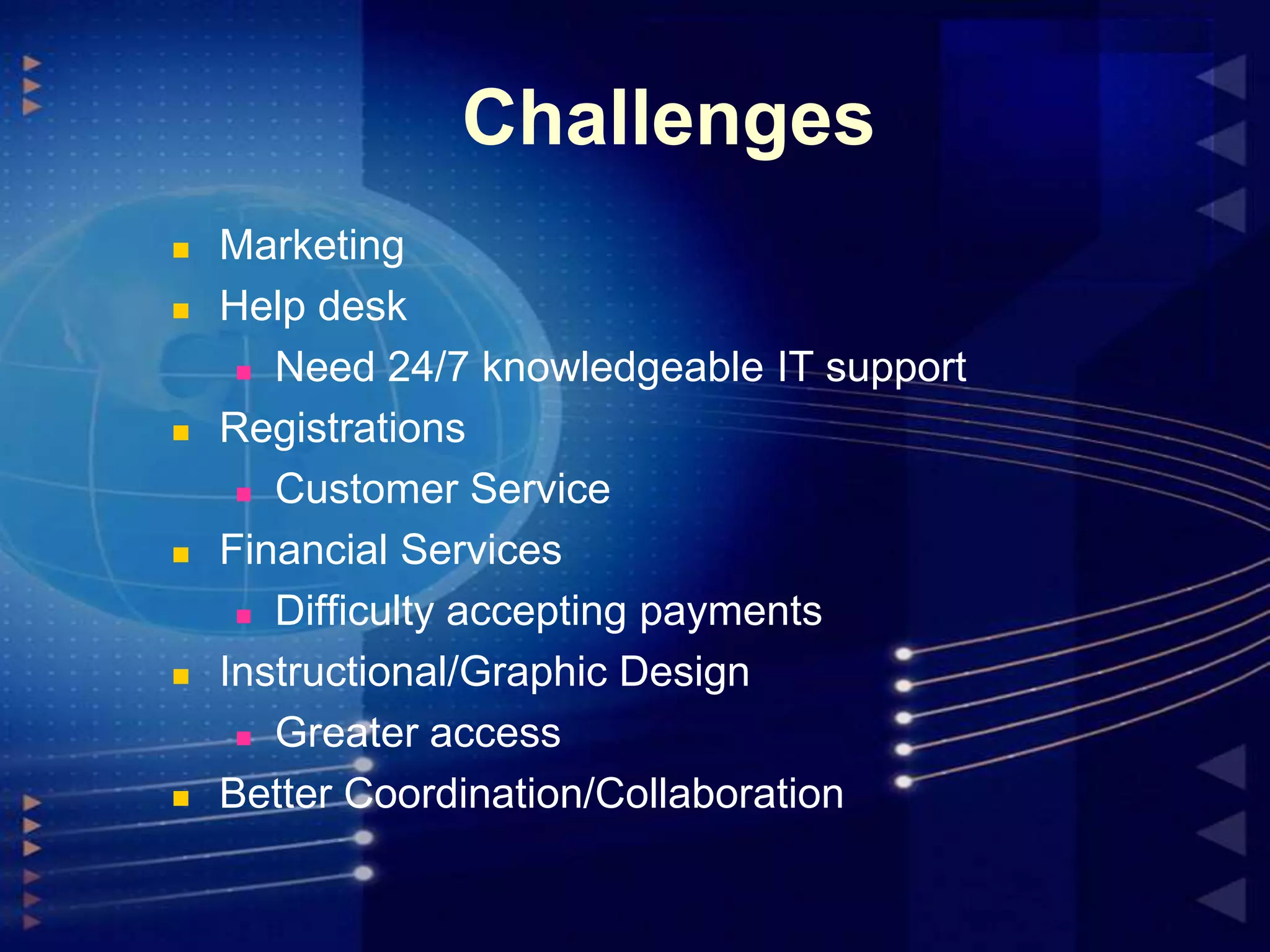
Challenges











Marketing
Help desk
 Need 24/7 knowledgeable IT support
Registrations
 Customer Service
Financial Services
 Difficulty accepting payments
Instructional/Graphic Design
 Greater access
Better Coordination/Collaboration
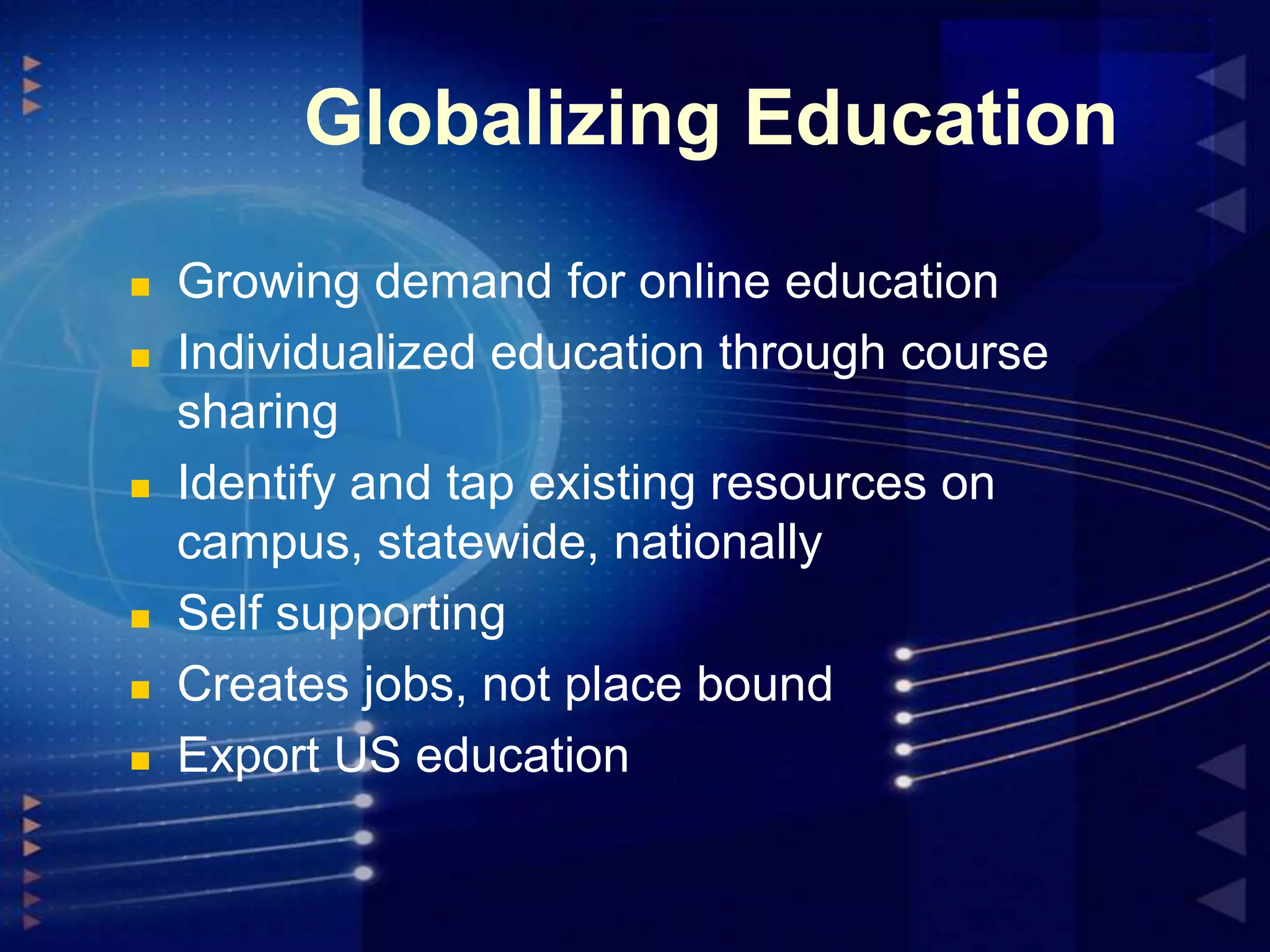
Globalizing Education










Growing demand for online education
Individualized education through course
sharing
Identify and tap existing resources on
campus, statewide, nationally
Self supporting
Creates jobs, not place bound
Export US education
Dr. Joel L. Hartman
Vice Provost and Chief Information Officer
University of Central Florida

WHAT DOES ONLINE LEARNING
HAVE TO DO WITH ECONOMIC
DEVELOPMENT?
Premise
• Economic development means the creation and
growth of businesses and job creation to
promote economic well being
• An educated workforce is critical to the
economic development of a city or region
• Well-paying jobs and upward mobility are
requiring increasingly higher levels of education
A College Educated Person
• Earns about $1M more over their lifetime,
which leads to greater tax revenue
• Is healthier
• Is more likely to support their community and
donate to charity
• Is less likely to be unemployed
A College Educated Person
• Is three times less likely to be incarcerated (the
annual cost of maintaining a prisoner is more
than the cost of educating a student)
• Is likely to make greater contributions to society
• Is believed to have a happier, more fulfilling life
The 21st Century Economy
• Will need an increasingly well educated
workforce in a broadening array of fields
• Four of the five fastest-growing occupations will
require high levels of postsecondary education
The 21st Century Economy
• 55 million new job openings by 2020
– 24 million will be new jobs
– 31 million will be replacing retirees
– 65% of these jobs will require some postsecondary
education and training, up from 28% in 1973
– 5 million of these new jobs will remain unfilled due
to a lack of workers with sufficient education
(over two years’ worth of BS/MS graduates: IPEDS)
- Georgetown University Center on Education and the Workforce
Online Learning
• Expands access to higher education through
increased convenience and flexibility
• Brings education to the student, rather than
the student to education
• Allows students to blend school, family, and
work obligations around their personal
schedules
Online Learning
• Increasing numbers of baccalaureate and
graduate degree and certificate programs
becoming available online (>700 in Florida)
• Can “geotarget” programs to areas where the
need exists, when no institution or suitable
program is nearby
• Can bring higher education to rural areas
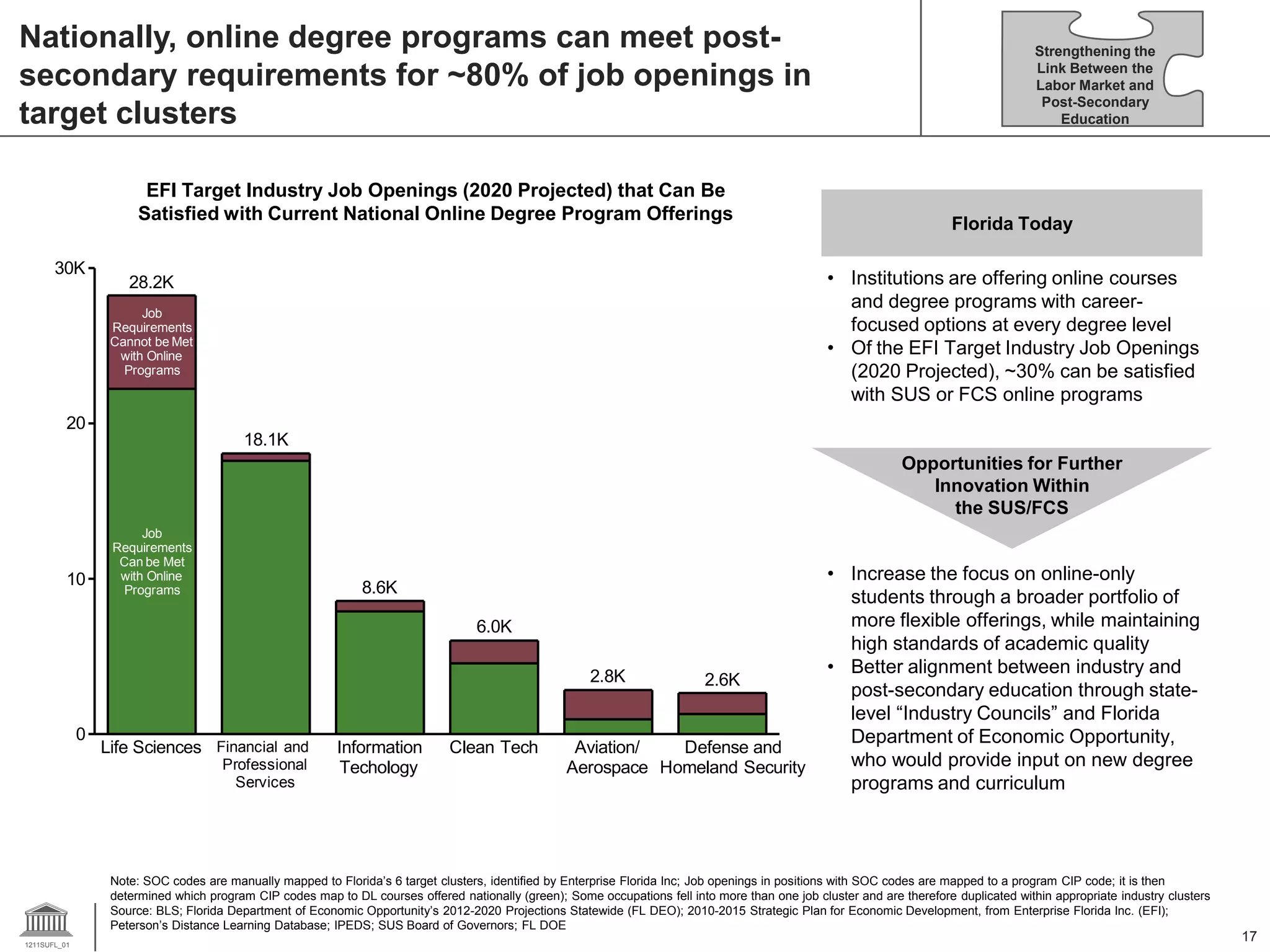
Nationally, online degree programs can meet postsecondary requirements for ~80% of job openings in
target clusters
EFI Target Industry Job Openings (2020 Projected) that Can Be
Satisfied with Current National Online Degree Program Offerings
30K

Strengthening the
Link Between the
Labor Market and
Post-Secondary
Education

Florida Today

• Institutions are offering online courses
and degree programs with careerfocused options at every degree level
• Of the EFI Target Industry Job Openings
(2020 Projected), ~30% can be satisfied
with SUS or FCS online programs

28.2K
Job
Requirements
Cannot be Met
with Online
Programs

20
18.1K

Opportunities for Further
Innovation Within
the SUS/FCS

10

Job
Requirements
Can be Met
with Online
Programs

8.6K
6.0K
2.8K

0

Life Sciences Financial and
Professional
Services

Information
Techology

Clean Tech

2.6K

Aviation/
Defense and
Aerospace Homeland Security

• Increase the focus on online-only
students through a broader portfolio of
more flexible offerings, while maintaining
high standards of academic quality
• Better alignment between industry and
post-secondary education through statelevel “Industry Councils” and Florida
Department of Economic Opportunity,
who would provide input on new degree
programs and curriculum

Note: SOC codes are manually mapped to Florida’s 6 target clusters, identified by Enterprise Florida Inc; Job openings in positions with SOC codes are mapped to a program CIP code; it is then
determined which program CIP codes map to DL courses offered nationally (green); Some occupations fell into more than one job cluster and are therefore duplicated within appropriate industry clusters
Source: BLS; Florida Department of Economic Opportunity’s 2012-2020 Projections Statewide (FL DEO); 2010-2015 Strategic Plan for Economic Development, from Enterprise Florida Inc. (EFI);
Peterson’s Distance Learning Database; IPEDS; SUS Board of Governors; FL DOE
1211SUFL_01

17
•
•
•
•
•

14 online undergraduate degrees
24 online graduate degrees
30 online graduate, 1 undergraduate certificates
Numerous online minors
Complete general education
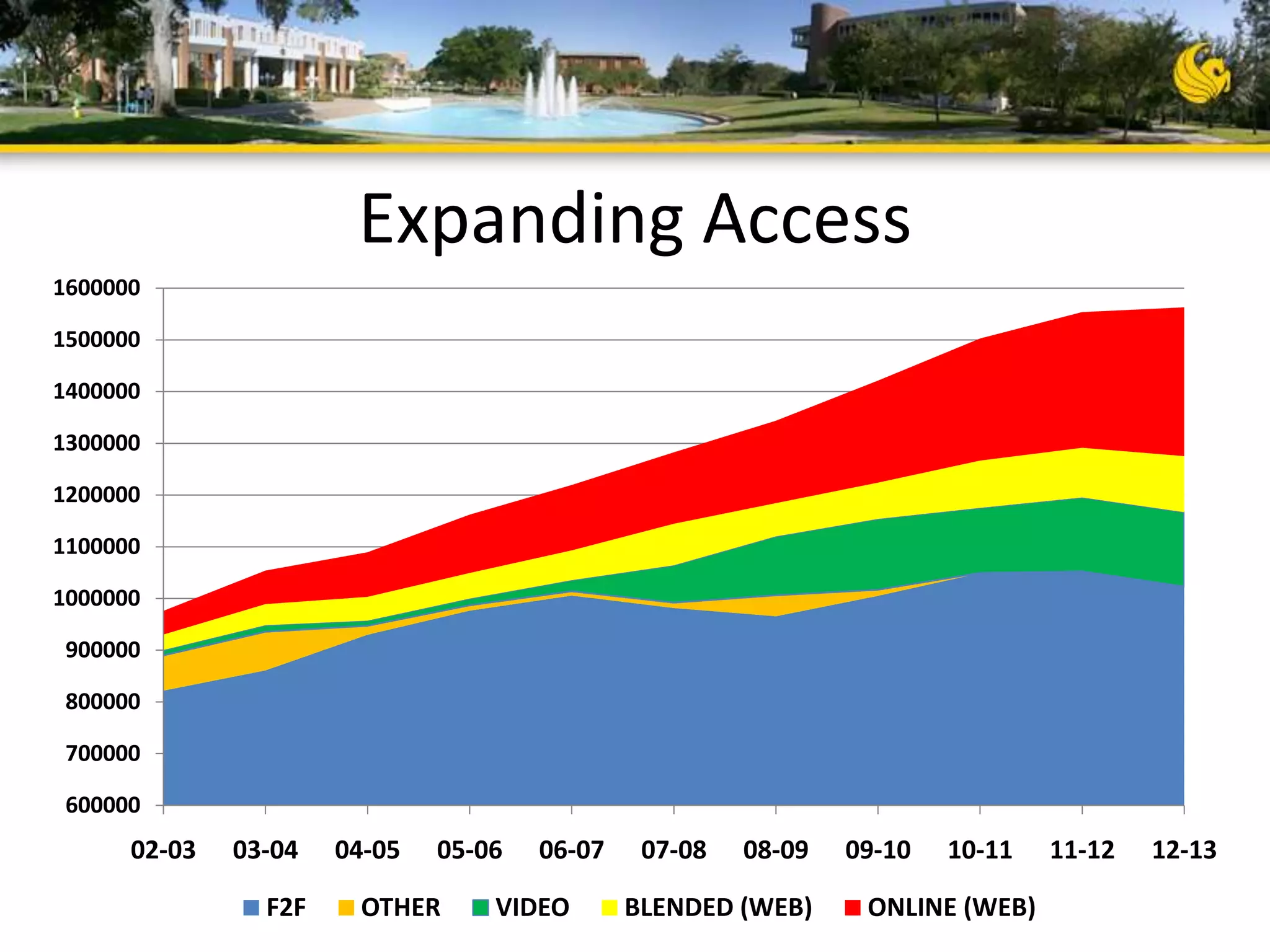
Expanding Access
1600000
1500000
1400000

1300000
1200000
1100000
1000000
900000
800000
700000

600000

02-03

03-04
F2F

04-05

05-06

OTHER

06-07

VIDEO

07-08

08-09

BLENDED (WEB)

09-10

10-11

ONLINE (WEB)

11-12

12-13
Academic Year 2012-2013
• UCF enrolled ~60,000 students
• 34.5% of total university SCH from online courses
• 72% (46,995) of all students took at least one
online or blended course
• 74% (41,251) of all undergraduate students took
at least one online or blended course
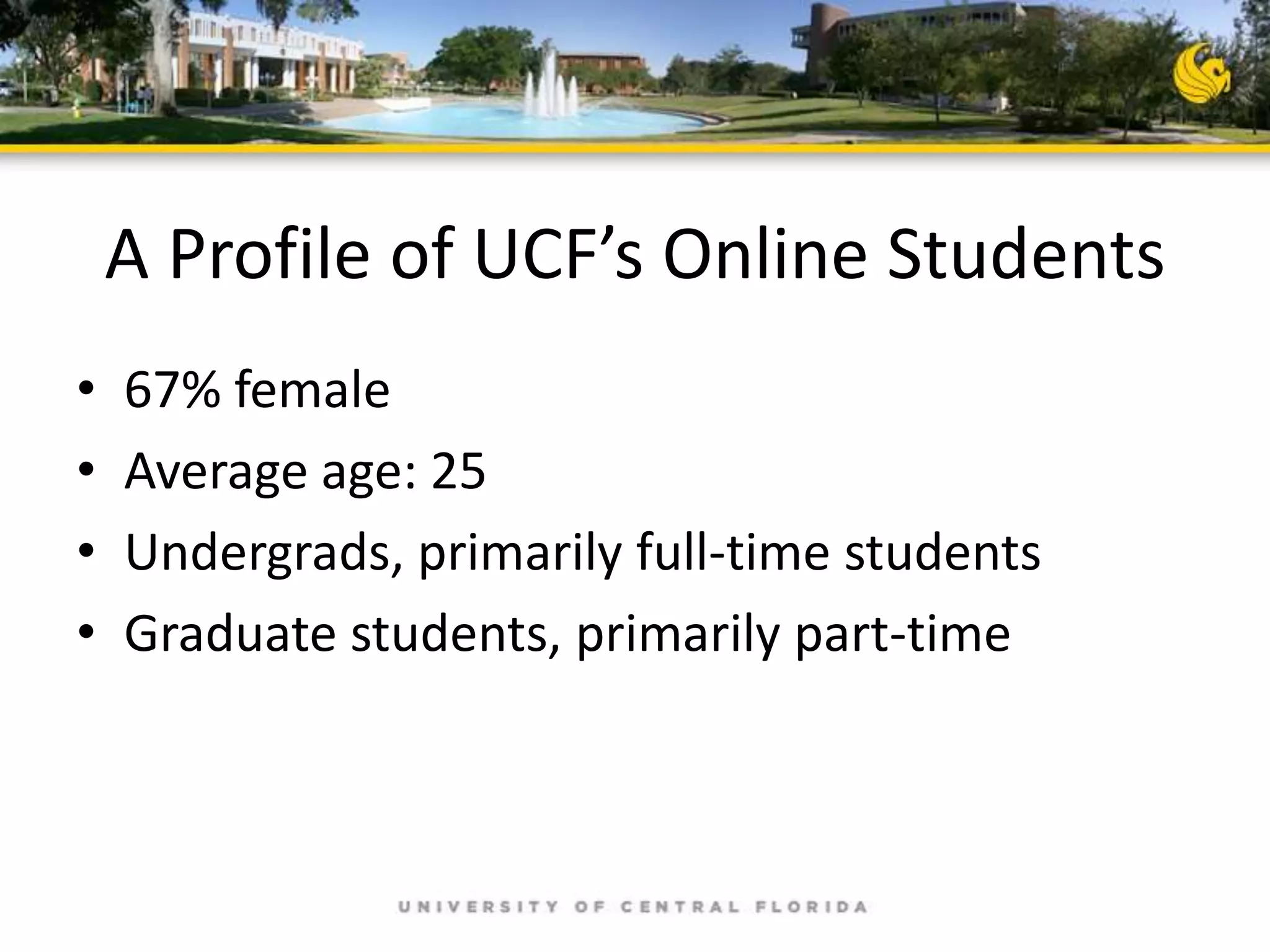
A Profile of UCF’s Online Students
•
•
•
•

67% female
Average age: 25
Undergrads, primarily full-time students
Graduate students, primarily part-time
What Online Grad Students Study
1.
2.
3.
4.
5.

Social Work
Health Sciences
Criminal Justice
Nursing
Communication
Disorders

6. Accounting
7. Teacher Education
8. Counselor Education
9. Nonprofit Management
10. Education PhD
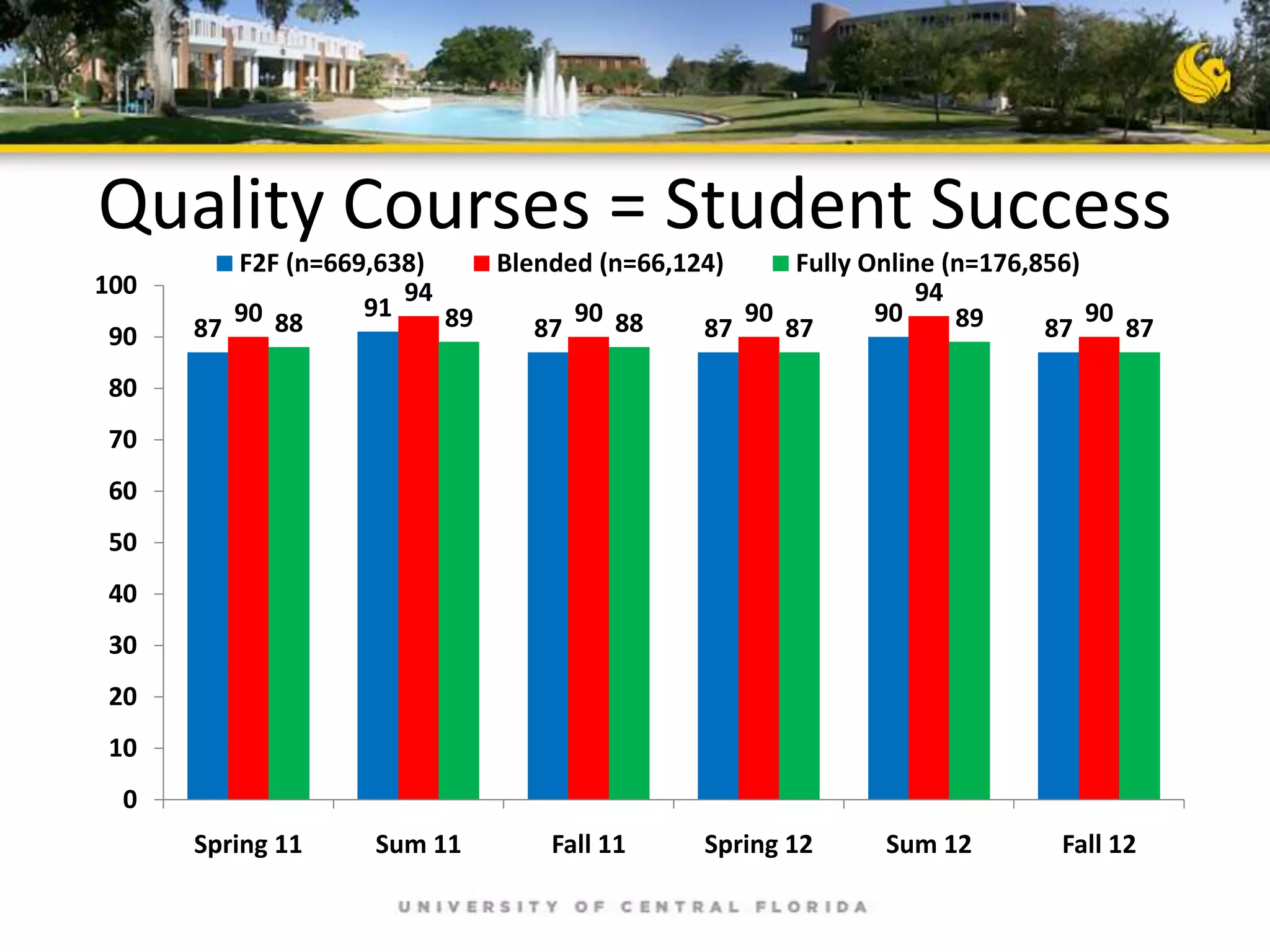
Quality Courses = Student Success
100
90

F2F (n=669,638)
Blended (n=66,124)
Fully Online (n=176,856)
94
94
91
90 88
90 88
90
90
90
89
89
87
87
87
87
87
87

80
70
60
50
40
30
20
10
0
Spring 11

Sum 11

Fall 11

Spring 12

Sum 12

Fall 12
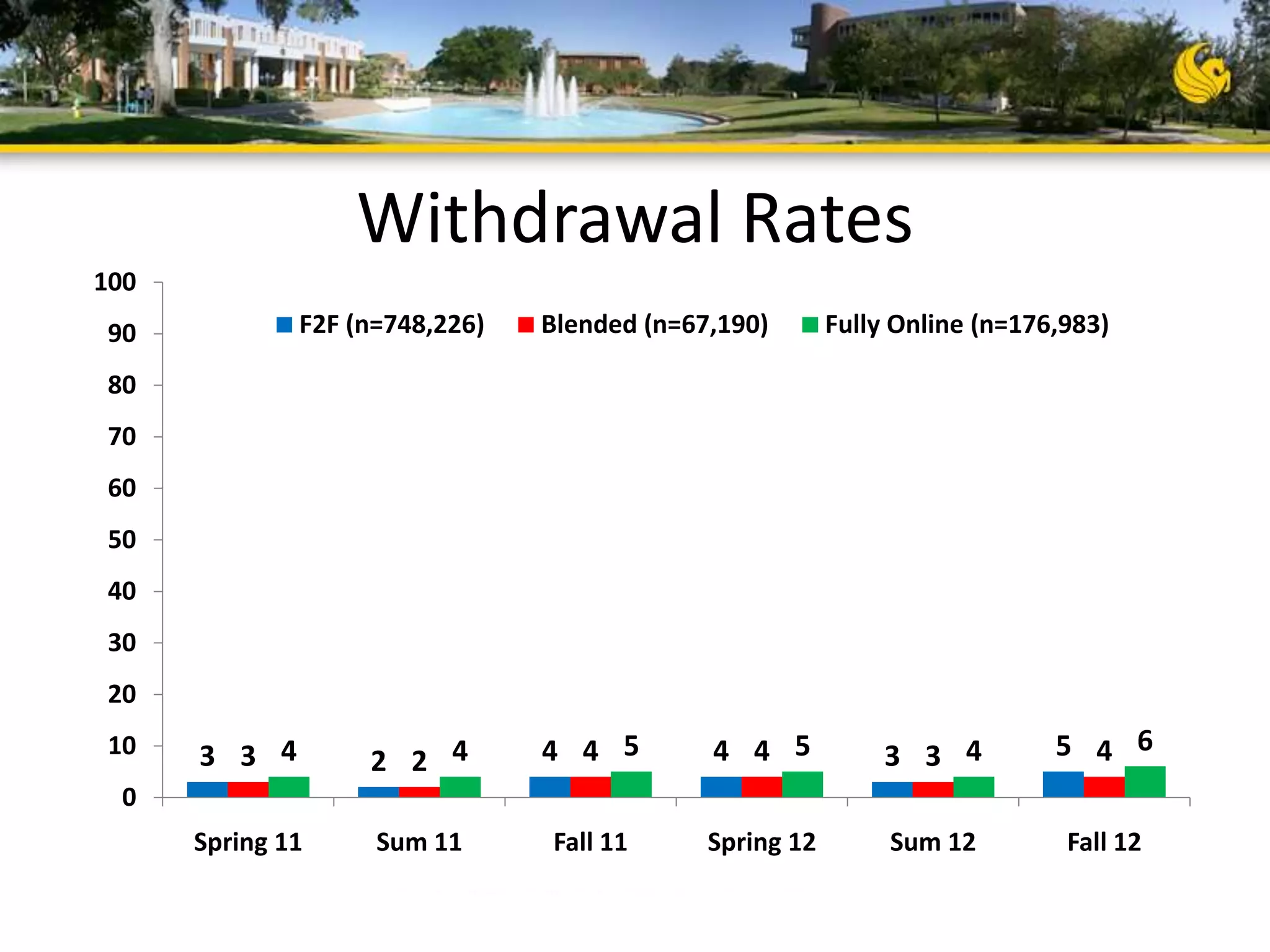
Withdrawal Rates
100
F2F (n=748,226)

90

Blended (n=67,190)

Fully Online (n=176,983)

80
70
60
50
40
30
20
10

3 3 4

2 2 4

4 4 5

4 4 5

3 3 4

5 4 6

Spring 11

Sum 11

Fall 11

Spring 12

Sum 12

Fall 12

0
MOOCs
•
•
•
•

Massive – up to 160,000 students
Open – anyone can register
Online – delivered via the Web
Courses – but not yet degree programs
MOOCs
• Free – no tuition
• No credit from originating institution
• But options are emerging to get academic credit
Florida Performance Funding
• UCF and USF each received the top performance
funding awards
– % of bachelor’s grads employed or continuing their
education 1 year after graduation
– median average full-time wages of undergrads
employed 1 year after graduation
– average institutional cost per undergrad
Dr. Joel L. Hartman
Vice Provost and Chief Information Officer
University of Central Florida

WHAT DOES ONLINE LEARNING
HAVE TO DO WITH ECONOMIC
DEVELOPMENT?
Creating Economic
Development through
Online Learning
Michael Pearce
CEO Innovative Education & System Vice
President, Information Technology, CIO
University of South Florida
The University of South Florida
• Located in the Tampa Bay area and founded in 1956.

• USF is one of the nation’s top public research universities and
one of only 40 public research universities nationwide with very
high research activity.
• USF serves more than 47,000 students, with campuses in
Tampa, St. Petersburg, and Sarasota-Manatee, with a medical
campus in Tampa.
• USF offers 241 degree programs at the
undergraduate, graduate, specialist, and doctorate levels.

• 80,000 enrollments in more than 2,000 online course sections
annually, including 31 degree and 31 certificate programs
availably fully online.
The Market
• Of the 4.4 trillion dollar education market
in, 2012, $91 billion is attributed to online learning.
• eLearning is the fastest growing and forecasted to
have 23% compound annual growth through 2017
• Investments in the US are increasing and have grown
more than 3.5x in last decade
Source: http://blogs.edweek.org/edweek/marketplacek12/IBIS.pdf
Distance Learning
• Creates greater access for learners
• Allows flexibility for learners
• Meets growing demand in expanding marketplace
• Advances professional and workforce development
• Encourages lifelong learning
Challenges
• Mobility

• Anytime, anywhere learning
• Competency-based programs
• Workforce alignment
• Marketplace trends and requirements
Addressing Challenges
• Mobility
– Tailoring classes for adult learning
• Anytime, anywhere learning

– Flexibility in delivery
– Building models that can evolve
• Competency-based programs
– Credit to non-credit
– Building a strong foundation
Addressing Challenges
• Workforce alignment

– Changing model to “outside looking in”
– Creating skill sets that meet industry needs
• Marketplace
– Listening to workforce demands from industry
– Redefining what a traditional “student” is
QUESTIONS?

Creating Economic Development Through Online Learning

  • 1.
  • 2.
    Economic Development through OnlineEducation Ian Tebbett, PhD University of Florida
  • 3.
    On Line ForensicPrograms  MS Programs       Forensic Toxicology Drug Chemistry DNA & Serology Forensic Science Pharm. Chem Clinical Toxicology   6 Graduate Certificates Two non credit (CE) courses
  • 4.
    Forensic program growth      3000enrollments/year Students from 50 countries Self supporting from $4million annual revenue Started with $40k loan UF $70million revenue from 6700 online students
  • 5.
    Reasons for Success   UFName and Reputation Flexible  Students can start any semester.   Degree Seeking   Graduate level designed for working professionals Market Research   All key courses available 3 x year Has to quickly become self sustaining Advertizing
  • 6.
    Reasons for Success  CustomerService     Registrations support Help Desk/IT Advising Funding Model    University/College/Department 20% Marketing 40% Everything else 40%
  • 7.
    Challenges       Marketing Help desk  Need24/7 knowledgeable IT support Registrations  Customer Service Financial Services  Difficulty accepting payments Instructional/Graphic Design  Greater access Better Coordination/Collaboration
  • 8.
    Globalizing Education       Growing demandfor online education Individualized education through course sharing Identify and tap existing resources on campus, statewide, nationally Self supporting Creates jobs, not place bound Export US education
  • 9.
    Dr. Joel L.Hartman Vice Provost and Chief Information Officer University of Central Florida WHAT DOES ONLINE LEARNING HAVE TO DO WITH ECONOMIC DEVELOPMENT?
  • 10.
    Premise • Economic developmentmeans the creation and growth of businesses and job creation to promote economic well being • An educated workforce is critical to the economic development of a city or region • Well-paying jobs and upward mobility are requiring increasingly higher levels of education
  • 11.
    A College EducatedPerson • Earns about $1M more over their lifetime, which leads to greater tax revenue • Is healthier • Is more likely to support their community and donate to charity • Is less likely to be unemployed
  • 12.
    A College EducatedPerson • Is three times less likely to be incarcerated (the annual cost of maintaining a prisoner is more than the cost of educating a student) • Is likely to make greater contributions to society • Is believed to have a happier, more fulfilling life
  • 13.
    The 21st CenturyEconomy • Will need an increasingly well educated workforce in a broadening array of fields • Four of the five fastest-growing occupations will require high levels of postsecondary education
  • 14.
    The 21st CenturyEconomy • 55 million new job openings by 2020 – 24 million will be new jobs – 31 million will be replacing retirees – 65% of these jobs will require some postsecondary education and training, up from 28% in 1973 – 5 million of these new jobs will remain unfilled due to a lack of workers with sufficient education (over two years’ worth of BS/MS graduates: IPEDS) - Georgetown University Center on Education and the Workforce
  • 15.
    Online Learning • Expandsaccess to higher education through increased convenience and flexibility • Brings education to the student, rather than the student to education • Allows students to blend school, family, and work obligations around their personal schedules
  • 16.
    Online Learning • Increasingnumbers of baccalaureate and graduate degree and certificate programs becoming available online (>700 in Florida) • Can “geotarget” programs to areas where the need exists, when no institution or suitable program is nearby • Can bring higher education to rural areas
  • 17.
    Nationally, online degreeprograms can meet postsecondary requirements for ~80% of job openings in target clusters EFI Target Industry Job Openings (2020 Projected) that Can Be Satisfied with Current National Online Degree Program Offerings 30K Strengthening the Link Between the Labor Market and Post-Secondary Education Florida Today • Institutions are offering online courses and degree programs with careerfocused options at every degree level • Of the EFI Target Industry Job Openings (2020 Projected), ~30% can be satisfied with SUS or FCS online programs 28.2K Job Requirements Cannot be Met with Online Programs 20 18.1K Opportunities for Further Innovation Within the SUS/FCS 10 Job Requirements Can be Met with Online Programs 8.6K 6.0K 2.8K 0 Life Sciences Financial and Professional Services Information Techology Clean Tech 2.6K Aviation/ Defense and Aerospace Homeland Security • Increase the focus on online-only students through a broader portfolio of more flexible offerings, while maintaining high standards of academic quality • Better alignment between industry and post-secondary education through statelevel “Industry Councils” and Florida Department of Economic Opportunity, who would provide input on new degree programs and curriculum Note: SOC codes are manually mapped to Florida’s 6 target clusters, identified by Enterprise Florida Inc; Job openings in positions with SOC codes are mapped to a program CIP code; it is then determined which program CIP codes map to DL courses offered nationally (green); Some occupations fell into more than one job cluster and are therefore duplicated within appropriate industry clusters Source: BLS; Florida Department of Economic Opportunity’s 2012-2020 Projections Statewide (FL DEO); 2010-2015 Strategic Plan for Economic Development, from Enterprise Florida Inc. (EFI); Peterson’s Distance Learning Database; IPEDS; SUS Board of Governors; FL DOE 1211SUFL_01 17
  • 18.
    • • • • • 14 online undergraduatedegrees 24 online graduate degrees 30 online graduate, 1 undergraduate certificates Numerous online minors Complete general education
  • 19.
  • 20.
    Academic Year 2012-2013 •UCF enrolled ~60,000 students • 34.5% of total university SCH from online courses • 72% (46,995) of all students took at least one online or blended course • 74% (41,251) of all undergraduate students took at least one online or blended course
  • 21.
    A Profile ofUCF’s Online Students • • • • 67% female Average age: 25 Undergrads, primarily full-time students Graduate students, primarily part-time
  • 22.
    What Online GradStudents Study 1. 2. 3. 4. 5. Social Work Health Sciences Criminal Justice Nursing Communication Disorders 6. Accounting 7. Teacher Education 8. Counselor Education 9. Nonprofit Management 10. Education PhD
  • 23.
    Quality Courses =Student Success 100 90 F2F (n=669,638) Blended (n=66,124) Fully Online (n=176,856) 94 94 91 90 88 90 88 90 90 90 89 89 87 87 87 87 87 87 80 70 60 50 40 30 20 10 0 Spring 11 Sum 11 Fall 11 Spring 12 Sum 12 Fall 12
  • 24.
    Withdrawal Rates 100 F2F (n=748,226) 90 Blended(n=67,190) Fully Online (n=176,983) 80 70 60 50 40 30 20 10 3 3 4 2 2 4 4 4 5 4 4 5 3 3 4 5 4 6 Spring 11 Sum 11 Fall 11 Spring 12 Sum 12 Fall 12 0
  • 25.
    MOOCs • • • • Massive – upto 160,000 students Open – anyone can register Online – delivered via the Web Courses – but not yet degree programs
  • 26.
    MOOCs • Free –no tuition • No credit from originating institution • But options are emerging to get academic credit
  • 27.
    Florida Performance Funding •UCF and USF each received the top performance funding awards – % of bachelor’s grads employed or continuing their education 1 year after graduation – median average full-time wages of undergrads employed 1 year after graduation – average institutional cost per undergrad
  • 28.
    Dr. Joel L.Hartman Vice Provost and Chief Information Officer University of Central Florida WHAT DOES ONLINE LEARNING HAVE TO DO WITH ECONOMIC DEVELOPMENT?
  • 29.
    Creating Economic Development through OnlineLearning Michael Pearce CEO Innovative Education & System Vice President, Information Technology, CIO University of South Florida
  • 30.
    The University ofSouth Florida • Located in the Tampa Bay area and founded in 1956. • USF is one of the nation’s top public research universities and one of only 40 public research universities nationwide with very high research activity. • USF serves more than 47,000 students, with campuses in Tampa, St. Petersburg, and Sarasota-Manatee, with a medical campus in Tampa. • USF offers 241 degree programs at the undergraduate, graduate, specialist, and doctorate levels. • 80,000 enrollments in more than 2,000 online course sections annually, including 31 degree and 31 certificate programs availably fully online.
  • 31.
    The Market • Ofthe 4.4 trillion dollar education market in, 2012, $91 billion is attributed to online learning. • eLearning is the fastest growing and forecasted to have 23% compound annual growth through 2017 • Investments in the US are increasing and have grown more than 3.5x in last decade Source: http://blogs.edweek.org/edweek/marketplacek12/IBIS.pdf
  • 32.
    Distance Learning • Createsgreater access for learners • Allows flexibility for learners • Meets growing demand in expanding marketplace • Advances professional and workforce development • Encourages lifelong learning
  • 33.
    Challenges • Mobility • Anytime,anywhere learning • Competency-based programs • Workforce alignment • Marketplace trends and requirements
  • 34.
    Addressing Challenges • Mobility –Tailoring classes for adult learning • Anytime, anywhere learning – Flexibility in delivery – Building models that can evolve • Competency-based programs – Credit to non-credit – Building a strong foundation
  • 35.
    Addressing Challenges • Workforcealignment – Changing model to “outside looking in” – Creating skill sets that meet industry needs • Marketplace – Listening to workforce demands from industry – Redefining what a traditional “student” is
  • 36.

Editor's Notes

  • #19 UCF has been delivering online courses since 1996, and blended courses since 1997More online degrees in development
  • #21 UCF began delivering courses online in 1996, and added blended courses since 1997UCF has been named a “Next Generation University” and national model in a recent national study by the New America FoundationThe growth of online learning has accounted for 91% of the increase in UCF SCH over the past five academic years
  • #22 Online students:2/3 are femaleAverage age of 24¼ are 25 or older
  • #25 Success = achieving a grade of A, B, or CUCF provides award-winning faculty development, course design and development, and online student/faculty support
  • #26 Our online student withdrawal rates are among the lowest in the country and nearly identical to face-to-face
  • #33 According to a recent study by IBIS Capital, a London based investment bank, of the 4.4 trillion dollar education market, in 2012, $91 billion is attributed to online learning. The eLearning portion of the education market is the fastest growing and forecasted to have 23% compound annual growth through 2017. Investments in the US are increasing…grown more than 3.5x in last decade, with over $600M of VC funding to educational technology start ups in 2012 alone…from 2Tor (now 2U) to Lynda.com, to the Minerva Project…not all just going to MOOCs, but MOOC platforms also receiving heavy investments.
  • #34 Institutions have to ask why they are entering online learning?