IVY TECH Accelerating Greatness 2013 IVY TECH OnLine TEAM IX ACE Fellows 2011-12 Revised 12/09/11
Team IX Members Gwendolyn Packnett Rosemary Feal Tim Elgren Stephen Myers Mohammed Bhuiyan
To prepare Indiana residents to learn, live, and work in a diverse and globally competitive environment by delivering professional, technical, transfer, and lifelong education. Through its affordable, open access education and training programs, the College enhances the  development of Indiana’s citizens  and communities and strengthens its economy. IVY TECH Mission:
Vision Statement Ivy Tech Online is the premier provider of choice for online education. Mission Statement Ivy Tech Community College prepares individuals to learn, live and work in a diverse and globally competitive world. To fulfill its part of the mission, Ivy Tech Online provides high‐quality, low cost education and training facilitated through technology  to serve the students of Indiana and the country, and international students . Ivy Tech Online offers a rich, online or technology‐based instructional environment in a wide variety of credit and non‐credit courses and programs. Ivy Tech Online serves as a resource for faculty and staff through instructional design and development, faculty training, research and development in the area of online and technology facilitated learning, and provides oversight of the learning management system for the College.
Share of OL students has tripled in past decade OL demand not being met through domestic  programs Gender imbalance in OL participation  (63%W, 47%M) 50% of participants are non-traditional age    (outside of 18-25)  Projects 50% of students will take classes OL  Only 29% of public surveyed view OL as valuable as  classroom experience Least selective institutions and community colleges  offering the most OL Perceived quality of OL experience questioned    (Presidents’ perceptions: 50:50) Data from report from PEW Research Center reported in 11/11/11 Chronicle of Higher Education National Trends in On-Line Education
IVY TECH OnLine Offerings  IVY TECH can boast many accomplishments. Amongst them are: the only singly-accredited statewide community college system in the united states,  (2) the state's leading workforce provider, (3) a solid, well-structured, long-range plan for on-line education, which meshes well with the "accelerating greatness 2013" strategic plan.
The strengths of the on-line program are many  It assists students in achieving their educational  goals  Creates options for coursework choices and  enrollment  Offers on-line courses in competitive subject areas  On-line telephone prompter to assist with questions  and/or answers  Mandatory face-to-face visit with advisor  Centralized course outline of record for the IVY  TECH  community college system  Professional staff qualified to teach on-line courses Clear listing of all courses offered on-line  Value added-everyone can respond to discussion in  classroom
The areas of challenges for on-line learning includes:  Clarity in assessing and navigating the on-line web site  Centralization taking place within the system-further development  Improved training and recruitment of faculty  Improved curriculum development  Certification for on-line instruction  System wide workshop for on-line instruction for all students  Improved marketing for both regional and global appeal  Expand on-line offerings to corporations wanting to offer professional development to personnel  On-line library similar to actual library, with a help section  Establish solid reputation for academic rigor  Offer new student seminar course or orientation for on-line
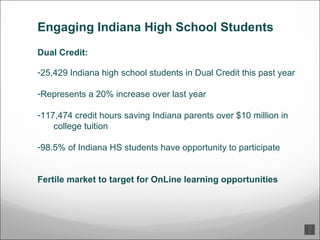
Engaging Indiana High School Students Dual Credit: 25,429 Indiana high school students in Dual Credit this past year Represents a 20% increase over last year 117,474 credit hours saving Indiana parents over $10 million in college tuition 98.5% of Indiana HS students have opportunity to participate Fertile market to target for OnLine learning opportunities
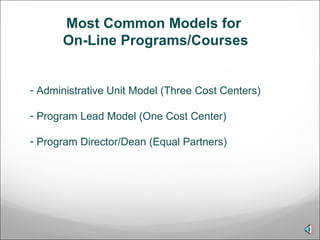
Administrative Unit Model (Three Cost Centers) Program Lead Model (One Cost Center) Program Director/Dean (Equal Partners)  Most Common Models for  On-Line Programs/Courses
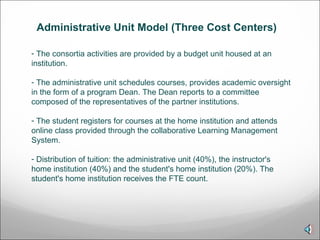
The consortia activities are provided by a budget unit housed at an institution. The administrative unit schedules courses, provides academic oversight in the form of a program Dean. The Dean reports to a committee composed of the representatives of the partner institutions. The student registers for courses at the home institution and attends online class provided through the collaborative Learning Management System. Distribution of tuition: the administrative unit (40%), the instructor's home institution (40%) and the student's home institution (20%). The student's home institution receives the FTE count.  Administrative Unit Model (Three Cost Centers)
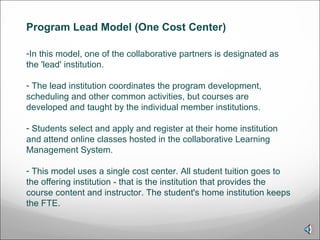
In this model, one of the collaborative partners is designated as the 'lead' institution. The lead institution coordinates the program development, scheduling and other common activities, but courses are developed and taught by the individual member institutions. Students select and apply and register at their home institution and attend online classes hosted in the collaborative Learning Management System.  This model uses a single cost center. All student tuition goes to the offering institution - that is the institution that provides the course content and instructor. The student's home institution keeps the FTE.  Program Lead Model (One Cost Center)
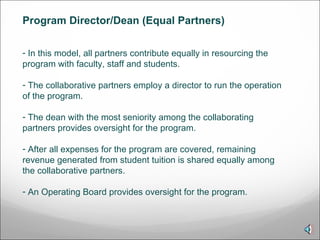
In this model, all partners contribute equally in resourcing the program with faculty, staff and students. The collaborative partners employ a director to run the operation of the program. The dean with the most seniority among the collaborating partners provides oversight for the program. After all expenses for the program are covered, remaining revenue generated from student tuition is shared equally among the collaborative partners. An Operating Board provides oversight for the program.  Program Director/Dean (Equal Partners)
SWOT Analysis Preliminary SWOT Analysis based upon limited information available Limitations to our external perspective Internal input/buy-in essential to successful strategy
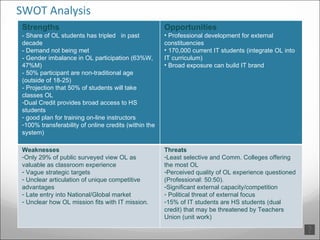
SWOT Analysis Strengths - Share of OL students has tripled  in past decade - Demand not being met - Gender imbalance in OL participation (63%W, 47%M)  - 50% participant are non-traditional age (outside of 18-25)  - Projection that 50% of students will take classes OL Dual Credit provides broad access to HS students good plan for training on-line instructors 100% transferability of online credits (within the system) Opportunities Professional development for external constituencies 170,000 current IT students (integrate OL into IT curriculum) Broad exposure can build IT brand Weaknesses Only 29% of public surveyed view OL as valuable as classroom experience  Vague strategic targets Unclear articulation of unique competitive advantages Late entry into National/Global market Unclear how OL mission fits with IT mission. Threats Least selective and Comm. Colleges offering the most OL Perceived quality of OL experience questioned (Professional: 50:50).  Significant external capacity/competition Political threat of external focus 15% of IT students are HS students (dual credit) that may be threatened by Teachers Union (unit work)
Summary and Recommendations  IVY TECH is an established leader in higher education well-positioned with strategic partners IVY TECH has decided to use on-line delivery to enhance the “Accelerating Greatness 2013” Strategic Plan Systematic analysis of internal and external factors is essential in determining how on-line delivery best complements the IVY TECH Strategic Plan This presentation provides a beginning framework for such an analysis by IVY TECH

Team 9 (narrated ppt)

  • 1.
    IVY TECH AcceleratingGreatness 2013 IVY TECH OnLine TEAM IX ACE Fellows 2011-12 Revised 12/09/11
  • 2.
    Team IX MembersGwendolyn Packnett Rosemary Feal Tim Elgren Stephen Myers Mohammed Bhuiyan
  • 3.
    To prepare Indianaresidents to learn, live, and work in a diverse and globally competitive environment by delivering professional, technical, transfer, and lifelong education. Through its affordable, open access education and training programs, the College enhances the development of Indiana’s citizens and communities and strengthens its economy. IVY TECH Mission:
  • 4.
    Vision Statement IvyTech Online is the premier provider of choice for online education. Mission Statement Ivy Tech Community College prepares individuals to learn, live and work in a diverse and globally competitive world. To fulfill its part of the mission, Ivy Tech Online provides high‐quality, low cost education and training facilitated through technology to serve the students of Indiana and the country, and international students . Ivy Tech Online offers a rich, online or technology‐based instructional environment in a wide variety of credit and non‐credit courses and programs. Ivy Tech Online serves as a resource for faculty and staff through instructional design and development, faculty training, research and development in the area of online and technology facilitated learning, and provides oversight of the learning management system for the College.
  • 5.
    Share of OLstudents has tripled in past decade OL demand not being met through domestic programs Gender imbalance in OL participation (63%W, 47%M) 50% of participants are non-traditional age (outside of 18-25) Projects 50% of students will take classes OL Only 29% of public surveyed view OL as valuable as classroom experience Least selective institutions and community colleges offering the most OL Perceived quality of OL experience questioned (Presidents’ perceptions: 50:50) Data from report from PEW Research Center reported in 11/11/11 Chronicle of Higher Education National Trends in On-Line Education
  • 6.
    IVY TECH OnLineOfferings IVY TECH can boast many accomplishments. Amongst them are: the only singly-accredited statewide community college system in the united states, (2) the state's leading workforce provider, (3) a solid, well-structured, long-range plan for on-line education, which meshes well with the "accelerating greatness 2013" strategic plan.
  • 7.
    The strengths ofthe on-line program are many It assists students in achieving their educational goals Creates options for coursework choices and enrollment Offers on-line courses in competitive subject areas On-line telephone prompter to assist with questions and/or answers Mandatory face-to-face visit with advisor Centralized course outline of record for the IVY TECH community college system Professional staff qualified to teach on-line courses Clear listing of all courses offered on-line Value added-everyone can respond to discussion in classroom
  • 8.
    The areas ofchallenges for on-line learning includes: Clarity in assessing and navigating the on-line web site Centralization taking place within the system-further development Improved training and recruitment of faculty Improved curriculum development Certification for on-line instruction System wide workshop for on-line instruction for all students Improved marketing for both regional and global appeal Expand on-line offerings to corporations wanting to offer professional development to personnel On-line library similar to actual library, with a help section Establish solid reputation for academic rigor Offer new student seminar course or orientation for on-line
  • 9.
    Engaging Indiana HighSchool Students Dual Credit: 25,429 Indiana high school students in Dual Credit this past year Represents a 20% increase over last year 117,474 credit hours saving Indiana parents over $10 million in college tuition 98.5% of Indiana HS students have opportunity to participate Fertile market to target for OnLine learning opportunities
  • 10.
    Administrative Unit Model(Three Cost Centers) Program Lead Model (One Cost Center) Program Director/Dean (Equal Partners) Most Common Models for On-Line Programs/Courses
  • 11.
    The consortia activitiesare provided by a budget unit housed at an institution. The administrative unit schedules courses, provides academic oversight in the form of a program Dean. The Dean reports to a committee composed of the representatives of the partner institutions. The student registers for courses at the home institution and attends online class provided through the collaborative Learning Management System. Distribution of tuition: the administrative unit (40%), the instructor's home institution (40%) and the student's home institution (20%). The student's home institution receives the FTE count. Administrative Unit Model (Three Cost Centers)
  • 12.
    In this model,one of the collaborative partners is designated as the 'lead' institution. The lead institution coordinates the program development, scheduling and other common activities, but courses are developed and taught by the individual member institutions. Students select and apply and register at their home institution and attend online classes hosted in the collaborative Learning Management System. This model uses a single cost center. All student tuition goes to the offering institution - that is the institution that provides the course content and instructor. The student's home institution keeps the FTE. Program Lead Model (One Cost Center)
  • 13.
    In this model,all partners contribute equally in resourcing the program with faculty, staff and students. The collaborative partners employ a director to run the operation of the program. The dean with the most seniority among the collaborating partners provides oversight for the program. After all expenses for the program are covered, remaining revenue generated from student tuition is shared equally among the collaborative partners. An Operating Board provides oversight for the program. Program Director/Dean (Equal Partners)
  • 14.
    SWOT Analysis PreliminarySWOT Analysis based upon limited information available Limitations to our external perspective Internal input/buy-in essential to successful strategy
  • 15.
    SWOT Analysis Strengths- Share of OL students has tripled in past decade - Demand not being met - Gender imbalance in OL participation (63%W, 47%M) - 50% participant are non-traditional age (outside of 18-25) - Projection that 50% of students will take classes OL Dual Credit provides broad access to HS students good plan for training on-line instructors 100% transferability of online credits (within the system) Opportunities Professional development for external constituencies 170,000 current IT students (integrate OL into IT curriculum) Broad exposure can build IT brand Weaknesses Only 29% of public surveyed view OL as valuable as classroom experience Vague strategic targets Unclear articulation of unique competitive advantages Late entry into National/Global market Unclear how OL mission fits with IT mission. Threats Least selective and Comm. Colleges offering the most OL Perceived quality of OL experience questioned (Professional: 50:50). Significant external capacity/competition Political threat of external focus 15% of IT students are HS students (dual credit) that may be threatened by Teachers Union (unit work)
  • 16.
    Summary and Recommendations IVY TECH is an established leader in higher education well-positioned with strategic partners IVY TECH has decided to use on-line delivery to enhance the “Accelerating Greatness 2013” Strategic Plan Systematic analysis of internal and external factors is essential in determining how on-line delivery best complements the IVY TECH Strategic Plan This presentation provides a beginning framework for such an analysis by IVY TECH