CREATE A DIGITAL PRESENCE
Tony Passey
What will we learn right now?
1. How to decide what your business needs
online?
2. What resources can you use to create
what you need?
3. How do you measure what is working?
4. How do you optimize your web
presence?
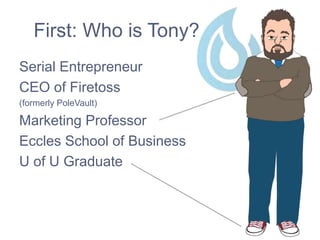
First: Who is Tony?
Serial Entrepreneur
CEO of Firetoss
(formerly PoleVault)
Marketing Professor
Eccles School of Business
U of U Graduate
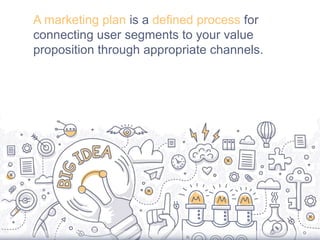
A marketing plan is a defined process for
connecting user segments to your value
proposition through appropriate channels.
Let’s break this down.
A marketing plan is a defined process for
connecting user segments to your value
proposition through appropriate channels.
A marketing plan is a defined process for
connecting user segments to your value
proposition through appropriate channels.
A marketing plan is a defined process for
connecting user segments to your value
proposition through appropriate channels.
A marketing plan is a defined process for
connecting user segments to your value
proposition through appropriate channels.
Most channels you will pursue require digital
assets.
How do I get it done?
It’s actually a lot easier that most people
think.
Define your objectives for your first website
and ONLY work on those.
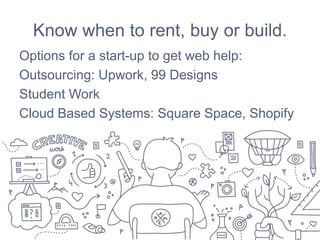
Know when to rent, buy or build.
Options for a start-up to get web help:
Outsourcing: Upwork, 99 Designs
Student Work
Cloud Based Systems: Square Space, Shopify
Web Metrics | Analytics
“Measure what is measurable and make
measurable what is not so.”
–Galileo
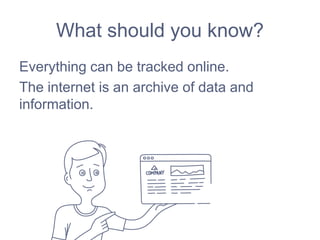
What should you know?
Everything can be tracked online.
The internet is an archive of data and
information.
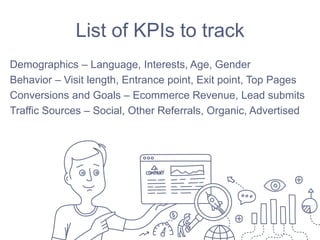
List of KPIs to track
Demographics – Language, Interests, Age, Gender
Behavior – Visit length, Entrance point, Exit point, Top Pages
Conversions and Goals – Ecommerce Revenue, Lead submits
Traffic Sources – Social, Other Referrals, Organic, Advertised
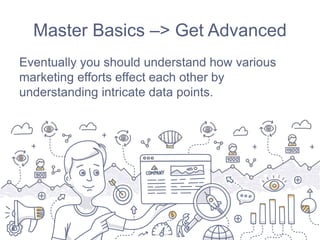
Master Basics –> Get Advanced
Eventually you should understand how various
marketing efforts effect each other by
understanding intricate data points.
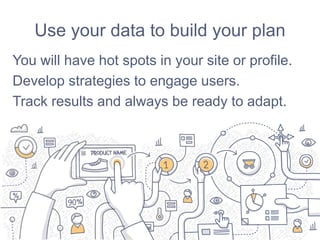
Use your data to build your plan
You will have hot spots in your site or profile.
Develop strategies to engage users.
Track results and always be ready to adapt.
Recap
1. Each customer segment gets reached
through specific channels
2. Your first site isn’t your masterpiece. Start
with a specific goal and limit how much
time / money you invest.
3. Don’t do anything on the web without
tracking.
4. Use data to make decisions about online
strategies.
@tonypassey
tony@firetoss.com
linkedin.com/in/tonypassey

Creating a digital presence

  • 1.
    CREATE A DIGITALPRESENCE Tony Passey
  • 2.
    What will welearn right now? 1. How to decide what your business needs online? 2. What resources can you use to create what you need? 3. How do you measure what is working? 4. How do you optimize your web presence?
  • 3.
    First: Who isTony? Serial Entrepreneur CEO of Firetoss (formerly PoleVault) Marketing Professor Eccles School of Business U of U Graduate
  • 4.
    A marketing planis a defined process for connecting user segments to your value proposition through appropriate channels. Let’s break this down.
  • 5.
    A marketing planis a defined process for connecting user segments to your value proposition through appropriate channels.
  • 6.
    A marketing planis a defined process for connecting user segments to your value proposition through appropriate channels.
  • 7.
    A marketing planis a defined process for connecting user segments to your value proposition through appropriate channels.
  • 8.
    A marketing planis a defined process for connecting user segments to your value proposition through appropriate channels.
  • 9.
    Most channels youwill pursue require digital assets.
  • 10.
    How do Iget it done? It’s actually a lot easier that most people think. Define your objectives for your first website and ONLY work on those.
  • 11.
    Know when torent, buy or build. Options for a start-up to get web help: Outsourcing: Upwork, 99 Designs Student Work Cloud Based Systems: Square Space, Shopify
  • 12.
    Web Metrics |Analytics “Measure what is measurable and make measurable what is not so.” –Galileo
  • 13.
    What should youknow? Everything can be tracked online. The internet is an archive of data and information.
  • 14.
    List of KPIsto track Demographics – Language, Interests, Age, Gender Behavior – Visit length, Entrance point, Exit point, Top Pages Conversions and Goals – Ecommerce Revenue, Lead submits Traffic Sources – Social, Other Referrals, Organic, Advertised
  • 15.
    Master Basics –>Get Advanced Eventually you should understand how various marketing efforts effect each other by understanding intricate data points.
  • 16.
    Use your datato build your plan You will have hot spots in your site or profile. Develop strategies to engage users. Track results and always be ready to adapt.
  • 17.
    Recap 1. Each customersegment gets reached through specific channels 2. Your first site isn’t your masterpiece. Start with a specific goal and limit how much time / money you invest. 3. Don’t do anything on the web without tracking. 4. Use data to make decisions about online strategies.
  • 18.

Editor's Notes

  • #3 How to decide what your business needs online? What resources can you use to create what you need? How do you measure what is working? How do you build a repeatable marketing and advertising process?
  • #5 A marketing plan is a defined process for connecting user segments to your value proposition through appropriate channels.
  • #7 The way we connect to our user segments is evolving with new technologies, new social networks and the change in how we use devices.
  • #11 Do you need an entire website? Will a Google Profile page suffice? Will a facebook page work? What are the differences? WHAT HAPPENS WHEN WE TRY TO WORK IN 7 DIRECTIONS???? FACEBOOK VS. INSTAGRAM
  • #12 This is a finance concept that applies to marketing management more than ever right now. The internet makes so many talented people available to you. You don’t need to own until it is sustainable.
  • #13 Metrics are imperative! Cautionary tale about Ucann Connect
  • #16 One channel effects the other. Example: Radio Advertising will effect organic searches.
  • #17 You begin with a hunch but you finish with empirical data. Channels drive each other and there is no one channel that can sustain your business. Understand your channel mix. Know what drives one channel or another.