WHAT ARE YOU BIGGEST MARKETING CHALLENGES?
WHAT IS YOUR DIGITAL FOOTPRINT?
ARE YOU VISIBLE ONLINE?
CAN YOUR CUSTOMERS FIND YOU? IF SO, WHAT WOULD THEY SEE
OR READ ABOUT YOU, YOUR COMPANY OR YOUR PRODUCT?
GENERAL DIGITAL OVERVIEW
▪ Branding and Positioning
▪ Online Visibility
▪ Search results
▪ Awareness (impressions on different channels)
▪ Site traffic (Sources, channels, Direct vs. referral, paid)
▪ Social Footprint (Number of fans/followers)
▪ Engagement (Number of mentions)
▪ Frequency (Number of posts)
▪ Content Strategy (Unique/Curated/Repurposed)
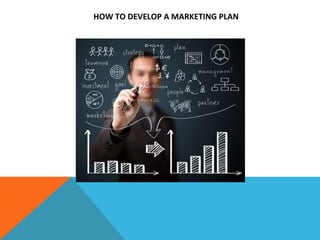
HOW TO DEVELOP A MARKETING PLAN
DEVELOPING A MARKETING PLAN
▪ Vision / Mission / Strategy
▪ SWOT Analysis
▪ Competitor Analysis
▪ Customer Analysis
▪ Tactics
▪ Implementation / Action Plans
▪ Monitor and Evaluate
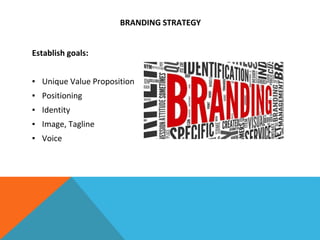
BRANDING STRATEGY
Establish goals:
▪ Unique Value Proposition
▪ Positioning
▪ Identity
▪ Image, Tagline
▪ Voice
Branding Strategy - Concept development and storytelling
Brand storytelling is:
● The reason why your company came to be
● What motivates your team to wake up and come to work everyday
● How your product came to be
● What types of customers find value in working with your brand and why
● A transparent view into the people behind the company
● A relationship-building tool
● More subtle than you realize
● A concept that underscores your entire web presence
● Something that your entire team, at organizational levels, embraces
● A look into who you are as a company
● Direct
VISION – MISSION - STRATEGY
1. What is your vision for 3 years hence?
I want to be the leading....
2. What is your mission?
To achieve a turnover of X with X% profitability by 2017.
3. How are you going to get there?
New marketing campaigns, partner with complementary
organisations, local radio and pr activity, educational events /
seminars, blog, social media etc.
CURRENT PERFORMANCE AND SITUATION
1. How well are you performing
Financial analysis, competitor analysis, what’s contributing to
success or failure.
2. What needs to change?
What are your main obstacles?
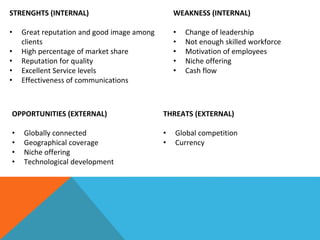
STRENGHTS (INTERNAL)
• Great reputation and good image among
clients
• High percentage of market share
• Reputation for quality
• Excellent Service levels
• Effectiveness of communications
WEAKNESS (INTERNAL)
• Change of leadership
• Not enough skilled workforce
• Motivation of employees
• Niche offering
• Cash flow
OPPORTUNITIES (EXTERNAL)
• Globally connected
• Geographical coverage
• Niche offering
• Technological development
THREATS (EXTERNAL)
• Global competition
• Currency
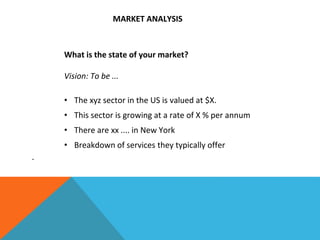
MARKET ANALYSIS
What is the state of your market?
Vision: To be ...
• The xyz sector in the US is valued at $X.
• This sector is growing at a rate of X % per annum
• There are xx .... in New York
• Breakdown of services they typically offer
.
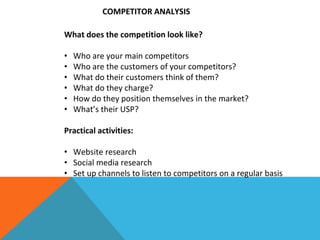
COMPETITOR ANALYSIS
What does the competition look like?
• Who are your main competitors
• Who are the customers of your competitors?
• What do their customers think of them?
• What do they charge?
• How do they position themselves in the market?
• What’s their USP?
Practical activities:
• Website research
• Social media research
• Set up channels to listen to competitors on a regular basis
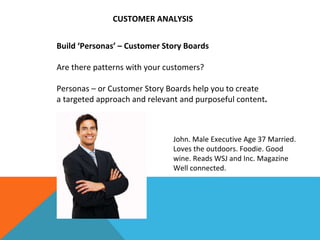
Build ‘Personas’ – Customer Story Boards
Are there patterns with your customers?
Personas – or Customer Story Boards help you to create
a targeted approach and relevant and purposeful content.
John. Male Executive Age 37 Married.
Loves the outdoors. Foodie. Good
wine. Reads WSJ and Inc. Magazine
Well connected.
CUSTOMER ANALYSIS
CUSTOMER INSIGHTS
What problems can you solve for your customers?
• What problems / pain do they have?
• What solution can you offer them?
• How can you compel them to want to choose you over your
competitors?
• How can you make their life easier?
• How can you make that solution unique?
• What’s your USP?
Build your marketing proposition – around customer needs.
The better you understand your market the more targeted your marketing
can be.
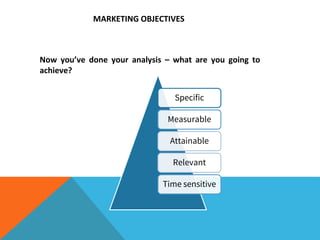
Now you’ve done your analysis – what are you going to
achieve?
Specific
Measurable
Attainable
Relevant
Time sensitive
MARKETING OBJECTIVES
SMART GOALS
• Increase the number of leads to 25 per week within 6 months.
• Convert 20% of leads to new customers
• Increase the average spend from X to X or by X %
• Increase the number of transactions per customer from 2 per month to
3 per month within 12 months.
CONTENT MARKETING
CONTENT MARKETING STRATEGY
▪ Identify type of content to share with target audience (do research
on different channels to identify trending content by keyword or
category)
▪ Monitor and optimize frequency and type of content
▪ Strategy and schedule
▪ Influencer content
▪ Curated content vs. Original
▪ Editorial schedule
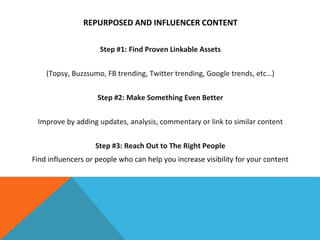
REPURPOSED AND INFLUENCER CONTENT
Step #1: Find Proven Linkable Assets
(Topsy, Buzzsumo, FB trending, Twitter trending, Google trends, etc…)
Step #2: Make Something Even Better
Improve by adding updates, analysis, commentary or link to similar content
Step #3: Reach Out to The Right People
Find influencers or people who can help you increase visibility for your content
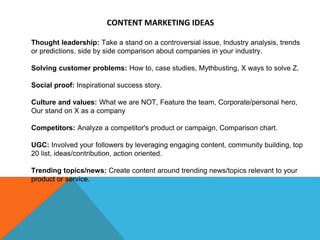
CONTENT MARKETING IDEAS
Thought leadership: Take a stand on a controversial issue, Industry analysis, trends
or predictions, side by side comparison about companies in your industry.
Solving customer problems: How to, case studies, Mythbusting, X ways to solve Z.
Social proof: Inspirational success story.
Culture and values: What we are NOT, Feature the team, Corporate/personal hero,
Our stand on X as a company
Competitors: Analyze a competitor's product or campaign, Comparison chart.
UGC: Involved your followers by leveraging engaging content, community building, top
20 list, ideas/contribution, action oriented.
Trending topics/news: Create content around trending news/topics relevant to your
product or service.
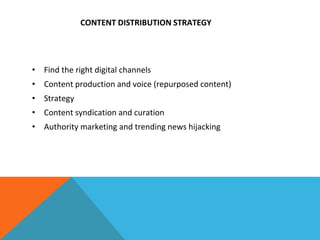
CONTENT DISTRIBUTION STRATEGY
• Find the right digital channels
• Content production and voice (repurposed content)
• Strategy
• Content syndication and curation
• Authority marketing and trending news hijacking
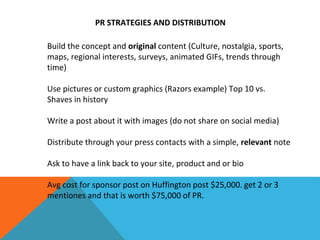
PR STRATEGIES AND DISTRIBUTION
Build the concept and original content (Culture, nostalgia, sports,
maps, regional interests, surveys, animated GIFs, trends through
time)
Use pictures or custom graphics (Razors example) Top 10 vs.
Shaves in history
Write a post about it with images (do not share on social media)
Distribute through your press contacts with a simple, relevant note
Ask to have a link back to your site, product and or bio
Avg cost for sponsor post on Huffington post $25,000. get 2 or 3
mentiones and that is worth $75,000 of PR.
SOCIAL MEDIA
Primary Objectives:
 Grow your audience and footprint
 Increase interactions with prospects, customers and fans
 Increase conversions (leads, sales, reviews)
 Promote upcoming events
 Improve customer engagement and customer service
FACEBOOK
Primary Objectives:
 Brand awareness and engagement
 Lead generation or customer acquisition
 Share a mix of relevant links, blog posts, and engaging content
 Promote upcoming events
 Engage with influencers
KEY METRICS
 X number of posts per day
 Page follows
 Likes
 Engagement and comments
 Referring traffic
 Shares
 Lead generation/new customers
LINKEDIN
Primary Objectives
 Brand awareness and engagement
 Lead generation or customer acquisition
 Share a mix of relevant links, blog posts, and engaging content
 Promote upcoming events
 Engage with influencers
KEY METRICS
 X number of posts per day
 Page follows
 Comments, likes, and shares
 Group participation
 Referring traffic
 Lead generation/new customers
TWITTER
Primary Objectives
 Brand awareness and engagement
 Lead generation or customer acquisition
 Share a mix of relevant links, blog posts, and engaging content
 Segment influencers and create lists
 Communicate issues from social media to support team and
ensure follow-up
 Listen and respond to relevant conversations
 Build reputation
KEY METRICS
 X number of posts
 Followers
 Mentions
 Retweets
 Number of lists
 Hashtag usage
 Influence of Twitter followers
 Lead generation or customer acquisition
 Referring traffic
 Favorited tweets
GOOGLE +
Primary Objectives
 Brand awareness and engagement
 Search authority and visibility
 Lead generation or customer acquisition
 Share a mix of relevant links, blog posts, and engaging content
KEY METRICS
 X number of posts
 Google+ circle adds/follows
 Google+ mentions
 Google +1
 Referring traffic
PHOTO SHARING PLATFORMS
Primary Objectives:
 Brand awareness
 Engagement with visual assets
 Showcase products
 Showcase company culture
 Showcase marketing events
 Link back to website, blog, and other content assets
KEY METRICS
 Referral traffic
 Shares and comments
 View of photos
 Page rankings on key terms from photo sharing sites
 Product purchasing and lead generation
ONLINE VIDEO PLATFORMS
Primary Objectives
• Brand awareness and engagement
• Viral sharing
• Showcase company culture
• Post product videos and demos
• Create a video series to share
KEY METRICS
 Views
 Shares
 Referral traffic
 Pages ranking on key terms from YouTube
INFLUENCER PROGRAM
Identify Influencers that will serve as ambassadors (research phase)
▪ Establish a dialogue
▪ Create content that will speak to their audience
▪ Find a value proposition that works for influencers
▪ Share goals and objectives
MEASURE AND OPTIMIZE
Compare original goals and measure:
▪ Influence
▪ Reach
▪ Traffic
▪ Engagement
▪ Social media footprint

How to create a Digital Marketing Plan

  • 2.
    WHAT ARE YOUBIGGEST MARKETING CHALLENGES? WHAT IS YOUR DIGITAL FOOTPRINT? ARE YOU VISIBLE ONLINE? CAN YOUR CUSTOMERS FIND YOU? IF SO, WHAT WOULD THEY SEE OR READ ABOUT YOU, YOUR COMPANY OR YOUR PRODUCT?
  • 3.
    GENERAL DIGITAL OVERVIEW ▪Branding and Positioning ▪ Online Visibility ▪ Search results ▪ Awareness (impressions on different channels) ▪ Site traffic (Sources, channels, Direct vs. referral, paid) ▪ Social Footprint (Number of fans/followers) ▪ Engagement (Number of mentions) ▪ Frequency (Number of posts) ▪ Content Strategy (Unique/Curated/Repurposed)
  • 4.
    HOW TO DEVELOPA MARKETING PLAN
  • 5.
    DEVELOPING A MARKETINGPLAN ▪ Vision / Mission / Strategy ▪ SWOT Analysis ▪ Competitor Analysis ▪ Customer Analysis ▪ Tactics ▪ Implementation / Action Plans ▪ Monitor and Evaluate
  • 6.
    BRANDING STRATEGY Establish goals: ▪Unique Value Proposition ▪ Positioning ▪ Identity ▪ Image, Tagline ▪ Voice
  • 7.
    Branding Strategy -Concept development and storytelling Brand storytelling is: ● The reason why your company came to be ● What motivates your team to wake up and come to work everyday ● How your product came to be ● What types of customers find value in working with your brand and why ● A transparent view into the people behind the company ● A relationship-building tool ● More subtle than you realize ● A concept that underscores your entire web presence ● Something that your entire team, at organizational levels, embraces ● A look into who you are as a company ● Direct
  • 8.
    VISION – MISSION- STRATEGY 1. What is your vision for 3 years hence? I want to be the leading.... 2. What is your mission? To achieve a turnover of X with X% profitability by 2017. 3. How are you going to get there? New marketing campaigns, partner with complementary organisations, local radio and pr activity, educational events / seminars, blog, social media etc.
  • 9.
    CURRENT PERFORMANCE ANDSITUATION 1. How well are you performing Financial analysis, competitor analysis, what’s contributing to success or failure. 2. What needs to change? What are your main obstacles?
  • 10.
    STRENGHTS (INTERNAL) • Greatreputation and good image among clients • High percentage of market share • Reputation for quality • Excellent Service levels • Effectiveness of communications WEAKNESS (INTERNAL) • Change of leadership • Not enough skilled workforce • Motivation of employees • Niche offering • Cash flow OPPORTUNITIES (EXTERNAL) • Globally connected • Geographical coverage • Niche offering • Technological development THREATS (EXTERNAL) • Global competition • Currency
  • 11.
    MARKET ANALYSIS What isthe state of your market? Vision: To be ... • The xyz sector in the US is valued at $X. • This sector is growing at a rate of X % per annum • There are xx .... in New York • Breakdown of services they typically offer .
  • 12.
    COMPETITOR ANALYSIS What doesthe competition look like? • Who are your main competitors • Who are the customers of your competitors? • What do their customers think of them? • What do they charge? • How do they position themselves in the market? • What’s their USP? Practical activities: • Website research • Social media research • Set up channels to listen to competitors on a regular basis
  • 13.
    Build ‘Personas’ –Customer Story Boards Are there patterns with your customers? Personas – or Customer Story Boards help you to create a targeted approach and relevant and purposeful content. John. Male Executive Age 37 Married. Loves the outdoors. Foodie. Good wine. Reads WSJ and Inc. Magazine Well connected. CUSTOMER ANALYSIS
  • 14.
    CUSTOMER INSIGHTS What problemscan you solve for your customers? • What problems / pain do they have? • What solution can you offer them? • How can you compel them to want to choose you over your competitors? • How can you make their life easier? • How can you make that solution unique? • What’s your USP? Build your marketing proposition – around customer needs. The better you understand your market the more targeted your marketing can be.
  • 15.
    Now you’ve doneyour analysis – what are you going to achieve? Specific Measurable Attainable Relevant Time sensitive MARKETING OBJECTIVES
  • 16.
    SMART GOALS • Increasethe number of leads to 25 per week within 6 months. • Convert 20% of leads to new customers • Increase the average spend from X to X or by X % • Increase the number of transactions per customer from 2 per month to 3 per month within 12 months.
  • 17.
  • 18.
    CONTENT MARKETING STRATEGY ▪Identify type of content to share with target audience (do research on different channels to identify trending content by keyword or category) ▪ Monitor and optimize frequency and type of content ▪ Strategy and schedule ▪ Influencer content ▪ Curated content vs. Original ▪ Editorial schedule
  • 19.
    REPURPOSED AND INFLUENCERCONTENT Step #1: Find Proven Linkable Assets (Topsy, Buzzsumo, FB trending, Twitter trending, Google trends, etc…) Step #2: Make Something Even Better Improve by adding updates, analysis, commentary or link to similar content Step #3: Reach Out to The Right People Find influencers or people who can help you increase visibility for your content
  • 20.
    CONTENT MARKETING IDEAS Thoughtleadership: Take a stand on a controversial issue, Industry analysis, trends or predictions, side by side comparison about companies in your industry. Solving customer problems: How to, case studies, Mythbusting, X ways to solve Z. Social proof: Inspirational success story. Culture and values: What we are NOT, Feature the team, Corporate/personal hero, Our stand on X as a company Competitors: Analyze a competitor's product or campaign, Comparison chart. UGC: Involved your followers by leveraging engaging content, community building, top 20 list, ideas/contribution, action oriented. Trending topics/news: Create content around trending news/topics relevant to your product or service.
  • 21.
    CONTENT DISTRIBUTION STRATEGY •Find the right digital channels • Content production and voice (repurposed content) • Strategy • Content syndication and curation • Authority marketing and trending news hijacking
  • 22.
    PR STRATEGIES ANDDISTRIBUTION Build the concept and original content (Culture, nostalgia, sports, maps, regional interests, surveys, animated GIFs, trends through time) Use pictures or custom graphics (Razors example) Top 10 vs. Shaves in history Write a post about it with images (do not share on social media) Distribute through your press contacts with a simple, relevant note Ask to have a link back to your site, product and or bio Avg cost for sponsor post on Huffington post $25,000. get 2 or 3 mentiones and that is worth $75,000 of PR.
  • 23.
    SOCIAL MEDIA Primary Objectives: Grow your audience and footprint  Increase interactions with prospects, customers and fans  Increase conversions (leads, sales, reviews)  Promote upcoming events  Improve customer engagement and customer service
  • 24.
    FACEBOOK Primary Objectives:  Brandawareness and engagement  Lead generation or customer acquisition  Share a mix of relevant links, blog posts, and engaging content  Promote upcoming events  Engage with influencers
  • 25.
    KEY METRICS  Xnumber of posts per day  Page follows  Likes  Engagement and comments  Referring traffic  Shares  Lead generation/new customers
  • 26.
    LINKEDIN Primary Objectives  Brandawareness and engagement  Lead generation or customer acquisition  Share a mix of relevant links, blog posts, and engaging content  Promote upcoming events  Engage with influencers
  • 27.
    KEY METRICS  Xnumber of posts per day  Page follows  Comments, likes, and shares  Group participation  Referring traffic  Lead generation/new customers
  • 28.
    TWITTER Primary Objectives  Brandawareness and engagement  Lead generation or customer acquisition  Share a mix of relevant links, blog posts, and engaging content  Segment influencers and create lists  Communicate issues from social media to support team and ensure follow-up  Listen and respond to relevant conversations  Build reputation
  • 29.
    KEY METRICS  Xnumber of posts  Followers  Mentions  Retweets  Number of lists  Hashtag usage  Influence of Twitter followers  Lead generation or customer acquisition  Referring traffic  Favorited tweets
  • 30.
    GOOGLE + Primary Objectives Brand awareness and engagement  Search authority and visibility  Lead generation or customer acquisition  Share a mix of relevant links, blog posts, and engaging content
  • 31.
    KEY METRICS  Xnumber of posts  Google+ circle adds/follows  Google+ mentions  Google +1  Referring traffic
  • 32.
    PHOTO SHARING PLATFORMS PrimaryObjectives:  Brand awareness  Engagement with visual assets  Showcase products  Showcase company culture  Showcase marketing events  Link back to website, blog, and other content assets
  • 33.
    KEY METRICS  Referraltraffic  Shares and comments  View of photos  Page rankings on key terms from photo sharing sites  Product purchasing and lead generation
  • 34.
    ONLINE VIDEO PLATFORMS PrimaryObjectives • Brand awareness and engagement • Viral sharing • Showcase company culture • Post product videos and demos • Create a video series to share
  • 35.
    KEY METRICS  Views Shares  Referral traffic  Pages ranking on key terms from YouTube
  • 36.
    INFLUENCER PROGRAM Identify Influencersthat will serve as ambassadors (research phase) ▪ Establish a dialogue ▪ Create content that will speak to their audience ▪ Find a value proposition that works for influencers ▪ Share goals and objectives
  • 37.
    MEASURE AND OPTIMIZE Compareoriginal goals and measure: ▪ Influence ▪ Reach ▪ Traffic ▪ Engagement ▪ Social media footprint