

Creating a Culture of Learning in
the Modern Workplace
Presenting Today
Lezlie Stephens
Director People Operations
BizLibrary
lstephens@bizlibrary.com
Erin Boettge
Content Marketing Manager
BizLibrary
eboettge@bizlibrary.com
Follow along on Twitter: #BizWebinar @BizLibrary
BizLibrary helps organizations succeed by improving the way
employees learn.
www.bizlibrary.com/free-trial
[POLL] On a Scale of 1-10, how
would my CEO rate our training
results?
Make your selection now.
| Creating a Culture of Learning in the Modern Workplace
| Creating a Culture of Learning in the Modern Workplace
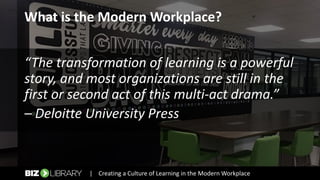
What is the Modern Workplace?
“The transformation of learning is a powerful
story, and most organizations are still in the
first or second act of this multi-act drama.”
– Deloitte University Press
| Creating a Culture of Learning in the Modern Workplace
What is the Modern Workplace?
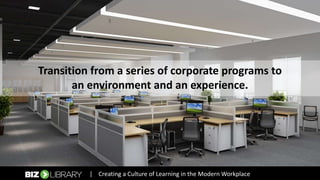
Transition from a series of corporate programs to
an environment and an experience.
| Creating a Culture of Learning in the Modern Workplace
| Creating a Culture of Learning in the Modern Workplace
A World of Constant Change
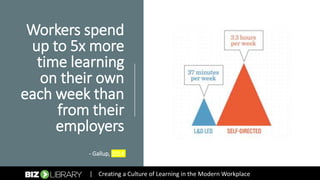
Workers spend
up to 5x more
time learning
on their own
each week than
from their
employers
- Gallup, 2014
| Creating a Culture of Learning in the Modern Workplace
What is a Learning Culture?
| Creating a Culture of Learning in the Modern Workplace
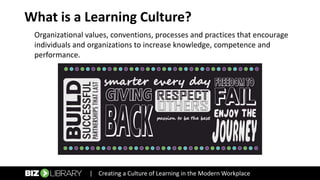
Organizational values, conventions, processes and practices that encourage
individuals and organizations to increase knowledge, competence and
performance.
| Creating a Culture of Learning in the Modern Workplace
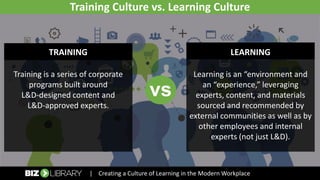
TRAINING
Training is a series of corporate
programs built around
L&D-designed content and
L&D-approved experts.
Training Culture vs. Learning Culture
LEARNING
Learning is an “environment and
an “experience,” leveraging
experts, content, and materials
sourced and recommended by
external communities as well as by
other employees and internal
experts (not just L&D).
vs
| Creating a Culture of Learning in the Modern Workplace
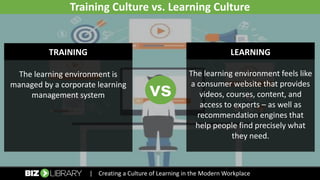
TRAINING
The learning environment is
managed by a corporate learning
management system
Training Culture vs. Learning Culture
LEARNING
The learning environment feels like
a consumer website that provides
videos, courses, content, and
access to experts – as well as
recommendation engines that
help people find precisely what
they need.
vs
| Creating a Culture of Learning in the Modern Workplace
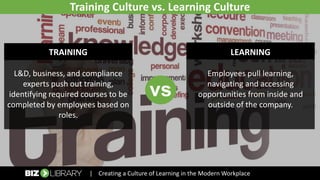
TRAINING
L&D, business, and compliance
experts push out training,
identifying required courses to be
completed by employees based on
roles.
vs
Training Culture vs. Learning Culture
LEARNING
Employees pull learning,
navigating and accessing
opportunities from inside and
outside of the company.
| Creating a Culture of Learning in the Modern Workplace
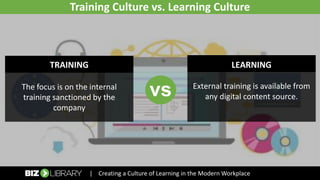
TRAINING
The focus is on the internal
training sanctioned by the
company
Training Culture vs. Learning Culture
LEARNING
External training is available from
any digital content source.vs
| Creating a Culture of Learning in the Modern Workplace
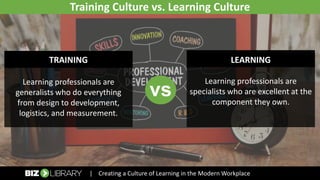
TRAINING
Learning professionals are
generalists who do everything
from design to development,
logistics, and measurement.
Training Culture vs. Learning Culture
LEARNING
Learning professionals are
specialists who are excellent at the
component they own.
vs
| Creating a Culture of Learning in the Modern Workplace
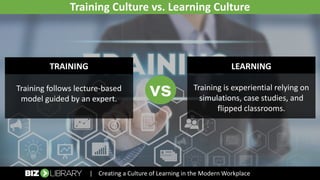
TRAINING
Training follows lecture-based
model guided by an expert.
Training Culture vs. Learning Culture
LEARNING
Training is experiential relying on
simulations, case studies, and
flipped classrooms.
vs
| Creating a Culture of Learning in the Modern Workplace
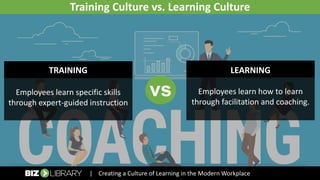
TRAINING
Employees learn specific skills
through expert-guided instruction
Training Culture vs. Learning Culture
LEARNING
Employees learn how to learn
through facilitation and coaching.
vs
| Creating a Culture of Learning in the Modern Workplace
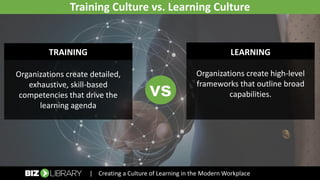
TRAINING
Organizations create detailed,
exhaustive, skill-based
competencies that drive the
learning agenda
Training Culture vs. Learning Culture
LEARNING
Organizations create high-level
frameworks that outline broad
capabilities.vs
| Creating a Culture of Learning in the Modern Workplace
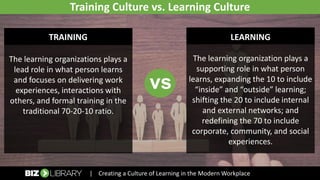
TRAINING
The learning organizations plays a
lead role in what person learns
and focuses on delivering work
experiences, interactions with
others, and formal training in the
traditional 70-20-10 ratio.
Training Culture vs. Learning Culture
LEARNING
The learning organization plays a
supporting role in what person
learns, expanding the 10 to include
“inside” and “outside” learning;
shifting the 20 to include internal
and external networks; and
redefining the 70 to include
corporate, community, and social
experiences.
vs
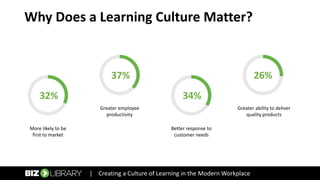
Why Does a Learning Culture Matter?
| Creating a Culture of Learning in the Modern Workplace
32%
37%
34%
26%
More likely to be
first to market
Greater employee
productivity
Better response to
customer needs
Greater ability to deliver
quality products
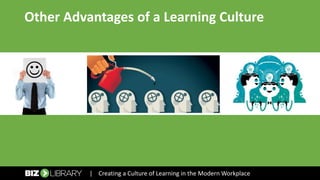
Other Advantages of a Learning Culture
| Creating a Culture of Learning in the Modern Workplace
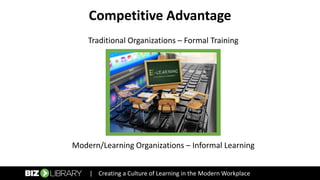
Traditional Organizations – Formal Training
Modern/Learning Organizations – Informal Learning
Competitive Advantage
| Creating a Culture of Learning in the Modern Workplace
How Do We Create a Learning
Culture?
[POLL] Would you consider your
Organization to have a:
A: Modern Learning Culture
B: Traditional Training Culture
| Creating a Culture of Learning in the Modern Workplace
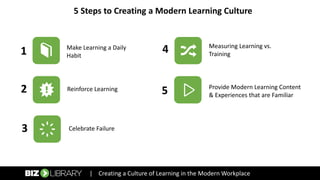
5 Steps to Creating a Modern Learning Culture
| Creating a Culture of Learning in the Modern Workplace
Provide Modern Learning Content
& Experiences that are Familiar
Measuring Learning vs.
Training
Reinforce Learning
Celebrate Failure
Make Learning a Daily
Habit1
2
3
4
5
Make Learning a Daily Habit
| Creating a Culture of Learning in the Modern Workplace
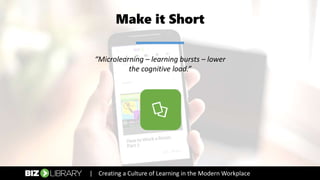
Make it Short
“Microlearning – learning bursts – lower
the cognitive load.”
| Creating a Culture of Learning in the Modern Workplace
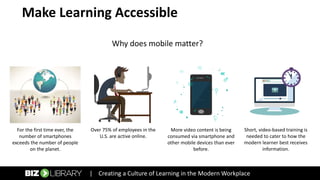
Make Learning Accessible
Why does mobile matter?
| Creating a Culture of Learning in the Modern Workplace
For the first time ever, the
number of smartphones
exceeds the number of people
on the planet.
Over 75% of employees in the
U.S. are active online.
More video content is being
consumed via smartphone and
other mobile devices than ever
before.
Short, video-based training is
needed to cater to how the
modern learner best receives
information.
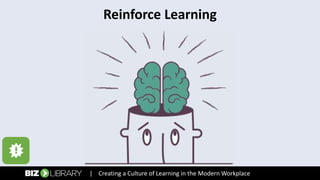
Reinforce Learning
| Creating a Culture of Learning in the Modern Workplace
| Creating a Culture of Learning in the Modern Workplace
| Creating a Culture of Learning in the Modern Workplace
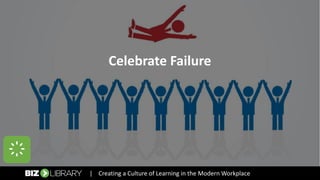
Celebrate Failure
| Creating a Culture of Learning in the Modern Workplace
| Creating a Culture of Learning in the Modern Workplace
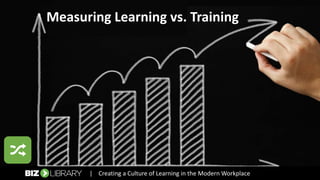
Measuring Learning vs. Training
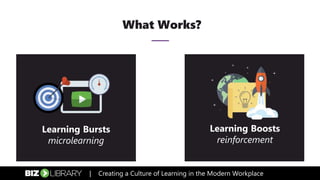
What Works?
Learning Bursts
microlearning
Learning Boosts
reinforcement
| Creating a Culture of Learning in the Modern Workplace
| Creating a Culture of Learning in the Modern Workplace
Provide Modern Learning Content and
Experiences that are Familiar
…How Will I Manage All This
Change?
| Creating a Culture of Learning in the Modern Workplace
Have all managers on board
| Creating a Culture of Learning in the Modern Workplace
Communicate regularly with employees
| Creating a Culture of Learning in the Modern Workplace
Deliver metrics and results
| Creating a Culture of Learning in the Modern Workplace
Be consistent
| Creating a Culture of Learning in the Modern Workplace
Key Takeaways
• The Modern Workplace AND the Modern Worker have
changed and a new type of Learning Culture has become
necessary.
• Burst and Boost (Microlearning and Post-Training
Reinforcement) are cornerstones on which to build your
Modern Learning Culture.
• Creating a learning culture won’t happen overnight, and it
does represent change…but change is manageable.
| Creating a Culture of Learning in the Modern Workplace
Questions?
Train the Trainer: Becoming a “Learning Organization”
Train the Trainer Series
27 Lesson Series
BizLibrary helps organizations succeed by improving the way
employees learn.
www.bizlibrary.com/free-trial
Get in Touch
www.bizlibrary.com
Lezlie Stephens
Director of People Operations
BizLibrary
lstephens@bizlibrary.com
Erin Boettge
Content Marketing Manager
BizLibrary
eboettge@bizlibrary.com

Create a culture_of_learning_8.16.2017 (002)

  • 1.
    Creating a Cultureof Learning in the Modern Workplace
  • 2.
    Presenting Today Lezlie Stephens DirectorPeople Operations BizLibrary lstephens@bizlibrary.com Erin Boettge Content Marketing Manager BizLibrary eboettge@bizlibrary.com Follow along on Twitter: #BizWebinar @BizLibrary
  • 3.
    BizLibrary helps organizationssucceed by improving the way employees learn. www.bizlibrary.com/free-trial
  • 4.
    [POLL] On aScale of 1-10, how would my CEO rate our training results? Make your selection now. | Creating a Culture of Learning in the Modern Workplace
  • 5.
    | Creating aCulture of Learning in the Modern Workplace
  • 7.
    What is theModern Workplace? “The transformation of learning is a powerful story, and most organizations are still in the first or second act of this multi-act drama.” – Deloitte University Press | Creating a Culture of Learning in the Modern Workplace
  • 8.
    What is theModern Workplace? Transition from a series of corporate programs to an environment and an experience. | Creating a Culture of Learning in the Modern Workplace
  • 9.
    | Creating aCulture of Learning in the Modern Workplace A World of Constant Change
  • 10.
    Workers spend up to5x more time learning on their own each week than from their employers - Gallup, 2014 | Creating a Culture of Learning in the Modern Workplace
  • 11.
    What is aLearning Culture? | Creating a Culture of Learning in the Modern Workplace Organizational values, conventions, processes and practices that encourage individuals and organizations to increase knowledge, competence and performance.
  • 12.
    | Creating aCulture of Learning in the Modern Workplace TRAINING Training is a series of corporate programs built around L&D-designed content and L&D-approved experts. Training Culture vs. Learning Culture LEARNING Learning is an “environment and an “experience,” leveraging experts, content, and materials sourced and recommended by external communities as well as by other employees and internal experts (not just L&D). vs
  • 13.
    | Creating aCulture of Learning in the Modern Workplace TRAINING The learning environment is managed by a corporate learning management system Training Culture vs. Learning Culture LEARNING The learning environment feels like a consumer website that provides videos, courses, content, and access to experts – as well as recommendation engines that help people find precisely what they need. vs
  • 14.
    | Creating aCulture of Learning in the Modern Workplace TRAINING L&D, business, and compliance experts push out training, identifying required courses to be completed by employees based on roles. vs Training Culture vs. Learning Culture LEARNING Employees pull learning, navigating and accessing opportunities from inside and outside of the company.
  • 15.
    | Creating aCulture of Learning in the Modern Workplace TRAINING The focus is on the internal training sanctioned by the company Training Culture vs. Learning Culture LEARNING External training is available from any digital content source.vs
  • 16.
    | Creating aCulture of Learning in the Modern Workplace TRAINING Learning professionals are generalists who do everything from design to development, logistics, and measurement. Training Culture vs. Learning Culture LEARNING Learning professionals are specialists who are excellent at the component they own. vs
  • 17.
    | Creating aCulture of Learning in the Modern Workplace TRAINING Training follows lecture-based model guided by an expert. Training Culture vs. Learning Culture LEARNING Training is experiential relying on simulations, case studies, and flipped classrooms. vs
  • 18.
    | Creating aCulture of Learning in the Modern Workplace TRAINING Employees learn specific skills through expert-guided instruction Training Culture vs. Learning Culture LEARNING Employees learn how to learn through facilitation and coaching. vs
  • 19.
    | Creating aCulture of Learning in the Modern Workplace TRAINING Organizations create detailed, exhaustive, skill-based competencies that drive the learning agenda Training Culture vs. Learning Culture LEARNING Organizations create high-level frameworks that outline broad capabilities.vs
  • 20.
    | Creating aCulture of Learning in the Modern Workplace TRAINING The learning organizations plays a lead role in what person learns and focuses on delivering work experiences, interactions with others, and formal training in the traditional 70-20-10 ratio. Training Culture vs. Learning Culture LEARNING The learning organization plays a supporting role in what person learns, expanding the 10 to include “inside” and “outside” learning; shifting the 20 to include internal and external networks; and redefining the 70 to include corporate, community, and social experiences. vs
  • 21.
    Why Does aLearning Culture Matter? | Creating a Culture of Learning in the Modern Workplace 32% 37% 34% 26% More likely to be first to market Greater employee productivity Better response to customer needs Greater ability to deliver quality products
  • 22.
    Other Advantages ofa Learning Culture | Creating a Culture of Learning in the Modern Workplace
  • 23.
    Traditional Organizations –Formal Training Modern/Learning Organizations – Informal Learning Competitive Advantage | Creating a Culture of Learning in the Modern Workplace
  • 24.
    How Do WeCreate a Learning Culture? [POLL] Would you consider your Organization to have a: A: Modern Learning Culture B: Traditional Training Culture | Creating a Culture of Learning in the Modern Workplace
  • 25.
    5 Steps toCreating a Modern Learning Culture | Creating a Culture of Learning in the Modern Workplace Provide Modern Learning Content & Experiences that are Familiar Measuring Learning vs. Training Reinforce Learning Celebrate Failure Make Learning a Daily Habit1 2 3 4 5
  • 26.
    Make Learning aDaily Habit | Creating a Culture of Learning in the Modern Workplace
  • 27.
    Make it Short “Microlearning– learning bursts – lower the cognitive load.” | Creating a Culture of Learning in the Modern Workplace
  • 28.
    Make Learning Accessible Whydoes mobile matter? | Creating a Culture of Learning in the Modern Workplace For the first time ever, the number of smartphones exceeds the number of people on the planet. Over 75% of employees in the U.S. are active online. More video content is being consumed via smartphone and other mobile devices than ever before. Short, video-based training is needed to cater to how the modern learner best receives information.
  • 29.
    Reinforce Learning | Creatinga Culture of Learning in the Modern Workplace
  • 30.
    | Creating aCulture of Learning in the Modern Workplace
  • 31.
    | Creating aCulture of Learning in the Modern Workplace
  • 32.
    Celebrate Failure | Creatinga Culture of Learning in the Modern Workplace
  • 33.
    | Creating aCulture of Learning in the Modern Workplace Measuring Learning vs. Training
  • 34.
    What Works? Learning Bursts microlearning LearningBoosts reinforcement | Creating a Culture of Learning in the Modern Workplace
  • 35.
    | Creating aCulture of Learning in the Modern Workplace Provide Modern Learning Content and Experiences that are Familiar
  • 36.
    …How Will IManage All This Change? | Creating a Culture of Learning in the Modern Workplace
  • 37.
    Have all managerson board | Creating a Culture of Learning in the Modern Workplace
  • 38.
    Communicate regularly withemployees | Creating a Culture of Learning in the Modern Workplace
  • 39.
    Deliver metrics andresults | Creating a Culture of Learning in the Modern Workplace
  • 40.
    Be consistent | Creatinga Culture of Learning in the Modern Workplace
  • 41.
    Key Takeaways • TheModern Workplace AND the Modern Worker have changed and a new type of Learning Culture has become necessary. • Burst and Boost (Microlearning and Post-Training Reinforcement) are cornerstones on which to build your Modern Learning Culture. • Creating a learning culture won’t happen overnight, and it does represent change…but change is manageable. | Creating a Culture of Learning in the Modern Workplace
  • 42.
  • 43.
    Train the Trainer:Becoming a “Learning Organization” Train the Trainer Series 27 Lesson Series
  • 44.
    BizLibrary helps organizationssucceed by improving the way employees learn. www.bizlibrary.com/free-trial
  • 45.
    Get in Touch www.bizlibrary.com LezlieStephens Director of People Operations BizLibrary lstephens@bizlibrary.com Erin Boettge Content Marketing Manager BizLibrary eboettge@bizlibrary.com

Editor's Notes

  • #2 Thanks Adam, and hi everyone! Thank you for joining us for Creating a Culture of Learning in the Modern Workplace.
  • #3 My name is Erin Boettge, I’m the Content Marketing Manager at BizLibrary, and presenting with us today is President and CEO of BizLibrary, Dean Pichee. Dean founded BizLibrary in 1996, to provide affordable, high-quality, training resources to small and mid-sized organizations across all industries. Prior to founding BizLibrary, Dean founded and sold Capital Training Company, a training solutions provider for banks and financial institutions. Before founding Capital Training Company, Pichee served as the Vice President for Bankers Training, also a training provider for the financial training industry. Dean has served on the board of directors of leading trade associations for learning providers, including the Digital Learning Organization, and its predecessor, Training Media Association. He has also served on the board for the ALS Society of St. Louis. Dean earned a business degree from Washington University.
  • #4  A little bit about us…BizLibrary is a leading provider of online employee training solutions. Our award-winning online training library contains thousands of micro-video lessons, video courses, interactive videos, and elearning courses covering a wide variety of topics and includes additional support materials to further increase learning retention. Our platform is powerful and easy to use. All of our online training solutions are mobile-ready, allowing learners unlimited access to training content on any device, anytime, and anywhere for true just-in-time learning. Enough about us, I think we’re ready to get started here…Dean, do we have you on?
  • #5 On a scale of 1-10 how would my CEO rate our training results? Let us know in Chat? 10 would be “It’s PERFECT!” I can’t spend enough on Training. Review the scores by a CEO. Goal of today’s program is Why do we need a training program? What are some differences between a modern learning culture and training.
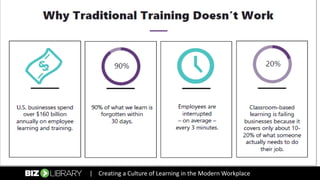
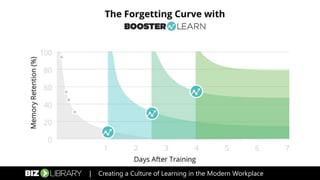
  • #6 Why Microlearning makes a difference in the modern workplace? Microlearning has become a necessary asset in organizations looking to implement a strong learning culture. Learning needs to be continuous and traditional training no longer meets that need. Research has shown that 90% of what we learn is forgotten One survey states that employees are interrupted every three minutes. That means that you can expect to be interrupted over 15 times during this webinar.
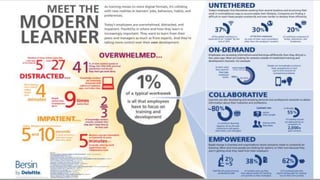
  • #7 The way learners work and receive information has fundamentally changed.
  • #9 Transition from a series of corporate programs to an environment and an experience.
  • #10 New employees have grown up in a world of constant change and innovation. Employees want to learn continuously and expect that their employers value and nurture their potential. The global, mobile, transient nature of this new workforce makes it easy for employees to jump ship to organizations that offer more development opportunities.
  • #11 Degreed - Graphic – Workers spent 37 minutes of their average week on employer training, 3.3 hrs of training learning on their own Employees are spending 5x more time learning on their own each week
  • #12 A learning culture is a set of organizational values, conventions, processes and practices that encourage individuals and organizations to increase knowledge, competence and performance. BizLibrary has created values with learning culture in mind:
  • #22 Why Does Learning Culture Matter? Companies with Learning Cultures Outperform their peers: According to a study by Bersin and Associates, “High-Impact Learning Culture: The 40 Best Practices for Creating an Empowered Enterprise”, High-Impact Learning Organizations that have a strong learning foundation in place tend to significantly outperform their peers in several areas They are 32% more likely to be first to market. They have 37% greater employee productivity. They have 34% better response to customer needs. They have a 26% greater ability to deliver quality products. They generate, on average, three times higher profit growth.
  • #23 Other advantages of a learning culture: Increased employee satisfaction and decreased turnover Studies are showing that the modern worker values training and development more than salary increases and other benefits. An improvement in mindset among employees A developed sense of ownership and accountability Ease in succession and transition A culture of knowledge inquiry and sharing An enhanced ability for workers to adapt to change
  • #24 In traditional organizations, the learning function is largely reactive. Learning is viewed as a noun rather than a verb and a cost rather than an investment. This kind of thinking will never put you ahead of the competition.
  • #25 POLL QUESTION: Would you consider your organization to have a modern learning culture, or a traditional training culture?
  • #26 Make it a daily habit Reinforce Learning Celebrating failure (after-action reviews) Measuring learning vs. training Providing Modern Learning Content and Experiences that are familiar (video/youtube-style training)
  • #28   In cognitive psychology, cognitive load refers to the total amount of mental effort being used in the working memory. _______________________________________ Chunk It. In cognitive psychology, cognitive load refers to the total amount of mental effort being used in the working memory. Cognitive load theory states that we have mental “bandwidth” restrictions. In other words, our brain can only process a certain amount of information at a time. And one of the things that can cause overload is too much information. So the #1 thing we need to do with our training content is to chunk it down into bite-sized “bursts” to lower the cognitive load. Microlearning is very popular today and a key component of our online training solution. We offer training videos that are typically 5-10 minutes in length to address the needs of today’s workplace and the realities of learning science.
  • #29 Learning Away from Work Why does mobile matter? For the first time ever, the number of smartphones exceeds the number of people on the planet. Over 75% of employees in the U.S. are active online. More video content is being consumed via smartphone and other mobile devices than ever before. Short, video-based training is needed to cater to how the modern learner best receives information. Mobile training helps companies stay competitive in an increasingly complex, global business environment Information is the new currency in today’s competitive global business setting. A mobile learning solution provides an edge, and giving learners access to training in multiple locations via mobile devices eliminates travel expenses and scheduling issues.
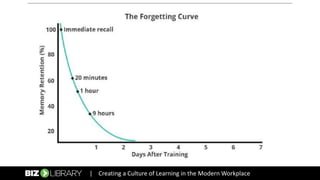
  • #32 The image here illustrates this concept. This has very important implications for us as learning professionals. We need to space out our programs so employees will get the most from their training time.
  • #35 Great stuff. So what can you use to improve your employee training programs… we suggest you incorporate 2 big things…   First, we hope you’ll incorporate short training “bursts” into your training programs. Chunk you content into bite-sized pieces.   Second, we hope you’ll develop a series of short learning “boosts” following your training to help your employees retain and transfer the information learned to their jobs.
  • #37 POLL: What is the goal and objective of employee training (Let us know in chat!)
  • #38 Manager buy-in and consistent training will ensure everyone is getting the same message and opportunities.
  • #39 Employees should know that not only is the shift in culture beneficial for the organization, but extremely beneficial to the employee individually and their career goals.
  • #40 Show employees the difference training, learning and an open culture of sharing knowledge is making
  • #41 Set your program up for success ahead of time by having leadership buy-in, a marketing plan and a consistent message. Don’t let your program fizzle out after the first few weeks or months.
  • #42 The Modern Workplace AND the Modern Worker have changed and a Learning Culture has become necessary. Microlearning and Post-Training Reinforcement are cornerstones on which to build your Learning Culture. Creating a learning culture won’t happen overnight, but it IS possible. Change management is inevitable, but manageable.
  • #43 Impact of Technology if there was new studies or data on cognitive load theory? Is technology impacting cognitive load? From a content perspective, are we seeing a shift from taking a conservative approach based on cognitive load limitations or is content becoming more liberal in its use of stimulating elements?   Does it matter if the learner gets the importance of the content on his/her own or because manager says you must do this task differently? but if the learner is assigned the training, rather than searching it out, how does that affect the result?   Diversity - Impact of Literacy and Disabilities – 708 - generations is accuracy of memory important? a characteristic of adult learners is changes in memory performance as learners age   How Familiar – current level of mastery – muscle memory Performing the task, quiz and knowledge checks – what are the requirements for the recall?   Recommended Intervals How long should the wait time be between learning and then the quiz? When do we begin to forget information? This will help identify when it is best to recall. And if you have a limited time with the group, perhaps you need to take advantage of e-communication before and after? When people need the content, the motivation is there.   Why Flipped Classroom works? Is this type of encoding done with virtual trainings only? Or can it be done in a face to face setting? Tips for improving retention in classroom training   Book to check out -  Efficiency in Learning: Evidence-Based Guidelines to Manage Cognitive Load By Ruth C. Clark, Frank Nguyen, John Sweller   Idea : so the video accompanying the baseball example would be focused around the ball leaving the pitchers hand?
  • #44 This is the 24th video in our Advanced Train the Trainer series. The series is designed to help experienced trainers improve the impact of their work and is divided into four sets of programs: Training Management, Research, Content Development and Delivering Training. This video is part of the Delivering Training programs and talks about the importance of building a training curriculum in a learner organization.
  • #45 You can try out these video lessons and courses and more by doing a free 30-day trial with BizLibrary. Just go to www.bizlibrary.com/free trial and we’ll have someone set you up to view all of our video, lessons and courses and access all of our features, including what we have in the way of post-training reinforcement. So again, that’s BizLibrary.com/free-trial
  • #46 Another big thank you to Dean for presenting with us today, thank you to elearning for having us, and thanks to all of you for attending. I’m going to pass it back over to Adam, because he has a few more things to cover before we wrap up! Adam?