Practical anatomy
Meninges, DVS & CSF circulation
• Lab; C.O.A
• Session; 10th
session; pages; 519-582-640-645-710
• References; C.O.A By Richard
• Snell & Frank Netters atlas
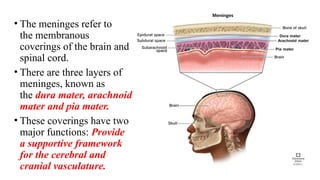
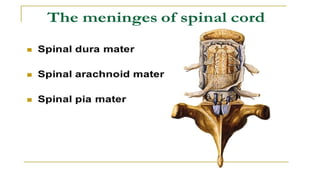
• The meninges refer to
the membranous
coverings of the brain and
spinal cord.
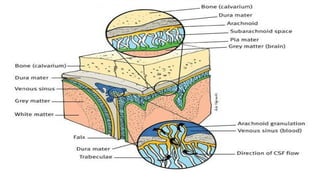
• There are three layers of
meninges, known as
the dura mater, arachnoid
mater and pia mater.
• These coverings have two
major functions: Provide
a supportive framework
for the cerebral and
cranial vasculature.
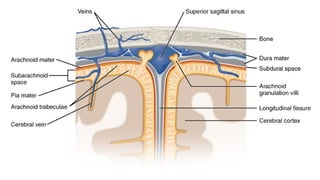
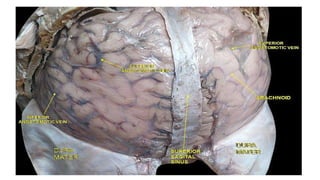
Dura Mater
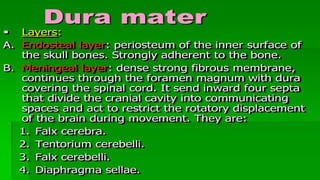
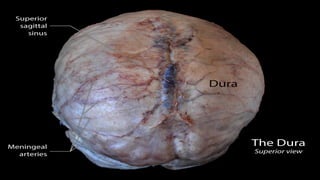
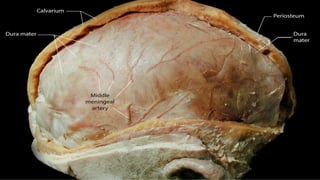
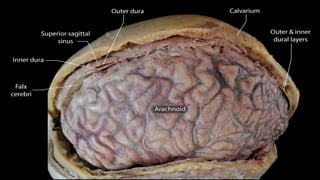
• The dura mater is the outermost layer of the meninges and is located
directly underneath the bones of the skull and vertebral column!.
• It is thick, tough, and inextensible (non-stretchable).
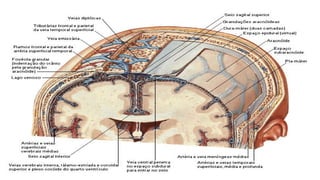
• The dura mater consists of two layered sheets of connective tissue:
• Periosteal layer – lines the inner surface of the bones of the cranium.
• Meningeal layer – located deep to the periosteal layer. It is
continuous with the dura mater of the spinal cord.
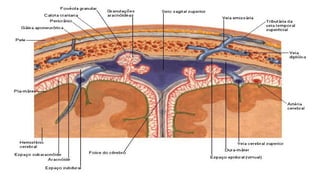
• The dural venous sinuses are located between the two layers of dura
mater. They are responsible for the venous drainage of the cranium
and empty into the internal jugular veins.
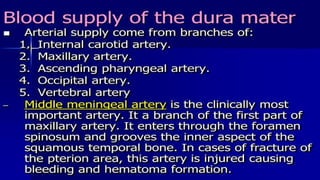
• The dura mater receives its own vascular supply – primarily from
the middle meningeal artery and vein. It is innervated by the
trigeminal nerve (V1, V2 and V3).
Dural Reflections
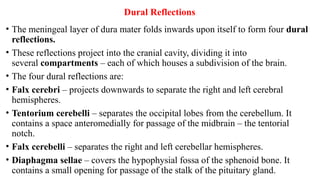
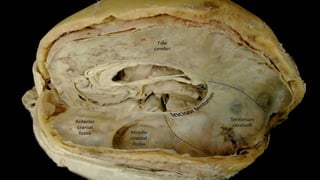
• The meningeal layer of dura mater folds inwards upon itself to form four dural
reflections.
• These reflections project into the cranial cavity, dividing it into
several compartments – each of which houses a subdivision of the brain.
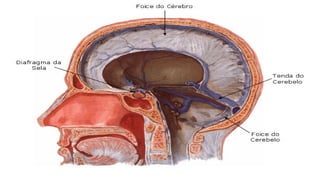
• The four dural reflections are:
• Falx cerebri – projects downwards to separate the right and left cerebral
hemispheres.
• Tentorium cerebelli – separates the occipital lobes from the cerebellum. It
contains a space anteromedially for passage of the midbrain – the tentorial
notch.
• Falx cerebelli – separates the right and left cerebellar hemispheres.
• Diaphagma sellae – covers the hypophysial fossa of the sphenoid bone. It
contains a small opening for passage of the stalk of the pituitary gland.
DVS
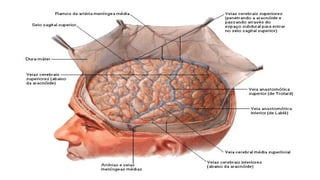
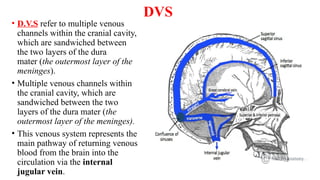
• D.V.S refer to multiple venous
channels within the cranial cavity,
which are sandwiched between
the two layers of the dura
mater (the outermost layer of the
meninges).
• Multiple venous channels within
the cranial cavity, which are
sandwiched between the two
layers of the dura mater (the
outermost layer of the meninges).
• This venous system represents the
main pathway of returning venous
blood from the brain into the
circulation via the internal
jugular vein.
v
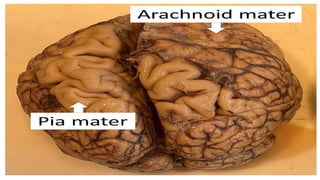
Pia mater
• It is the innermost of the meninges, closely adhering to the surface of
the brain and spinal cord.
• The term “pia mater” means “tender matter.” It is composed of
delicate connective tissue and has many tiny blood vessels.
• The pia mater accompanies the vessels that enter the nervous tissue
from the subarachnoid space, forming the outer wall of the
perivascular spaces.
• Cerebral arteries and veins travel in the subarachnoid space,
completely enveloped by pia mater.
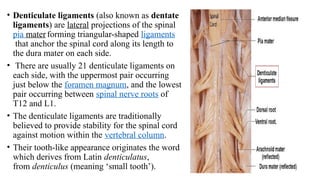
• Denticulate ligaments (also known as dentate
ligaments) are lateral projections of the spinal
pia materforming triangular-shaped ligaments
that anchor the spinal cord along its length to
the dura mater on each side.
• There are usually 21 denticulate ligaments on
each side, with the uppermost pair occurring
just below the foramen magnum, and the lowest
pair occurring between spinal nerve roots of
T12 and L1.
• The denticulate ligaments are traditionally
believed to provide stability for the spinal cord
against motion within the vertebral column.
• Their tooth-like appearance originates the word
which derives from Latin denticulatus,
from denticulus (meaning ‘small tooth’).
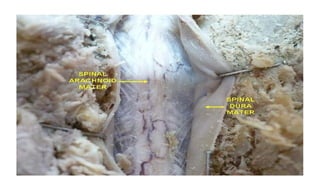
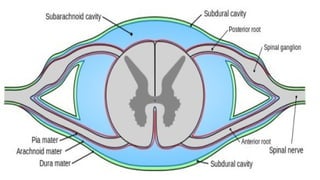
The main difference between cranial and spinal meninges ;
•Cranial meninges are the protective coverings of the brain,
consisting of channels in the dura mater between various
parts of the brain called dural folds, whereas spinal
meninges are the protective coverings of the spinal cord
whose dura mater acts as a dural sheath.
•Cranial meninges contain two layers in the dura mater
while the spinal meninges contain a single layer in
the dura mater.
•In addition, cranial meninges may not produce an epidural
space while spinal meninges produce an epidural space
filled with fat.
Clinical significance
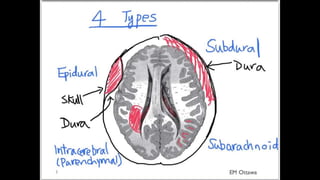
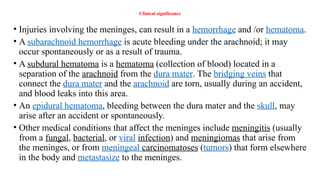
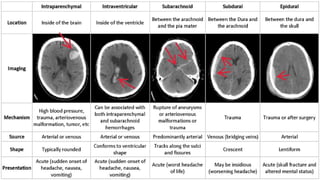
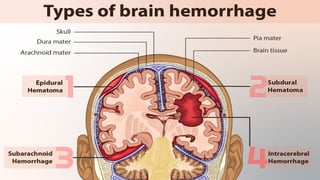
• Injuries involving the meninges, can result in a hemorrhage and /or hematoma.
• A subarachnoid hemorrhage is acute bleeding under the arachnoid; it may
occur spontaneously or as a result of trauma.
• A subdural hematoma is a hematoma (collection of blood) located in a
separation of the arachnoid from the dura mater. The bridging veins that
connect the dura mater and the arachnoid are torn, usually during an accident,
and blood leaks into this area.
• An epidural hematoma, bleeding between the dura mater and the skull, may
arise after an accident or spontaneously.
• Other medical conditions that affect the meninges include meningitis (usually
from a fungal, bacterial, or viral infection) and meningiomas that arise from
the meninges, or from meningeal carcinomatoses (tumors) that form elsewhere
in the body and metastasize to the meninges.
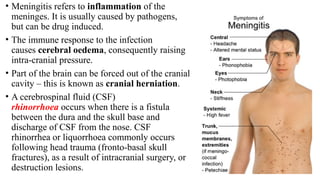
• Meningitis refers to inflammation of the
meninges. It is usually caused by pathogens,
but can be drug induced.
• The immune response to the infection
causes cerebral oedema, consequently raising
intra-cranial pressure.
• Part of the brain can be forced out of the cranial
cavity – this is known as cranial herniation.
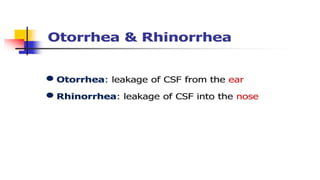
• A cerebrospinal fluid (CSF)
rhinorrhoea occurs when there is a fistula
between the dura and the skull base and
discharge of CSF from the nose. CSF
rhinorrhea or liquorrhoea commonly occurs
following head trauma (fronto-basal skull
fractures), as a result of intracranial surgery, or
destruction lesions.
meninges, Dural sinuses and CSF circulation.pptx

meninges, Dural sinuses and CSF circulation.pptx

  • 1.
    Practical anatomy Meninges, DVS& CSF circulation • Lab; C.O.A • Session; 10th session; pages; 519-582-640-645-710 • References; C.O.A By Richard • Snell & Frank Netters atlas
  • 2.
    • The meningesrefer to the membranous coverings of the brain and spinal cord. • There are three layers of meninges, known as the dura mater, arachnoid mater and pia mater. • These coverings have two major functions: Provide a supportive framework for the cerebral and cranial vasculature.
  • 4.
    Dura Mater • Thedura mater is the outermost layer of the meninges and is located directly underneath the bones of the skull and vertebral column!. • It is thick, tough, and inextensible (non-stretchable). • The dura mater consists of two layered sheets of connective tissue: • Periosteal layer – lines the inner surface of the bones of the cranium. • Meningeal layer – located deep to the periosteal layer. It is continuous with the dura mater of the spinal cord. • The dural venous sinuses are located between the two layers of dura mater. They are responsible for the venous drainage of the cranium and empty into the internal jugular veins. • The dura mater receives its own vascular supply – primarily from the middle meningeal artery and vein. It is innervated by the trigeminal nerve (V1, V2 and V3).
  • 7.
    Dural Reflections • Themeningeal layer of dura mater folds inwards upon itself to form four dural reflections. • These reflections project into the cranial cavity, dividing it into several compartments – each of which houses a subdivision of the brain. • The four dural reflections are: • Falx cerebri – projects downwards to separate the right and left cerebral hemispheres. • Tentorium cerebelli – separates the occipital lobes from the cerebellum. It contains a space anteromedially for passage of the midbrain – the tentorial notch. • Falx cerebelli – separates the right and left cerebellar hemispheres. • Diaphagma sellae – covers the hypophysial fossa of the sphenoid bone. It contains a small opening for passage of the stalk of the pituitary gland.
  • 14.
    DVS • D.V.S referto multiple venous channels within the cranial cavity, which are sandwiched between the two layers of the dura mater (the outermost layer of the meninges). • Multiple venous channels within the cranial cavity, which are sandwiched between the two layers of the dura mater (the outermost layer of the meninges). • This venous system represents the main pathway of returning venous blood from the brain into the circulation via the internal jugular vein.
  • 25.
  • 27.
    Pia mater • Itis the innermost of the meninges, closely adhering to the surface of the brain and spinal cord. • The term “pia mater” means “tender matter.” It is composed of delicate connective tissue and has many tiny blood vessels. • The pia mater accompanies the vessels that enter the nervous tissue from the subarachnoid space, forming the outer wall of the perivascular spaces. • Cerebral arteries and veins travel in the subarachnoid space, completely enveloped by pia mater.
  • 30.
    • Denticulate ligaments(also known as dentate ligaments) are lateral projections of the spinal pia materforming triangular-shaped ligaments that anchor the spinal cord along its length to the dura mater on each side. • There are usually 21 denticulate ligaments on each side, with the uppermost pair occurring just below the foramen magnum, and the lowest pair occurring between spinal nerve roots of T12 and L1. • The denticulate ligaments are traditionally believed to provide stability for the spinal cord against motion within the vertebral column. • Their tooth-like appearance originates the word which derives from Latin denticulatus, from denticulus (meaning ‘small tooth’).
  • 34.
    The main differencebetween cranial and spinal meninges ; •Cranial meninges are the protective coverings of the brain, consisting of channels in the dura mater between various parts of the brain called dural folds, whereas spinal meninges are the protective coverings of the spinal cord whose dura mater acts as a dural sheath. •Cranial meninges contain two layers in the dura mater while the spinal meninges contain a single layer in the dura mater. •In addition, cranial meninges may not produce an epidural space while spinal meninges produce an epidural space filled with fat.
  • 35.
    Clinical significance • Injuriesinvolving the meninges, can result in a hemorrhage and /or hematoma. • A subarachnoid hemorrhage is acute bleeding under the arachnoid; it may occur spontaneously or as a result of trauma. • A subdural hematoma is a hematoma (collection of blood) located in a separation of the arachnoid from the dura mater. The bridging veins that connect the dura mater and the arachnoid are torn, usually during an accident, and blood leaks into this area. • An epidural hematoma, bleeding between the dura mater and the skull, may arise after an accident or spontaneously. • Other medical conditions that affect the meninges include meningitis (usually from a fungal, bacterial, or viral infection) and meningiomas that arise from the meninges, or from meningeal carcinomatoses (tumors) that form elsewhere in the body and metastasize to the meninges.
  • 39.
    • Meningitis refersto inflammation of the meninges. It is usually caused by pathogens, but can be drug induced. • The immune response to the infection causes cerebral oedema, consequently raising intra-cranial pressure. • Part of the brain can be forced out of the cranial cavity – this is known as cranial herniation. • A cerebrospinal fluid (CSF) rhinorrhoea occurs when there is a fistula between the dura and the skull base and discharge of CSF from the nose. CSF rhinorrhea or liquorrhoea commonly occurs following head trauma (fronto-basal skull fractures), as a result of intracranial surgery, or destruction lesions.

Editor's Notes

  • #2 Your brain and spinal cord are protected and supported by three meningeal layers. These membrane layers are the dura mater, arachnoid mater and pia mater. The layers plus cerebrospinal fluid keep your brain tissue from jostling against your skull, as well as other functions.
  • #3 right above the meninges; the is SCALP; The scalp is composed of soft tissue layers that cover the cranium.There are five layers to the scalp: the skin, connective tissue layer, galea aponeurotica, loose areolar connective tissue, and the pericranium.
  • #4 The dura mater, unlike the other meninges, is richly innervated. As the brain lacks sensory nerve endings, all or any intracranial sensitivity is located in the dura mater, which is responsible for most headaches. Periosteal layer – lines the inner surface of the bones of the cranium. Meningeal layer – located deep to the periosteal layer. It is continuous with the dura mater of the spinal cord. The dura mater receives its own vascular supply – primarily from the middle meningeal artery and vein. It is innervated by the trigeminal nerve (V1, V2 and V3).
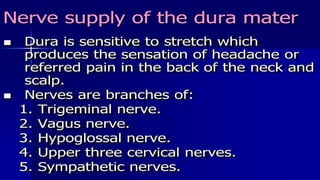
  • #6 The meninges primarily receives innervation by the vagus and trigeminal nerves, with some cervical spinal nerves contributing to a lesser degree. While the dura of the anterior cranial fossa is primarily innervated by the anterior and posterior ethmoidal nerve branches of the ophthalmic division of the trigeminal nerve, the dura of the middle cranial fossa receives nerve supply from a branch of the maxillary division of the trigeminal nerve. The tentorium cerebelli and the posterior third of the falx cerebri are primarily innervated by the tentorial nerve, which is also a branch of the ophthalmic division of the trigeminal nerve. The first three cervical spinal nerves, along with the cranial sympathetic trunk, mainly innervate the infratentorial dura of the posterior cranial fossa. The major arteries that supply the dura are derived from the internal carotid, vertebral, maxillary, ascending pharyngeal, lacrimal, occipital, and ethmoidal arteries.  The dural venous sinuses are venous channels formed where the periosteal and meningeal layers of the dura mater separate and serve as the major pathway for venous drainage from the brain.
  • #7 Dura Mater Folds : In some areas the inner layer of the dura mater detaches from the outer to form folds that divide the cranial cavity into widely communicating compartments. The main pleats are:  Sickle Cerebro : It is a median vertical sickle-shaped septum that occupies the longitudinal fissure of the brain, separating the two hemispheres.  Tent of Cerebellum : It projects forward as a transverse septum between the occipital lobes and the cerebellum. The tent cerebellum separates the posterior fossa from the middle cranial fossa, dividing the cranial cavity into a superior, or supratentorial, compartment and an inferior, or infratentorial, compartment. The free anterior edge of the tent cerebellum, called the tent notch, fits into the midbrain.  Sickle Cerebellum : Small vertical median septum, situated below the cerebellar tent between the two cerebellar hemispheres.  Saddle diaphragm : small horizontal blade that closes the sella turcica superiorly, leaving only a passage hole for the pituitary stalk.
  • #10 dip·​loe ˈdi-plə-ˌwē -plō-ˌē : cancellous bony tissue between the external and internal layers of the skull.
  • #13 Dural Nerve Supplied heavily by Branches of the trigeminal, vagus, and first three cervical nerves and branches from the sympathetic system pass to the dura. Numerous sensory endings are in the dura. The dura is sensitive to stretching, which produces the sensation of headache.
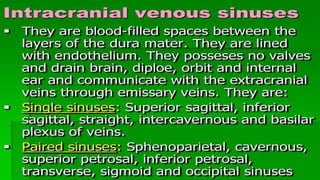
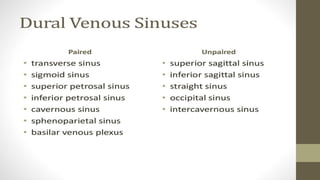
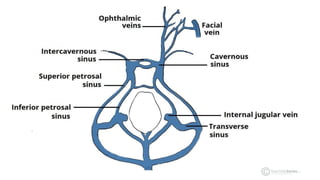
  • #16 Unpaired Sinuses There are five main unpaired dural venous sinuses. These typically lie along the sagittal midline of the brain. Superior Sagittal Sinus The superior sagittal sinus is the largest dural venous sinus. It receives venous blood from many tributaries of the cerebral hemispheres and superficial cortical veins. It extends from the frontal crest (of the frontal bone) to the internal occipital protuberance (of the occipital bone). Here, it combines with the straight and occipital sinuses to form the confluence of sinuses. This venous sinus lies within the superior border of the falx cerebri. Inferior Sagittal Sinus The inferior sagittal sinus is smaller than its superior counterpart and lies within the inferior margin of the falx cerebri. It receives venous drainage from the falx cerebri itself, and numerous small venous veins which drain the medial surface of the cerebral hemispheres. Posteriorly, it combines with the great cerebral vein to form the straight sinus. Straight Sinus The straight sinus forms from the convergence of the inferior sagittal sinus with the great cerebral vein. It is located where the falx cerebri meets the tentorium cerebelli. As it courses posteriorly, it receives venous tributaries from superior cerebellar veins before joining the confluence of sinuses. Occipital Sinus The occipital sinus is the smallest of the venous sinuses and is situated on the inner surface of the occipital bone within the falx cerebri. It is formed at the edge of the foramen magnum and empties into the confluence of sinuses at the internal occipital protuberance. Intercavernous Sinuses The intercavernous sinuses provide a connection between the right and left paired cavernous sinuses. They are variable in position and number, but usually consist of anterior and posterior channels – which lie either side of the pituitary stalk.
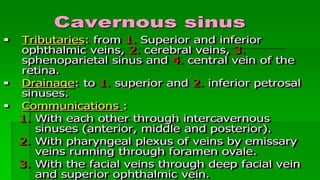
  • #17 Paired Sinuses There are five main paired dural venous sinuses, located on the left and right side of the cranial cavity. Transverse Sinuses The right and left transverse sinuses (also known as lateral sinuses) are formed at the confluence of sinuses by the convergence of the superior sagittal, straight and occipital sinuses. They pass along the posterolateral border of the tentorium cerebelli, along the internal surface of the occipital bone. As they approach the petrous part of the temporal bone, the transverse sinuses become the sigmoid sinuses. Sigmoid Sinuses The sigmoid sinuses are a continuation of the transverse sinuses at the internal surface of the petrous part of the temporal bone. They take an ‘S’ shaped course along the temporal and occipital bones. When they pass through the jugular foramen to leave the cranial cavity, the right and left sigmoid sinuses become the internal jugular veins. Cavernous Sinuses The cavernous sinuses are located within the sphenoid bone of the skull base. They receive drainage from the ophthalmic vein, superficial middle cerebral vein and sphenoparietal sinus. They are interconnected by the intercavernous sinuse and drained by the superior and inferior petrosal sinuses. Superior Petrosal Sinuses The superior petrosal sinuses drain the cavernous sinuses into the transverse sinuses. They begin at the posterior border of the cavernous sinus and pass along the internal surface of the petrous part of the temporal bone. They empty into the transverse sinus. In addition to draining the cavernous sinus, they also receive tributaries from inferior cerebral veins, cerebellar veins, and the labyrinth vein. Inferior Petrosal Sinuses The inferior petrosal sinuses assist in the drainage of the cavernous sinuses. They also begin at the posterior border of the cavernous sinus. They pass between the petrous part of the temporal bone and the basal part of the occipital bone – emptying into the internal jugular vein at the jugular foramen. The left and right sinuses are interconnected by the basilar venous plexus.
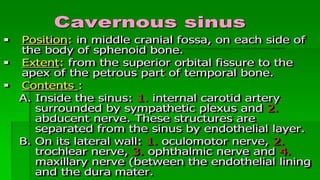
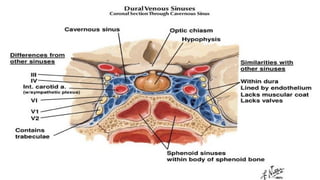
  • #19 The cavernous sinus is part of the brain's dural venous sinus and contains multiple neuro-vasculatures. It is situated bilaterally to the sella turcica and extends from the superior orbital fissure anteriorly to the petrous part of the temporal bone posteriorly, and is about 1 cm wide and 2 cm long. Cavernous sinus thrombosis (CST) refers to the formation of a clot within the cavernous sinus. This most common cause of CST is infection, which typically spreads from an extracranial location such as the orbit, paranasal sinuses, or the ‘danger zone’ of the face. Infection is able to spread in this manner due to the anastomosis between the facial vein and superior ophthalmic veins. Common clinical features include headache, unilateral periorbital oedema, proptosis (eye bulging), photophobia and cranial nerve palsies. The abducens nerve (CN VI) is most commonly affected. Treatment is typically with antibiotic therapy. Where the cause is infection, thrombosis of the cavernous sinus can rapidly progress to meningitis. Cavernous sinus thrombosis (CST) refers to the formation of a clot within the cavernous sinus. This most common cause of CST is infection, which typically spreads from an extracranial location such as the orbit, paranasal sinuses, or the ‘danger zone’ of the face. Infection is able to spread in this manner due to the anastomosis between the facial vein and superior ophthalmic veins. Common clinical features include headache, unilateral periorbital oedema, proptosis (eye bulging), photophobia and cranial nerve palsies. The abducens nerve (CN VI) is most commonly affected. Treatment is typically with antibiotic therapy. Where the cause is infection, thrombosis of the cavernous sinus can rapidly progress to meningitis.
  • #20 Cavernous sinus is the major venous sinus of the brain that is bordered by the temporal bone and sphenoid bone of the skull. If the sinus is infected, it causes the blood, within sinus, to clot which causes cavernous sinus thrombosis which affects the structure passing through it. In cavernous sinus, nuclei of cranial nerve III (occulomotor) , IV (trochlear), VI(Abduces) and V (trigeminal) especially ophthalmic branch and maxillary branch are found and if infected for a long period manifest in the loss of function of the specific muscle and glands.
  • #22 Your arachnoid mater, the middle layer of your meninges, lies directly below your dura mater. It's a thin layer that lays between your dura mater and pia mater. It doesn't contain blood vessels or nerves. These projections are called arachnoid villi or arachnoid granulation, depending on their size. Arachnoid villi are microscopic, whereas granulation is visible to the naked eye11). They function as a passive filtration system for CSF, providing a pathway from subarachnoid space into the venous system. The arachnoid mater is the middle layer of the meninges, lying directly underneath the dura mater. It consists of layers of connective tissue, is avascular, and does not receive any innervation. Underneath the arachnoid is a space known as the sub-arachnoid space. It contains cerebrospinal fluid, which acts to cushion the brain. Small projections of arachnoid mater into the dura (known as arachnoid granulations) allow CSF to re-enter the circulation via the dural venous sinuses.  By TeachMeSeries Ltd (2023) The pia mater is located underneath the sub-arachnoid space. It is very thin, and tightly adhered to the surface of the brain and spinal cord. It is the only covering to follow the contours of the brain (the gyri and fissures). Like the dura mater, it is highly vascularised, with blood vessels perforating through the membrane to supply the underlying neural tissue.
  • #24 Arachnoid granulations : in some points of the arachnoid, small tufts are formed that penetrate inside the dura mater sinuses, constituting the arachnoid granulations, more abundant in the superior sagittal sinus. Arachnoid granulations carry small extensions of the subarachnoid space, true diverticula of this space, in which the CSF is separated from the blood only by the sinus endothelium and a thin layer of arachnoid. They are structures admirably adapted to the absorption of liquor, which at this point, goes into the blood. These projections are called arachnoid villi or arachnoid granulation, depending on their size. Arachnoid villi are microscopic, whereas granulation is visible to the naked eye11). They function as a passive filtration system for CSF, providing a pathway from subarachnoid space into the venous system. Aberrant arachnoid granulations, also known as arachnoid pits, are arachnoid granulations that penetrated the dura but failed to migrate normally in the venous sinus. They are most often located in the greater wing of the sphenoid bone and may be seen in idiopathic intracranial hypertension.
  • #25 Diploeic veins vs emissary veins ; What is the difference between diploic and emissary veins? Diploic ones stay in the skull. Emissary veins are “emissary” — they go through and through the skull to end up in the soft tissues. When a diploic vein exits the skull it becomes an emissary vein.
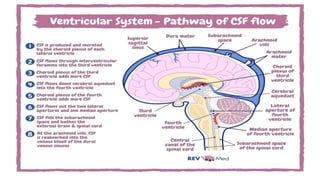
  • #26 Cerebrospinal fluid (CSF) is an ultra filtrate of plasma contained within the ventricles of the brain and the subarachnoid spaces of the cranium and spine. It performs vital functions, including providing nourishment, waste removal, and protection to the brain. 150 ml volume
  • #27  The pia mater is the only layer that clings tightly to the brain and follows all of its convolutions.
  • #36 Intracranial hemorrhage encompasses four broad types of hemorrhage: epidural hemorrhage, subdural hemorrhage, subarachnoid hemorrhage, and intraparenchymal hemorrhage. Clinical Relevance: Extradural and Subdural Haematomas A haematoma is a collection of blood. As the cranial cavity is effectively a closed box, a haematoma can cause a rapid increase in intra-cranial pressure. Death will result if untreated. There are two types of haematomas involving the dura mater: Extradural – arterial blood collects between the skull and periosteal layer of the dura. The causative vessel is usually the middle meningeal artery, tearing as a consequence of brain trauma. Subdural – venous blood collects between the dura and the arachnoid mater. It results from damage to cerebral veins as they empty into the dural venous sinuses.
  • #37 Bridging veins drain the venous blood from the cerebral cortex into the superior sagittal sinus (SSS) and doing so they bridge the subdural space.
  • #39 Rhinorrhea (runny nose) is mucus (snot) dripping or “running” out of your nose. It has several possible causes, such as cold and/or dry air, allergies or the common cold. A related condition is rhinitis. A cerebrospinal fluid (CSF) rhinorrhoea occurs when there is a fistula between the dura and the skull base and discharge of CSF from the nose. CSF rhinorrhea or liquorrhoea commonly occurs following head trauma (fronto-basal skull fractures), as a result of intracranial surgery, or destruction lesions.