SUB ARACHNOID HEMORRHAGE
Dr. Abhinov K
MBBS DNB FNB
50-yr / f known smoker and ethanolic, Htn on irregular treatment,
had sudden headache and brief loss OF consciousness in the office
while doing work. Colleagues shifted her immediately to the
hospital.
On examination in ER
• she is drowsy but arousable and following commands, GCS-E4V4M6
• BP :186/92 mm Hg.
• Stroke
• Seizures
• Syncope
• Migraine
SUB ARACHNOID HEMORRHAGE
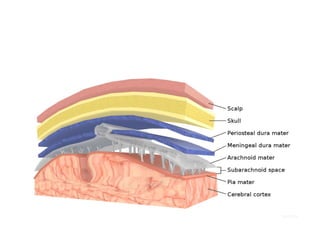
• The term subarachnoid hemorrhage (SAH)
refers to extravasation of blood into the
subarachnoid space between the pia and
arachnoid membranes.
• It is a neurological emergency.it is associated
with significant morbidity and mortality.
• 12% pts die before reaching hospital, 25% die
in the hospital and 50% of survivors left with
significant deficits.
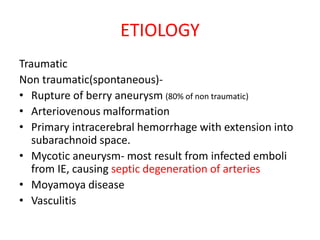
ETIOLOGY
Traumatic
Non traumatic(spontaneous)-
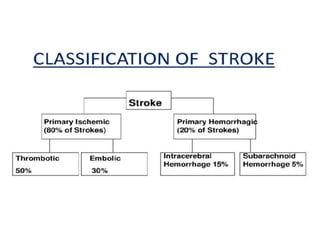
• Rupture of berry aneurysm (80% of non traumatic)
• Arteriovenous malformation
• Primary intracerebral hemorrhage with extension into
subarachnoid space.
• Mycotic aneurysm- most result from infected emboli
from IE, causing septic degeneration of arteries
• Moyamoya disease
• Vasculitis
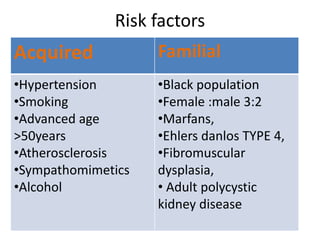
Risk factors
Acquired Familial
•Hypertension
•Smoking
•Advanced age
>50years
•Atherosclerosis
•Sympathomimetics
•Alcohol
•Black population
•Female :male 3:2
•Marfans,
•Ehlers danlos TYPE 4,
•Fibromuscular
dysplasia,
• Adult polycystic
kidney disease
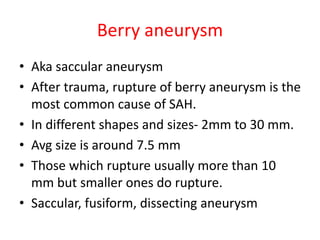
Berry aneurysm
• Aka saccular aneurysm
• After trauma, rupture of berry aneurysm is the
most common cause of SAH.
• In different shapes and sizes- 2mm to 30 mm.
• Avg size is around 7.5 mm
• Those which rupture usually more than 10
mm but smaller ones do rupture.
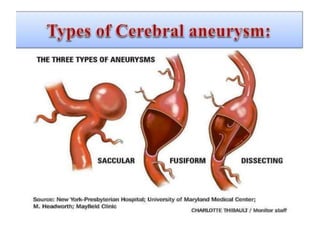
• Saccular, fusiform, dissecting aneurysm
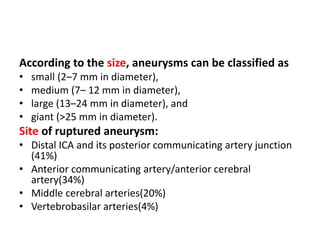
According to the size, aneurysms can be classified as
• small (2–7 mm in diameter),
• medium (7– 12 mm in diameter),
• large (13–24 mm in diameter), and
• giant (>25 mm in diameter).
Site of ruptured aneurysm:
• Distal ICA and its posterior communicating artery junction
(41%)
• Anterior communicating artery/anterior cerebral
artery(34%)
• Middle cerebral arteries(20%)
• Vertebrobasilar arteries(4%)
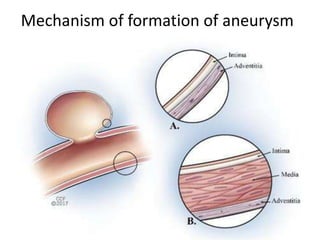
Mechanism of formation of aneurysm
Two theories
• Developmental defects in tunica media—
weakness in vessel wall causing bulging of
intima covered only with adventetia
• Hemodynamic forces causing focal destruction
of intima at bifurcation and branching of
arteries.
• The sac gradually enlarges and subsequently
brusts.
• Aneurysm site and size are important in
predicting risk of rupture-
Those greater than 7 mm in diameter
Location at the top of basialr artery
At the origin of posterior communicating
artery
Clinical manifestations
The signs and symptoms of subarachnoid hemorrhage are
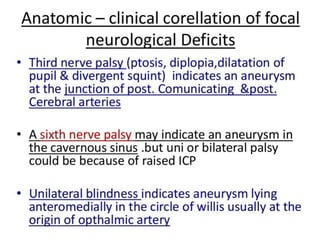
• Headache (48%)- worst headache
• Dizziness (10%)
• Orbital pain (7%)
• Diplopia (4%)
• Visual loss (4%)
• Loss of consciousness
Signs and symptoms present prior to rupture of aneurysm- these are due to
aneurysm size expansion, sentinel bleeds,
• Sensory or motor disturbance (6%)
• Seizures (4%)
• Ptosis (3%)
• Bruits (3%)
• Dysphasia (2%)
Clinical manifestations cont
• Aneurysm rupture usually occurs while patient
is active.
• In few cases it occurs when patient straining
to pass stool, lifting heavy weights, and some
other sustained exertion.
• In patients who survive initial rupture, the
most feared complication is rebleed which
may occur at any time from few minutes to 3
weeks
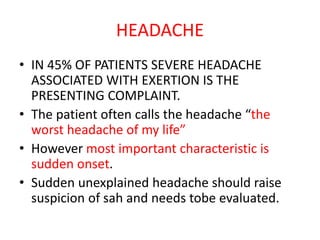
HEADACHE
• IN 45% OF PATIENTS SEVERE HEADACHE
ASSOCIATED WITH EXERTION IS THE
PRESENTING COMPLAINT.
• The patient often calls the headache “the
worst headache of my life”
• However most important characteristic is
sudden onset.
• Sudden unexplained headache should raise
suspicion of sah and needs tobe evaluated.
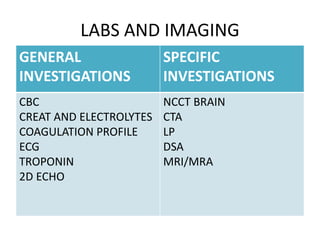
LABS AND IMAGING
GENERAL
INVESTIGATIONS
SPECIFIC
INVESTIGATIONS
CBC
CREAT AND ELECTROLYTES
COAGULATION PROFILE
ECG
TROPONIN
2D ECHO
NCCT BRAIN
CTA
LP
DSA
MRI/MRA
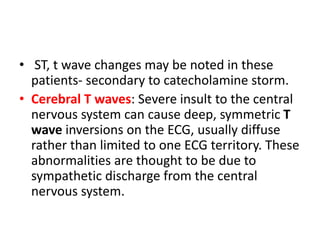
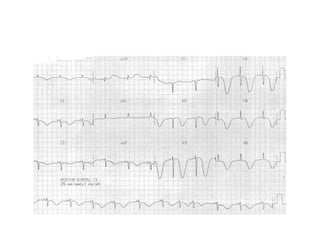
• ST, t wave changes may be noted in these
patients- secondary to catecholamine storm.
• Cerebral T waves: Severe insult to the central
nervous system can cause deep, symmetric T
wave inversions on the ECG, usually diffuse
rather than limited to one ECG territory. These
abnormalities are thought to be due to
sympathetic discharge from the central
nervous system.
Investigations to confirm diagnosis
• NCCT BRAIN
• CTA
• LP
• DSA
• MRI/MRA
• CEREBRAL CATHETER ANGIOGRAPHY
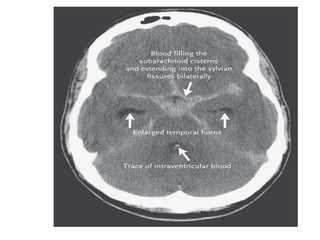
CT BRAIN
• In the first 3 days after the onset of symptoms, sensitivity is
close to 100% subsequently declines to 50% by 5 to 7 days
• If CT is negative but clinical suspicion is high, additional
tests are indicated.
• CT may also show a space-occupying hematoma or acute
hydrocephalus — consequences of aneurysm rupture, this
needs immediate surgical attention.
CT ANGIOGRAPHY
• THIS is now commonly performed at the time of the initial CT,
• IT CAN IDENTIFY aneurysms EVEN as small as 2 mm
• can provide the essential information in the case of patients who
present in extremes with a large intraparenchymal clot that is
thought to require immediate surgical evacuation.
• What if CT IS NORMAL ? BUT A STRONG SUSPICION
OF SAH ?
LUMBAR PUNCTURE
• LP is mandatory if NCCT is negative and strong suspicion of SAH-grade 1 b
• DONE IN CT NEGATIVE PATIENTS
• POSITIVE AFTER 6-12 HRS
• Elevated opening pressure
• XANTHOCHROMIA (YELLOW CSF DUE TO HEMOGLOBIN) OR BLOOD,
indicates that blood is present in csf for more than 2 hours
• Elevated RBC count in CSF that does not diminish from tube 1 to 4-
differentiates traumatic tap
• ALBUMINOCYTOLOGICAL DISSOCIATION
Digital subtraction angiography
• The standard for diagnosing an aneurysm and for defining
relevant anatomy for treatment
• The combination of three-dimensional angiography
reconstructions with two-dimensional DSA is more
sensitive for detecting aneurysms
• COMBINATION provides more detailed anatomical data
than digital subtraction angiography alone and also helps in
planning treatment.
MR AND MRA
INDICATED MAINLY IN CONDITIONS LIKE
• NEGATIVE CT
• IN PREGNANCY : NO RADIATION
SENSITIVITY OF MR IS BASED ON SIZE OF ANEURYSM -
• >5MM : 85-100 % SENSITIVITY
• <5MM : 56% SENSITIVITY
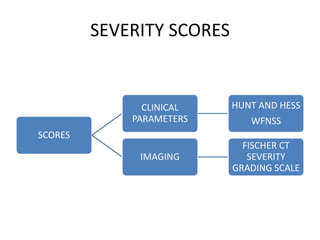
SEVERITY SCORES
SCORES
CLINICAL
PARAMETERS
HUNT AND HESS
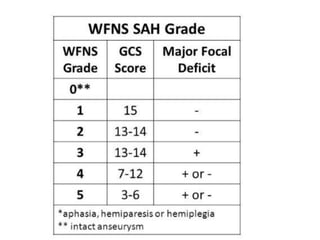
WFNSS
IMAGING
FISCHER CT
SEVERITY
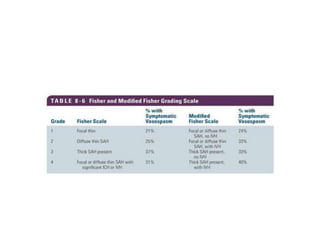
GRADING SCALE
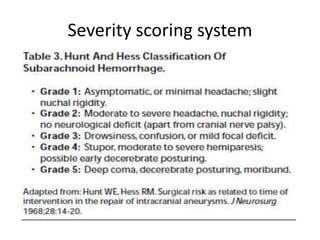
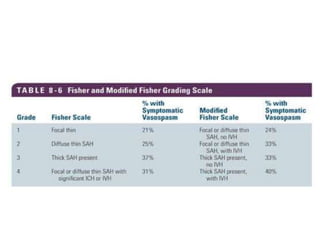
Severity scoring system
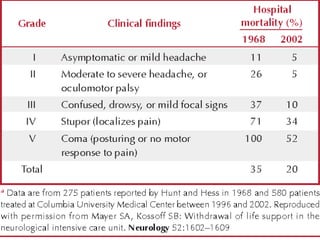
• Clinical and radiological grading system
• Clinical gardes are better at predicting outcome
and radiological garding is better at predicting
vasospasam.
• None of the grading system have high sensitivity
and specificity
• Grading inaccurate if there is acute
hydrocephalus, post ictal state and medications
• Half of patients with poor grades on admission
have good outcomes.
MANAGMENT
• General supportive management
• Disease specific management.
Managment
Supportive management
• Assess and support airway, breathing and circulation
Treat hypertension
• BP CONTROL : target SBP<140 mmhg , > 150 a/w increased
risk of rebleeding .
• Use labetalol, esmolol, Avoid nitrates( increases ICP).
• Pain control- opioids- may impair monitoring of neurological
status.
Steroids
• used by some to decrease meningeal irritation + oedema ,
but it has no evidence
• Antifibrinolytics :short term <72hrs can be used but no significant
improvement in mortality or morbidity, increased risk of dvt and
DCI
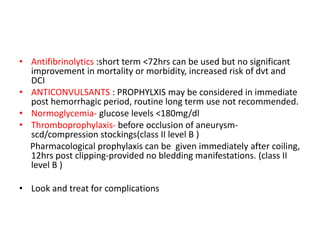
• ANTICONVULSANTS : PROPHYLXIS may be considered in immediate
post hemorrhagic period, routine long term use not recommended.
• Normoglycemia- glucose levels <180mg/dl
• Thromboprophylaxis- before occlusion of aneurysm-
scd/compression stockings(class II level B )
Pharmacological prophylaxis can be given immediately after coiling,
12hrs post clipping-provided no bledding manifestations. (class II
level B )
• Look and treat for complications
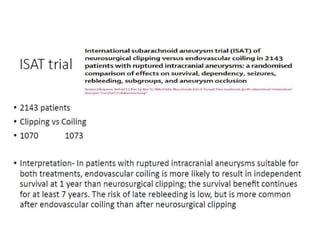
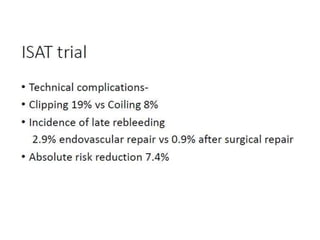
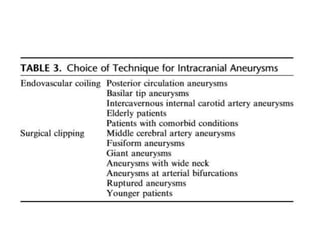
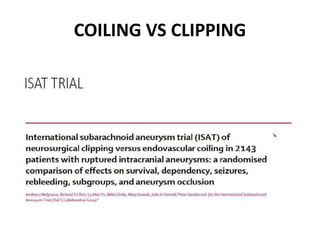
COILING VS CLIPPING
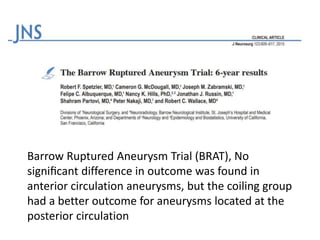
Barrow Ruptured Aneurysm Trial (BRAT), No
significant difference in outcome was found in
anterior circulation aneurysms, but the coiling group
had a better outcome for aneurysms located at the
posterior circulation
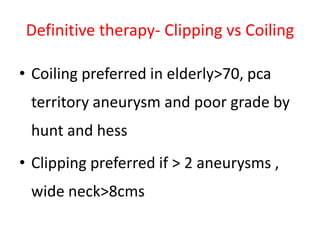
Definitive therapy- Clipping vs Coiling
• Coiling preferred in elderly>70, pca
territory aneurysm and poor grade by
hunt and hess
• Clipping preferred if > 2 aneurysms ,
wide neck>8cms
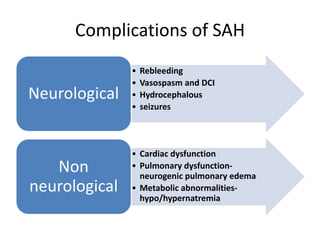
Complications of SAH
• Rebleeding
• Vasospasm and DCI
• Hydrocephalous
• seizures
Neurological
• Cardiac dysfunction
• Pulmonary dysfunction-
neurogenic pulmonary edema
• Metabolic abnormalities-
hypo/hypernatremia
Non
neurological
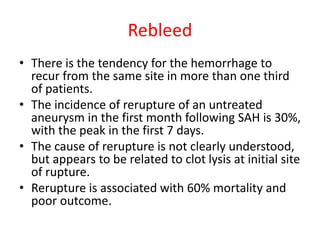
Rebleed
• There is the tendency for the hemorrhage to
recur from the same site in more than one third
of patients.
• The incidence of rerupture of an untreated
aneurysm in the first month following SAH is 30%,
with the peak in the first 7 days.
• The cause of rerupture is not clearly understood,
but appears to be related to clot lysis at initial site
of rupture.
• Rerupture is associated with 60% mortality and
poor outcome.
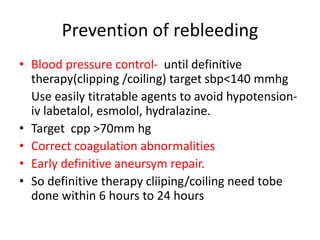
Prevention of rebleeding
• Blood pressure control- until definitive
therapy(clipping /coiling) target sbp<140 mmhg
Use easily titratable agents to avoid hypotension-
iv labetalol, esmolol, hydralazine.
• Target cpp >70mm hg
• Correct coagulation abnormalities
• Early definitive aneursym repair.
• So definitive therapy cliiping/coiling need tobe
done within 6 hours to 24 hours
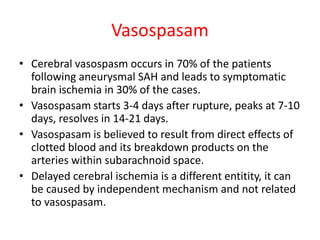
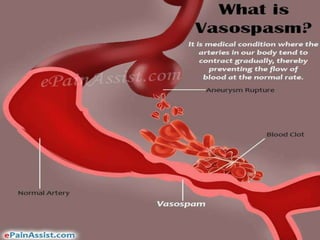
Vasospasam
• Cerebral vasospasm occurs in 70% of the patients
following aneurysmal SAH and leads to symptomatic
brain ischemia in 30% of the cases.
• Vasospasam starts 3-4 days after rupture, peaks at 7-10
days, resolves in 14-21 days.
• Vasospasam is believed to result from direct effects of
clotted blood and its breakdown products on the
arteries within subarachnoid space.
• Delayed cerebral ischemia is a different entitity, it can
be caused by independent mechanism and not related
to vasospasam.
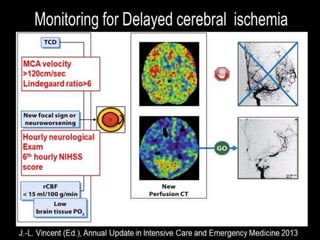
DELAYED CEREBRAL ISCHEMIA
• Any delayed neurological deterioration presumed to be
related to ischemia that persists for more than 1 hour and
cannot be explained differently -has been defined as DCI.
• Presents after day 3 and peaks at day 7 after aneurysmal
rupture.
• Acute deterioration in consciousness or new focal
neurological defects.
• Vasospasam of cerebral vessels is the main cause.
• But this is not the only cause for DCI because angiographic
vasospasam is seen in 70% of patients but DCI is seen in
only 20-30% of patients- so terms cannot be used
interchangably
• Nimodipine to prevent DCI, once established dosent work
Managment
Prevention of vasospasam
• Nimodipine is the preferred agent (Grade 1 A)
May improve outcome without reducing vasospasam.
MOA- neuroprotection via reduction of calcium dependent excitotoxicity,
diminished platelet aggregation, dilation of small arteries
60mg 4th hourly orally – start at the earliest and for 21 days.
Can cause hypotension- reduce dose and intervals
• Avoiding hypovolemia and hypotension.
• Removal of blood clot at the time of aneurysm
clipping
Hemodynamic Augmentation
• HTN , Hypervolemia, Hemodilution- TRIPLE H– no
longer recommended
Present recommendations:
• Induction of HTN by vasopressors (noradr, dopa)
if cardiac status allows (Grade 1 B)
• Euvolemia instead of hypervolemia (Grade 1 B)
• Hypervolemia- CCF, Pulmo, cerebral edema
• Hemodilution- reduces o2 carrying capacity
Hence not
recommended
• Magnesium sulphate- Antagonist to calcium so
reduces vasospasam.
• Various doses were used- 4, 6, 8, 12 gm
• MASH 2 (Lancet)- magnesium in aneurysmal SAH
• IMASH- IV magnesium in aneurysmal SAH
Both trials showed no use of magnesium for prevention
of vasospasam,
• Recent metanalysis also dosent support its use
STATINS
• MOA- induction of vascular NOS-
vasodilatation.
• Several RCT showed mixed results
• STASH trial Published in LANCET
Largest RCT 800 patients were enrolled in
multicentre phase III trial of simvastatin 40 mg
or placebo, which found no short or long term
benefit of the drug
Other therapies
Endothelin Receptor antagonist-
• Conscious 2, Conscious 3
• CLAZOSENTAN- not recommended as
complications like pulmonary edema, anemia
PDEI- sildenafil- still no confirmed benefits
Intrathecal thrombolysis-
Meta analysis have shown benefit but none of the studies are
RCT
Ballon angioplasty-
• Symptomatic focal vasospasam of larger cerebral
arteries refractory to hemodynamic
augmentation.
• Limitations- only for Large arteries
Intra arterial administration of vasodilators-
• Diffuse vasospasam of smaller arteries
• Nicardipine, milrinone, papaverine, nimodipine,
verapamil.
Seizures
Risk factors-
• Thick subarachnoid clot
• Intra cerebral hemorrhage
• Delayed infraction
• Aneurysm in middle cerebral artery
Rx-
• use of prophylactic anticonvulsants may be considered in the
immediate post hemorrhagic period (class II , Level B )
• Routine long term use of anticonvulsants is not recommended
(class III , Level B ), but may be considered if they have risk factors
for delayed seizure disorder .(class II , Level B )
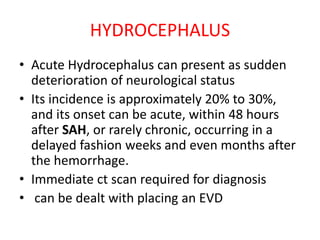
HYDROCEPHALUS
• Acute Hydrocephalus can present as sudden
deterioration of neurological status
• Its incidence is approximately 20% to 30%,
and its onset can be acute, within 48 hours
after SAH, or rarely chronic, occurring in a
delayed fashion weeks and even months after
the hemorrhage.
• Immediate ct scan required for diagnosis
• can be dealt with placing an EVD
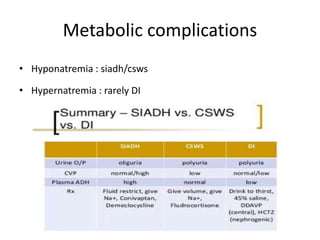
Metabolic complications
• Hyponatremia : siadh/csws
• Hypernatremia : rarely DI
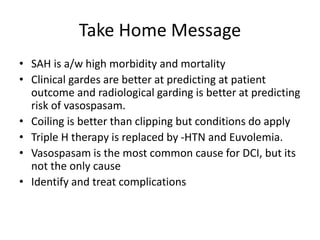
Take Home Message
• SAH is a/w high morbidity and mortality
• Clinical gardes are better at predicting at patient
outcome and radiological garding is better at predicting
risk of vasospasam.
• Coiling is better than clipping but conditions do apply
• Triple H therapy is replaced by -HTN and Euvolemia.
• Vasospasam is the most common cause for DCI, but its
not the only cause
• Identify and treat complications
SUBARACHNOID HEMORRHAGE

SUBARACHNOID HEMORRHAGE

  • 1.
    SUB ARACHNOID HEMORRHAGE Dr.Abhinov K MBBS DNB FNB
  • 2.
    50-yr / fknown smoker and ethanolic, Htn on irregular treatment, had sudden headache and brief loss OF consciousness in the office while doing work. Colleagues shifted her immediately to the hospital. On examination in ER • she is drowsy but arousable and following commands, GCS-E4V4M6 • BP :186/92 mm Hg.
  • 3.
    • Stroke • Seizures •Syncope • Migraine
  • 5.
    SUB ARACHNOID HEMORRHAGE •The term subarachnoid hemorrhage (SAH) refers to extravasation of blood into the subarachnoid space between the pia and arachnoid membranes. • It is a neurological emergency.it is associated with significant morbidity and mortality. • 12% pts die before reaching hospital, 25% die in the hospital and 50% of survivors left with significant deficits.
  • 7.
    ETIOLOGY Traumatic Non traumatic(spontaneous)- • Ruptureof berry aneurysm (80% of non traumatic) • Arteriovenous malformation • Primary intracerebral hemorrhage with extension into subarachnoid space. • Mycotic aneurysm- most result from infected emboli from IE, causing septic degeneration of arteries • Moyamoya disease • Vasculitis
  • 8.
    Risk factors Acquired Familial •Hypertension •Smoking •Advancedage >50years •Atherosclerosis •Sympathomimetics •Alcohol •Black population •Female :male 3:2 •Marfans, •Ehlers danlos TYPE 4, •Fibromuscular dysplasia, • Adult polycystic kidney disease
  • 9.
    Berry aneurysm • Akasaccular aneurysm • After trauma, rupture of berry aneurysm is the most common cause of SAH. • In different shapes and sizes- 2mm to 30 mm. • Avg size is around 7.5 mm • Those which rupture usually more than 10 mm but smaller ones do rupture. • Saccular, fusiform, dissecting aneurysm
  • 11.
    According to thesize, aneurysms can be classified as • small (2–7 mm in diameter), • medium (7– 12 mm in diameter), • large (13–24 mm in diameter), and • giant (>25 mm in diameter). Site of ruptured aneurysm: • Distal ICA and its posterior communicating artery junction (41%) • Anterior communicating artery/anterior cerebral artery(34%) • Middle cerebral arteries(20%) • Vertebrobasilar arteries(4%)
  • 12.
  • 13.
    Two theories • Developmentaldefects in tunica media— weakness in vessel wall causing bulging of intima covered only with adventetia • Hemodynamic forces causing focal destruction of intima at bifurcation and branching of arteries. • The sac gradually enlarges and subsequently brusts.
  • 14.
    • Aneurysm siteand size are important in predicting risk of rupture- Those greater than 7 mm in diameter Location at the top of basialr artery At the origin of posterior communicating artery
  • 15.
    Clinical manifestations The signsand symptoms of subarachnoid hemorrhage are • Headache (48%)- worst headache • Dizziness (10%) • Orbital pain (7%) • Diplopia (4%) • Visual loss (4%) • Loss of consciousness Signs and symptoms present prior to rupture of aneurysm- these are due to aneurysm size expansion, sentinel bleeds, • Sensory or motor disturbance (6%) • Seizures (4%) • Ptosis (3%) • Bruits (3%) • Dysphasia (2%)
  • 16.
    Clinical manifestations cont •Aneurysm rupture usually occurs while patient is active. • In few cases it occurs when patient straining to pass stool, lifting heavy weights, and some other sustained exertion. • In patients who survive initial rupture, the most feared complication is rebleed which may occur at any time from few minutes to 3 weeks
  • 17.
    HEADACHE • IN 45%OF PATIENTS SEVERE HEADACHE ASSOCIATED WITH EXERTION IS THE PRESENTING COMPLAINT. • The patient often calls the headache “the worst headache of my life” • However most important characteristic is sudden onset. • Sudden unexplained headache should raise suspicion of sah and needs tobe evaluated.
  • 19.
    LABS AND IMAGING GENERAL INVESTIGATIONS SPECIFIC INVESTIGATIONS CBC CREATAND ELECTROLYTES COAGULATION PROFILE ECG TROPONIN 2D ECHO NCCT BRAIN CTA LP DSA MRI/MRA
  • 20.
    • ST, twave changes may be noted in these patients- secondary to catecholamine storm. • Cerebral T waves: Severe insult to the central nervous system can cause deep, symmetric T wave inversions on the ECG, usually diffuse rather than limited to one ECG territory. These abnormalities are thought to be due to sympathetic discharge from the central nervous system.
  • 22.
    Investigations to confirmdiagnosis • NCCT BRAIN • CTA • LP • DSA • MRI/MRA • CEREBRAL CATHETER ANGIOGRAPHY
  • 23.
    CT BRAIN • Inthe first 3 days after the onset of symptoms, sensitivity is close to 100% subsequently declines to 50% by 5 to 7 days • If CT is negative but clinical suspicion is high, additional tests are indicated. • CT may also show a space-occupying hematoma or acute hydrocephalus — consequences of aneurysm rupture, this needs immediate surgical attention.
  • 25.
    CT ANGIOGRAPHY • THISis now commonly performed at the time of the initial CT, • IT CAN IDENTIFY aneurysms EVEN as small as 2 mm • can provide the essential information in the case of patients who present in extremes with a large intraparenchymal clot that is thought to require immediate surgical evacuation. • What if CT IS NORMAL ? BUT A STRONG SUSPICION OF SAH ?
  • 26.
    LUMBAR PUNCTURE • LPis mandatory if NCCT is negative and strong suspicion of SAH-grade 1 b • DONE IN CT NEGATIVE PATIENTS • POSITIVE AFTER 6-12 HRS • Elevated opening pressure • XANTHOCHROMIA (YELLOW CSF DUE TO HEMOGLOBIN) OR BLOOD, indicates that blood is present in csf for more than 2 hours • Elevated RBC count in CSF that does not diminish from tube 1 to 4- differentiates traumatic tap • ALBUMINOCYTOLOGICAL DISSOCIATION
  • 27.
    Digital subtraction angiography •The standard for diagnosing an aneurysm and for defining relevant anatomy for treatment • The combination of three-dimensional angiography reconstructions with two-dimensional DSA is more sensitive for detecting aneurysms • COMBINATION provides more detailed anatomical data than digital subtraction angiography alone and also helps in planning treatment.
  • 28.
    MR AND MRA INDICATEDMAINLY IN CONDITIONS LIKE • NEGATIVE CT • IN PREGNANCY : NO RADIATION SENSITIVITY OF MR IS BASED ON SIZE OF ANEURYSM - • >5MM : 85-100 % SENSITIVITY • <5MM : 56% SENSITIVITY
  • 29.
    SEVERITY SCORES SCORES CLINICAL PARAMETERS HUNT ANDHESS WFNSS IMAGING FISCHER CT SEVERITY GRADING SCALE
  • 30.
  • 34.
    • Clinical andradiological grading system • Clinical gardes are better at predicting outcome and radiological garding is better at predicting vasospasam. • None of the grading system have high sensitivity and specificity • Grading inaccurate if there is acute hydrocephalus, post ictal state and medications • Half of patients with poor grades on admission have good outcomes.
  • 35.
    MANAGMENT • General supportivemanagement • Disease specific management.
  • 36.
    Managment Supportive management • Assessand support airway, breathing and circulation Treat hypertension • BP CONTROL : target SBP<140 mmhg , > 150 a/w increased risk of rebleeding . • Use labetalol, esmolol, Avoid nitrates( increases ICP). • Pain control- opioids- may impair monitoring of neurological status. Steroids • used by some to decrease meningeal irritation + oedema , but it has no evidence
  • 37.
    • Antifibrinolytics :shortterm <72hrs can be used but no significant improvement in mortality or morbidity, increased risk of dvt and DCI • ANTICONVULSANTS : PROPHYLXIS may be considered in immediate post hemorrhagic period, routine long term use not recommended. • Normoglycemia- glucose levels <180mg/dl • Thromboprophylaxis- before occlusion of aneurysm- scd/compression stockings(class II level B ) Pharmacological prophylaxis can be given immediately after coiling, 12hrs post clipping-provided no bledding manifestations. (class II level B ) • Look and treat for complications
  • 38.
  • 41.
    Barrow Ruptured AneurysmTrial (BRAT), No significant difference in outcome was found in anterior circulation aneurysms, but the coiling group had a better outcome for aneurysms located at the posterior circulation
  • 42.
    Definitive therapy- Clippingvs Coiling • Coiling preferred in elderly>70, pca territory aneurysm and poor grade by hunt and hess • Clipping preferred if > 2 aneurysms , wide neck>8cms
  • 44.
    Complications of SAH •Rebleeding • Vasospasm and DCI • Hydrocephalous • seizures Neurological • Cardiac dysfunction • Pulmonary dysfunction- neurogenic pulmonary edema • Metabolic abnormalities- hypo/hypernatremia Non neurological
  • 45.
    Rebleed • There isthe tendency for the hemorrhage to recur from the same site in more than one third of patients. • The incidence of rerupture of an untreated aneurysm in the first month following SAH is 30%, with the peak in the first 7 days. • The cause of rerupture is not clearly understood, but appears to be related to clot lysis at initial site of rupture. • Rerupture is associated with 60% mortality and poor outcome.
  • 46.
    Prevention of rebleeding •Blood pressure control- until definitive therapy(clipping /coiling) target sbp<140 mmhg Use easily titratable agents to avoid hypotension- iv labetalol, esmolol, hydralazine. • Target cpp >70mm hg • Correct coagulation abnormalities • Early definitive aneursym repair. • So definitive therapy cliiping/coiling need tobe done within 6 hours to 24 hours
  • 47.
    Vasospasam • Cerebral vasospasmoccurs in 70% of the patients following aneurysmal SAH and leads to symptomatic brain ischemia in 30% of the cases. • Vasospasam starts 3-4 days after rupture, peaks at 7-10 days, resolves in 14-21 days. • Vasospasam is believed to result from direct effects of clotted blood and its breakdown products on the arteries within subarachnoid space. • Delayed cerebral ischemia is a different entitity, it can be caused by independent mechanism and not related to vasospasam.
  • 50.
    DELAYED CEREBRAL ISCHEMIA •Any delayed neurological deterioration presumed to be related to ischemia that persists for more than 1 hour and cannot be explained differently -has been defined as DCI. • Presents after day 3 and peaks at day 7 after aneurysmal rupture. • Acute deterioration in consciousness or new focal neurological defects. • Vasospasam of cerebral vessels is the main cause. • But this is not the only cause for DCI because angiographic vasospasam is seen in 70% of patients but DCI is seen in only 20-30% of patients- so terms cannot be used interchangably • Nimodipine to prevent DCI, once established dosent work
  • 52.
    Managment Prevention of vasospasam •Nimodipine is the preferred agent (Grade 1 A) May improve outcome without reducing vasospasam. MOA- neuroprotection via reduction of calcium dependent excitotoxicity, diminished platelet aggregation, dilation of small arteries 60mg 4th hourly orally – start at the earliest and for 21 days. Can cause hypotension- reduce dose and intervals • Avoiding hypovolemia and hypotension. • Removal of blood clot at the time of aneurysm clipping
  • 53.
    Hemodynamic Augmentation • HTN, Hypervolemia, Hemodilution- TRIPLE H– no longer recommended Present recommendations: • Induction of HTN by vasopressors (noradr, dopa) if cardiac status allows (Grade 1 B) • Euvolemia instead of hypervolemia (Grade 1 B) • Hypervolemia- CCF, Pulmo, cerebral edema • Hemodilution- reduces o2 carrying capacity Hence not recommended
  • 54.
    • Magnesium sulphate-Antagonist to calcium so reduces vasospasam. • Various doses were used- 4, 6, 8, 12 gm • MASH 2 (Lancet)- magnesium in aneurysmal SAH • IMASH- IV magnesium in aneurysmal SAH Both trials showed no use of magnesium for prevention of vasospasam, • Recent metanalysis also dosent support its use
  • 55.
    STATINS • MOA- inductionof vascular NOS- vasodilatation. • Several RCT showed mixed results • STASH trial Published in LANCET Largest RCT 800 patients were enrolled in multicentre phase III trial of simvastatin 40 mg or placebo, which found no short or long term benefit of the drug
  • 56.
    Other therapies Endothelin Receptorantagonist- • Conscious 2, Conscious 3 • CLAZOSENTAN- not recommended as complications like pulmonary edema, anemia PDEI- sildenafil- still no confirmed benefits Intrathecal thrombolysis- Meta analysis have shown benefit but none of the studies are RCT
  • 57.
    Ballon angioplasty- • Symptomaticfocal vasospasam of larger cerebral arteries refractory to hemodynamic augmentation. • Limitations- only for Large arteries Intra arterial administration of vasodilators- • Diffuse vasospasam of smaller arteries • Nicardipine, milrinone, papaverine, nimodipine, verapamil.
  • 58.
    Seizures Risk factors- • Thicksubarachnoid clot • Intra cerebral hemorrhage • Delayed infraction • Aneurysm in middle cerebral artery Rx- • use of prophylactic anticonvulsants may be considered in the immediate post hemorrhagic period (class II , Level B ) • Routine long term use of anticonvulsants is not recommended (class III , Level B ), but may be considered if they have risk factors for delayed seizure disorder .(class II , Level B )
  • 59.
    HYDROCEPHALUS • Acute Hydrocephaluscan present as sudden deterioration of neurological status • Its incidence is approximately 20% to 30%, and its onset can be acute, within 48 hours after SAH, or rarely chronic, occurring in a delayed fashion weeks and even months after the hemorrhage. • Immediate ct scan required for diagnosis • can be dealt with placing an EVD
  • 60.
    Metabolic complications • Hyponatremia: siadh/csws • Hypernatremia : rarely DI
  • 61.
    Take Home Message •SAH is a/w high morbidity and mortality • Clinical gardes are better at predicting at patient outcome and radiological garding is better at predicting risk of vasospasam. • Coiling is better than clipping but conditions do apply • Triple H therapy is replaced by -HTN and Euvolemia. • Vasospasam is the most common cause for DCI, but its not the only cause • Identify and treat complications

Editor's Notes

  • #13 All arteries and veins contain three layers. The innermost layer is called the tunica intima. The muscular middle layer is called the tunica media, and the outermost layer is called the tunica adventitia
  • #51 That is progressive neurological deterioration lasting for >one hr and not explained by bleed, hypotension, seizures, hydrocephalus
  • #54 HTN- increase 20% from baseline