Steel Portal Frame
Building With
Overhead Runway
Crane
By
Salih Al-Jumaili
Typical Cladding System
• Typically spans 3 meters.
• Formed from profile coated
steel.
• Incorporate insulations to
meet regulations of
buildings requirement.
Secondary members are
needed which transfer the
loading to rafters and
columns, and they called:
• For the roofs, these members are
called purlins.
• For the walls, these members are
called wall rails.
Diagonal and
Horizontal Bracings
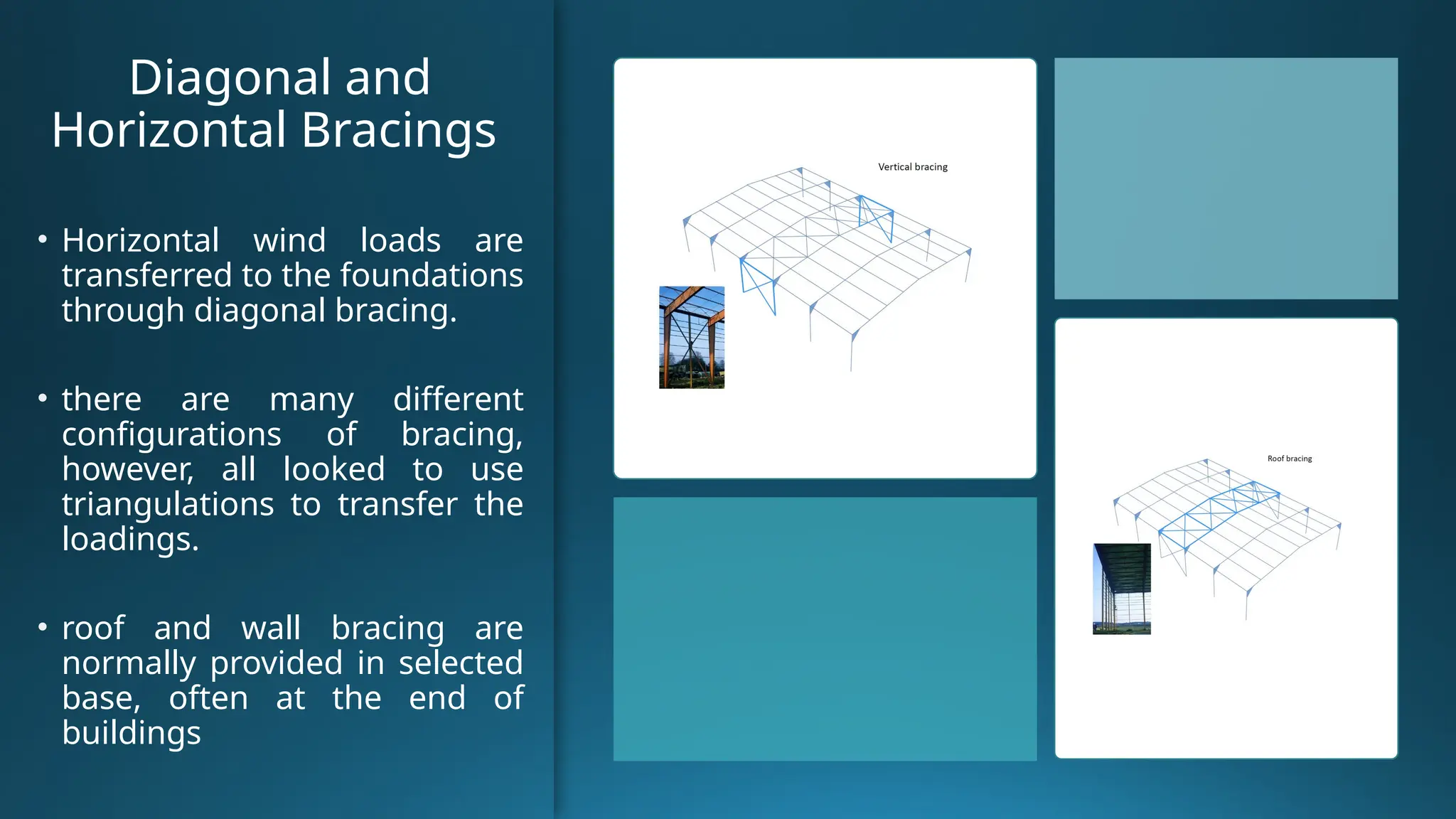
• Horizontal wind loads are
transferred to the foundations
through diagonal bracing.
• there are many different
configurations of bracing,
however, all looked to use
triangulations to transfer the
loadings.
• roof and wall bracing are
normally provided in selected
base, often at the end of
buildings
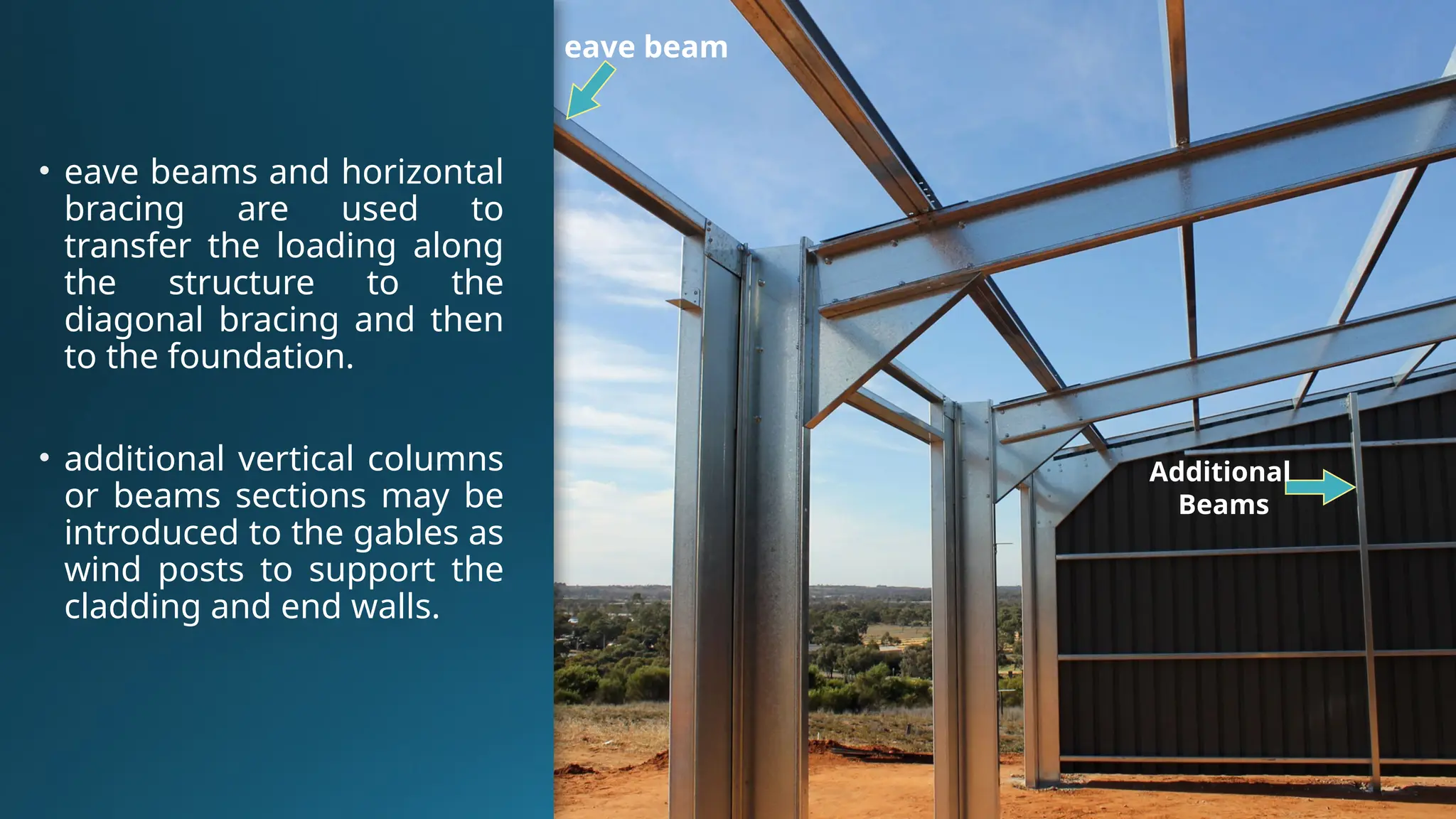
• eave beams and horizontal
bracing are used to
transfer the loading along
the structure to the
diagonal bracing and then
to the foundation.
• additional vertical columns
or beams sections may be
introduced to the gables as
wind posts to support the
cladding and end walls.
eave beam
Additional
Beams
Haunch Connections
• Apex connections (rafter-to-rafter)
• Eaves connections (rafter-to-column)
• It cut from the rafter section and
extends for 10% of the span of the
eaves.
• Connection of the haunch rafter-to-
column is by an end plate.
Apex
Eave
•The haunch is an
effective method of
locally increasing the
capacity of the rafter
at the points of
highest loading.
For economy, connections should be arranged to
minimize any requirement for additional
reinforcement.
This is generally achieved by:
• Making the haunch deeper (increasing the lever arms).
• Extending the eaves connection above the top flange of
the rafter.
• Adding bolt rows.
• Selecting a stronger column section.
Column
design
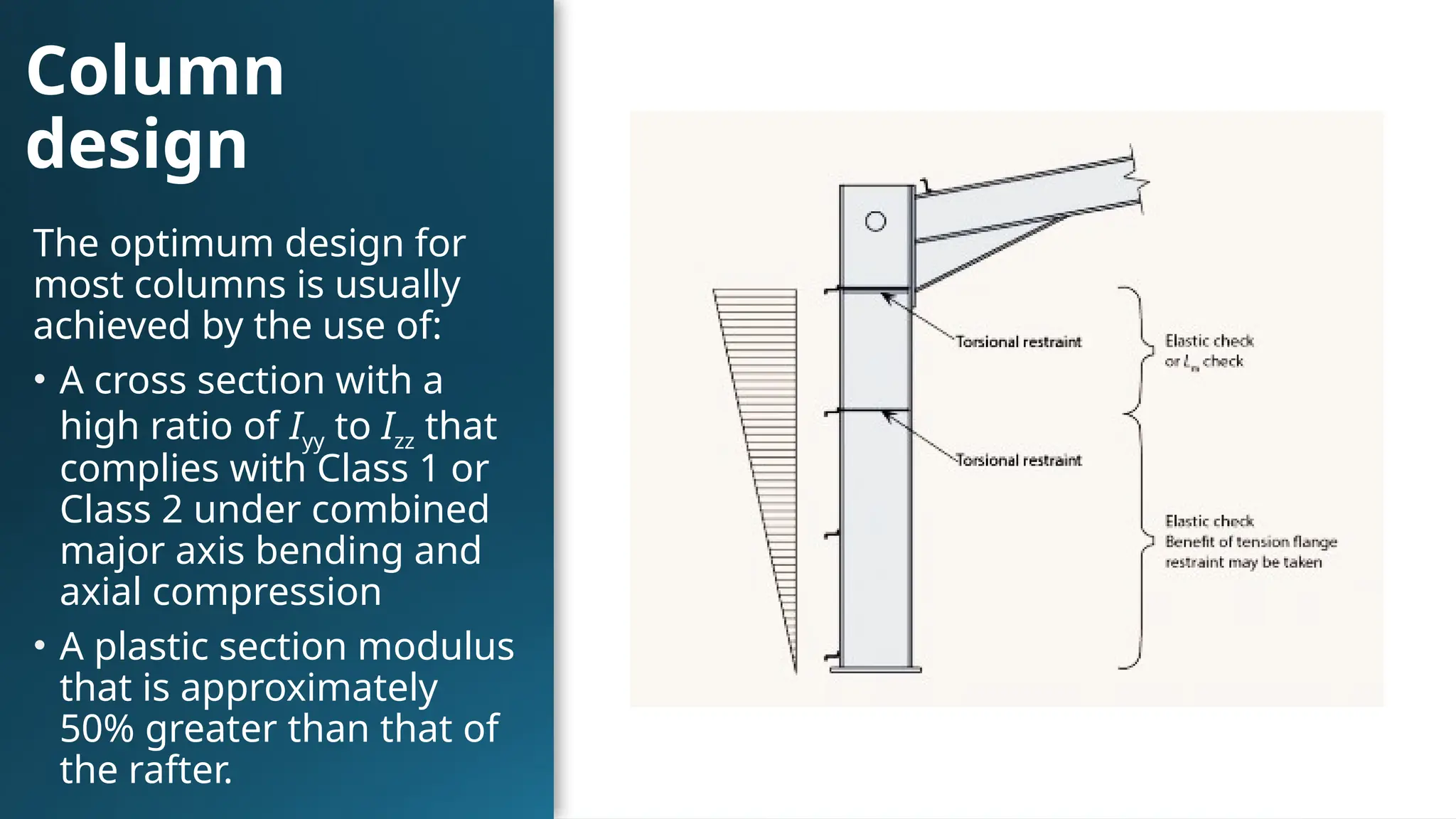
The optimum design for
most columns is usually
achieved by the use of:
• A cross section with a
high ratio of Iyy to Izz that
complies with Class 1 or
Class 2 under combined
major axis bending and
axial compression
• A plastic section modulus
that is approximately
50% greater than that of
the rafter.
Column bases
• In the majority of cases,
a nominally pinned
base is provided,
because of the difficulty
and expense of
providing a rigid base.
• the foundation must
also resist the moment,
which increases costs
significantly compared
to a nominally pinned
base.
Methods of structural analysis
• Elastic analysis
- Material is supposed to behave perfectly linear
elastic
• Plastic analysis
- Material non linearity is taken into account
- Redistribution of internal forces and moments
Effects to be taken into account when significant
• Effects of deformed geometry (2nd order effects)
• Imperfections
• Stiffness of joints
• Ground-structure interaction
First order and second order analysis
• First order analysis: performed on
the non deformed structure
• Second order analysis: performed
including effects of deformed
geometry
Structural imperfections
• Due to:
- lack of verticality
- lack of straightness
- eccentricities in joints
- residual stresses
- inhomogeneity of material
• Physical imperfection are replaced by equivalent geometric
imperfection.
Equivalent geometric imperfection
• Local bow imperfection
• Global initial sway imperfection
Example of joints:
• The designer will probably choose the
assumption of rigid rafter-to-column
joints.
• The designer will probably choose the
assumption of either pinned or rigid
column bases.
Conclusion
• Generally 2nd order effects and imperfections have to be accounted
for in the design of portal frames.
• Depending on the value of αcr (factor by which the design loads would
have to be increased to cause elastic instability in a globalMode)
different calculation methods can be adopted.
• For portal frames it is convenient to account for global imperfection
and global 2nd order effects in the global analysis.
• Local 2nd order effects are generally included in the member
verification formulas of EN 1993-1-1 §6.3.
• Physical imperfections are replaced by either equivalent geometric
imperfections or equivalent loads.
• Bracing systems are subjected to external horizontal loads and loads
due to their function as stabilizing elements.
The most common types of cranes
running on elevated runway
girders are:
• Top running bridge
cranes consisting of a
single or a double girder
spanning between the
end carriages.
• Underslung bridge
crane with special end
carriages where the
wheels are running on
the bottom flange of the
runway girders.
Classification of the cranes is based on two factors:
• Frequency of use.
• State of loading (ratio of magnitude of actual or
assumed load to the safe working load).
Crane Runway Girder
supporting types
• The maximum capacity
of cranes supported in
this manner is about
100kN as shown in (a).
• Above this capacity,
additional column may
required to increase
the depth of the
column below the
crane runway girder to
give adequate support
(b-d).
The Crane
Runway Girder
and the
Structure
• Seating for simply
supported crane girders
• Free rotation at the
supports of crane runway
girders is important in order
to prevent bending and
torsional moments in the
columns.
• Continuous crane
runway girder on
bracket.
• Horizontal truss is
an effective restraint
to the crane
brackets to prevent
torsion in the
column.
Various types of
rail fastenings
• Providing a fastening to
restrain the rail in all
directions.
• The fastening of block
rails is always by welding.
• The fastening of specially
rolled rail sections is
normally obtained by a
fully rigid clamp or by
welding the rail to the
flange of the crane
runway girder.
Typical sections of
crane runway girders
Overhead
travelling cranes
actions
Vertical actions
• (1) The relevant vertical
wheel loads from a
crane on a runway
girder.
Note: The load to the
crane girder will be
maximum when trolley
wheels are closest to the
girder.
Overhead
travelling cranes
actions
Vertical Actions
• (2) Eccentricity of
application of wheel
load
Overhead travelling cranes actions
Horizontal Forces
• (1) horizontal forces caused by acceleration
or deceleration of the crane in relation to its
movement along the runway beam.
• (2) Trolley in relation to its movement along
the crane bridge.
• (3) Horizontal forces caused by skewing of
the crane in relation to its m0vement along
the runway beam.
• (4) Buffer forces related to crane movement.
Overhead travelling cranes
actions
Other types of actions
• Temperature actions.
• Loads on access walkways, stairs, platforms and guard rails
(vertically and horizontally).
• Accidental actions.
• Fatigue loads
Design of the crane runway girder
check
• (1) Major axis bending
• (2) Lateral torsional buckling
• (3) Horizontal moment capacity
• (4) Consider combined vertical and horizontal moments
• (5) Web shear at supports
• (6) Local compression under wheels
• (7) Web bearing and buckling under the wheel
• (8) Deflection
Final Conclusion
1. Design the crane runway girder for combined vertical and
lateral loads.
2. Determine the maximum crane load reactions on the (corbel
or the additional column) supporting the crane runway
beam and the coincident minimum crane load reactions on
the opposite portal column.
3. Determine the coincident lateral loads on the portal frame
due to oblique travel or lateral inertia.
Final Conclusion
4. Add the crane runway beam dead load to the main dead
load (above the main columns of the portal frame) , and
adding new load cases:
- Crane loads with maximum load at the left column.
- Crane loads with maximum load at right column.
- Lateral crane loads with maximum at left column and
acting
from left to right.
- Lateral crane loads with maximum at right column and
acting
from left to right.
Final Conclusion
5. Determine load combinations.
6. Analyze the portal frame.
7. Check the deflections.
8. Check columns and rafter for strength
THANK YOU FOR YOUR ATTENTION

SteelPortalFrameBuildingWithOverheadRunwayCrane-RG (1).pptx

  • 1.
    Steel Portal Frame BuildingWith Overhead Runway Crane By Salih Al-Jumaili
  • 7.
    Typical Cladding System •Typically spans 3 meters. • Formed from profile coated steel. • Incorporate insulations to meet regulations of buildings requirement.
  • 8.
    Secondary members are neededwhich transfer the loading to rafters and columns, and they called: • For the roofs, these members are called purlins. • For the walls, these members are called wall rails.
  • 11.
    Diagonal and Horizontal Bracings •Horizontal wind loads are transferred to the foundations through diagonal bracing. • there are many different configurations of bracing, however, all looked to use triangulations to transfer the loadings. • roof and wall bracing are normally provided in selected base, often at the end of buildings
  • 12.
    • eave beamsand horizontal bracing are used to transfer the loading along the structure to the diagonal bracing and then to the foundation. • additional vertical columns or beams sections may be introduced to the gables as wind posts to support the cladding and end walls. eave beam Additional Beams
  • 13.
    Haunch Connections • Apexconnections (rafter-to-rafter) • Eaves connections (rafter-to-column) • It cut from the rafter section and extends for 10% of the span of the eaves. • Connection of the haunch rafter-to- column is by an end plate. Apex Eave
  • 14.
    •The haunch isan effective method of locally increasing the capacity of the rafter at the points of highest loading.
  • 15.
    For economy, connectionsshould be arranged to minimize any requirement for additional reinforcement. This is generally achieved by: • Making the haunch deeper (increasing the lever arms). • Extending the eaves connection above the top flange of the rafter. • Adding bolt rows. • Selecting a stronger column section.
  • 16.
    Column design The optimum designfor most columns is usually achieved by the use of: • A cross section with a high ratio of Iyy to Izz that complies with Class 1 or Class 2 under combined major axis bending and axial compression • A plastic section modulus that is approximately 50% greater than that of the rafter.
  • 17.
    Column bases • Inthe majority of cases, a nominally pinned base is provided, because of the difficulty and expense of providing a rigid base. • the foundation must also resist the moment, which increases costs significantly compared to a nominally pinned base.
  • 18.
    Methods of structuralanalysis • Elastic analysis - Material is supposed to behave perfectly linear elastic • Plastic analysis - Material non linearity is taken into account - Redistribution of internal forces and moments
  • 19.
    Effects to betaken into account when significant • Effects of deformed geometry (2nd order effects) • Imperfections • Stiffness of joints • Ground-structure interaction
  • 20.
    First order andsecond order analysis • First order analysis: performed on the non deformed structure • Second order analysis: performed including effects of deformed geometry
  • 21.
    Structural imperfections • Dueto: - lack of verticality - lack of straightness - eccentricities in joints - residual stresses - inhomogeneity of material • Physical imperfection are replaced by equivalent geometric imperfection.
  • 22.
    Equivalent geometric imperfection •Local bow imperfection • Global initial sway imperfection
  • 23.
    Example of joints: •The designer will probably choose the assumption of rigid rafter-to-column joints. • The designer will probably choose the assumption of either pinned or rigid column bases.
  • 25.
    Conclusion • Generally 2ndorder effects and imperfections have to be accounted for in the design of portal frames. • Depending on the value of αcr (factor by which the design loads would have to be increased to cause elastic instability in a globalMode) different calculation methods can be adopted. • For portal frames it is convenient to account for global imperfection and global 2nd order effects in the global analysis. • Local 2nd order effects are generally included in the member verification formulas of EN 1993-1-1 §6.3. • Physical imperfections are replaced by either equivalent geometric imperfections or equivalent loads. • Bracing systems are subjected to external horizontal loads and loads due to their function as stabilizing elements.
  • 27.
    The most commontypes of cranes running on elevated runway girders are: • Top running bridge cranes consisting of a single or a double girder spanning between the end carriages. • Underslung bridge crane with special end carriages where the wheels are running on the bottom flange of the runway girders.
  • 28.
    Classification of thecranes is based on two factors: • Frequency of use. • State of loading (ratio of magnitude of actual or assumed load to the safe working load).
  • 29.
    Crane Runway Girder supportingtypes • The maximum capacity of cranes supported in this manner is about 100kN as shown in (a). • Above this capacity, additional column may required to increase the depth of the column below the crane runway girder to give adequate support (b-d).
  • 30.
    The Crane Runway Girder andthe Structure • Seating for simply supported crane girders • Free rotation at the supports of crane runway girders is important in order to prevent bending and torsional moments in the columns.
  • 31.
    • Continuous crane runwaygirder on bracket.
  • 32.
    • Horizontal trussis an effective restraint to the crane brackets to prevent torsion in the column.
  • 33.
    Various types of railfastenings • Providing a fastening to restrain the rail in all directions. • The fastening of block rails is always by welding. • The fastening of specially rolled rail sections is normally obtained by a fully rigid clamp or by welding the rail to the flange of the crane runway girder.
  • 34.
  • 35.
    Overhead travelling cranes actions Vertical actions •(1) The relevant vertical wheel loads from a crane on a runway girder. Note: The load to the crane girder will be maximum when trolley wheels are closest to the girder.
  • 36.
    Overhead travelling cranes actions Vertical Actions •(2) Eccentricity of application of wheel load
  • 37.
    Overhead travelling cranesactions Horizontal Forces • (1) horizontal forces caused by acceleration or deceleration of the crane in relation to its movement along the runway beam. • (2) Trolley in relation to its movement along the crane bridge. • (3) Horizontal forces caused by skewing of the crane in relation to its m0vement along the runway beam. • (4) Buffer forces related to crane movement.
  • 38.
    Overhead travelling cranes actions Othertypes of actions • Temperature actions. • Loads on access walkways, stairs, platforms and guard rails (vertically and horizontally). • Accidental actions. • Fatigue loads
  • 39.
    Design of thecrane runway girder check • (1) Major axis bending • (2) Lateral torsional buckling • (3) Horizontal moment capacity • (4) Consider combined vertical and horizontal moments • (5) Web shear at supports • (6) Local compression under wheels • (7) Web bearing and buckling under the wheel • (8) Deflection
  • 40.
    Final Conclusion 1. Designthe crane runway girder for combined vertical and lateral loads. 2. Determine the maximum crane load reactions on the (corbel or the additional column) supporting the crane runway beam and the coincident minimum crane load reactions on the opposite portal column. 3. Determine the coincident lateral loads on the portal frame due to oblique travel or lateral inertia.
  • 41.
    Final Conclusion 4. Addthe crane runway beam dead load to the main dead load (above the main columns of the portal frame) , and adding new load cases: - Crane loads with maximum load at the left column. - Crane loads with maximum load at right column. - Lateral crane loads with maximum at left column and acting from left to right. - Lateral crane loads with maximum at right column and acting from left to right.
  • 42.
    Final Conclusion 5. Determineload combinations. 6. Analyze the portal frame. 7. Check the deflections. 8. Check columns and rafter for strength
  • 43.
    THANK YOU FORYOUR ATTENTION