International Research Journal of Engineering and Technology (IRJET) e-ISSN: 2395-0056
Volume: 10 Issue: 03 | Mar 2023 www.irjet.net p-ISSN: 2395-0072
© 2023, IRJET | Impact Factor value: 8.226 | ISO 9001:2008 Certified Journal | Page 59
Design & Analysis of Crane Hook with Ansys
ANKIT KUMAR YADAV, PANKAJ SIDAR, BAPI BISWAS
(MECHANICAL ENGINEERING DEPARTMENT)]
Ankit Kumar Yadav (Vec Ambikapur)
Pankaj Sidar (Professor, Department Of Mechanical Vec Ambikapur)
Bapi Biswas (Professor, Department Of Mechanical Vec, Ambikapur)
Viswavidyalaya Engineering College Ambikapur, Sarguja Chhattisgarh Swami Vivekananda Technical University
(Csvtu) Bhilai, Chattisgarh
------------------------------------------------------------------------***-------------------------------------------------------------------------
ABSTRACT:-
Crane hook is very significant component for lifting the
load with the help of chain or links. Crane hooks are
highly liable and are always subjected to failure due to
the amount of stresses can ultimately lead to its failure.
To minimize the failure of crane hook, the stress induced
in it must be studied. A crane is subjected to continuous
loading and unloading. This may causes fatigue failure of
the crane hook. The review of previous enable to
conclude that components with complex geometry as
crane hooks require a more extensive investigation in
view of the fact that a very few articles have been
published so far regarding stress analysis of this curved
beam (crane hook).
Keywords:- crane Hook, design
1. INTRODUCTION OF CRANE
Crane hooks are always subjected to loads due to
accumulation of large amount of stresses which can
eventually lead to its failure. These are the components
which are generally used to elevate the heavy load in
industries and constructional sites. A crane is a machine,
equipped with a hoist, wire ropes or chains and sheaves
used to lift and move heavy material.
1.1 Used in Construction Field
A crane is a lifting machine principally works by the use
of pulleys and cables. For the construction industry,
these are valuable machines because they make working
with heavy machinery and construction materials
effectively.
The invention of cranes made things easy for humankind
because without them, loading, unloading, and lifting had
to be done by human hands, would consume more time,
and the entire system was not efficient at all. The ancient
Greeks invented the first construction crane hundreds of
years ago. Modern day construction cranes are huge,
taking up tons of material hundreds of meters in height.
For high end infrastructure projects, tower cranes are
used that have a reach as high as 800 meters.
Fig.1 Crane used in construction site
2. CRANE WORK
The reason for this research is, damage is one of the key
points toward the safety improvement. If a crack is
developed in the crane hook, mainly at stress
concentration areas, it can cause fracture of the hook and
lead to serious accidents. In ductile fracture, the crack
propagates continuously and is more easily detectable
and hence preferred over brittle fracture. In brittle
fracture, there is sudden propagation of the crack and
the hook fails eventually.
Fig.2Triangular cross-section Sketch
International Research Journal of Engineering and Technology (IRJET) e-ISSN: 2395-0056
Volume: 10 Issue: 03 | Mar 2023 www.irjet.net p-ISSN: 2395-0072
© 2023, IRJET | Impact Factor value: 8.226 | ISO 9001:2008 Certified Journal | Page 60
This type of fracture is very dangerous as it is very
difficult to detect. Hence continuous use of crane hooks
may increase the magnitude of these stresses and leads
to the result in failure of the hook. All the above
mentioned failures may be prevented if the stress
concentration areas are well predicted and some design
modification to reduce the stresses in those particular
areas.
Failure of crane Hook:- Bending stresses combined
with tensile stresses, weakening of hook due to wear,
plastic deformation due to overloading, and excessive
thermal stresses are some of the other reasons for
failure. Hence continuous use of crane hooks may
increase the magnitude of these stresses and eventually
result in failure of the hook. due to continuous working
structure of crane Hook are changes and some problems
like weakness of crane hook due to tensile
stresses,wear,plastic deformation due to overloading
and excessive stresses these are other reason of failure.
2.1 Circumferential Stresses In A Curved Beam:
The circumferential stress distribution for the curved
beam is obtained by the curved beam formula:
Where,
= hoop stress, = axial stress,remaining
quantity is bending stress.
2.2 Radial Stresses In Curved Beams
The radial stresses stress distribution for the curved
beam is obtained by formula:
2.3 Analytical Method For Stress Calculation
Curved beam flexure formula is used when the curvature
of the member is pronounced as in case of hook for
different cross-sections mathematical analysis of stress.
Where,
M=maximum bending moment.
Y=Distance between centroid axis to neutral axis.
I=Moment of inertia for different cross sections.
Crane Hook safety:- Crane hooks used with safety
latches used to provide an extra level of security when
hoisting and rigging loads, safety latches can help ensure
that a sling is securely attached to the load, to prevent it
from sliding when the sling becomes slack. Proper lifting
can move large objects efficiently and decrease manual
handling operation improper design of crane hook lead
to accident improper lifting case injuries lowest to work
time and property manpower machinery loads methods
and the environment are all important factor for proper
lifting providers that enough safety measures are fully
implemented accidents can be decreased.
2.4 Design Calculations
Design of crane hook using trapezoidal cross section
area:
Allowable stress = 160 N/mm2
h=70mm (diameter)
C=164 mm (bed diameter)
Parameter of crane hook:
Width of cross section:
Bi = 0.65 × h = 0.65 × 70
= 45.5 mm
Let us take; B0= 0.5×Bi
= 0.5 × 45.5
= 22.7 mm
(I)Cross section area (A):
A = ((bi+b0)/2) × h
= (( ) ×70
A = 2387 mm2
(II) Inner and outer radius:
= 0.5 × c
= 0.5 ×164
= 82 mm
Ro= (0.5 × c) + h
= (0.5 × 164) + 70
Ro = 152 mm
(III) Radius of neutral axis ( )
( )
( ) ( )
International Research Journal of Engineering and Technology (IRJET) e-ISSN: 2395-0056
Volume: 10 Issue: 03 | Mar 2023 www.irjet.net p-ISSN: 2395-0072
© 2023, IRJET | Impact Factor value: 8.226 | ISO 9001:2008 Certified Journal | Page 61
( ) ( )
Rn = 92.6mm
(IV) Radius of centroidal axis = ( )
=
= 82
= 113 mm
(V) Distance between centroidal axis or neutral axis
E = – Rn = 113 – 92.6
=20.4 mm
Resultant stresses at inner surface(
M = p × Rn = p × 92.6
Hi= – = 92.6 – 82
=10.6 mm
H0 =R0 - Rn = 152 - 92.6 = 59.4
= +
= +
130=5.65 × 10⁻³ P
P = 35.5x10³ N
Resultant stresses at outer surface (σ0)
170 =1.4638 × 10⁻³ P
P = 63508 N
Load carrying capacity:
Taking lowest of two values given by equations the load
carrying capacity of crane hook is
P = 35.5 ×10³ N
ANSYS:-Ansys, Inc. is an American multinational
company with its headquarters based in Canonsburg,
Pennsylvania. It develops and markets CAE/metaphysics
engineering simulation software for product design,
testing and operation and offers its products and
services to customers worldwide. Ansys develops and
markets engineering simulation software for use across
the product life cycle. Ansys Mechanical finite element
analysis software is used to simulate computer models of
structures, electronics, or machine components for
analyzing the strength, toughness, elasticity,
temperature distribution, electromagnetism, fluid flow,
and other attributes. Ansys is used to determine how a
product will function with different specifications,
without building test products or conducting crash
tests.[5] For example, Ansys software may simulate how
a bridge will hold up after years of traffic, how to best
process salmon in a cannery to reduce waste, or how to
design a slide that uses less material without sacrificing
safety.Most Ansys simulations are performed using the
Ansys Workbench system,which is one of the company’s
main products. Typically Ansys users break down larger
structures into small components that are each modeled
and tested individually. A user may start by defining the
dimensions of an object, and then adding weight,
pressure, temperature and other physical properties.
Finally, the Ansys software simulates and analyzes
movement, fatigue, fractures, fluid flow, temperature
distribution, electromagnetic efficiency and other effects
over time. Ansys also develops software for data
management and backup, academic research and
teaching. Ansys software is sold on an annual
subscription basis.
3. RESULT AND DISCUSSION:
A single point load (6 tons/ 63508N) is applied which is
equally distributed throughout the selected surfaces and
required results such as equivalent stress, strain and
total deformation is analyzed. The simulations process is
carried out by assigning four different materials having
different characteristics.
Table 1 Material properties
International Research Journal of Engineering and Technology (IRJET) e-ISSN: 2395-0056
Volume: 10 Issue: 03 | Mar 2023 www.irjet.net p-ISSN: 2395-0072
© 2023, IRJET | Impact Factor value: 8.226 | ISO 9001:2008 Certified Journal | Page 62
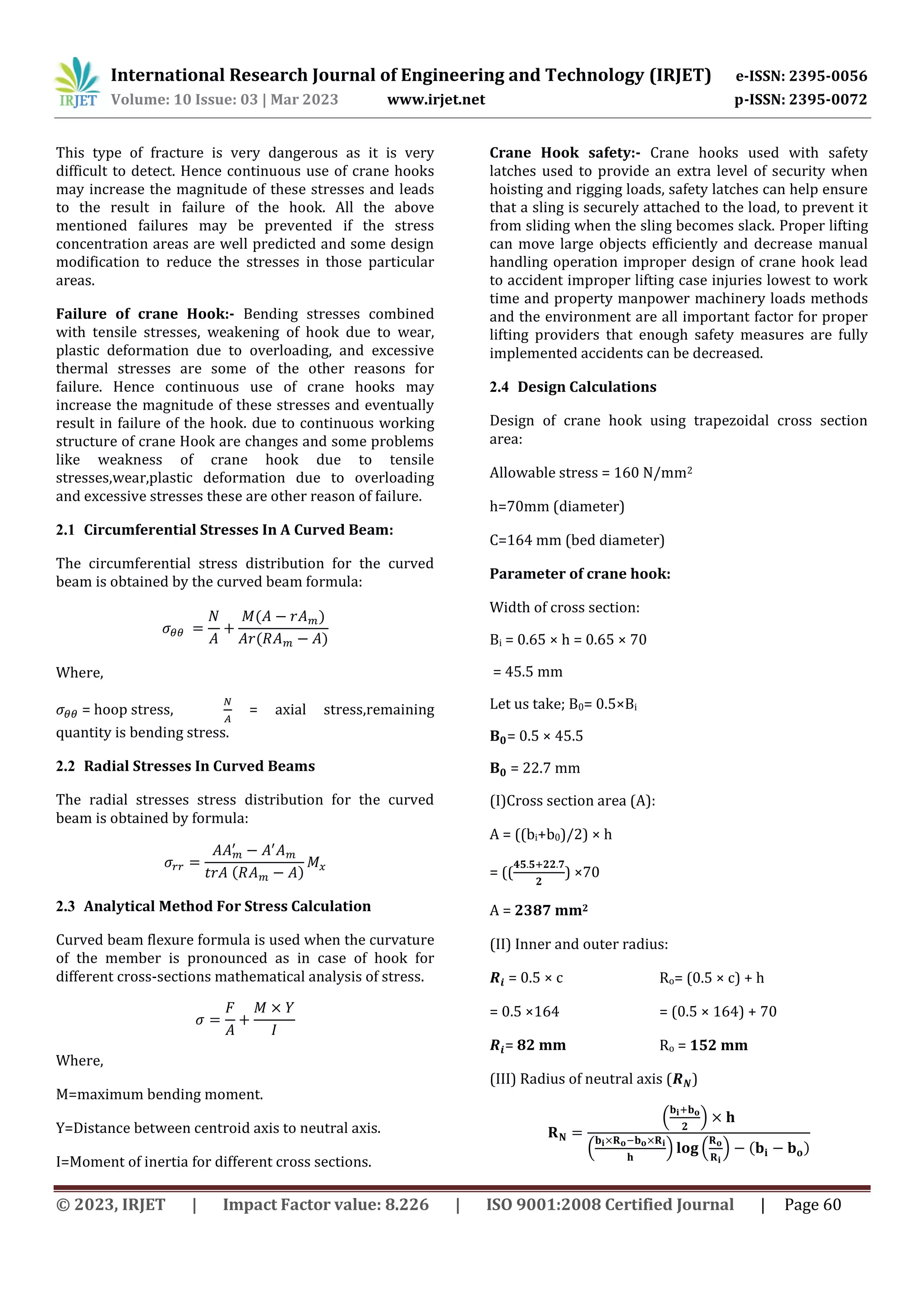
Fig.3 Material properties
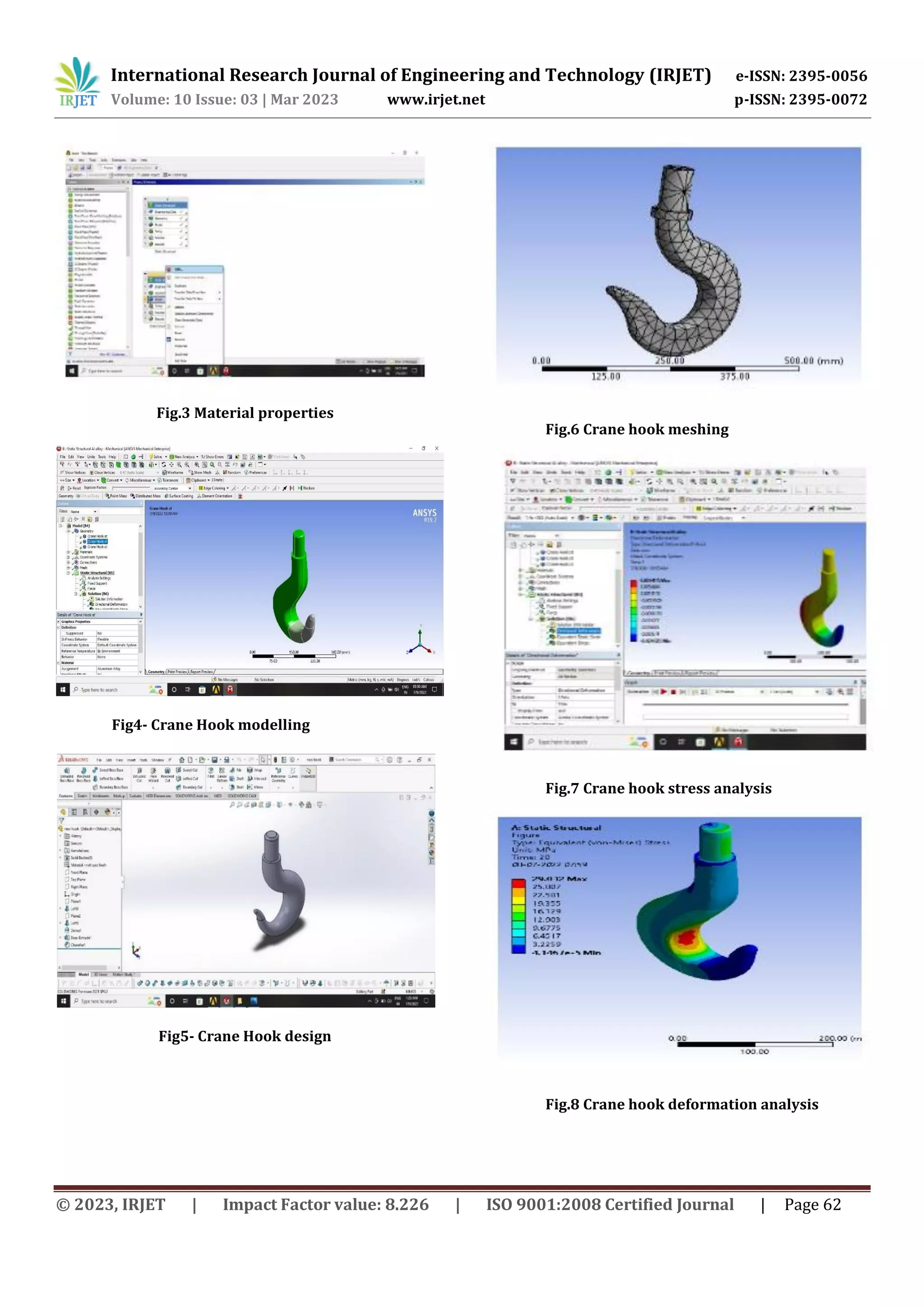
Fig4- Crane Hook modelling
Fig5- Crane Hook design
Fig.6 Crane hook meshing
Fig.7 Crane hook stress analysis
Fig.8 Crane hook deformation analysis
International Research Journal of Engineering and Technology (IRJET) e-ISSN: 2395-0056
Volume: 10 Issue: 03 | Mar 2023 www.irjet.net p-ISSN: 2395-0072
© 2023, IRJET | Impact Factor value: 8.226 | ISO 9001:2008 Certified Journal | Page 63
Structural steel is a category of steel used for
making construction materials in a variety of shapes.
Many structural steel shapes take the form of an
elongated beam having a profile of a specific cross
section. Most steels used throughout Europe are
specified to comply with the European standard EN
10025. However, many national standards also remain in
force.
Structural steel material is the most feasible material as
compare to the other [ wrought iron, Structural steel &
Grey cast iron] because of its lowest Max.
Stress 250 MPa (as shown in graph).
Fig.9 Graph of stress and deformation
The simulation studies conducted on the crane hook
using the Alloy S355 for its sustainability against loading
gives the results such as Von Mises stress, Factor of
Safety (FOS), Strain and Displacements.
CONCLUSIONS:-
Structural steel material is the most feasible material
compared to wrought iron, & grey cast iron as it has
lowest maximum stress 250 MPa. The basic of structural
steel compair to other yield strength, toughness is
higher.We have successfully optimized the material of
the crane hook We have study the structural stresses of
hook by ANSYS R19.2 &o concluded that the material
which is having less deformation will have more stability
if less failure of crane hook. Final we got the material
Structural Steel with less deformation. So it is the
material suitable for crane hook.
REFERENCE
[1] Machine Design Book By V.B. Bhandari
[2] Design Data Book By PSG College of Technology
Coimbatore
[3]Govind Narayan Sahu, Narendra Yadav “Design and
stress analysis of various cross section of hook”
International Journal of Modern Engineering Research-
vol. 3, Issue. 4, Jul-Aug. 2013, pp-2187-2189, ISSN:
2249-6645
[4 ]Sayyedkasim Ali, Harish Kumar et al, “Analysis of
crane hook with different cross section using finite
element method”, International Journal of Science and
Research, ISSN (online): 2319-7064
[5]Cook, R., “Circumferential stresses in curved beams”,
Journal of Applied Mechanics-Transactions of ASME 59:
224-225, 1992
[6]Santosh Shau, Ritesh Dewangan et al, “ Study of Crane
Hook having trapezoidal section by finite element
method & design of experiments”, International Journal
of Modern Engineering Research-vol.2, Issue.4, July-Aug
2012, pp-2779-2781, ISSN: 2249-6645
[7] R .S. Khurmi,“Strength of materials” 23rd edition
Chapter 33 (2009)
[8]Yogeshtripathi, U.K.Joshi Comparision of stress
between Winkler Bach theory and Ansys finite element
method for crane hook with a trapezoidal cross-section
[9] Sushovan Ghosh, Biswaranjan Pati, Rohit Ghosh,
Ashutosh Palo and Dr. Rabindra Nath
Barman, Static Analysis of Crane Hooks with Different
Cross Sections A Comparative Study Using Ansys
Workbench. International Journal of Mechanical
Engineering andTechnology, 8(4), 2017, pp. 474–482.
[10]M.Amareswari Reddy1, M.N.V Krishnaveni, B.
Nagaraju, M RajaRoy4, Static Analysis of Crane Hook
with T-Section Using ANSYS, International Journal of
Engineering Trends and Technology (IJETT) – Volume 26
Number 2- August 2015
0
10000
20000
30000
40000
50000
60000
70000
0 100 200 300
LOAD
STRESS
Chart Title
Series1

Design & Analysis of Crane Hook with Ansys

  • 1.
    International Research Journalof Engineering and Technology (IRJET) e-ISSN: 2395-0056 Volume: 10 Issue: 03 | Mar 2023 www.irjet.net p-ISSN: 2395-0072 © 2023, IRJET | Impact Factor value: 8.226 | ISO 9001:2008 Certified Journal | Page 59 Design & Analysis of Crane Hook with Ansys ANKIT KUMAR YADAV, PANKAJ SIDAR, BAPI BISWAS (MECHANICAL ENGINEERING DEPARTMENT)] Ankit Kumar Yadav (Vec Ambikapur) Pankaj Sidar (Professor, Department Of Mechanical Vec Ambikapur) Bapi Biswas (Professor, Department Of Mechanical Vec, Ambikapur) Viswavidyalaya Engineering College Ambikapur, Sarguja Chhattisgarh Swami Vivekananda Technical University (Csvtu) Bhilai, Chattisgarh ------------------------------------------------------------------------***------------------------------------------------------------------------- ABSTRACT:- Crane hook is very significant component for lifting the load with the help of chain or links. Crane hooks are highly liable and are always subjected to failure due to the amount of stresses can ultimately lead to its failure. To minimize the failure of crane hook, the stress induced in it must be studied. A crane is subjected to continuous loading and unloading. This may causes fatigue failure of the crane hook. The review of previous enable to conclude that components with complex geometry as crane hooks require a more extensive investigation in view of the fact that a very few articles have been published so far regarding stress analysis of this curved beam (crane hook). Keywords:- crane Hook, design 1. INTRODUCTION OF CRANE Crane hooks are always subjected to loads due to accumulation of large amount of stresses which can eventually lead to its failure. These are the components which are generally used to elevate the heavy load in industries and constructional sites. A crane is a machine, equipped with a hoist, wire ropes or chains and sheaves used to lift and move heavy material. 1.1 Used in Construction Field A crane is a lifting machine principally works by the use of pulleys and cables. For the construction industry, these are valuable machines because they make working with heavy machinery and construction materials effectively. The invention of cranes made things easy for humankind because without them, loading, unloading, and lifting had to be done by human hands, would consume more time, and the entire system was not efficient at all. The ancient Greeks invented the first construction crane hundreds of years ago. Modern day construction cranes are huge, taking up tons of material hundreds of meters in height. For high end infrastructure projects, tower cranes are used that have a reach as high as 800 meters. Fig.1 Crane used in construction site 2. CRANE WORK The reason for this research is, damage is one of the key points toward the safety improvement. If a crack is developed in the crane hook, mainly at stress concentration areas, it can cause fracture of the hook and lead to serious accidents. In ductile fracture, the crack propagates continuously and is more easily detectable and hence preferred over brittle fracture. In brittle fracture, there is sudden propagation of the crack and the hook fails eventually. Fig.2Triangular cross-section Sketch
  • 2.
    International Research Journalof Engineering and Technology (IRJET) e-ISSN: 2395-0056 Volume: 10 Issue: 03 | Mar 2023 www.irjet.net p-ISSN: 2395-0072 © 2023, IRJET | Impact Factor value: 8.226 | ISO 9001:2008 Certified Journal | Page 60 This type of fracture is very dangerous as it is very difficult to detect. Hence continuous use of crane hooks may increase the magnitude of these stresses and leads to the result in failure of the hook. All the above mentioned failures may be prevented if the stress concentration areas are well predicted and some design modification to reduce the stresses in those particular areas. Failure of crane Hook:- Bending stresses combined with tensile stresses, weakening of hook due to wear, plastic deformation due to overloading, and excessive thermal stresses are some of the other reasons for failure. Hence continuous use of crane hooks may increase the magnitude of these stresses and eventually result in failure of the hook. due to continuous working structure of crane Hook are changes and some problems like weakness of crane hook due to tensile stresses,wear,plastic deformation due to overloading and excessive stresses these are other reason of failure. 2.1 Circumferential Stresses In A Curved Beam: The circumferential stress distribution for the curved beam is obtained by the curved beam formula: Where, = hoop stress, = axial stress,remaining quantity is bending stress. 2.2 Radial Stresses In Curved Beams The radial stresses stress distribution for the curved beam is obtained by formula: 2.3 Analytical Method For Stress Calculation Curved beam flexure formula is used when the curvature of the member is pronounced as in case of hook for different cross-sections mathematical analysis of stress. Where, M=maximum bending moment. Y=Distance between centroid axis to neutral axis. I=Moment of inertia for different cross sections. Crane Hook safety:- Crane hooks used with safety latches used to provide an extra level of security when hoisting and rigging loads, safety latches can help ensure that a sling is securely attached to the load, to prevent it from sliding when the sling becomes slack. Proper lifting can move large objects efficiently and decrease manual handling operation improper design of crane hook lead to accident improper lifting case injuries lowest to work time and property manpower machinery loads methods and the environment are all important factor for proper lifting providers that enough safety measures are fully implemented accidents can be decreased. 2.4 Design Calculations Design of crane hook using trapezoidal cross section area: Allowable stress = 160 N/mm2 h=70mm (diameter) C=164 mm (bed diameter) Parameter of crane hook: Width of cross section: Bi = 0.65 × h = 0.65 × 70 = 45.5 mm Let us take; B0= 0.5×Bi = 0.5 × 45.5 = 22.7 mm (I)Cross section area (A): A = ((bi+b0)/2) × h = (( ) ×70 A = 2387 mm2 (II) Inner and outer radius: = 0.5 × c = 0.5 ×164 = 82 mm Ro= (0.5 × c) + h = (0.5 × 164) + 70 Ro = 152 mm (III) Radius of neutral axis ( ) ( ) ( ) ( )
  • 3.
    International Research Journalof Engineering and Technology (IRJET) e-ISSN: 2395-0056 Volume: 10 Issue: 03 | Mar 2023 www.irjet.net p-ISSN: 2395-0072 © 2023, IRJET | Impact Factor value: 8.226 | ISO 9001:2008 Certified Journal | Page 61 ( ) ( ) Rn = 92.6mm (IV) Radius of centroidal axis = ( ) = = 82 = 113 mm (V) Distance between centroidal axis or neutral axis E = – Rn = 113 – 92.6 =20.4 mm Resultant stresses at inner surface( M = p × Rn = p × 92.6 Hi= – = 92.6 – 82 =10.6 mm H0 =R0 - Rn = 152 - 92.6 = 59.4 = + = + 130=5.65 × 10⁻³ P P = 35.5x10³ N Resultant stresses at outer surface (σ0) 170 =1.4638 × 10⁻³ P P = 63508 N Load carrying capacity: Taking lowest of two values given by equations the load carrying capacity of crane hook is P = 35.5 ×10³ N ANSYS:-Ansys, Inc. is an American multinational company with its headquarters based in Canonsburg, Pennsylvania. It develops and markets CAE/metaphysics engineering simulation software for product design, testing and operation and offers its products and services to customers worldwide. Ansys develops and markets engineering simulation software for use across the product life cycle. Ansys Mechanical finite element analysis software is used to simulate computer models of structures, electronics, or machine components for analyzing the strength, toughness, elasticity, temperature distribution, electromagnetism, fluid flow, and other attributes. Ansys is used to determine how a product will function with different specifications, without building test products or conducting crash tests.[5] For example, Ansys software may simulate how a bridge will hold up after years of traffic, how to best process salmon in a cannery to reduce waste, or how to design a slide that uses less material without sacrificing safety.Most Ansys simulations are performed using the Ansys Workbench system,which is one of the company’s main products. Typically Ansys users break down larger structures into small components that are each modeled and tested individually. A user may start by defining the dimensions of an object, and then adding weight, pressure, temperature and other physical properties. Finally, the Ansys software simulates and analyzes movement, fatigue, fractures, fluid flow, temperature distribution, electromagnetic efficiency and other effects over time. Ansys also develops software for data management and backup, academic research and teaching. Ansys software is sold on an annual subscription basis. 3. RESULT AND DISCUSSION: A single point load (6 tons/ 63508N) is applied which is equally distributed throughout the selected surfaces and required results such as equivalent stress, strain and total deformation is analyzed. The simulations process is carried out by assigning four different materials having different characteristics. Table 1 Material properties
  • 4.
    International Research Journalof Engineering and Technology (IRJET) e-ISSN: 2395-0056 Volume: 10 Issue: 03 | Mar 2023 www.irjet.net p-ISSN: 2395-0072 © 2023, IRJET | Impact Factor value: 8.226 | ISO 9001:2008 Certified Journal | Page 62 Fig.3 Material properties Fig4- Crane Hook modelling Fig5- Crane Hook design Fig.6 Crane hook meshing Fig.7 Crane hook stress analysis Fig.8 Crane hook deformation analysis
  • 5.
    International Research Journalof Engineering and Technology (IRJET) e-ISSN: 2395-0056 Volume: 10 Issue: 03 | Mar 2023 www.irjet.net p-ISSN: 2395-0072 © 2023, IRJET | Impact Factor value: 8.226 | ISO 9001:2008 Certified Journal | Page 63 Structural steel is a category of steel used for making construction materials in a variety of shapes. Many structural steel shapes take the form of an elongated beam having a profile of a specific cross section. Most steels used throughout Europe are specified to comply with the European standard EN 10025. However, many national standards also remain in force. Structural steel material is the most feasible material as compare to the other [ wrought iron, Structural steel & Grey cast iron] because of its lowest Max. Stress 250 MPa (as shown in graph). Fig.9 Graph of stress and deformation The simulation studies conducted on the crane hook using the Alloy S355 for its sustainability against loading gives the results such as Von Mises stress, Factor of Safety (FOS), Strain and Displacements. CONCLUSIONS:- Structural steel material is the most feasible material compared to wrought iron, & grey cast iron as it has lowest maximum stress 250 MPa. The basic of structural steel compair to other yield strength, toughness is higher.We have successfully optimized the material of the crane hook We have study the structural stresses of hook by ANSYS R19.2 &o concluded that the material which is having less deformation will have more stability if less failure of crane hook. Final we got the material Structural Steel with less deformation. So it is the material suitable for crane hook. REFERENCE [1] Machine Design Book By V.B. Bhandari [2] Design Data Book By PSG College of Technology Coimbatore [3]Govind Narayan Sahu, Narendra Yadav “Design and stress analysis of various cross section of hook” International Journal of Modern Engineering Research- vol. 3, Issue. 4, Jul-Aug. 2013, pp-2187-2189, ISSN: 2249-6645 [4 ]Sayyedkasim Ali, Harish Kumar et al, “Analysis of crane hook with different cross section using finite element method”, International Journal of Science and Research, ISSN (online): 2319-7064 [5]Cook, R., “Circumferential stresses in curved beams”, Journal of Applied Mechanics-Transactions of ASME 59: 224-225, 1992 [6]Santosh Shau, Ritesh Dewangan et al, “ Study of Crane Hook having trapezoidal section by finite element method & design of experiments”, International Journal of Modern Engineering Research-vol.2, Issue.4, July-Aug 2012, pp-2779-2781, ISSN: 2249-6645 [7] R .S. Khurmi,“Strength of materials” 23rd edition Chapter 33 (2009) [8]Yogeshtripathi, U.K.Joshi Comparision of stress between Winkler Bach theory and Ansys finite element method for crane hook with a trapezoidal cross-section [9] Sushovan Ghosh, Biswaranjan Pati, Rohit Ghosh, Ashutosh Palo and Dr. Rabindra Nath Barman, Static Analysis of Crane Hooks with Different Cross Sections A Comparative Study Using Ansys Workbench. International Journal of Mechanical Engineering andTechnology, 8(4), 2017, pp. 474–482. [10]M.Amareswari Reddy1, M.N.V Krishnaveni, B. Nagaraju, M RajaRoy4, Static Analysis of Crane Hook with T-Section Using ANSYS, International Journal of Engineering Trends and Technology (IJETT) – Volume 26 Number 2- August 2015 0 10000 20000 30000 40000 50000 60000 70000 0 100 200 300 LOAD STRESS Chart Title Series1