Copyright © 2016, 2011, 2009 Pearson Education, Inc. All Rights Reserved
The Heritage of World Civilizations
Tenth Edition
Chapter 15
Europe to the Early
1500s: Revival,
Decline, and
Renaissance
Copyright © 2016, 2011, 2009 Pearson Education, Inc. All Rights Reserved
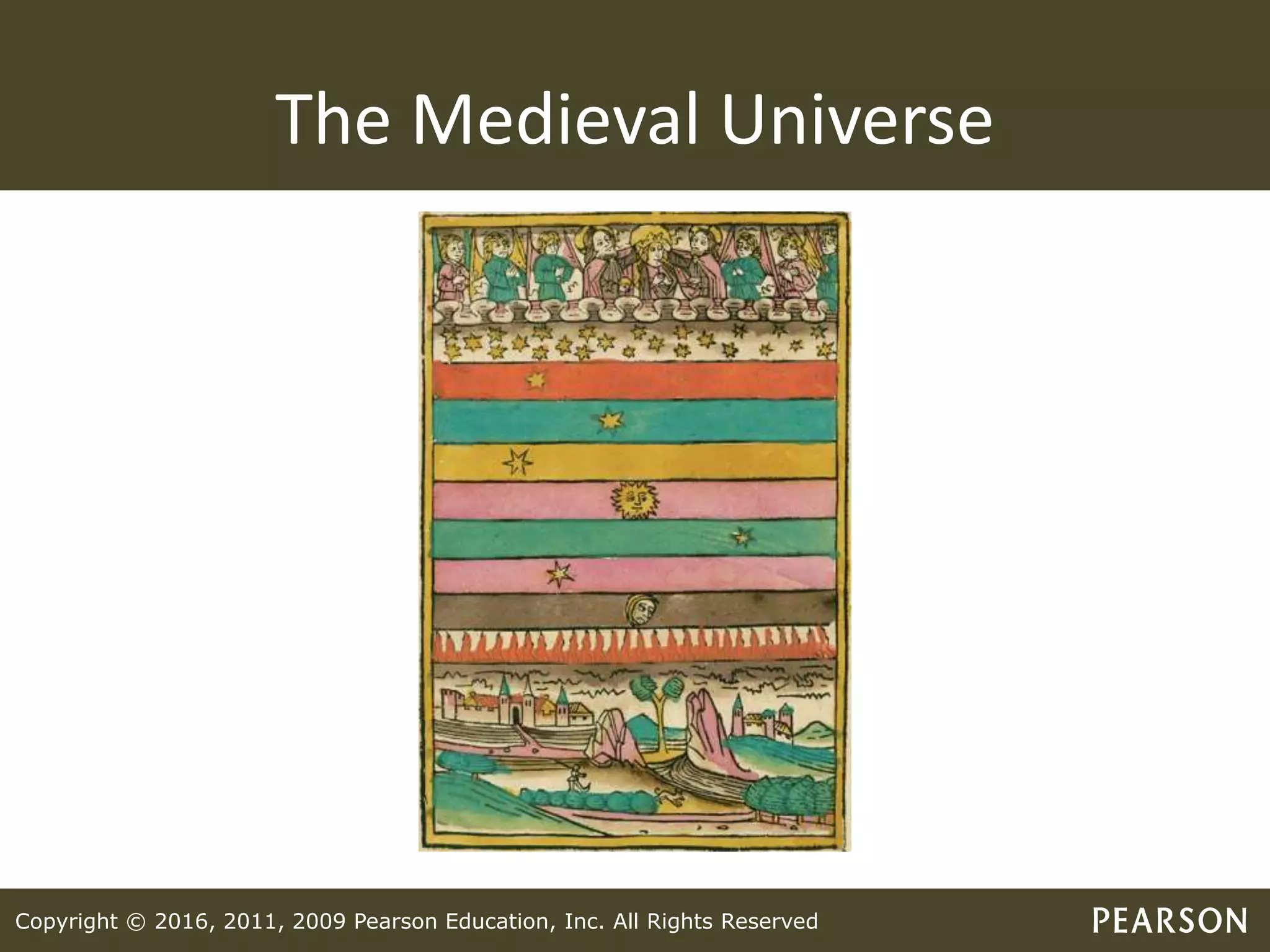
The Medieval Universe
Copyright © 2016, 2011, 2009 Pearson Education, Inc. All Rights Reserved
Learning Objectives (1 of 2)
15.1 Revival of Empire, Church, and Towns
• Analyze the factors involved in the revival of the Holy Roman
Empire and the Catholic Church and in the rise of towns during the
eleventh and twelfth centuries.
15.2 Society
• Summarize the changes affecting the nobility, clergy, peasantry,
and women during the Late Middle Ages.
15.3 Growth of National Monarchies
• Compare and contrast the relations among monarchs, lesser
nobility, and the Catholic Church in England, France, and the
Hohenstaufen Empire during the Late Middle Ages.
Copyright © 2016, 2011, 2009 Pearson Education, Inc. All Rights Reserved
Learning Objectives (2 of 2)
15.4 Political and Social Breakdown
• Summarize the causes and consequences of the Hundred Years’ War and the
Black Death.
15.5 Ecclesiastical Breakdown and Revival: The Late Medieval Church
• Describe the factors leading to the Great Schism and the subsequent
reunification of the Church.
15.6 The Renaissance in Italy (1375–1527)
• Survey the Renaissance in Italy, including the social conflicts in the Italian city-
states, humanism, Renaissance art, and the Italian political decline.
15.7 Revival of Monarchy: Nation-Building in the Fifteenth Century
• Analyze the revival of monarchy and the process of nation-building in the
fifteenth century in Russia, France, Spain, and England.
Copyright © 2016, 2011, 2009 Pearson Education, Inc. All Rights Reserved
Introduction (1 of 2)
• The High Middle Ages was a period of political
expansion and consolidation and of
intellectual flowering and synthesis.
• The Latin, or Western, church established
itself as a spiritual authority independent of
secular monarchies.
• The High Middle Ages saw a revolution in
agriculture that increased food supplies and
populations.
Copyright © 2016, 2011, 2009 Pearson Education, Inc. All Rights Reserved
Introduction (2 of 2)
• Commerce revived, printing was invented, and
new intellectual currents emerged drawing on
the writings of antiquity.
• War and the Black Death were calamities for
Europe.
• The vernacular—local language—took its
place alongside Latin.
Copyright © 2016, 2011, 2009 Pearson Education, Inc. All Rights Reserved
Global Perspective: The High Middle Ages
in Western Europe (1 of 3)
• Europe began to escape its relative isolation
from the rest of the world.
• The Crusades and renewed trade along the
Silk Road linking China and Europe were
central to ending this isolation.
• Christianity allowed Europeans to think of
themselves as one people and to unite in the
Crusades.
Copyright © 2016, 2011, 2009 Pearson Education, Inc. All Rights Reserved
Global Perspective: The High Middle Ages
in Western Europe (2 of 3)
• The Crusades brought Europeans into more
direct and frequent contact with the non-
European world than they had known since
the Roman Empire.
• Eventually Europeans sought to bypass the
Islamic world entirely and secure supplies of
Eastern products by going directly to the
sources in India and East Asia.
Copyright © 2016, 2011, 2009 Pearson Education, Inc. All Rights Reserved
Global Perspective: The High Middle Ages
in Western Europe (3 of 3)
1. How did the High Middle Ages in Europe
differ from the Early Middle Ages?
2. What was the legacy of the Crusades for
Europe? In what ways did they signal the
start of new relationships between Europe
and the wider world?
Copyright © 2016, 2011, 2009 Pearson Education, Inc. All Rights Reserved
15.1 Revival of Empire, Church, and Towns
Learning Objective:
Analyze the factors involved in the revival
of the Holy Roman Empire and the Catholic
Church and in the rise of towns during the
eleventh and twelfth centuries.
Copyright © 2016, 2011, 2009 Pearson Education, Inc. All Rights Reserved
15.1.1 Otto I and the Revival of the Empire
• Otto I (r. 936–973) invaded Italy and
proclaimed himself king in 951.
• Otto enlisted bishops and abbots as agents of
the king.
• In 962 Otto became Holy Roman Emperor.
Copyright © 2016, 2011, 2009 Pearson Education, Inc. All Rights Reserved
15.1.2 The Reviving Catholic Church
• In a great monastery at Cluny, a reform movement was
born that aimed to free the church from secular
control.
• The Cluny reformers uncompromisingly condemned
the mixing of religious and secular institutions and the
clergy’s subservience to royal authority.
• They further denounced the transgression of ascetic
piety by “secular” parish clergy.
• In the Investiture Controversy, church and state agreed
to distinctive spheres of ecclesiastical and secular
authority.
Copyright © 2016, 2011, 2009 Pearson Education, Inc. All Rights Reserved
15.1.3 The Crusades (1 of 2)
• Religion was not the only motive inspiring the
Crusades, but early Crusades were inspired by
genuine religious piety and were orchestrated by
the papacy.
• In the First Crusade (1095–1099), the Crusaders
soundly defeated one Seljuk army after another
and captured Jerusalem on July 15, 1099.
• The victorious Crusaders divided conquered
territories into the feudal states of Jerusalem,
Edessa, and Antioch.
Copyright © 2016, 2011, 2009 Pearson Education, Inc. All Rights Reserved
15.1.3 The Crusades (2 of 2)
• Muslim resistance broke the Crusaders’
resolve around the mid–twelfth century.
• The Second and Third Crusades failed
militarily.
• A Fourth Crusade (1202–1204) transformed
itself into a piratical commercial venture
controlled by the Venetians.
Copyright © 2016, 2011, 2009 Pearson Education, Inc. All Rights Reserved
Document: Pope Urban II (r. 1088–1099)
Preaches the First Crusade
• Is the pope engaging in a propaganda and smear
campaign?
• What images of the enemy does he create, and
how accurate and fair are they?
• Did the Christian church have a greater claim to
Jerusalem than the people then living there?
• Does a religious connection with the past entitle
one group to confiscate the land of another?
Copyright © 2016, 2011, 2009 Pearson Education, Inc. All Rights Reserved
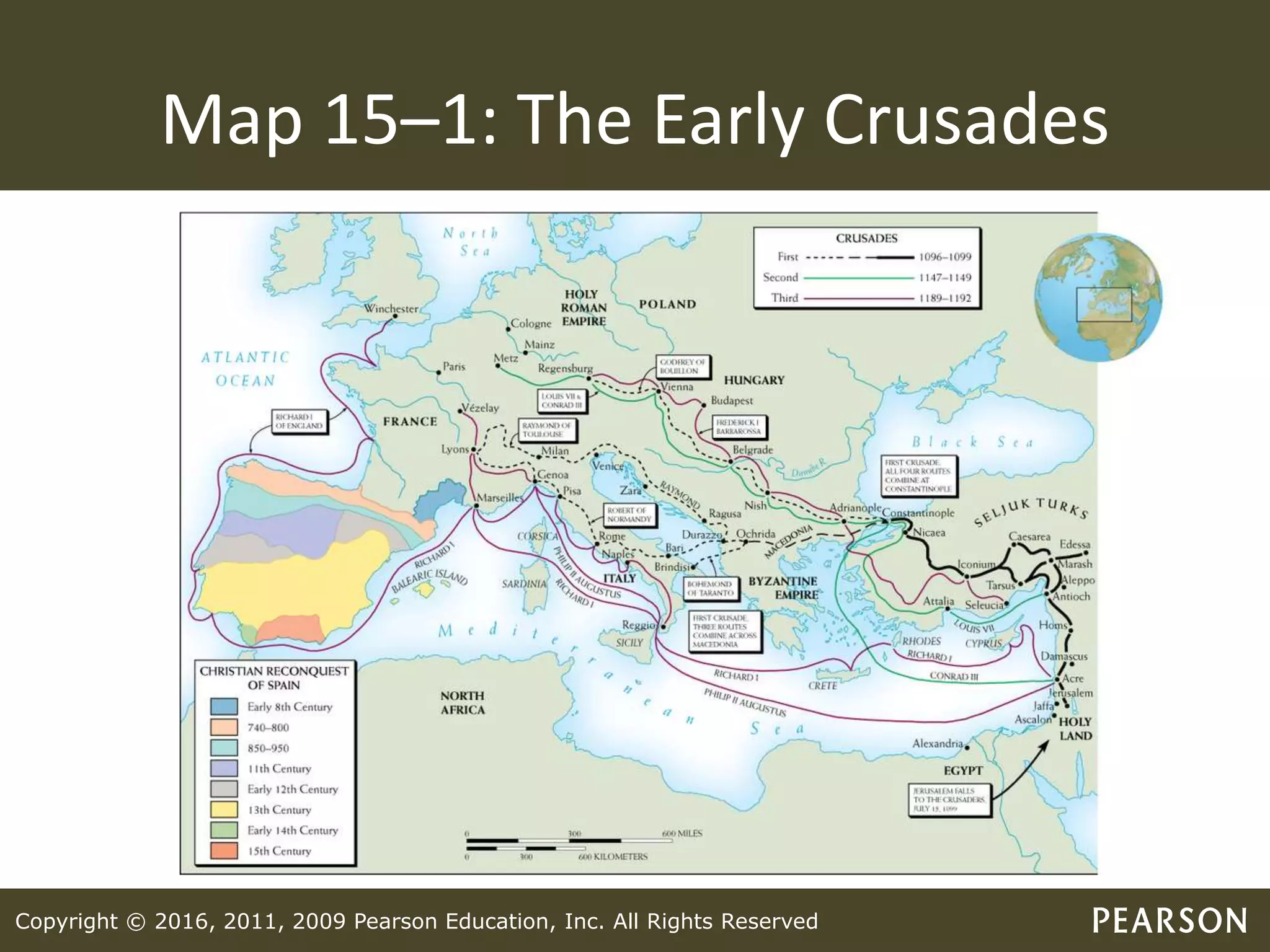
Map 15–1: The Early Crusades
Copyright © 2016, 2011, 2009 Pearson Education, Inc. All Rights Reserved
15.1.4 Towns and Townspeople (1 of 3)
• In the eleventh and twelfth centuries, most
towns were small and held only about 5 percent
of western Europe’s population.
• As towns grew, many serfs took their skills to the
new urban centers.
• Rural society gave the towns their craftspeople ,
laborers, and maybe even the first merchants.
• As the traders grew in wealth and numbers, they
became able to challenge traditional seigneurial
authority.
Copyright © 2016, 2011, 2009 Pearson Education, Inc. All Rights Reserved
15.1.4 Towns and Townspeople (2 of 3)
• Around 1100 the old urban nobility and the new
burgher upper class merged into an urban
patriciate.
• Small artisans and craftspeople also slowly
developed their own protective associations or
guilds and began to gain a voice in government.
• Towns became a major force in the transition
from feudal societies to national governments.
Copyright © 2016, 2011, 2009 Pearson Education, Inc. All Rights Reserved
15.1.4 Towns and Townspeople (3 of 3)
• Modern universities and university towns such
as Bologna in Italy emerged.
• The method of study known as Scholasticism
spread across Europe.
• Peter Abelard was the leading philosopher
and theologian of his time.
Copyright © 2016, 2011, 2009 Pearson Education, Inc. All Rights Reserved
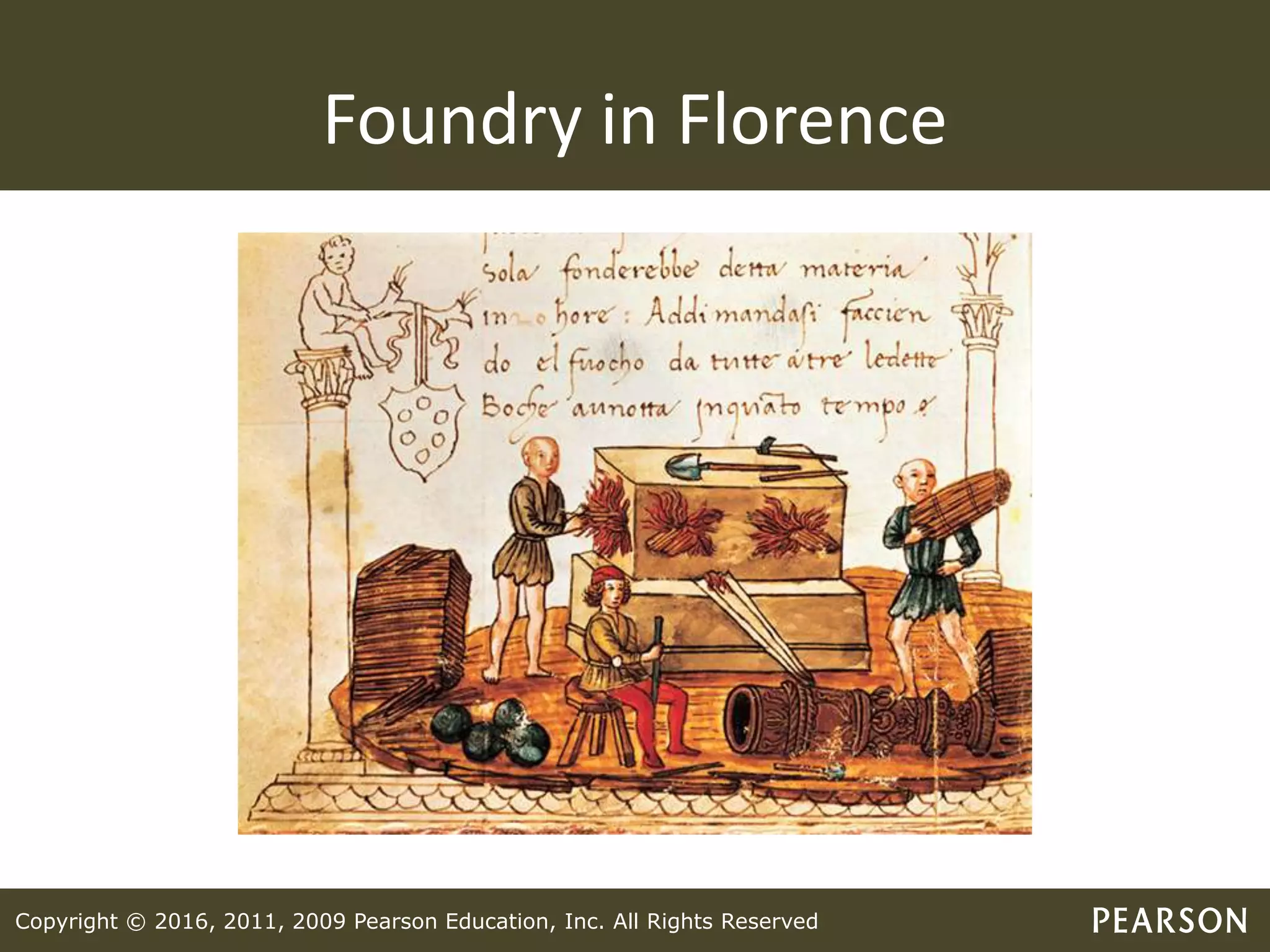
Foundry in Florence
Copyright © 2016, 2011, 2009 Pearson Education, Inc. All Rights Reserved
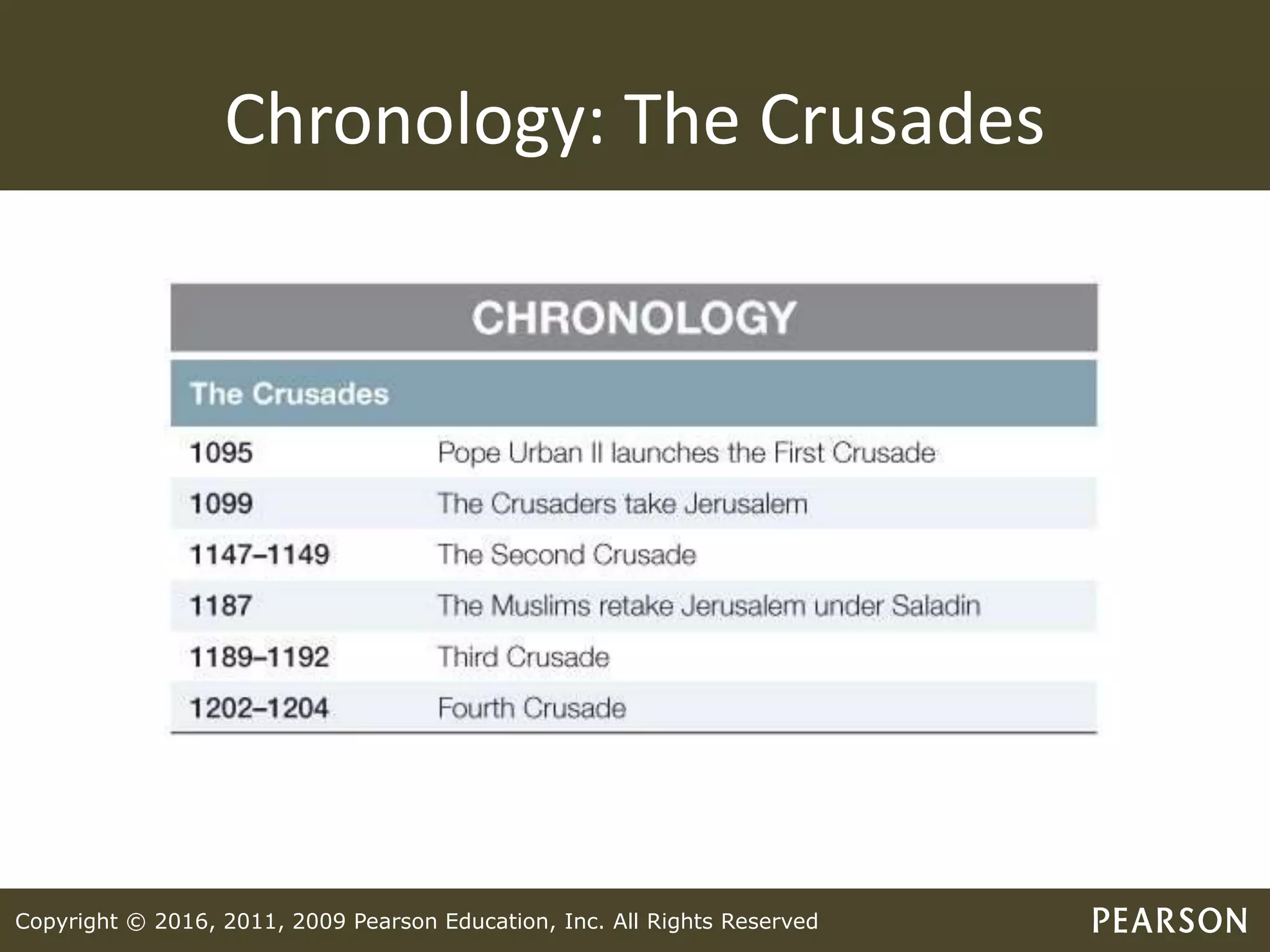
Chronology: The Crusades
Copyright © 2016, 2011, 2009 Pearson Education, Inc. All Rights Reserved
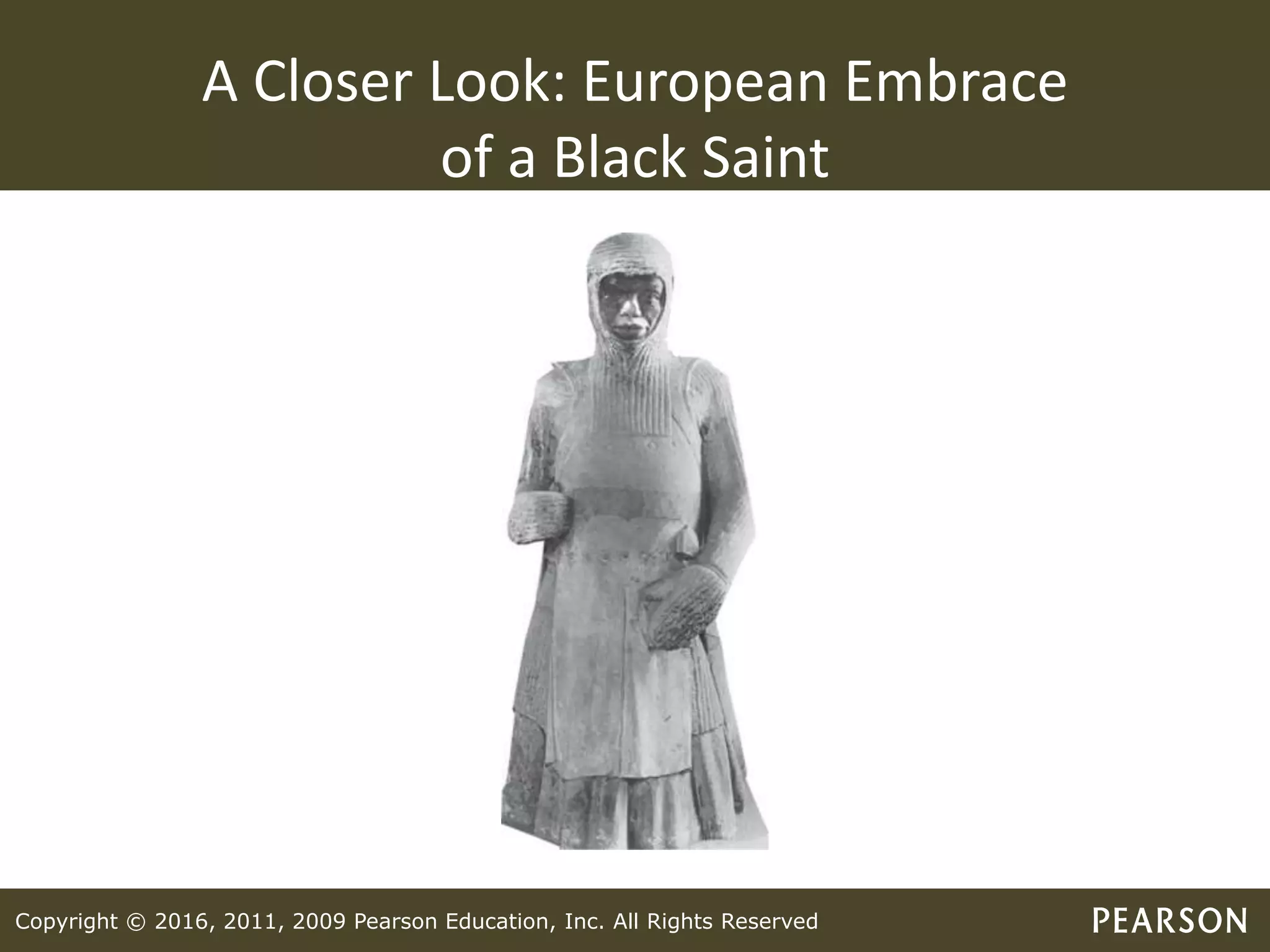
A Closer Look: European Embrace
of a Black Saint
Copyright © 2016, 2011, 2009 Pearson Education, Inc. All Rights Reserved
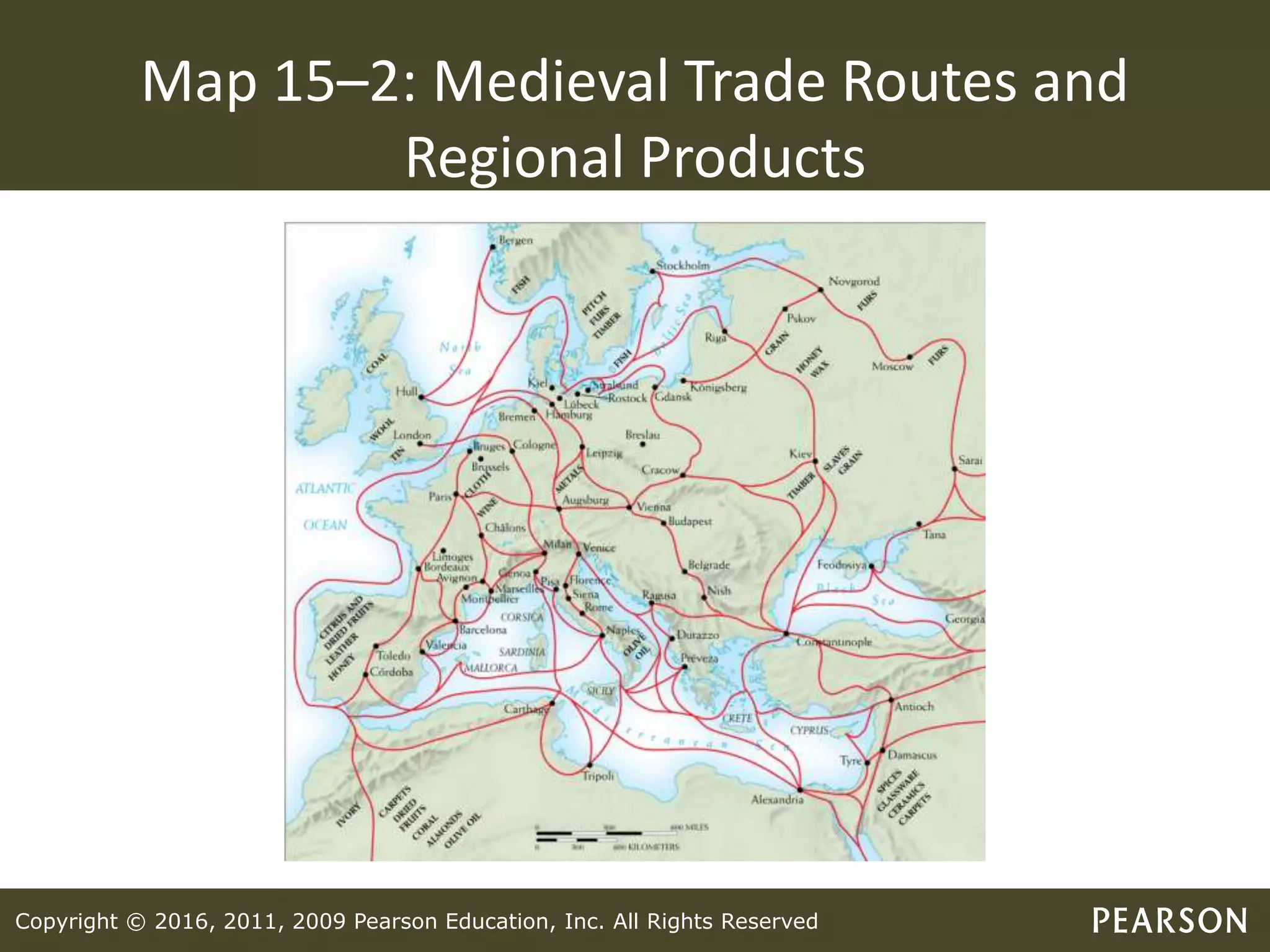
Map 15–2: Medieval Trade Routes and
Regional Products
Copyright © 2016, 2011, 2009 Pearson Education, Inc. All Rights Reserved
Document: Student Life at
the University of Paris
• Why were students from different lands so
prejudiced against one another?
• Was the rivalry among faculty members as
intense as that among students?
• What are the student criticisms of the faculty?
Do they sound credible?
Copyright © 2016, 2011, 2009 Pearson Education, Inc. All Rights Reserved
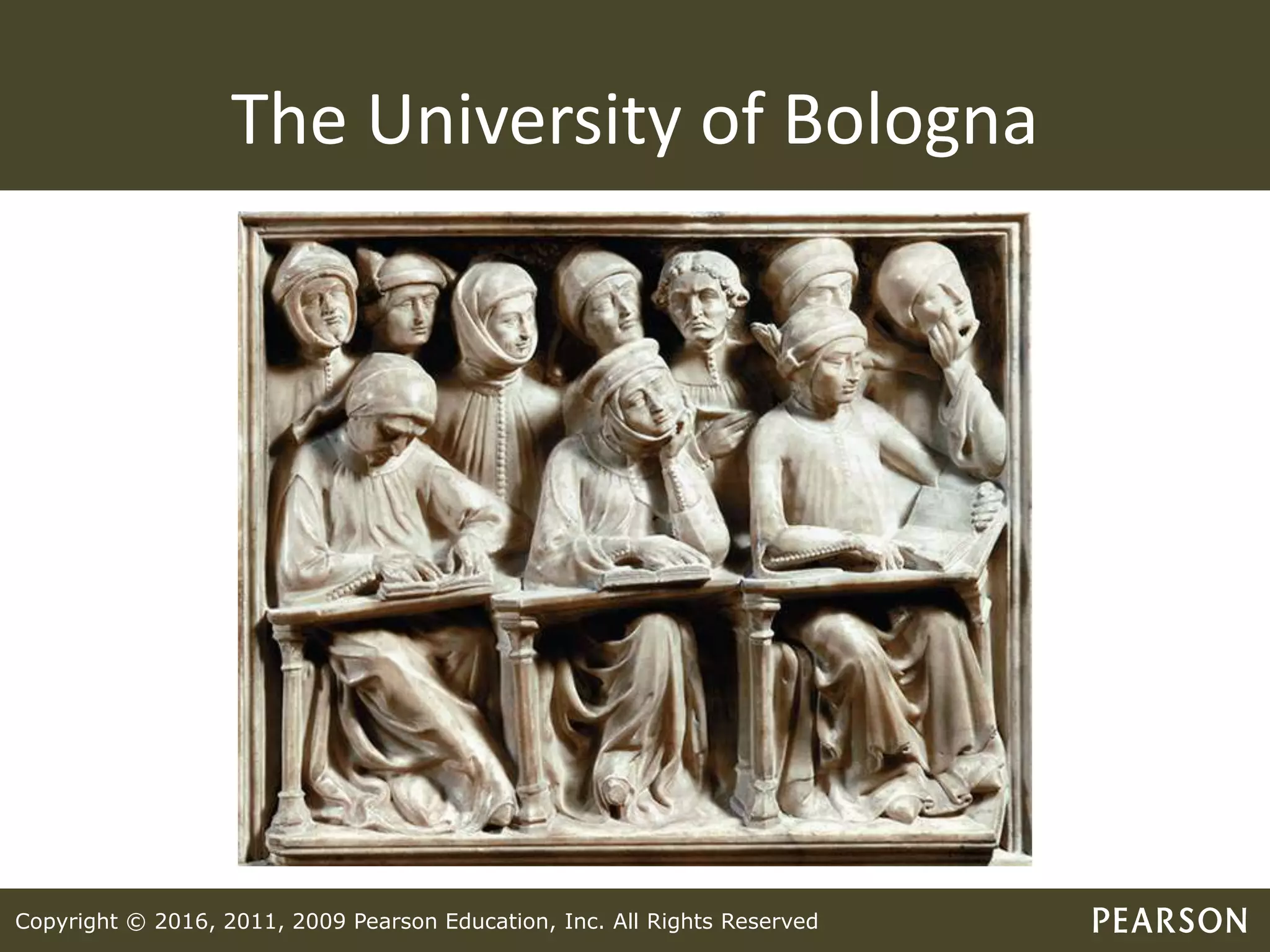
The University of Bologna
Copyright © 2016, 2011, 2009 Pearson Education, Inc. All Rights Reserved
15.2 Society
Learning Objective:
Summarize the changes affecting the
nobility, clergy, peasantry, and women
during the Late Middle Ages.
Copyright © 2016, 2011, 2009 Pearson Education, Inc. All Rights Reserved
15.2.1 The Order of Life (1 of 2)
• By the Late Middle Ages, a distinguishable
higher and lower nobility had evolved.
• Noblemen formed a broad spectrum.
• Unlike the nobility and the peasantry, the
clergy was an open estate that could be joined
through training.
• There were two basic types of clerical
vocation: regular clergy and secular clergy.
Copyright © 2016, 2011, 2009 Pearson Education, Inc. All Rights Reserved
15.2.1 The Order of Life (2 of 2)
• The largest and lowest social group in
medieval society was the agrarian peasantry.
• Manors changed in the later Middle Ages due
to the increasing importance of the single-
family holding and the conversion of the serf’s
dues into money payments.
Copyright © 2016, 2011, 2009 Pearson Education, Inc. All Rights Reserved
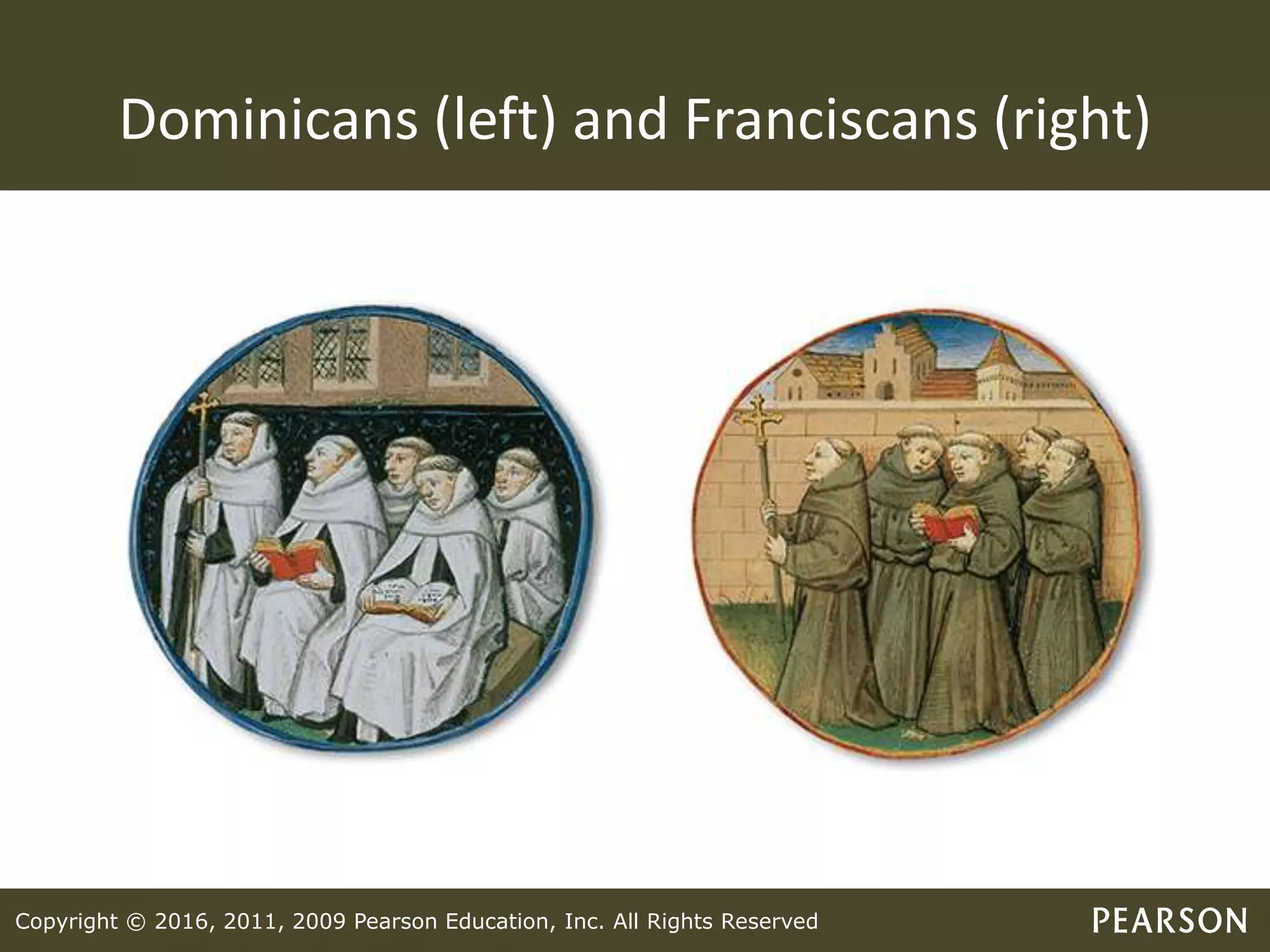
Dominicans (left) and Franciscans (right)
Copyright © 2016, 2011, 2009 Pearson Education, Inc. All Rights Reserved
15.2.2 Medieval Women (1 of 2)
• Christian theologians depicted women as
physically, mentally, and morally weaker than
men.
• All major Germanic law codes recognized the
economic freedom of women along with
certain legal rights.
• The nunnery was an option for single women
from the higher social classes.
Copyright © 2016, 2011, 2009 Pearson Education, Inc. All Rights Reserved
15.2.2 Medieval Women (2 of 2)
• In the ninth century, under the influence of
Christianity, the Carolingians made monogamy
official policy.
• Women were excluded from the professions
of scholarship, medicine, and law by gender
alone.
Copyright © 2016, 2011, 2009 Pearson Education, Inc. All Rights Reserved
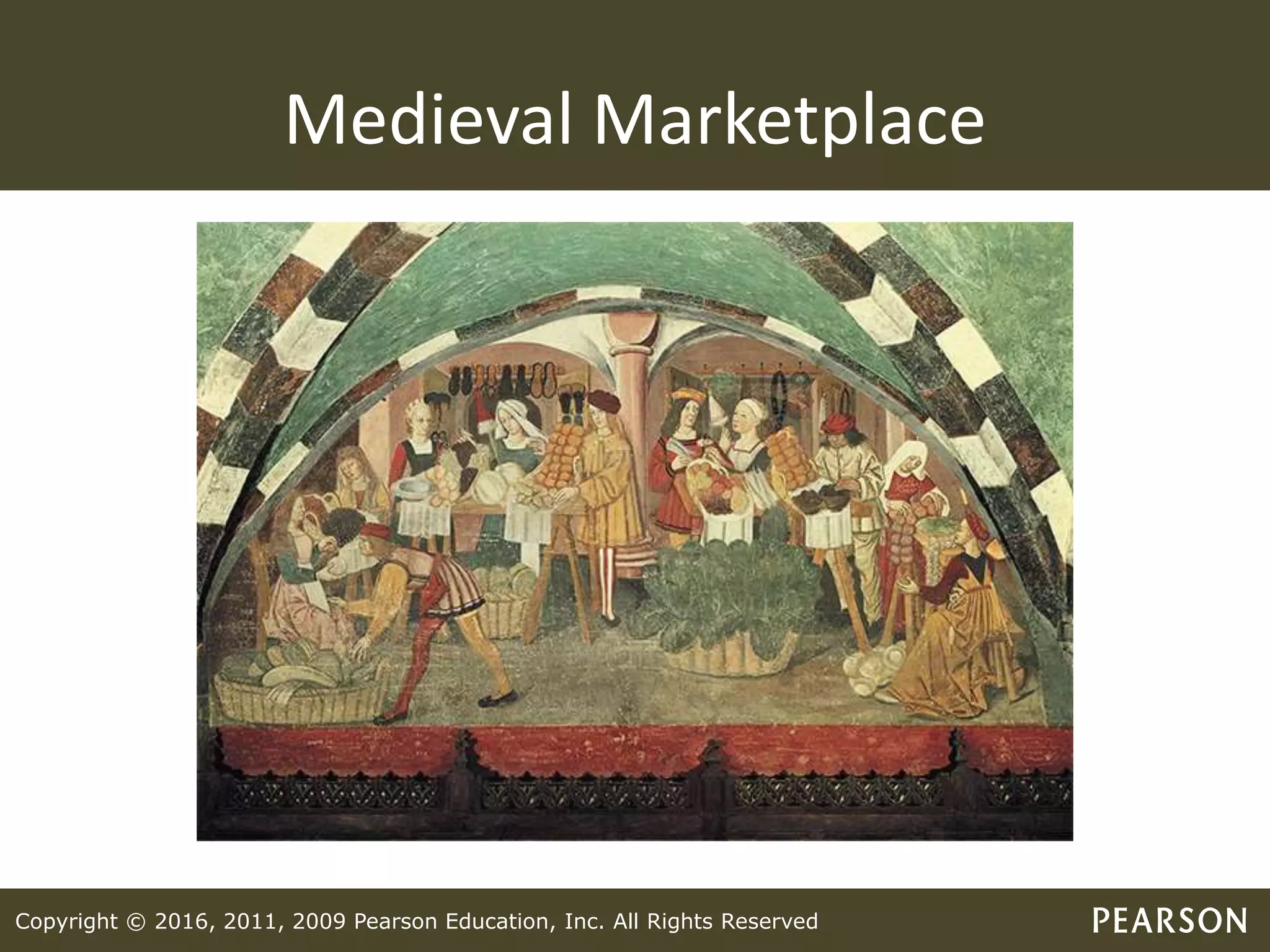
Medieval Marketplace
Copyright © 2016, 2011, 2009 Pearson Education, Inc. All Rights Reserved
15.3 Growth of National Monarchies
Learning Objective:
Compare and contrast the relations among
monarchs, lesser nobility, and the Catholic
Church in England, France, and the
Hohenstaufen Empire during the Late
Middle Ages.
Copyright © 2016, 2011, 2009 Pearson Education, Inc. All Rights Reserved
15.3.1 England and France: Hastings (1066)
and Bouvines (1214)
• In 1066 the Battle of Hastings led to the swift
conquest of England by the Normans.
• With the full support of the clergy and the
townspeople, the nobility forced the king’s
grudging recognition of the Magna Carta in 1215.
• At Bouvines on July 27, 1214, the French won
handily over the English and their German allies.
• The victory unified France and laid the foundation
for French ascendancy in the Late Middle Ages.
Copyright © 2016, 2011, 2009 Pearson Education, Inc. All Rights Reserved
15.3.2 France in the Thirteenth Century:
Reign of Louis IX
• Louis IX (r. 1226–1270), the grandson of Philip
Augustus, embodied the medieval view of the
perfect ruler.
• Louis’s greatest achievements lay at home as he
molded the French bureaucracy into an
instrument of order in local government.
• Louis abolished private wars and serfdom, gave
his subjects the right of appeal from local to
higher courts, and made the tax system more
equitable.
Copyright © 2016, 2011, 2009 Pearson Education, Inc. All Rights Reserved
15.3.3 The Hohenstaufen Empire
(1152–1272)
• While stable governments developed in
England and France, the Holy Roman Empire
fragmented in disunity and blood feuding.
• Frederick I Barbarossa (1152–1190), the first
of the Hohenstaufens, reestablished imperial
authority.
• To secure the imperial title for himself and his
sons, Frederick II made the German princes
undisputed lords over their territories.
Copyright © 2016, 2011, 2009 Pearson Education, Inc. All Rights Reserved
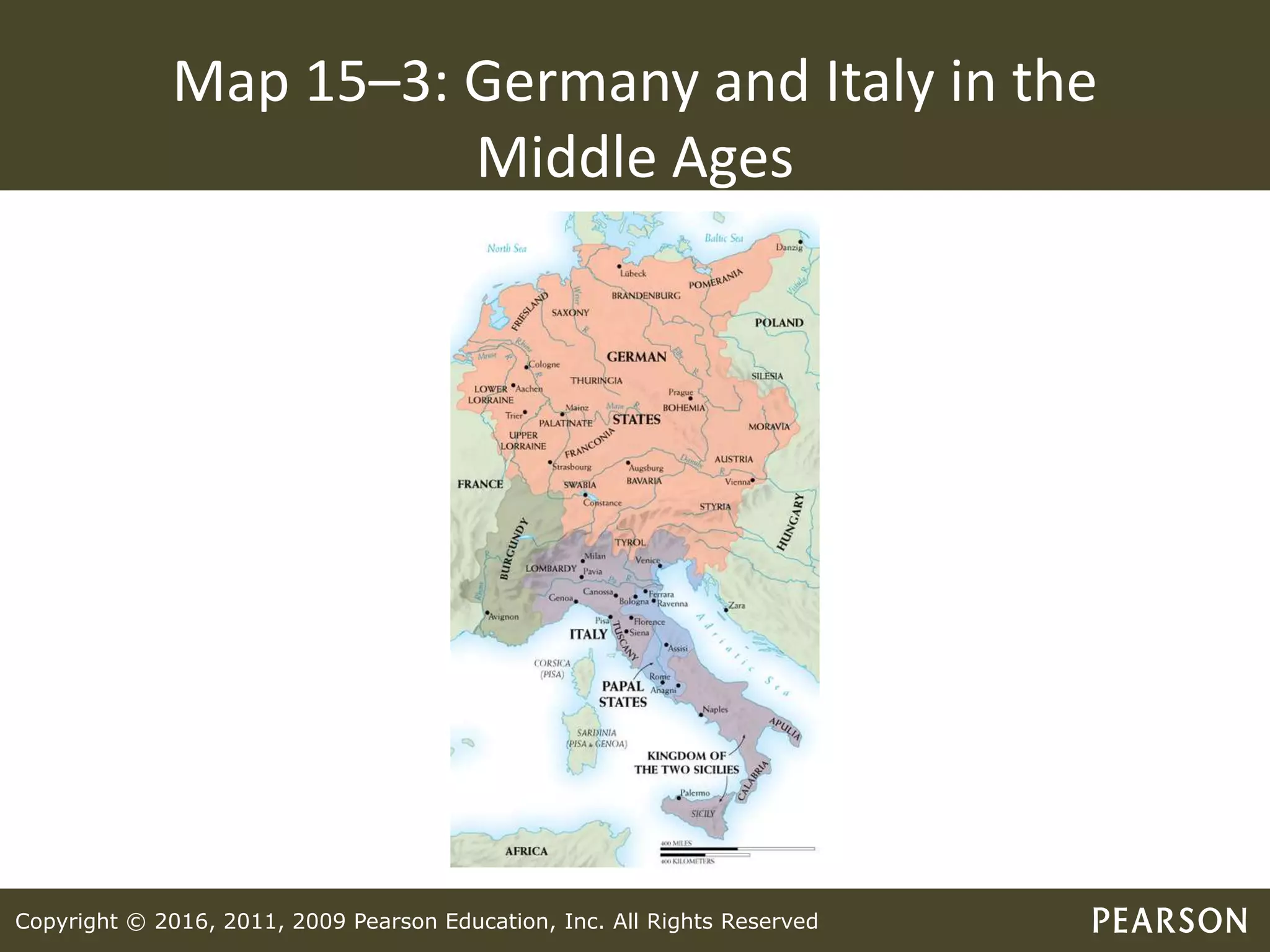
Map 15–3: Germany and Italy in the
Middle Ages
Copyright © 2016, 2011, 2009 Pearson Education, Inc. All Rights Reserved
15.4 Political and Social Breakdown
Learning Objective:
Summarize the causes and
consequences of the Hundred Years’
War and the Black Death.
Copyright © 2016, 2011, 2009 Pearson Education, Inc. All Rights Reserved
15.4.1 Hundred Years’ War:
Causes and Consequences (1 of 2)
• England and France were territorial and
economic rivals with a long history of prejudice
and animosity between them.
• Most of the major battles were stunning English
victories.
• Thanks in part to the inspiring leadership of Joan
of Arc (1412–1431), and a sense of national
identity and self-confidence, the French were
able to expel the English from France.
Copyright © 2016, 2011, 2009 Pearson Education, Inc. All Rights Reserved
15.4.1 Hundred Years’ War:
Causes and Consequences (2 of 2)
• The Hundred Years’ War devastated France
but also awakened French nationalism and
hastened the country’s transition to a
centralized state.
• In both France and England the burden of the
war fell most heavily on the peasantry.
Copyright © 2016, 2011, 2009 Pearson Education, Inc. All Rights Reserved
15.4.2 The Black Death (1 of 3)
• It is estimated that Europe’s population
doubled between the years 1000 and 1300
and began thereafter to outstrip food
production.
• Between 1315 and 1317, cold weather and
crop failures produced the greatest famine of
the Middle Ages.
• The Black Death was most likely introduced by
rats from Black Sea areas.
Copyright © 2016, 2011, 2009 Pearson Education, Inc. All Rights Reserved
15.4.2 The Black Death (2 of 3)
• It is estimated that western Europe had lost as
much as two-fifths of its population by the
early fifteenth century.
• In some places, Jews were cast as scapegoats.
• A shrunken labor supply and a decline in the
value of the estates of the nobility were
consequences of the plague.
Copyright © 2016, 2011, 2009 Pearson Education, Inc. All Rights Reserved
15.4.2 The Black Death (3 of 3)
• Landowners also sought to reverse their
misfortune by new repressive legislation that
forced peasants to stay on their farms while
freezing their wages at low levels.
• These policies resulted in peasant revolts,
including one in France ignited by a direct tax,
the taille.
Copyright © 2016, 2011, 2009 Pearson Education, Inc. All Rights Reserved
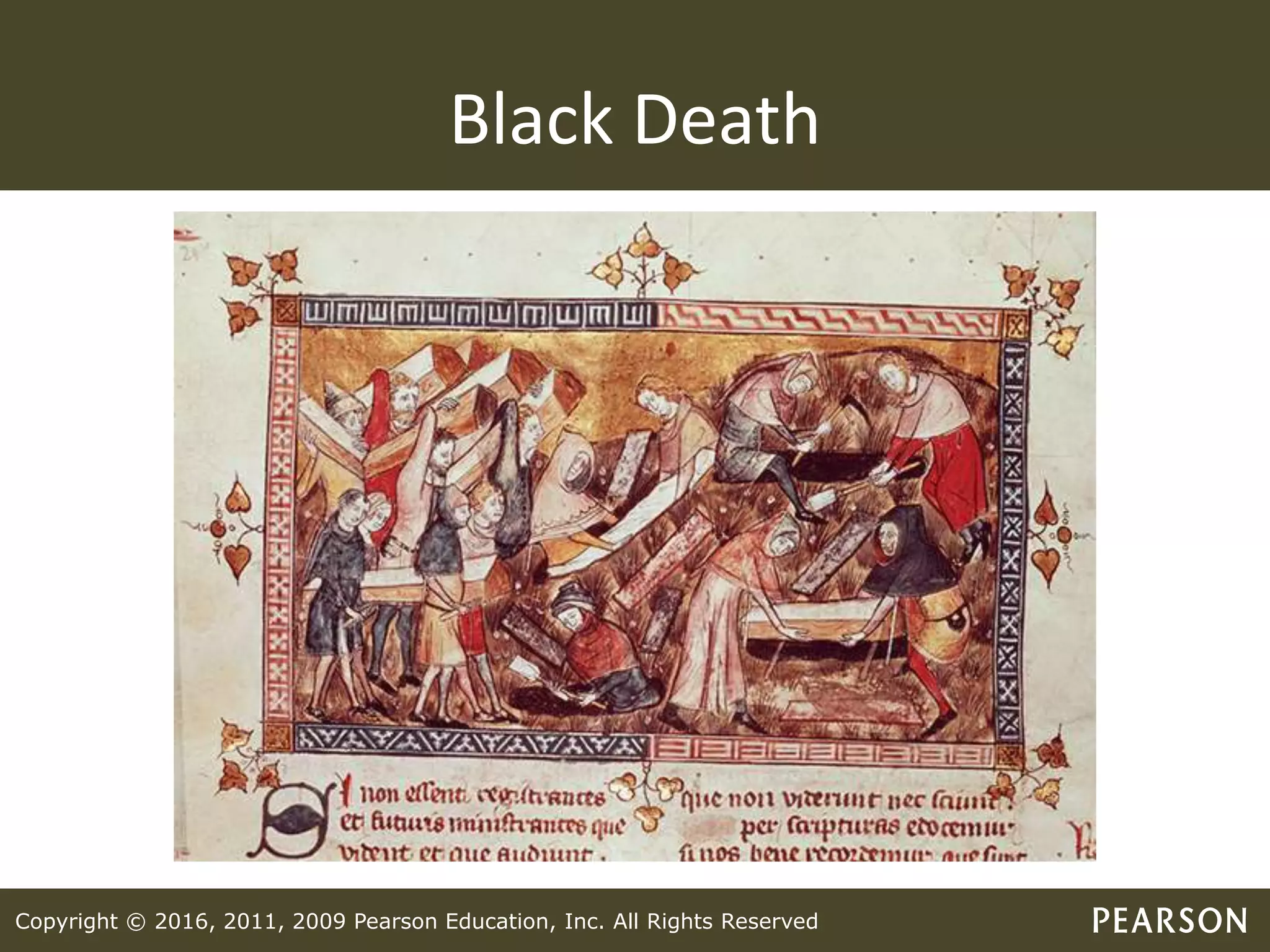
Black Death
Copyright © 2016, 2011, 2009 Pearson Education, Inc. All Rights Reserved
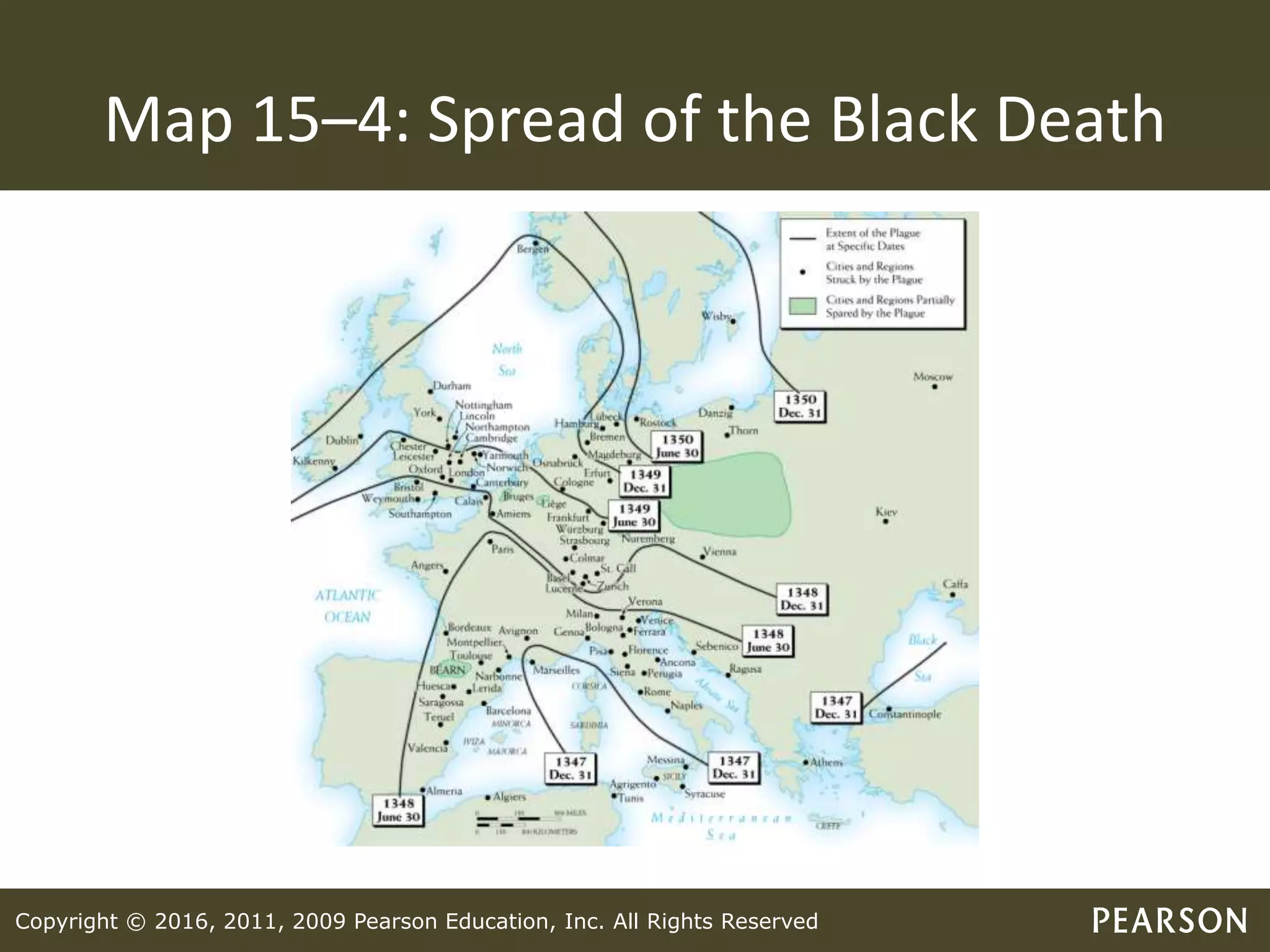
Map 15–4: Spread of the Black Death
Copyright © 2016, 2011, 2009 Pearson Education, Inc. All Rights Reserved
15.4.3 New Conflicts and Opportunities
• Conflicts within the guilds began to develop.
• Kings exploited growing national sentiment to
centralize their governments and economies.
Copyright © 2016, 2011, 2009 Pearson Education, Inc. All Rights Reserved
15.5 Ecclesiastical Breakdown and Revival:
The Late Medieval Church
Learning Objective:
Describe the factors leading to the
Great Schism and the subsequent
reunification of the Church.
Copyright © 2016, 2011, 2009 Pearson Education, Inc. All Rights Reserved
15.5.1 Boniface VIII and Philip the Fair
• When Pope Boniface VIII (r. 1294–1303) issued
a bull, Clericis Laicos, King Philip the Fair of
France (r. 1285–1314) unleashed a ruthless
antipapal campaign.
• No pope ever again so seriously threatened
kings and emperors.
Copyright © 2016, 2011, 2009 Pearson Education, Inc. All Rights Reserved
15.5.2 The Great Schism (1378–1417) and
the Conciliar Movement to 1449 (1 of 2)
• The papal court was moved to Avignon in
France for most of the fourteenth century.
• After being returned to Rome, plans were
made by a new pope to reform the papal
government in his Curia.
• Not wanting to surrender the benefits of a
papacy under French influence, the French
king, Charles V (r. 1364–1380), supported the
Great Schism.
Copyright © 2016, 2011, 2009 Pearson Education, Inc. All Rights Reserved
15.5.2 The Great Schism (1378–1417) and
the Conciliar Movement to 1449 (2 of 2)
• Hereafter allegiance to the two papal courts
divided along political lines. A third pope was
added in 1409.
• The church finally elected a new pope, Martin
V (r. 1417–1431), in November 1417, reuniting
the church.
• Secular authority, through Emperor Sigismund
of the Holy Roman Empire, was central to this
process.
Copyright © 2016, 2011, 2009 Pearson Education, Inc. All Rights Reserved
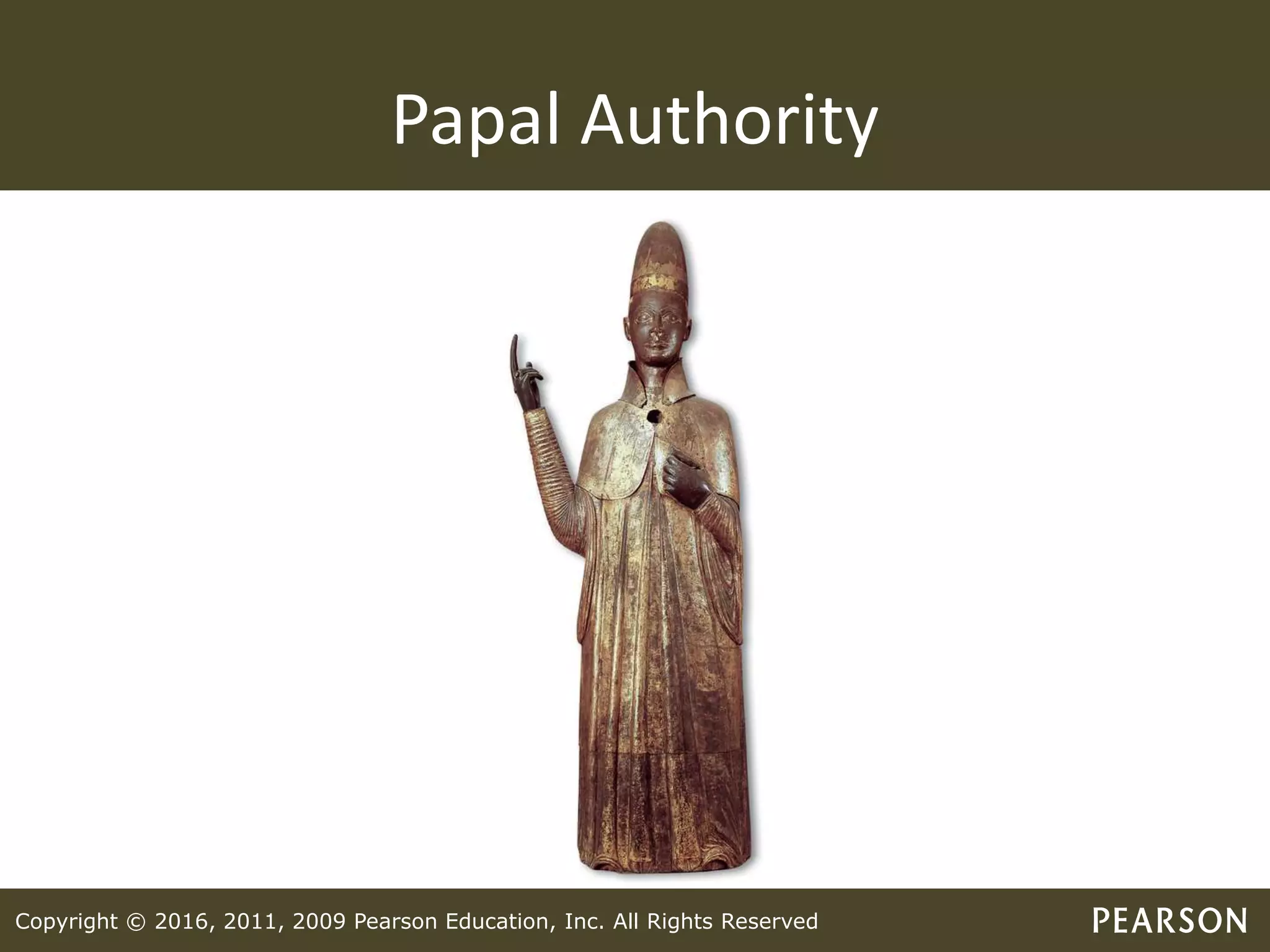
Papal Authority
Copyright © 2016, 2011, 2009 Pearson Education, Inc. All Rights Reserved
15.6 The Renaissance in Italy (1375–1527)
(1 of 2)
Learning Objective:
Survey the Renaissance in Italy, including
the social conflicts in the Italian city-states,
humanism, Renaissance art, and the Italian
political decline.
Copyright © 2016, 2011, 2009 Pearson Education, Inc. All Rights Reserved
15.6 The Renaissance in Italy (1375–1527)
(2 of 2)
• The Renaissance is the term used to describe
fourteenth- and fifteenth-century efforts to
revive ancient learning.
• This movement was a transition from the
medieval to the modern world.
• Renaissance Europe was characterized by
growing national consciousness and political
centralization, an urban capitalist economy,
and secular control of thought and culture.
Copyright © 2016, 2011, 2009 Pearson Education, Inc. All Rights Reserved
15.6.1 The Italian City-State:
Social Conflict and Despotism
• Renaissance society took distinctive shape
within the cities of late medieval Italy.
• During the thirteenth and fourteenth
centuries, Italian cities became powerful city-
states, dominating the political and economic
life of the surrounding countryside.
• Social strife and competition for political
power were so intense that most evolved into
despotisms by the fifteenth century.
Copyright © 2016, 2011, 2009 Pearson Education, Inc. All Rights Reserved
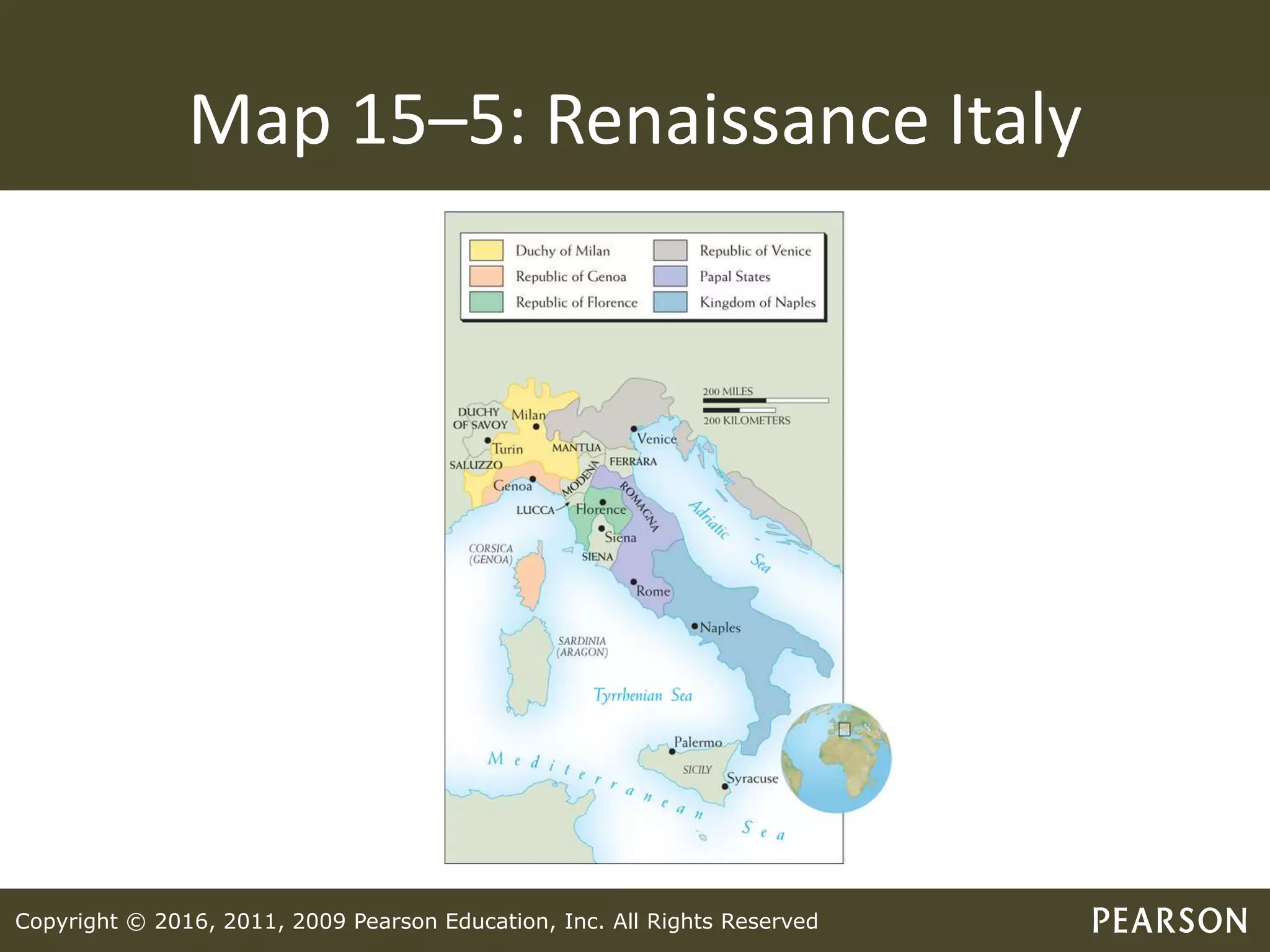
Map 15–5: Renaissance Italy
Copyright © 2016, 2011, 2009 Pearson Education, Inc. All Rights Reserved
15.6.2 Humanism (1 of 2)
• Humanism refers to the scholarly study of the
Latin and Greek classics and the writings of
the ancient Church Fathers.
• Humanists supported a liberal arts program,
studia humanitatis.
• Unlike their Scholastic rivals, humanists went
directly to the original source and drew their
own conclusions.
Copyright © 2016, 2011, 2009 Pearson Education, Inc. All Rights Reserved
15.6.2 Humanism (2 of 2)
• The classical ideal of a useful education that
produces well-rounded, effective people
inspired far-reaching reforms in traditional
education.
Copyright © 2016, 2011, 2009 Pearson Education, Inc. All Rights Reserved
15.6.3 Renaissance Art in and beyond Italy
(1 of 2)
• Renaissance art reproduced nature and
human nature realistically, in both its physical
beauty and its grotesqueness.
• New artistic materials and techniques, such as
chiaroscuro, added Renaissance artists.
• The Italian polymath Leonardo da Vinci (1452–
1519) personified the Renaissance ideal of the
universal person.
Copyright © 2016, 2011, 2009 Pearson Education, Inc. All Rights Reserved
15.6.3 Renaissance Art in and beyond Italy
(2 of 2)
• Michelangelo Buonarroti (1475–1564) also
excelled in a variety of arts and crafts.
• The experimental style known as Mannerism
developed late in the Renaissance.
Copyright © 2016, 2011, 2009 Pearson Education, Inc. All Rights Reserved
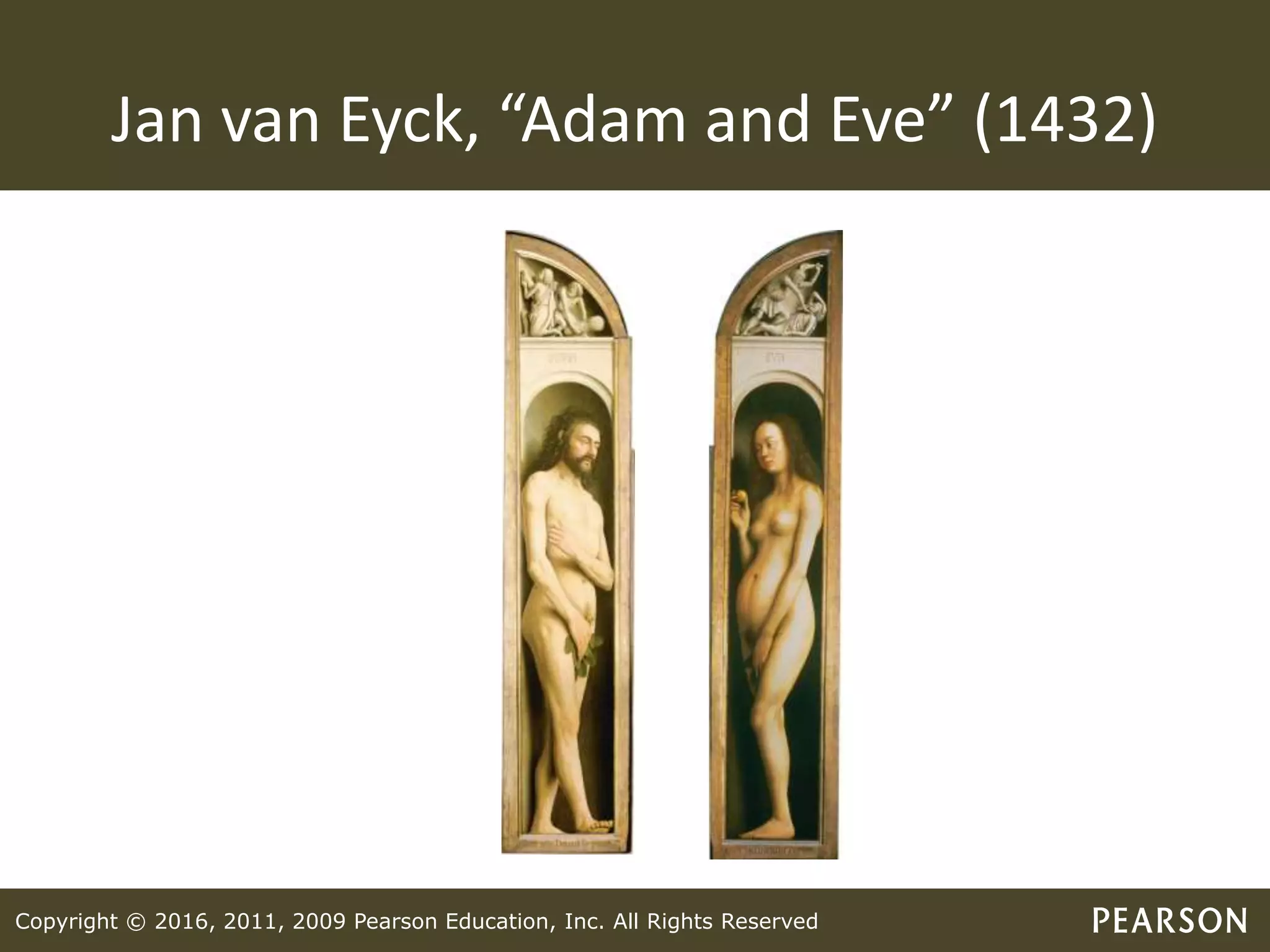
Jan van Eyck, “Adam and Eve” (1432)
Copyright © 2016, 2011, 2009 Pearson Education, Inc. All Rights Reserved
Document: Pico della Mirandola States the
Renaissance Image of the Human Ideal
• In what does the dignity of humankind
consist?
• Does Pico reject the biblical description of
Adam and Eve’s fall?
• Does he exaggerate a person’s ability to
choose freely to be whatever he or she
wishes?
• What inspired such seeming hubris during the
Renaissance?
Copyright © 2016, 2011, 2009 Pearson Education, Inc. All Rights Reserved
15.6.4 Italy’s Political Decline:
The French Invasions (1494–1527)
• Repeated French invasions over dynastic
claims weakened the Italian city-states.
• The French monarchy and papacy reached an
agreement known as the Concordat of
Bologna (August 1516).
Copyright © 2016, 2011, 2009 Pearson Education, Inc. All Rights Reserved
15.6.5 Niccolò Machiavelli
• Niccolò Machiavelli (1469–1527) argued that
only an unscrupulous strongman using
duplicity and terror could impose order on his
people.
Copyright © 2016, 2011, 2009 Pearson Education, Inc. All Rights Reserved
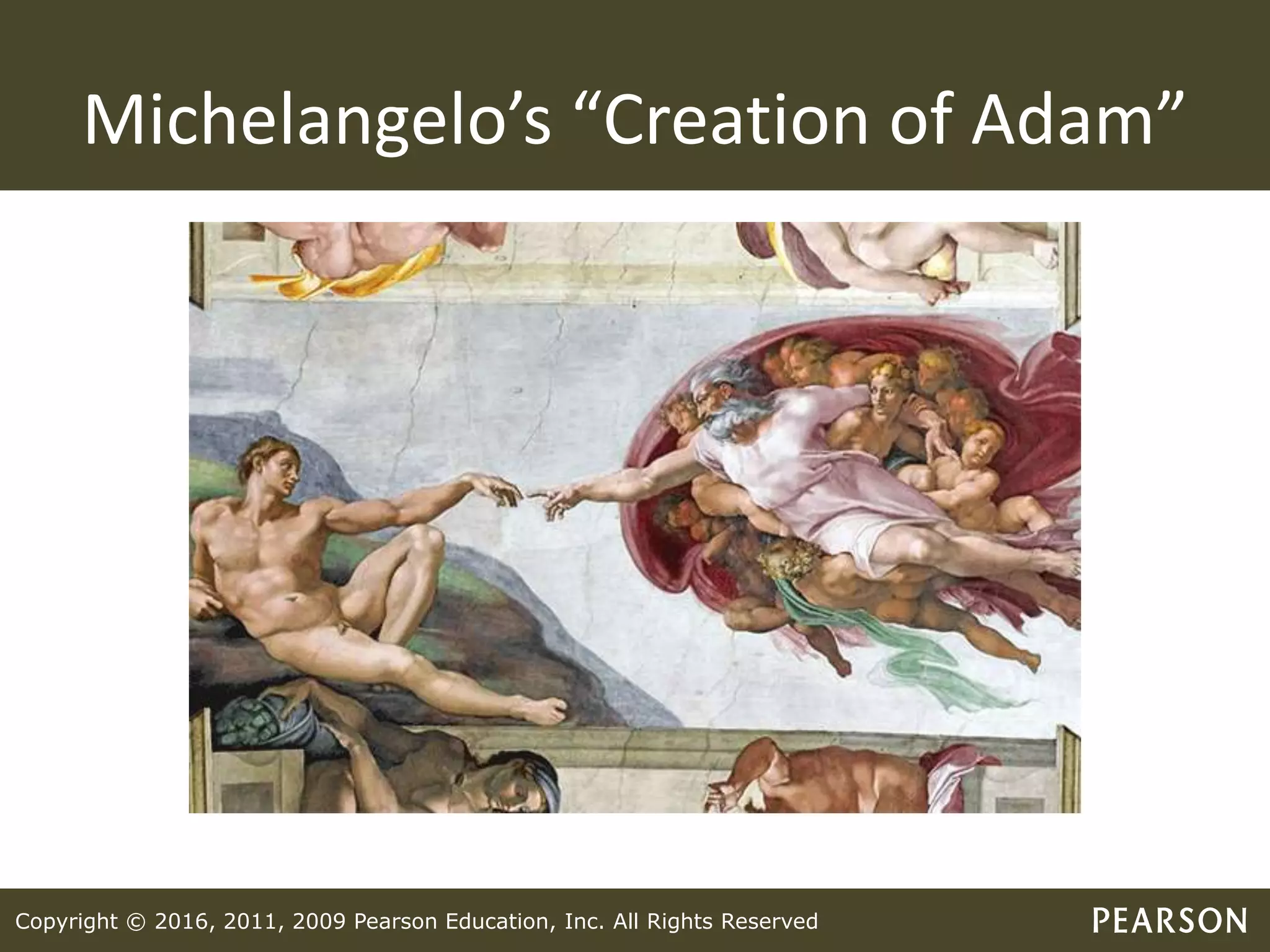
Michelangelo’s “Creation of Adam”
Copyright © 2016, 2011, 2009 Pearson Education, Inc. All Rights Reserved
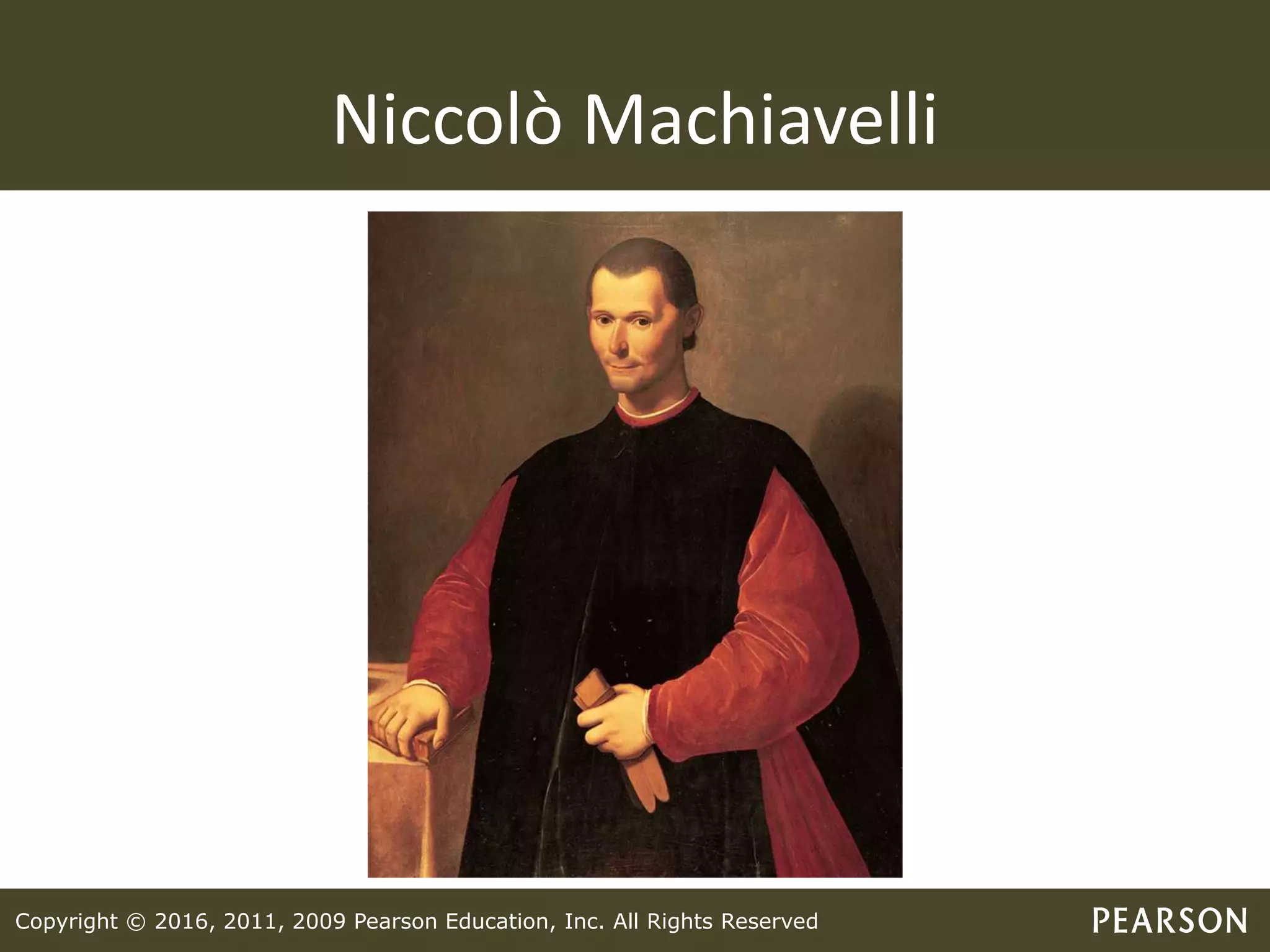
Niccolò Machiavelli
Copyright © 2016, 2011, 2009 Pearson Education, Inc. All Rights Reserved
15.7 Revival of Monarchy: Nation-Building
in the Fifteenth Century (1 of 2)
Learning Objective:
Analyze the revival of monarchy and
the process of nation-building in the
fifteenth century in Russia, France,
Spain, and England.
Copyright © 2016, 2011, 2009 Pearson Education, Inc. All Rights Reserved
15.7 Revival of Monarchy: Nation-Building
in the Fifteenth Century (2 of 2)
• With the emergence of sovereign rulers after
1450, unified national monarchies replaced
fragmented and divisive feudal governance.
• In a sovereign state, the powers of taxation,
war-making, and law enforcement became
concentrated in the hands of the monarch.
• The growing cost of warfare increased the
need to develop new national sources of royal
income.
Copyright © 2016, 2011, 2009 Pearson Education, Inc. All Rights Reserved
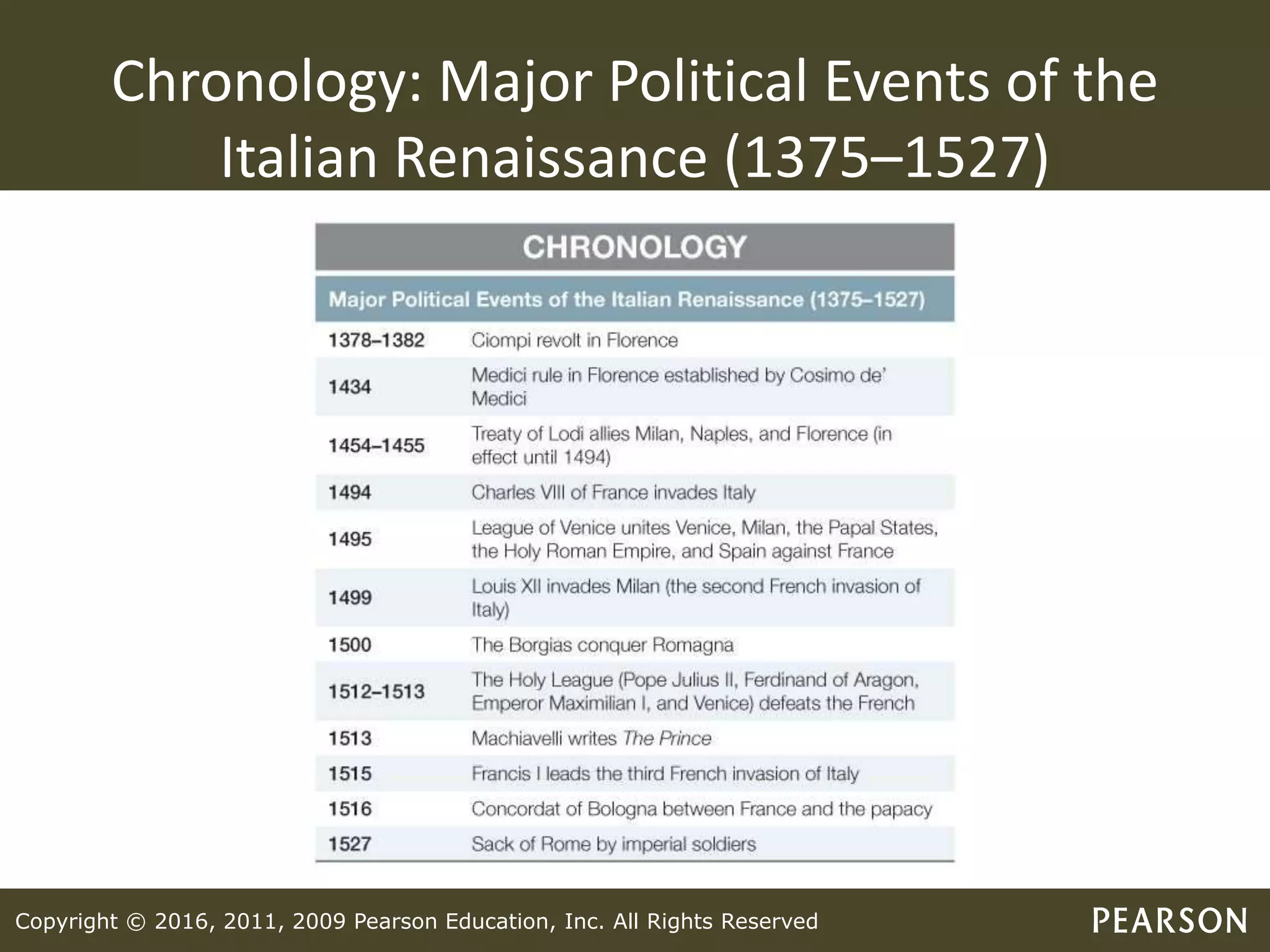
Chronology: Major Political Events of the
Italian Renaissance (1375–1527)
Copyright © 2016, 2011, 2009 Pearson Education, Inc. All Rights Reserved
15.7.1 Medieval Russia
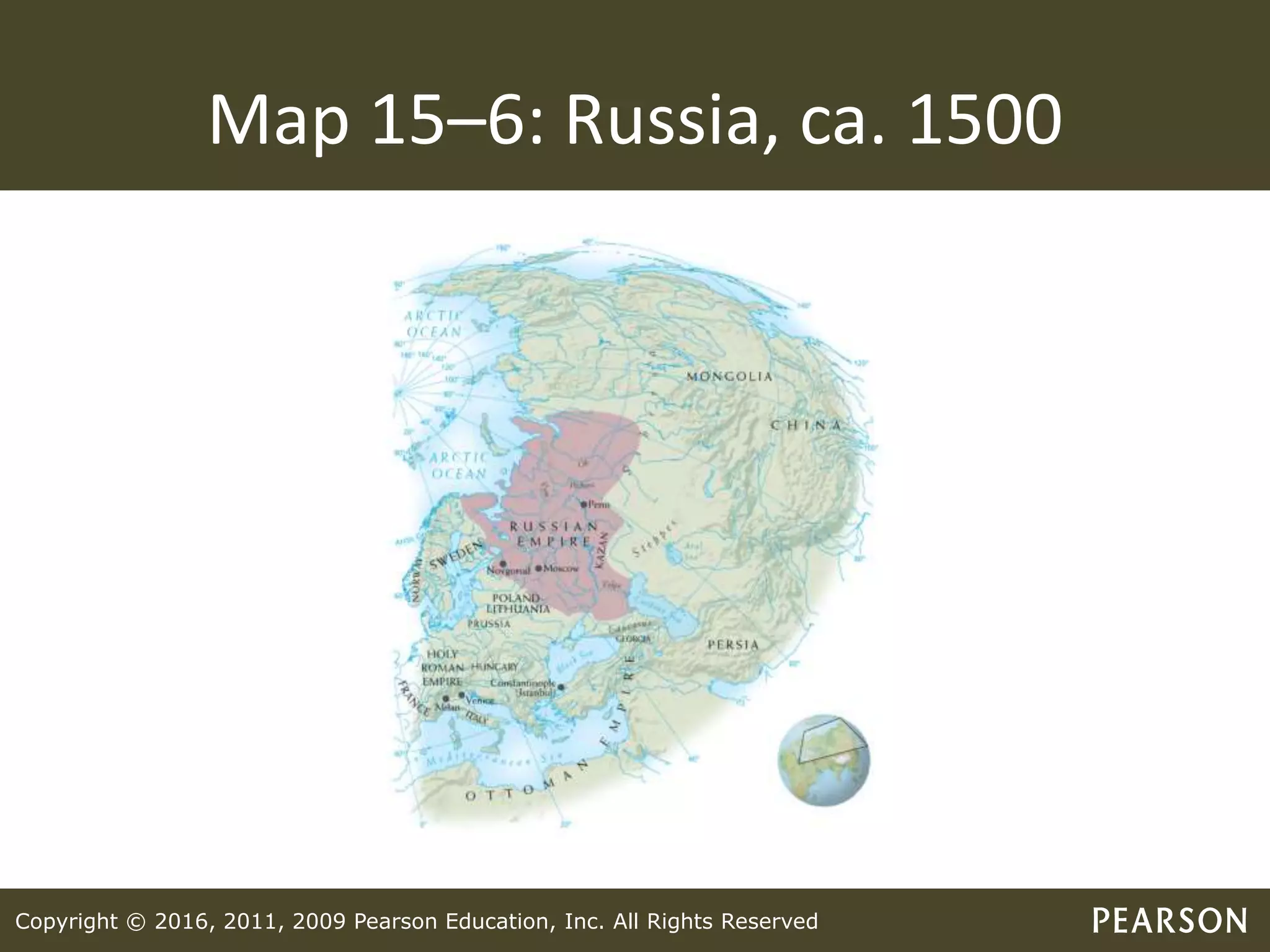
• Mongol armies invaded Russia in 1223, and Kiev
fell in 1240, forcing Russian cities to pay tribute to
the segment of the Mongol Empire called the
Golden Horde.
• Mongol rule divided Russia from the West but left
Russian political institutions and religion largely
intact.
• By the last quarter of the fifteenth century,
Moscow had replaced Kiev as the political and
religious center of Russia.
Copyright © 2016, 2011, 2009 Pearson Education, Inc. All Rights Reserved
Map 15–6: Russia, ca. 1500
Copyright © 2016, 2011, 2009 Pearson Education, Inc. All Rights Reserved
15.7.2 France
• By the mid–sixteenth century France was
again a defeated nation and almost as divided
internally as it had been during the Hundred
Years’ War.
Copyright © 2016, 2011, 2009 Pearson Education, Inc. All Rights Reserved
15.7.3 Spain
• Religious toleration ended dramatically under
Ferdinand and Isabella, who made Spain the
prime example of state-controlled religion.
• Ferdinand and Isabella exercised almost total
control over the Spanish church.
• The new Spanish power was also evident in
Ferdinand and Isabella’s promotion of
overseas exploration.
Copyright © 2016, 2011, 2009 Pearson Education, Inc. All Rights Reserved
15.7.4 England
• Henry Tudor ruled as Henry VII (r. 1485–1509),
the first of the new Tudor Dynasty.
• Henry shrewdly construed legal precedents to
the advantage of the Crown, using English law
to further his own ends.

Craig10e ch15 ppt_ops_final

  • 1.
    Copyright © 2016,2011, 2009 Pearson Education, Inc. All Rights Reserved The Heritage of World Civilizations Tenth Edition Chapter 15 Europe to the Early 1500s: Revival, Decline, and Renaissance
  • 2.
    Copyright © 2016,2011, 2009 Pearson Education, Inc. All Rights Reserved The Medieval Universe
  • 3.
    Copyright © 2016,2011, 2009 Pearson Education, Inc. All Rights Reserved Learning Objectives (1 of 2) 15.1 Revival of Empire, Church, and Towns • Analyze the factors involved in the revival of the Holy Roman Empire and the Catholic Church and in the rise of towns during the eleventh and twelfth centuries. 15.2 Society • Summarize the changes affecting the nobility, clergy, peasantry, and women during the Late Middle Ages. 15.3 Growth of National Monarchies • Compare and contrast the relations among monarchs, lesser nobility, and the Catholic Church in England, France, and the Hohenstaufen Empire during the Late Middle Ages.
  • 4.
    Copyright © 2016,2011, 2009 Pearson Education, Inc. All Rights Reserved Learning Objectives (2 of 2) 15.4 Political and Social Breakdown • Summarize the causes and consequences of the Hundred Years’ War and the Black Death. 15.5 Ecclesiastical Breakdown and Revival: The Late Medieval Church • Describe the factors leading to the Great Schism and the subsequent reunification of the Church. 15.6 The Renaissance in Italy (1375–1527) • Survey the Renaissance in Italy, including the social conflicts in the Italian city- states, humanism, Renaissance art, and the Italian political decline. 15.7 Revival of Monarchy: Nation-Building in the Fifteenth Century • Analyze the revival of monarchy and the process of nation-building in the fifteenth century in Russia, France, Spain, and England.
  • 5.
    Copyright © 2016,2011, 2009 Pearson Education, Inc. All Rights Reserved Introduction (1 of 2) • The High Middle Ages was a period of political expansion and consolidation and of intellectual flowering and synthesis. • The Latin, or Western, church established itself as a spiritual authority independent of secular monarchies. • The High Middle Ages saw a revolution in agriculture that increased food supplies and populations.
  • 6.
    Copyright © 2016,2011, 2009 Pearson Education, Inc. All Rights Reserved Introduction (2 of 2) • Commerce revived, printing was invented, and new intellectual currents emerged drawing on the writings of antiquity. • War and the Black Death were calamities for Europe. • The vernacular—local language—took its place alongside Latin.
  • 7.
    Copyright © 2016,2011, 2009 Pearson Education, Inc. All Rights Reserved Global Perspective: The High Middle Ages in Western Europe (1 of 3) • Europe began to escape its relative isolation from the rest of the world. • The Crusades and renewed trade along the Silk Road linking China and Europe were central to ending this isolation. • Christianity allowed Europeans to think of themselves as one people and to unite in the Crusades.
  • 8.
    Copyright © 2016,2011, 2009 Pearson Education, Inc. All Rights Reserved Global Perspective: The High Middle Ages in Western Europe (2 of 3) • The Crusades brought Europeans into more direct and frequent contact with the non- European world than they had known since the Roman Empire. • Eventually Europeans sought to bypass the Islamic world entirely and secure supplies of Eastern products by going directly to the sources in India and East Asia.
  • 9.
    Copyright © 2016,2011, 2009 Pearson Education, Inc. All Rights Reserved Global Perspective: The High Middle Ages in Western Europe (3 of 3) 1. How did the High Middle Ages in Europe differ from the Early Middle Ages? 2. What was the legacy of the Crusades for Europe? In what ways did they signal the start of new relationships between Europe and the wider world?
  • 10.
    Copyright © 2016,2011, 2009 Pearson Education, Inc. All Rights Reserved 15.1 Revival of Empire, Church, and Towns Learning Objective: Analyze the factors involved in the revival of the Holy Roman Empire and the Catholic Church and in the rise of towns during the eleventh and twelfth centuries.
  • 11.
    Copyright © 2016,2011, 2009 Pearson Education, Inc. All Rights Reserved 15.1.1 Otto I and the Revival of the Empire • Otto I (r. 936–973) invaded Italy and proclaimed himself king in 951. • Otto enlisted bishops and abbots as agents of the king. • In 962 Otto became Holy Roman Emperor.
  • 12.
    Copyright © 2016,2011, 2009 Pearson Education, Inc. All Rights Reserved 15.1.2 The Reviving Catholic Church • In a great monastery at Cluny, a reform movement was born that aimed to free the church from secular control. • The Cluny reformers uncompromisingly condemned the mixing of religious and secular institutions and the clergy’s subservience to royal authority. • They further denounced the transgression of ascetic piety by “secular” parish clergy. • In the Investiture Controversy, church and state agreed to distinctive spheres of ecclesiastical and secular authority.
  • 13.
    Copyright © 2016,2011, 2009 Pearson Education, Inc. All Rights Reserved 15.1.3 The Crusades (1 of 2) • Religion was not the only motive inspiring the Crusades, but early Crusades were inspired by genuine religious piety and were orchestrated by the papacy. • In the First Crusade (1095–1099), the Crusaders soundly defeated one Seljuk army after another and captured Jerusalem on July 15, 1099. • The victorious Crusaders divided conquered territories into the feudal states of Jerusalem, Edessa, and Antioch.
  • 14.
    Copyright © 2016,2011, 2009 Pearson Education, Inc. All Rights Reserved 15.1.3 The Crusades (2 of 2) • Muslim resistance broke the Crusaders’ resolve around the mid–twelfth century. • The Second and Third Crusades failed militarily. • A Fourth Crusade (1202–1204) transformed itself into a piratical commercial venture controlled by the Venetians.
  • 15.
    Copyright © 2016,2011, 2009 Pearson Education, Inc. All Rights Reserved Document: Pope Urban II (r. 1088–1099) Preaches the First Crusade • Is the pope engaging in a propaganda and smear campaign? • What images of the enemy does he create, and how accurate and fair are they? • Did the Christian church have a greater claim to Jerusalem than the people then living there? • Does a religious connection with the past entitle one group to confiscate the land of another?
  • 16.
    Copyright © 2016,2011, 2009 Pearson Education, Inc. All Rights Reserved Map 15–1: The Early Crusades
  • 17.
    Copyright © 2016,2011, 2009 Pearson Education, Inc. All Rights Reserved 15.1.4 Towns and Townspeople (1 of 3) • In the eleventh and twelfth centuries, most towns were small and held only about 5 percent of western Europe’s population. • As towns grew, many serfs took their skills to the new urban centers. • Rural society gave the towns their craftspeople , laborers, and maybe even the first merchants. • As the traders grew in wealth and numbers, they became able to challenge traditional seigneurial authority.
  • 18.
    Copyright © 2016,2011, 2009 Pearson Education, Inc. All Rights Reserved 15.1.4 Towns and Townspeople (2 of 3) • Around 1100 the old urban nobility and the new burgher upper class merged into an urban patriciate. • Small artisans and craftspeople also slowly developed their own protective associations or guilds and began to gain a voice in government. • Towns became a major force in the transition from feudal societies to national governments.
  • 19.
    Copyright © 2016,2011, 2009 Pearson Education, Inc. All Rights Reserved 15.1.4 Towns and Townspeople (3 of 3) • Modern universities and university towns such as Bologna in Italy emerged. • The method of study known as Scholasticism spread across Europe. • Peter Abelard was the leading philosopher and theologian of his time.
  • 20.
    Copyright © 2016,2011, 2009 Pearson Education, Inc. All Rights Reserved Foundry in Florence
  • 21.
    Copyright © 2016,2011, 2009 Pearson Education, Inc. All Rights Reserved Chronology: The Crusades
  • 22.
    Copyright © 2016,2011, 2009 Pearson Education, Inc. All Rights Reserved A Closer Look: European Embrace of a Black Saint
  • 23.
    Copyright © 2016,2011, 2009 Pearson Education, Inc. All Rights Reserved Map 15–2: Medieval Trade Routes and Regional Products
  • 24.
    Copyright © 2016,2011, 2009 Pearson Education, Inc. All Rights Reserved Document: Student Life at the University of Paris • Why were students from different lands so prejudiced against one another? • Was the rivalry among faculty members as intense as that among students? • What are the student criticisms of the faculty? Do they sound credible?
  • 25.
    Copyright © 2016,2011, 2009 Pearson Education, Inc. All Rights Reserved The University of Bologna
  • 26.
    Copyright © 2016,2011, 2009 Pearson Education, Inc. All Rights Reserved 15.2 Society Learning Objective: Summarize the changes affecting the nobility, clergy, peasantry, and women during the Late Middle Ages.
  • 27.
    Copyright © 2016,2011, 2009 Pearson Education, Inc. All Rights Reserved 15.2.1 The Order of Life (1 of 2) • By the Late Middle Ages, a distinguishable higher and lower nobility had evolved. • Noblemen formed a broad spectrum. • Unlike the nobility and the peasantry, the clergy was an open estate that could be joined through training. • There were two basic types of clerical vocation: regular clergy and secular clergy.
  • 28.
    Copyright © 2016,2011, 2009 Pearson Education, Inc. All Rights Reserved 15.2.1 The Order of Life (2 of 2) • The largest and lowest social group in medieval society was the agrarian peasantry. • Manors changed in the later Middle Ages due to the increasing importance of the single- family holding and the conversion of the serf’s dues into money payments.
  • 29.
    Copyright © 2016,2011, 2009 Pearson Education, Inc. All Rights Reserved Dominicans (left) and Franciscans (right)
  • 30.
    Copyright © 2016,2011, 2009 Pearson Education, Inc. All Rights Reserved 15.2.2 Medieval Women (1 of 2) • Christian theologians depicted women as physically, mentally, and morally weaker than men. • All major Germanic law codes recognized the economic freedom of women along with certain legal rights. • The nunnery was an option for single women from the higher social classes.
  • 31.
    Copyright © 2016,2011, 2009 Pearson Education, Inc. All Rights Reserved 15.2.2 Medieval Women (2 of 2) • In the ninth century, under the influence of Christianity, the Carolingians made monogamy official policy. • Women were excluded from the professions of scholarship, medicine, and law by gender alone.
  • 32.
    Copyright © 2016,2011, 2009 Pearson Education, Inc. All Rights Reserved Medieval Marketplace
  • 33.
    Copyright © 2016,2011, 2009 Pearson Education, Inc. All Rights Reserved 15.3 Growth of National Monarchies Learning Objective: Compare and contrast the relations among monarchs, lesser nobility, and the Catholic Church in England, France, and the Hohenstaufen Empire during the Late Middle Ages.
  • 34.
    Copyright © 2016,2011, 2009 Pearson Education, Inc. All Rights Reserved 15.3.1 England and France: Hastings (1066) and Bouvines (1214) • In 1066 the Battle of Hastings led to the swift conquest of England by the Normans. • With the full support of the clergy and the townspeople, the nobility forced the king’s grudging recognition of the Magna Carta in 1215. • At Bouvines on July 27, 1214, the French won handily over the English and their German allies. • The victory unified France and laid the foundation for French ascendancy in the Late Middle Ages.
  • 35.
    Copyright © 2016,2011, 2009 Pearson Education, Inc. All Rights Reserved 15.3.2 France in the Thirteenth Century: Reign of Louis IX • Louis IX (r. 1226–1270), the grandson of Philip Augustus, embodied the medieval view of the perfect ruler. • Louis’s greatest achievements lay at home as he molded the French bureaucracy into an instrument of order in local government. • Louis abolished private wars and serfdom, gave his subjects the right of appeal from local to higher courts, and made the tax system more equitable.
  • 36.
    Copyright © 2016,2011, 2009 Pearson Education, Inc. All Rights Reserved 15.3.3 The Hohenstaufen Empire (1152–1272) • While stable governments developed in England and France, the Holy Roman Empire fragmented in disunity and blood feuding. • Frederick I Barbarossa (1152–1190), the first of the Hohenstaufens, reestablished imperial authority. • To secure the imperial title for himself and his sons, Frederick II made the German princes undisputed lords over their territories.
  • 37.
    Copyright © 2016,2011, 2009 Pearson Education, Inc. All Rights Reserved Map 15–3: Germany and Italy in the Middle Ages
  • 38.
    Copyright © 2016,2011, 2009 Pearson Education, Inc. All Rights Reserved 15.4 Political and Social Breakdown Learning Objective: Summarize the causes and consequences of the Hundred Years’ War and the Black Death.
  • 39.
    Copyright © 2016,2011, 2009 Pearson Education, Inc. All Rights Reserved 15.4.1 Hundred Years’ War: Causes and Consequences (1 of 2) • England and France were territorial and economic rivals with a long history of prejudice and animosity between them. • Most of the major battles were stunning English victories. • Thanks in part to the inspiring leadership of Joan of Arc (1412–1431), and a sense of national identity and self-confidence, the French were able to expel the English from France.
  • 40.
    Copyright © 2016,2011, 2009 Pearson Education, Inc. All Rights Reserved 15.4.1 Hundred Years’ War: Causes and Consequences (2 of 2) • The Hundred Years’ War devastated France but also awakened French nationalism and hastened the country’s transition to a centralized state. • In both France and England the burden of the war fell most heavily on the peasantry.
  • 41.
    Copyright © 2016,2011, 2009 Pearson Education, Inc. All Rights Reserved 15.4.2 The Black Death (1 of 3) • It is estimated that Europe’s population doubled between the years 1000 and 1300 and began thereafter to outstrip food production. • Between 1315 and 1317, cold weather and crop failures produced the greatest famine of the Middle Ages. • The Black Death was most likely introduced by rats from Black Sea areas.
  • 42.
    Copyright © 2016,2011, 2009 Pearson Education, Inc. All Rights Reserved 15.4.2 The Black Death (2 of 3) • It is estimated that western Europe had lost as much as two-fifths of its population by the early fifteenth century. • In some places, Jews were cast as scapegoats. • A shrunken labor supply and a decline in the value of the estates of the nobility were consequences of the plague.
  • 43.
    Copyright © 2016,2011, 2009 Pearson Education, Inc. All Rights Reserved 15.4.2 The Black Death (3 of 3) • Landowners also sought to reverse their misfortune by new repressive legislation that forced peasants to stay on their farms while freezing their wages at low levels. • These policies resulted in peasant revolts, including one in France ignited by a direct tax, the taille.
  • 44.
    Copyright © 2016,2011, 2009 Pearson Education, Inc. All Rights Reserved Black Death
  • 45.
    Copyright © 2016,2011, 2009 Pearson Education, Inc. All Rights Reserved Map 15–4: Spread of the Black Death
  • 46.
    Copyright © 2016,2011, 2009 Pearson Education, Inc. All Rights Reserved 15.4.3 New Conflicts and Opportunities • Conflicts within the guilds began to develop. • Kings exploited growing national sentiment to centralize their governments and economies.
  • 47.
    Copyright © 2016,2011, 2009 Pearson Education, Inc. All Rights Reserved 15.5 Ecclesiastical Breakdown and Revival: The Late Medieval Church Learning Objective: Describe the factors leading to the Great Schism and the subsequent reunification of the Church.
  • 48.
    Copyright © 2016,2011, 2009 Pearson Education, Inc. All Rights Reserved 15.5.1 Boniface VIII and Philip the Fair • When Pope Boniface VIII (r. 1294–1303) issued a bull, Clericis Laicos, King Philip the Fair of France (r. 1285–1314) unleashed a ruthless antipapal campaign. • No pope ever again so seriously threatened kings and emperors.
  • 49.
    Copyright © 2016,2011, 2009 Pearson Education, Inc. All Rights Reserved 15.5.2 The Great Schism (1378–1417) and the Conciliar Movement to 1449 (1 of 2) • The papal court was moved to Avignon in France for most of the fourteenth century. • After being returned to Rome, plans were made by a new pope to reform the papal government in his Curia. • Not wanting to surrender the benefits of a papacy under French influence, the French king, Charles V (r. 1364–1380), supported the Great Schism.
  • 50.
    Copyright © 2016,2011, 2009 Pearson Education, Inc. All Rights Reserved 15.5.2 The Great Schism (1378–1417) and the Conciliar Movement to 1449 (2 of 2) • Hereafter allegiance to the two papal courts divided along political lines. A third pope was added in 1409. • The church finally elected a new pope, Martin V (r. 1417–1431), in November 1417, reuniting the church. • Secular authority, through Emperor Sigismund of the Holy Roman Empire, was central to this process.
  • 51.
    Copyright © 2016,2011, 2009 Pearson Education, Inc. All Rights Reserved Papal Authority
  • 52.
    Copyright © 2016,2011, 2009 Pearson Education, Inc. All Rights Reserved 15.6 The Renaissance in Italy (1375–1527) (1 of 2) Learning Objective: Survey the Renaissance in Italy, including the social conflicts in the Italian city-states, humanism, Renaissance art, and the Italian political decline.
  • 53.
    Copyright © 2016,2011, 2009 Pearson Education, Inc. All Rights Reserved 15.6 The Renaissance in Italy (1375–1527) (2 of 2) • The Renaissance is the term used to describe fourteenth- and fifteenth-century efforts to revive ancient learning. • This movement was a transition from the medieval to the modern world. • Renaissance Europe was characterized by growing national consciousness and political centralization, an urban capitalist economy, and secular control of thought and culture.
  • 54.
    Copyright © 2016,2011, 2009 Pearson Education, Inc. All Rights Reserved 15.6.1 The Italian City-State: Social Conflict and Despotism • Renaissance society took distinctive shape within the cities of late medieval Italy. • During the thirteenth and fourteenth centuries, Italian cities became powerful city- states, dominating the political and economic life of the surrounding countryside. • Social strife and competition for political power were so intense that most evolved into despotisms by the fifteenth century.
  • 55.
    Copyright © 2016,2011, 2009 Pearson Education, Inc. All Rights Reserved Map 15–5: Renaissance Italy
  • 56.
    Copyright © 2016,2011, 2009 Pearson Education, Inc. All Rights Reserved 15.6.2 Humanism (1 of 2) • Humanism refers to the scholarly study of the Latin and Greek classics and the writings of the ancient Church Fathers. • Humanists supported a liberal arts program, studia humanitatis. • Unlike their Scholastic rivals, humanists went directly to the original source and drew their own conclusions.
  • 57.
    Copyright © 2016,2011, 2009 Pearson Education, Inc. All Rights Reserved 15.6.2 Humanism (2 of 2) • The classical ideal of a useful education that produces well-rounded, effective people inspired far-reaching reforms in traditional education.
  • 58.
    Copyright © 2016,2011, 2009 Pearson Education, Inc. All Rights Reserved 15.6.3 Renaissance Art in and beyond Italy (1 of 2) • Renaissance art reproduced nature and human nature realistically, in both its physical beauty and its grotesqueness. • New artistic materials and techniques, such as chiaroscuro, added Renaissance artists. • The Italian polymath Leonardo da Vinci (1452– 1519) personified the Renaissance ideal of the universal person.
  • 59.
    Copyright © 2016,2011, 2009 Pearson Education, Inc. All Rights Reserved 15.6.3 Renaissance Art in and beyond Italy (2 of 2) • Michelangelo Buonarroti (1475–1564) also excelled in a variety of arts and crafts. • The experimental style known as Mannerism developed late in the Renaissance.
  • 60.
    Copyright © 2016,2011, 2009 Pearson Education, Inc. All Rights Reserved Jan van Eyck, “Adam and Eve” (1432)
  • 61.
    Copyright © 2016,2011, 2009 Pearson Education, Inc. All Rights Reserved Document: Pico della Mirandola States the Renaissance Image of the Human Ideal • In what does the dignity of humankind consist? • Does Pico reject the biblical description of Adam and Eve’s fall? • Does he exaggerate a person’s ability to choose freely to be whatever he or she wishes? • What inspired such seeming hubris during the Renaissance?
  • 62.
    Copyright © 2016,2011, 2009 Pearson Education, Inc. All Rights Reserved 15.6.4 Italy’s Political Decline: The French Invasions (1494–1527) • Repeated French invasions over dynastic claims weakened the Italian city-states. • The French monarchy and papacy reached an agreement known as the Concordat of Bologna (August 1516).
  • 63.
    Copyright © 2016,2011, 2009 Pearson Education, Inc. All Rights Reserved 15.6.5 Niccolò Machiavelli • Niccolò Machiavelli (1469–1527) argued that only an unscrupulous strongman using duplicity and terror could impose order on his people.
  • 64.
    Copyright © 2016,2011, 2009 Pearson Education, Inc. All Rights Reserved Michelangelo’s “Creation of Adam”
  • 65.
    Copyright © 2016,2011, 2009 Pearson Education, Inc. All Rights Reserved Niccolò Machiavelli
  • 66.
    Copyright © 2016,2011, 2009 Pearson Education, Inc. All Rights Reserved 15.7 Revival of Monarchy: Nation-Building in the Fifteenth Century (1 of 2) Learning Objective: Analyze the revival of monarchy and the process of nation-building in the fifteenth century in Russia, France, Spain, and England.
  • 67.
    Copyright © 2016,2011, 2009 Pearson Education, Inc. All Rights Reserved 15.7 Revival of Monarchy: Nation-Building in the Fifteenth Century (2 of 2) • With the emergence of sovereign rulers after 1450, unified national monarchies replaced fragmented and divisive feudal governance. • In a sovereign state, the powers of taxation, war-making, and law enforcement became concentrated in the hands of the monarch. • The growing cost of warfare increased the need to develop new national sources of royal income.
  • 68.
    Copyright © 2016,2011, 2009 Pearson Education, Inc. All Rights Reserved Chronology: Major Political Events of the Italian Renaissance (1375–1527)
  • 69.
    Copyright © 2016,2011, 2009 Pearson Education, Inc. All Rights Reserved 15.7.1 Medieval Russia • Mongol armies invaded Russia in 1223, and Kiev fell in 1240, forcing Russian cities to pay tribute to the segment of the Mongol Empire called the Golden Horde. • Mongol rule divided Russia from the West but left Russian political institutions and religion largely intact. • By the last quarter of the fifteenth century, Moscow had replaced Kiev as the political and religious center of Russia.
  • 70.
    Copyright © 2016,2011, 2009 Pearson Education, Inc. All Rights Reserved Map 15–6: Russia, ca. 1500
  • 71.
    Copyright © 2016,2011, 2009 Pearson Education, Inc. All Rights Reserved 15.7.2 France • By the mid–sixteenth century France was again a defeated nation and almost as divided internally as it had been during the Hundred Years’ War.
  • 72.
    Copyright © 2016,2011, 2009 Pearson Education, Inc. All Rights Reserved 15.7.3 Spain • Religious toleration ended dramatically under Ferdinand and Isabella, who made Spain the prime example of state-controlled religion. • Ferdinand and Isabella exercised almost total control over the Spanish church. • The new Spanish power was also evident in Ferdinand and Isabella’s promotion of overseas exploration.
  • 73.
    Copyright © 2016,2011, 2009 Pearson Education, Inc. All Rights Reserved 15.7.4 England • Henry Tudor ruled as Henry VII (r. 1485–1509), the first of the new Tudor Dynasty. • Henry shrewdly construed legal precedents to the advantage of the Crown, using English law to further his own ends.

Editor's Notes

  • #3 In medieval Europe, the traditional geocentric or Earth-centered universe was usually depicted by concentric circles. In this popular German work on natural history, medicine, and science, Konrad von Megenberg (1309–1374) depicted the universe in a most unusual but effective manner. The seven known planets are contained within straight horizontal bands that separate the earth below from heaven, populated by the saints, above.
  • #17 Routes and several leaders of the Crusades during the first century of the movement are shown. The names on this map do not exhaust the list of great nobles who went on the First Crusade. The even showier array of monarchs of the Second and Third Crusades still left the Crusades, on balance, ineffective in achieving their goals.
  • #21 Skilled workers were an integral component of the commerce of medieval towns. This scene shows the manufacture of cannons in a foundry in Florence.
  • #23 Saint Maurice, patron saint of Magdeburg, Germany, was a third-century Egyptian Christian who commanded the Egyptian legion of the Roman army in Gaul. In 286 c.e. he and his soldiers were executed for refusing to use violence against local Christians. Maurice’s cult began in 515, and he became a favorite saint of Charlemagne and other pious, warring German kings. Portrayed as a white man for centuries, Saint Maurice first appeared as a black man in the mid–thirteenth century. In the era of the Crusades, rulers had their eyes on new possessions in the Orient, and an Eastern-looking patron saint (Maurice) seemed the perfect talisman as Western merchants and armies ventured forth to trade and conquer. At this time, artists also began to paint as a black man one of the three Magi who visited baby Jesus after his birth. The name Maurice was close to the German word for black dye (“Mauro”) and later Moors (“Mohren”). Progressively, the third-century saint was transformed into a black African. By the fifteenth and sixteenth centuries, his head adorned the coats-of-arms of leading Nuremberg families who traded in the Near East, among them the Tuchers, Nuremberg’s great cloth merchants, and the family of Albrecht Dürer, Germany’s most famous Renaissance artist. Did Charlemagne and other German kings embrace Maurice as their favorite saint for mercenary, religious, or military motives? 2. Was racism behind the portrayal of Maurice as a white man for eleven centuries, before painters presented him as the black saint he had always been? 3. Why would some of Nuremberg’s wealthy, leading families adorn their coats of arms with the head of an African saint?
  • #24 Trade in Europe varied in intensity and geographical extent in different periods during the Middle Ages. The map shows some of the channels that came to be used in interregional commerce. Labels tell part of what was carried in that commerce.
  • #26 The University of Bologna in central Italy was distinguished as the center for the revival of Roman law. This carving on the tomb of a Bolognese professor of law shows students attending one of his lectures.
  • #30 Unlike the other religious orders, the Dominicans and Franciscans did not live in cloisters but wandered about preaching and combating heresy. They depended for support on their own labor and the kindness of the laity.
  • #33 A fifteenth-century rendering of an eleventh- or twelfth-century marketplace. Medieval women were active in all trades, but especially in the food and clothing industries.
  • #38 Medieval Germany and Italy were divided lands. The Holy Roman Empire (Germany) embraced hundreds of independent territories that the emperor ruled only in name. The papacy controlled Rome and tried to enforce its will in central Italy. Under the Hohenstaufens (mid–twelfth to mid–thirteenth century), internal German divisions and papal conflict reached new heights; German rulers sought to extend their power to southern Italy and Sicily.
  • #45 Men and women carrying plague victims in coffins to the burial ground in Tournai, Belgium, 1349.
  • #46 Apparently introduced by sea-borne rats from areas around the Black Sea where plague-infested rodents have long been known, the Black Death had great human, social, and economic consequences. According to one of the lower estimates, it killed 25 million people in Europe. The map charts the spread of the plague in the mid–fourteenth century. Generally following trade routes, it reached Scandinavia by 1350, and some believe it then went on to Iceland and even Greenland. Areas off the main trade routes were largely spared.
  • #52 Pope Boniface VIII (r. 1294–1303), who opposed the taxation of the clergy by the kings of France and England, issued one of the strongest declarations of papal authority, the bull Unam Sanctam. This statue is in the Museo Civico, Bologna, Italy.
  • #56 The city-states of Renaissance Italy were self-contained principalities whose internal strife was monitored by their despots and whose external conflicts were successfully controlled by treaties.
  • #61 In the wings of the Dutch painter Jan van Eyck’s early work the Ghent Altarpiece, Adam and Eve appear after their fall. Unlike the Italian Renaissance masters, the Netherlandish master portrays them as true-to-life humans, not heroic, idealized figures. Above their heads their son Cain kills his brother Abel, serving as a commentary on “humankind after the Fall.”
  • #65 The High Italian Renaissance obsession with the muscular, robust, heroic body finds expression in Michelangelo’s rendering of the “The Creation of Adam” in the Sistine Chapel.
  • #66 Santi di Tito’s portrait of Machiavelli, perhaps the most famous Italian political theorist, who advised Renaissance princes to practice artful deception and inspire fear in their subjects if they wished to succeed.