CPR
What’s new?
Dr. Anoop James
Assistant professor
Emergency Medicine
JMMC & RI
Continuous or Interrupted Chest Compressions for OHCA?
Zhan L, Yang LJ, Huang Y, He Q, Liu GJ.Continuous chest compression versus interrupted chest compression for cardiopulmonary
resuscitation of non-asphyxial out-of-hospital cardiac arrest.Cochrane Database of Systematic Reviews 2017, Issue 3.
Continuous or Interrupted Chest Compressions for OHCA?
Zhan L, Yang LJ, Huang Y, He Q, Liu GJ.Continuous chest compression versus interrupted chest compression for cardiopulmonary
resuscitation of non-asphyxial out-of-hospital cardiac arrest.Cochrane Database of Systematic Reviews 2017, Issue 3.
Untrained bystander-administered CPR:
“Continuous chest compression CPR without rescue breathing
improved participants’ survival to hospital discharge compared with
interrupted CPR (14% versus 11.6%)”
There were no data available for survival at one year, quality of life, return
of spontaneous circulation or adverse effects.
Continuous or Interrupted Chest Compressions for OHCA?
Zhan L, Yang LJ, Huang Y, He Q, Liu GJ.Continuous chest compression versus interrupted chest compression for cardiopulmonary
resuscitation of non-asphyxial out-of-hospital cardiac arrest.Cochrane Database of Systematic Reviews 2017, Issue 3.
CPR administered by a trained professional
“Survival to hospital – Higher with interrupted CPR (9.7% vs 9.0% )”
Survival to hospital admission – Higher with interrupted CPR
Return of spontaneous circulation - Higher with interrupted CPR
Neurological outcome – Little or no difference between two groups
Rates of adverse events – Higher with interrupted CPR
Continuous or Interrupted Chest Compressions for OHCA?
AHA 2017 UPDATE - For Adults in OHCA
1. Untrained lay rescuers should provide chest compression–only CPR with or
without dispatcher assistance.
2. For lay rescuers trained in chest compression–only CPR, we recommend
that they provide chest compression–only CPR for adults in OHCA.
3. For lay rescuers trained in CPR using chest compressions and ventilation
(rescue breaths), it is reasonable to provide ventilation (rescue breaths) in
addition to chest compressions for the adult in OHCA.
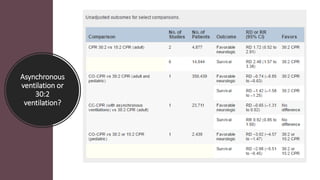
CPR with Asynchronous Ventilation or 30:2 Ventilation?
Nikolla, D. A., & Carlson, J. N. (2018). Which Compression-to-Ventilation Ratio Yields Better Cardiac Arrest Outcomes? Annals of Emergency
Medicine, 71(4), 485–486.
Asynchronous
ventilation or
30:2
ventilation?
Asynchronous ventilation or 30:2 ventilation?
Conclusions:
1. There was no difference between continuous-compression CPR
with asynchronous ventilations and 30:2 CPR for favorable
neurologic outcomes and survival to hospital discharge
2. CPR at 30:2 was associated with greater favorable neurologic
outcomes than 15:2 in adults.
3. In pediatric patients, 30:2 or 15:2 CPR resulted in improved rates
of favorable neurologic outcomes
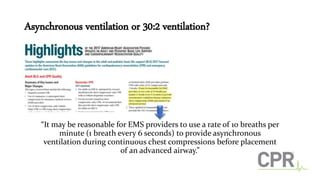
Asynchronous ventilation or 30:2 ventilation?
“It may be reasonable for EMS providers to use a rate of 10 breaths per
minute (1 breath every 6 seconds) to provide asynchronous
ventilation during continuous chest compressions before placement
of an advanced airway.”
Early Intubation In CPR Improves Survival – Yes or No?
Result: “Early intubation at any given time during
first 15 min of initiating CPR was associated with
decreased survival to hospital discharge, reduced
ROSC and reduced functional outcomes”
Andersen LW, Granfeldt A, Callaway CW, et al. Association Between Tracheal Intubation During Adult In-Hospital Cardiac Arrest and
Survival. JAMA. 2017;317(5):494-506.
1. No evidence of benefit with the use of mechanical devices for chest
compressions.
2. Manual chest compressions remain the standard of care for the treatment of
cardiac arrest.
3. Mechanical devices may be used as alternative to conventional CPR in specific
settings (e.g. limited rescuers available, prolonged CPR, CPR during hypothermic
cardiac arrest, CPR in a moving ambulance, CPR in the angiography suite, CPR
during preparation for ECPR).
AHA 2015 Update:
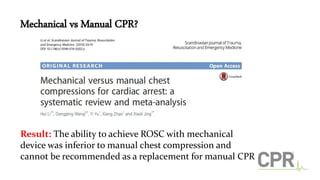
Mechanical vs Manual CPR?
Result: The ability to achieve ROSC with mechanical
device was inferior to manual chest compression and
cannot be recommended as a replacement for manual CPR
E-CPR vs Conventional CPR?
“ECPR may be considered among select cardiac arrest patients who have
not responded to initial conventional CPR, in settings where it can be
rapidly implemented.”
AHA 2015 Update……
E-CPR vs Conventional CPR?
“Efficacy of extracorporeal cardiopulmonary
resuscitation compared to conventional cardiopulmonary
resuscitation for adult cardiac arrest patients: a
systematic review and meta-analysis”
Meta-analysis by Ahn C et.
Al - 2016
Result: ECPR showed similar survival rates and neurologic
outcomes to CCPR in out-of-hospital cardiac arrest patients.
However, ECPR was associated with significantly better survival
rates and neurologic outcomes than CCPR in IHCA.
Ahn, C. et al. Efficacy of extracorporeal cardiopulmonary resuscitation compared to conventional cardiopulmonary resuscitation for adult cardiac
arrest patients: a systematic review and meta-analysis. Sci. Rep. 6, 34208
E-CPR vs Conventional CPR?
“Comparison of extracorporeal and conventional
cardiopulmonary resuscitation: A meta-analysis of
2 260 patients with cardiac arrest ”
Meta-analysis by Wang G
et. Al - 2017
Result: ECPR showed a beneficial effect on survival rate to discharge
and long-term neurological outcome over CCPR in adult patients with
CA.
There was a significant difference in survival to discharge favoring ECPR
over CCPR group in OHCA patients
No significant difference was found in IHCA patients
Wang GN, Chen XF, Qiao L, et al. Comparison of extracorporeal and conventional cardiopulmonary resuscitation: A meta-analysis of 2 260 patients with
cardiac arrest. World J Emerg Med. 2017;8(1):5-11.
Is PEA a Reason to Refuse ECPR?
Result: Survival to discharge in patients with PEA as initial rhythm at the time of
decision for ECPR is 23.8% while no patients with asystole as initial rhythm survived
discharge. Patients with PEA should be carefully considered for ECPR
• Most current recommendations for ECPR do not include patients
with a non-shockable rhythm such as PEA and asystole.
• Retrospective single-center study of adults who underwent
ECPR for in-hospital cardiac arrest
• 3 patient groups separated by initial rhythm : asystole, PEA and
shockable rhythm.
Pabst D, Brehm CE. Is pulseless electrical activity a reason to refuse cardiopulmonary resuscitation with ECMO support? Am J Emerg Med. 2018
Apr;36(4):637-640.
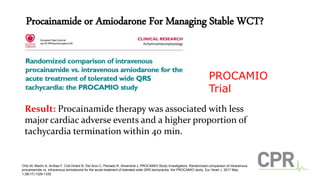
Procainamide or Amiodarone For Managing Stable WCT?
Ortiz M, Martín A, Arribas F, Coll-Vinent B, Del Arco C, Peinado R, Almendral J; PROCAMIO Study Investigators. Randomized comparison of intravenous
procainamide vs. intravenous amiodarone for the acute treatment of tolerated wide QRS tachycardia: the PROCAMIO study. Eur Heart J. 2017 May
1;38(17):1329-1335.
Result: Procainamide therapy was associated with less
major cardiac adverse events and a higher proportion of
tachycardia termination within 40 min.
PROCAMIO
Trial
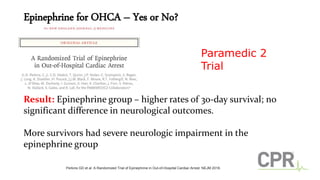
Epinephrine for OHCA – Yes or No?
Result: Epinephrine group – higher rates of 30-day survival; no
significant difference in neurological outcomes.
More survivors had severe neurologic impairment in the
epinephrine group
Paramedic 2
Trial
Perkins GD et al. A Randomized Trial of Epinephrine in Out-of-Hospital Cardiac Arrest. NEJM 2018.
T-CPR?????
 Telephone CPR (T-CPR)
 Telecommunicators are the true, first responders and a critical link in the
cardiac arrest chain of survival
 Every emergency dispatch center in the nation should be aware of the following:
• The provision of T-CPR instruction for virtually all cardiac arrests is a standard of care.
• Meeting this standard requires training, ongoing training, and continuous quality
improvement.
• Meeting this standard saves lives.
• Not meeting this standard results in deaths that are preventable.
T-CPR?????
Thank You

CPR -Whats New

  • 1.
    CPR What’s new? Dr. AnoopJames Assistant professor Emergency Medicine JMMC & RI
  • 2.
    Continuous or InterruptedChest Compressions for OHCA? Zhan L, Yang LJ, Huang Y, He Q, Liu GJ.Continuous chest compression versus interrupted chest compression for cardiopulmonary resuscitation of non-asphyxial out-of-hospital cardiac arrest.Cochrane Database of Systematic Reviews 2017, Issue 3.
  • 3.
    Continuous or InterruptedChest Compressions for OHCA? Zhan L, Yang LJ, Huang Y, He Q, Liu GJ.Continuous chest compression versus interrupted chest compression for cardiopulmonary resuscitation of non-asphyxial out-of-hospital cardiac arrest.Cochrane Database of Systematic Reviews 2017, Issue 3. Untrained bystander-administered CPR: “Continuous chest compression CPR without rescue breathing improved participants’ survival to hospital discharge compared with interrupted CPR (14% versus 11.6%)” There were no data available for survival at one year, quality of life, return of spontaneous circulation or adverse effects.
  • 4.
    Continuous or InterruptedChest Compressions for OHCA? Zhan L, Yang LJ, Huang Y, He Q, Liu GJ.Continuous chest compression versus interrupted chest compression for cardiopulmonary resuscitation of non-asphyxial out-of-hospital cardiac arrest.Cochrane Database of Systematic Reviews 2017, Issue 3. CPR administered by a trained professional “Survival to hospital – Higher with interrupted CPR (9.7% vs 9.0% )” Survival to hospital admission – Higher with interrupted CPR Return of spontaneous circulation - Higher with interrupted CPR Neurological outcome – Little or no difference between two groups Rates of adverse events – Higher with interrupted CPR
  • 5.
    Continuous or InterruptedChest Compressions for OHCA? AHA 2017 UPDATE - For Adults in OHCA 1. Untrained lay rescuers should provide chest compression–only CPR with or without dispatcher assistance. 2. For lay rescuers trained in chest compression–only CPR, we recommend that they provide chest compression–only CPR for adults in OHCA. 3. For lay rescuers trained in CPR using chest compressions and ventilation (rescue breaths), it is reasonable to provide ventilation (rescue breaths) in addition to chest compressions for the adult in OHCA.
  • 6.
    CPR with AsynchronousVentilation or 30:2 Ventilation? Nikolla, D. A., & Carlson, J. N. (2018). Which Compression-to-Ventilation Ratio Yields Better Cardiac Arrest Outcomes? Annals of Emergency Medicine, 71(4), 485–486.
  • 7.
  • 8.
    Asynchronous ventilation or30:2 ventilation? Conclusions: 1. There was no difference between continuous-compression CPR with asynchronous ventilations and 30:2 CPR for favorable neurologic outcomes and survival to hospital discharge 2. CPR at 30:2 was associated with greater favorable neurologic outcomes than 15:2 in adults. 3. In pediatric patients, 30:2 or 15:2 CPR resulted in improved rates of favorable neurologic outcomes
  • 9.
    Asynchronous ventilation or30:2 ventilation? “It may be reasonable for EMS providers to use a rate of 10 breaths per minute (1 breath every 6 seconds) to provide asynchronous ventilation during continuous chest compressions before placement of an advanced airway.”
  • 10.
    Early Intubation InCPR Improves Survival – Yes or No? Result: “Early intubation at any given time during first 15 min of initiating CPR was associated with decreased survival to hospital discharge, reduced ROSC and reduced functional outcomes” Andersen LW, Granfeldt A, Callaway CW, et al. Association Between Tracheal Intubation During Adult In-Hospital Cardiac Arrest and Survival. JAMA. 2017;317(5):494-506.
  • 11.
    1. No evidenceof benefit with the use of mechanical devices for chest compressions. 2. Manual chest compressions remain the standard of care for the treatment of cardiac arrest. 3. Mechanical devices may be used as alternative to conventional CPR in specific settings (e.g. limited rescuers available, prolonged CPR, CPR during hypothermic cardiac arrest, CPR in a moving ambulance, CPR in the angiography suite, CPR during preparation for ECPR). AHA 2015 Update: Mechanical vs Manual CPR?
  • 12.
    Mechanical vs ManualCPR? Result: The ability to achieve ROSC with mechanical device was inferior to manual chest compression and cannot be recommended as a replacement for manual CPR
  • 13.
    E-CPR vs ConventionalCPR? “ECPR may be considered among select cardiac arrest patients who have not responded to initial conventional CPR, in settings where it can be rapidly implemented.” AHA 2015 Update……
  • 14.
    E-CPR vs ConventionalCPR? “Efficacy of extracorporeal cardiopulmonary resuscitation compared to conventional cardiopulmonary resuscitation for adult cardiac arrest patients: a systematic review and meta-analysis” Meta-analysis by Ahn C et. Al - 2016 Result: ECPR showed similar survival rates and neurologic outcomes to CCPR in out-of-hospital cardiac arrest patients. However, ECPR was associated with significantly better survival rates and neurologic outcomes than CCPR in IHCA. Ahn, C. et al. Efficacy of extracorporeal cardiopulmonary resuscitation compared to conventional cardiopulmonary resuscitation for adult cardiac arrest patients: a systematic review and meta-analysis. Sci. Rep. 6, 34208
  • 15.
    E-CPR vs ConventionalCPR? “Comparison of extracorporeal and conventional cardiopulmonary resuscitation: A meta-analysis of 2 260 patients with cardiac arrest ” Meta-analysis by Wang G et. Al - 2017 Result: ECPR showed a beneficial effect on survival rate to discharge and long-term neurological outcome over CCPR in adult patients with CA. There was a significant difference in survival to discharge favoring ECPR over CCPR group in OHCA patients No significant difference was found in IHCA patients Wang GN, Chen XF, Qiao L, et al. Comparison of extracorporeal and conventional cardiopulmonary resuscitation: A meta-analysis of 2 260 patients with cardiac arrest. World J Emerg Med. 2017;8(1):5-11.
  • 16.
    Is PEA aReason to Refuse ECPR? Result: Survival to discharge in patients with PEA as initial rhythm at the time of decision for ECPR is 23.8% while no patients with asystole as initial rhythm survived discharge. Patients with PEA should be carefully considered for ECPR • Most current recommendations for ECPR do not include patients with a non-shockable rhythm such as PEA and asystole. • Retrospective single-center study of adults who underwent ECPR for in-hospital cardiac arrest • 3 patient groups separated by initial rhythm : asystole, PEA and shockable rhythm. Pabst D, Brehm CE. Is pulseless electrical activity a reason to refuse cardiopulmonary resuscitation with ECMO support? Am J Emerg Med. 2018 Apr;36(4):637-640.
  • 17.
    Procainamide or AmiodaroneFor Managing Stable WCT? Ortiz M, Martín A, Arribas F, Coll-Vinent B, Del Arco C, Peinado R, Almendral J; PROCAMIO Study Investigators. Randomized comparison of intravenous procainamide vs. intravenous amiodarone for the acute treatment of tolerated wide QRS tachycardia: the PROCAMIO study. Eur Heart J. 2017 May 1;38(17):1329-1335. Result: Procainamide therapy was associated with less major cardiac adverse events and a higher proportion of tachycardia termination within 40 min. PROCAMIO Trial
  • 18.
    Epinephrine for OHCA– Yes or No? Result: Epinephrine group – higher rates of 30-day survival; no significant difference in neurological outcomes. More survivors had severe neurologic impairment in the epinephrine group Paramedic 2 Trial Perkins GD et al. A Randomized Trial of Epinephrine in Out-of-Hospital Cardiac Arrest. NEJM 2018.
  • 19.
    T-CPR?????  Telephone CPR(T-CPR)  Telecommunicators are the true, first responders and a critical link in the cardiac arrest chain of survival  Every emergency dispatch center in the nation should be aware of the following: • The provision of T-CPR instruction for virtually all cardiac arrests is a standard of care. • Meeting this standard requires training, ongoing training, and continuous quality improvement. • Meeting this standard saves lives. • Not meeting this standard results in deaths that are preventable.
  • 20.
  • 21.