PRESENTED BY: Dr. Dheeraj Mulchandani
PG Resident
Dept. of Pharmacology (CMC, Ludhaina)
CPCSEA
LEARNING OBJECTIVES
• Aim, principles and functions of CPCSEA
• Guidelines laid by CPCSEA
overview
• Introduction to CPCSEA
• CPCSEA and IAEC
• Aim, Principles and functions of CPCSEA
• Guidelines laid by CPCSEA
• Conclusion
• Bibliography
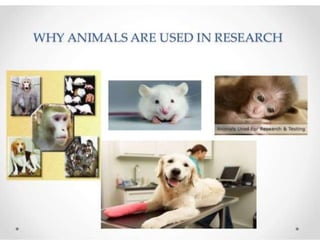
• The principal of anatomy and physiology are true for humans
and especially mammals.
• Certain strains or breeds of animals get the same disease or
conditions as humans.
• They help ensure the effectiveness and safety of new
treatments.
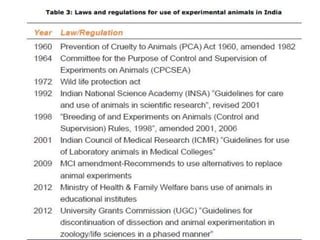
LAWS FOR EXPERIMENTAL ANIMALS
IN INDIA
CPCSEA
• The Committee for the Purpose of Control and
Supervision of Experiments on Animals ( CPCSEA )
• Statutory committee, established under Chapter 4,
Section 15(1) of the Prevention of cruelty to Animals Act
1960.
• National level expert committee to scrutinize and approve
the research projects conducted using animals.
• Introduced a national Good Laboratory Practice ( GLP
) document
• Introduced the credo of 3R principles
• 2004 – CPCSEA officially accepts the concept of the
4th R
CPCSEA AND IAEC
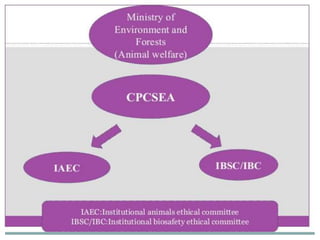
• Role of CPCSEA is to monitor animal experiments through
ethics committee set up in institution ( IAEC )
• CPCSEA nominee – important link between CPCSEA and
IAEC.
• IAEC scrutinize all the projects proposals for experiment on
animals
--For small animals – gives the final approval
--For large animals – makes its recommendation to
CPCSEA
AIM
• To promote the humane care of animals use in
biomedical and behavioral research and
testing.
• To provide quality in gaining advanced biological
knowledge that is relevant to humans and
animals
PRINCIPLES
Principle No.1
“Experiments on animals”
• may be carried out for t he purposes of advancement
by newdiscovery.
OR
• Knowledge which is expected to be useful for saving or
prolonging human life or alleviating suffering
52
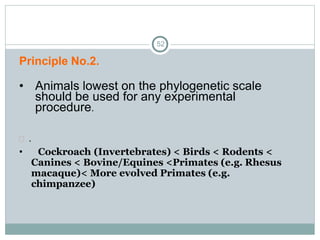
Principle No.2.
• Animals lowest on the phylogenetic scale
should be used for any experimental
procedure.
ď‚— .
• Cockroach (Invertebrates) < Birds < Rodents <
Canines < Bovine/Equines <Primates (e.g. Rhesus
macaque)< More evolved Primates (e.g.
chimpanzee)
53
Principle No.3
ď‚—Proper use of animals in experiments and
avoidance of pain and suffering inflicted on
experimental animals
By using appropriate sedation, analgesia or
anaesthesia.
ď‚—
54
ď‚—
Principle No.4
• Persons engaged in animal
experimentation have a moral responsibility
for the welfare of the animals after their use
in experiments.
.
Principle No.5
• The living conditions of animals should be
appropriate fortheir species and contribute to
their health and comfort
FUNCTIONS OF CPCSEA
40
Main activities
1. Registration of establishments conducting animal
experiments or breeding of animals.
2. Selection and appointment of Nominees in the IAEC.
3. Approval of Animal House Facilities:
4. Permission for Conducting Experiments
involving use of Animals.
5. Recommendation for import.
GROUND RULES
• The Member – Secretary would take a decision on any
application for registration within two months of receipt
• Application for permission for conducting experiments are
brought before CPCSEA by MS.
• IAEC of an establishment is constituted by CPCSEA at the
time of registration for a period of 5 years.
GUIDELINES
• To promote humane care of animals used
in research
GOAL
4
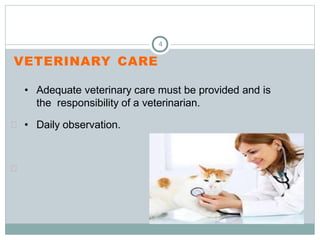
VETERINARY CARE
ď‚—
• Adequate veterinary care must be provided and is
the responsibility of a veterinarian.
ď‚—
• Daily observation.
5
• All animals must be acquired lawfully as per
the CPCSEA guidelines.
• A health surveillance program for incoming
animals should be carried out to assess
animal quality.
• Methods of transportation should be taken
into account.
ANIMAL PROCUREMENT
6
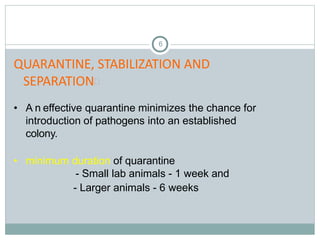
QUARANTINE, STABILIZATION AND
SEPARATIONď‚—
• A n effective quarantine minimizes the chance for
introduction of pathogens into an established
colony.
• minimum duration of quarantine
- Small lab animals - 1 week and
- Larger animals - 6 weeks
7
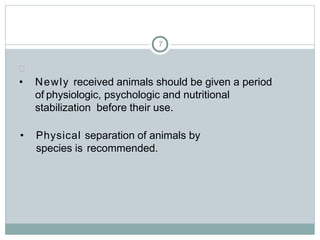
ď‚—
• Newly received animals should be given a period
of physiologic, psychologic and nutritional
stabilization before their use.
• Physical separation of animals by
species is recommended.
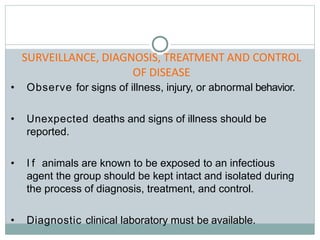
• Observe for signs of illness, injury, or abnormal behavior.
• Unexpected deaths and signs of illness should be
reported.
• I f animals are known to be exposed to an infectious
agent the group should be kept intact and isolated during
the process of diagnosis, treatment, and control.
• Diagnostic clinical laboratory must be available.
SURVEILLANCE, DIAGNOSIS, TREATMENT AND CONTROL
OF DISEASE
9
• Employ people who are trained in laboratory
animal science.
• They should be provide for both formal and on-the-
job training.
ANIMAL CARE AND TECHNICAL PERSONNEL
PERSONAL HYGIENE
• PPE – e.g. change of uniforms,
footwears.
• Use disposablegear.
• N o permission to eat, drink, smoke or
apply cosmetics in animal rooms.
12
• Institutional Biosafety Committee.
• The procedures must be reviewed by both theInstitutional
Biosafety committee and Institutional Animal Ethics
Committee (IAEC).
ANIMAL EXPERIMENTATION INVOLVING
HAZARDOUS AGENTS
14
• Multiple surgical procedures not to be practiced
unless specified in a protocol and only approved by
the IAEC.
DURATIONS OF EXPERIMENTS
• N o animal should be used for experimentation for
more than 3 years unless adequate justification is
provided.
MULTIPLE SURGICAL PROCEDURES ON SINGLE ANIMAL
15
• Brief physical restraint can be accomplished manually
or with devices.
• Prolonged restraint of any animal should be avoided.
• Less restrictive systems, such as the tether system or
the pole and collar system should be used when
compatible with research objectives.
PHYSICAL RESTRAINT
The following are important points for
the use of restraint equipments:
16
• Not be used simply as a convenience in handling
or managing animals
• Minimum time.
• Should be given training to adapt to the equipment.
• Observe the animal at appropriate intervals.
• Veterinary care should be provided if lesions or
illness associated with restraint are observed.
17
LOCATION OF ANIMAL FACILITIES TO
LABORATORY
• Isolated far away from human habitation.
• This separation can be done by putting animal quarters in
separate building, wing, floor or room.
18
FUNCTIONAL AREAS
Sufficient animal area is required to -
• Ensure separation of species or isolation of individual
projects when necessary;
• Receive, quarantine, and isolate animals;
• Provide for animal housing.
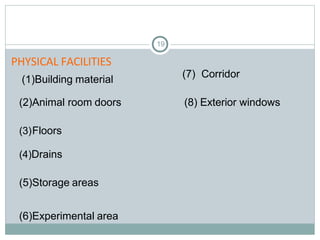
PHYSICAL FACILITIES
19
(1)Building material
(7) Corridor
(2)Animal room doors (8) Exterior windows
(3)Floors
(4)Drains
(5)Storage areas
(6)Experimental area
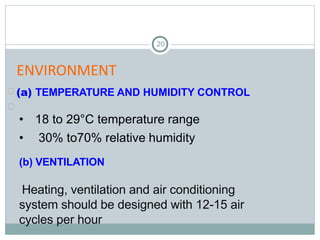
20
(a) TEMPERATURE AND HUMIDITY CONTROL
ď‚—
ď‚—
• 18 to 29°C temperature range
• 30% to70% relative humidity
(b) VENTILATION
Heating, ventilation and air conditioning
system should be designed with 12-15 air
cycles per hour
ENVIRONMENT
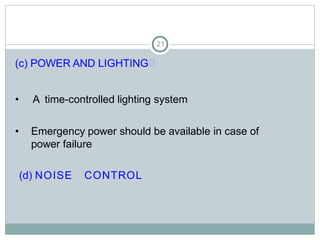
21
(c) POWER AND LIGHTING
• A time-controlled lighting system
• Emergency power should be available in case of
power failure
(d) NOISE CONTROL
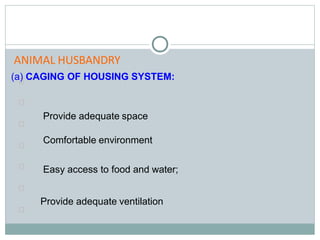
(a) CAGING OF HOUSING SYSTEM:
ď‚—
Provide adequate space
ď‚—
Comfortable environment
ď‚—
ď‚—
Easy access to food and water;
ď‚—
Provide adequate ventilation
ď‚—
ď‚—
ANIMAL HUSBANDRY
24
(b) SHELTERED OR OUTDOOR HOUSING:
ď‚— Accessible to all animals, sufficient ventilation, and prevent
accumulation of waste materials and excessive moisture.
26
ď‚—WATER
• Continuous access of fresh, potable,
uncontaminated drinking water.
• Periodic monitoring of microbial contamination.
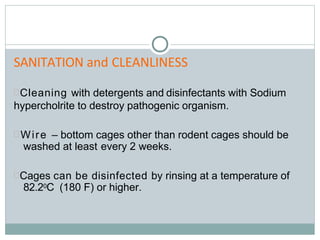
SANITATION and CLEANLINESS
ď‚—Cleaning with detergents and disinfectants with Sodium
hypercholrite to destroy pathogenic organism.
Wire – bottom cages other than rodent cages should be
washed at least every 2 weeks.
ď‚—Cages can be disinfected by rinsing at a temperature of
82.20C (180 F) or higher.
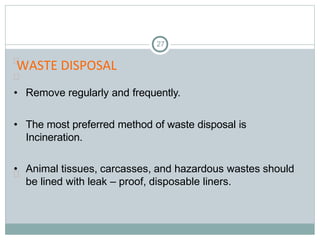
WASTE DISPOSAL
27
ď‚—
ď‚—
• Remove regularly and frequently.
• The most preferred method of waste disposal is
Incineration.
• Animal tissues, carcasses, and hazardous wastes should
be lined with leak – proof, disposable liners.
ď‚—
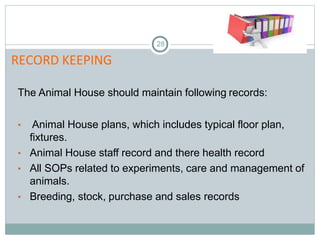
RECORD KEEPING
28
The Animal House should maintain following records:
• Animal House plans, which includes typical floor plan,
fixtures.
• Animal House staff record and there health record
• All SOPs related to experiments, care and management of
animals.
• Breeding, stock, purchase and sales records
• Minutes of Institutional Animals Ethics Committee Meetings
• Records of experiment conducted with number of animals
used.
• Clinical records of sick animals.
• Water, feed, and bedding material analysis report
STANDARD OPERATING PROCEDURES (SOPs)
29
The Institute shall maintain SOPs describing procedures /
methods adapted with regard to
ď‚—Animal Husbandry
ď‚—Maintenance
ď‚—Breeding
ď‚—Animal house activities
ď‚—Experimentation records.
The SOP should contain the following :
• Name of the Author
• Title of the SOP
• Reference of previous SOP on the same subject
and date.
• Normal value of all parameters
• Detail information of the instruments used with
methodology.
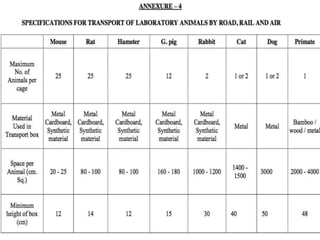
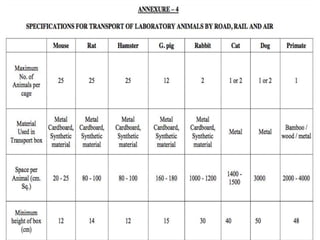
TRANSPORT OF LABORATORY ANIMALS
The main considerations for transport of animals
are:
• Mode of transport
• Containers
• Food and water during transit
• Protection from transit infections
• Injuries and stress
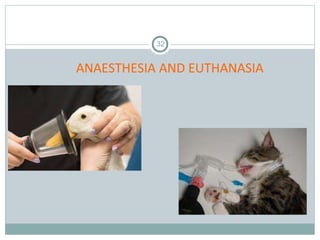
ANAESTHESIA AND EUTHANASIA
32
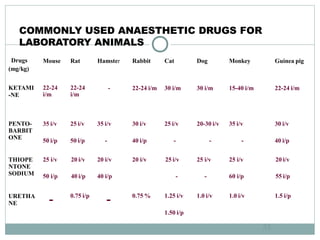
COMMONLY USED ANAESTHETIC DRUGS FOR
LABORATORY ANIMALS
Mouse Rat Hamster Rabbit Cat Dog Monkey Guinea pig
22-24
i/m
22-24
i/m
- 22-24 i/m 30 i/m 30 i/m 15-40 i/m 22-24 i/m
Drugs
(mg/kg)
KETAMI
-NE
PENTO-
BARBIT
ONE
35 i/v
50 i/p
25 i/v
50 i/p
35 i/v
-
30 i/v
40 i/p
25 i/v
-
20-30 i/v
-
35 i/v
-
30 i/v
40 i/p
THIOPE
NTONE
SODIUM
25 i/v 20 i/v 20 i/v 20 i/v 25 i/v 25 i/v 25 i/v 20 i/v
50 i/p 40 i/p 40 i/p - - 60 i/p 55 i/p
URETHA
NE - 0.75 i/p
- 0.75 % 1.25 i/v
1.50 i/p
1.0 i/v 1.0 i/v 1.5 i/p
33
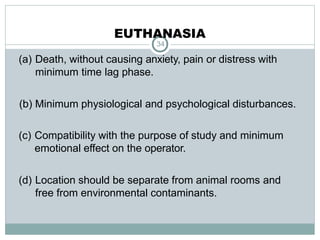
EUTHANASIA
34
(a) Death, without causing anxiety, pain or distress with
minimum time lag phase.
(b) Minimum physiological and psychological disturbances.
(c) Compatibility with the purpose of study and minimum
emotional effect on the operator.
(d) Location should be separate from animal rooms and
free from environmental contaminants.
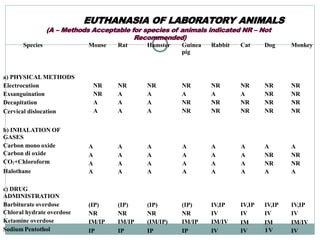
EUTHANASIA OF LABORATORY ANIMALS
(A – Methods Acceptable for species of animals indicated NR – Not
Recommended)
Species Mouse Rat Hamster Guinea
pig
Rabbit Cat Dog Monkey
a) PHYSICALMETHODS
Electrocution
Exsanguination
Decapitation
Cervical dislocation
NR
NR
A
A
NR
A
A
A
NR
A
A
A
NR
A
NR
NR
NR
A
NR
NR
NR
A
NR
NR
NR
NR
NR
NR
NR
NR
NR
NR
b) INHALATION OF
GASES
Carbon mono oxide
Carbon di oxide
CO2+Chloroform
Halothane
A A A A A A A A
A A A A A A NR NR
A A A A A A NR NR
A A A A A A A A
c) DRUG
ADMINISTRATION
Barbiturate overdose
Chloral hydrate overdose
Ketamine overdose
Sodium Pentothol
(IP)
NR
IM/IP
IP
(IP)
NR
IM/IP
IP
(IP)
NR
(IM/IP)
IP
(IP)
NR
IM/IP
IP
IV,IP
IV
IM/IV
IV IV
IV,IP IV,IP IV,IP
IV IV IV
IM IM IM/IV
IV
3
I
5
V
SUMMARY
• Laws related to animals
• The 3 R and introduction of the 4R
• Introduction of GLP
• Goal
BIBLIOGRAPHY
• Committee for the Purpose of Control and Supervision
of Experiments on Animals (CPCSEA). Available from
cpcsea.nic.in ( Last accessed on 2019 July 4 )
• Badyal DK, Desai C. Animal use in pharmacology
education and research: The changing scenario. Indian
J Pharmacol, 2014, 43: 257-65.
• Gandhi M, Husain O, Panjwani R. Animal laws of
India, 3rd edition.
CPCSEA

CPCSEA

  • 1.
    PRESENTED BY: Dr.Dheeraj Mulchandani PG Resident Dept. of Pharmacology (CMC, Ludhaina) CPCSEA
  • 2.
    LEARNING OBJECTIVES • Aim,principles and functions of CPCSEA • Guidelines laid by CPCSEA
  • 3.
    overview • Introduction toCPCSEA • CPCSEA and IAEC • Aim, Principles and functions of CPCSEA • Guidelines laid by CPCSEA • Conclusion • Bibliography
  • 5.
    • The principalof anatomy and physiology are true for humans and especially mammals. • Certain strains or breeds of animals get the same disease or conditions as humans. • They help ensure the effectiveness and safety of new treatments.
  • 6.
    LAWS FOR EXPERIMENTALANIMALS IN INDIA
  • 8.
    CPCSEA • The Committeefor the Purpose of Control and Supervision of Experiments on Animals ( CPCSEA ) • Statutory committee, established under Chapter 4, Section 15(1) of the Prevention of cruelty to Animals Act 1960. • National level expert committee to scrutinize and approve the research projects conducted using animals.
  • 9.
    • Introduced anational Good Laboratory Practice ( GLP ) document • Introduced the credo of 3R principles • 2004 – CPCSEA officially accepts the concept of the 4th R
  • 11.
    CPCSEA AND IAEC •Role of CPCSEA is to monitor animal experiments through ethics committee set up in institution ( IAEC ) • CPCSEA nominee – important link between CPCSEA and IAEC. • IAEC scrutinize all the projects proposals for experiment on animals --For small animals – gives the final approval --For large animals – makes its recommendation to CPCSEA
  • 12.
    AIM • To promotethe humane care of animals use in biomedical and behavioral research and testing. • To provide quality in gaining advanced biological knowledge that is relevant to humans and animals
  • 13.
    PRINCIPLES Principle No.1 “Experiments onanimals” • may be carried out for t he purposes of advancement by newdiscovery. OR • Knowledge which is expected to be useful for saving or prolonging human life or alleviating suffering
  • 14.
    52 Principle No.2. • Animalslowest on the phylogenetic scale should be used for any experimental procedure.  . • Cockroach (Invertebrates) < Birds < Rodents < Canines < Bovine/Equines <Primates (e.g. Rhesus macaque)< More evolved Primates (e.g. chimpanzee)
  • 15.
    53 Principle No.3 ď‚—Proper useof animals in experiments and avoidance of pain and suffering inflicted on experimental animals By using appropriate sedation, analgesia or anaesthesia. ď‚—
  • 16.
    54  Principle No.4 • Personsengaged in animal experimentation have a moral responsibility for the welfare of the animals after their use in experiments. .
  • 17.
    Principle No.5 • Theliving conditions of animals should be appropriate fortheir species and contribute to their health and comfort
  • 18.
    FUNCTIONS OF CPCSEA 40 Mainactivities 1. Registration of establishments conducting animal experiments or breeding of animals. 2. Selection and appointment of Nominees in the IAEC. 3. Approval of Animal House Facilities:
  • 19.
    4. Permission forConducting Experiments involving use of Animals. 5. Recommendation for import.
  • 20.
    GROUND RULES • TheMember – Secretary would take a decision on any application for registration within two months of receipt • Application for permission for conducting experiments are brought before CPCSEA by MS. • IAEC of an establishment is constituted by CPCSEA at the time of registration for a period of 5 years.
  • 22.
  • 23.
    • To promotehumane care of animals used in research GOAL
  • 24.
    4 VETERINARY CARE  • Adequateveterinary care must be provided and is the responsibility of a veterinarian.  • Daily observation.
  • 25.
    5 • All animalsmust be acquired lawfully as per the CPCSEA guidelines. • A health surveillance program for incoming animals should be carried out to assess animal quality. • Methods of transportation should be taken into account. ANIMAL PROCUREMENT
  • 27.
    6 QUARANTINE, STABILIZATION AND SEPARATION •A n effective quarantine minimizes the chance for introduction of pathogens into an established colony. • minimum duration of quarantine - Small lab animals - 1 week and - Larger animals - 6 weeks
  • 28.
    7  • Newly receivedanimals should be given a period of physiologic, psychologic and nutritional stabilization before their use. • Physical separation of animals by species is recommended.
  • 29.
    • Observe forsigns of illness, injury, or abnormal behavior. • Unexpected deaths and signs of illness should be reported. • I f animals are known to be exposed to an infectious agent the group should be kept intact and isolated during the process of diagnosis, treatment, and control. • Diagnostic clinical laboratory must be available. SURVEILLANCE, DIAGNOSIS, TREATMENT AND CONTROL OF DISEASE
  • 32.
    9 • Employ peoplewho are trained in laboratory animal science. • They should be provide for both formal and on-the- job training. ANIMAL CARE AND TECHNICAL PERSONNEL
  • 33.
    PERSONAL HYGIENE • PPE– e.g. change of uniforms, footwears. • Use disposablegear. • N o permission to eat, drink, smoke or apply cosmetics in animal rooms.
  • 34.
    12 • Institutional BiosafetyCommittee. • The procedures must be reviewed by both theInstitutional Biosafety committee and Institutional Animal Ethics Committee (IAEC). ANIMAL EXPERIMENTATION INVOLVING HAZARDOUS AGENTS
  • 35.
    14 • Multiple surgicalprocedures not to be practiced unless specified in a protocol and only approved by the IAEC. DURATIONS OF EXPERIMENTS • N o animal should be used for experimentation for more than 3 years unless adequate justification is provided. MULTIPLE SURGICAL PROCEDURES ON SINGLE ANIMAL
  • 36.
    15 • Brief physicalrestraint can be accomplished manually or with devices. • Prolonged restraint of any animal should be avoided. • Less restrictive systems, such as the tether system or the pole and collar system should be used when compatible with research objectives. PHYSICAL RESTRAINT
  • 37.
    The following areimportant points for the use of restraint equipments: 16 • Not be used simply as a convenience in handling or managing animals • Minimum time. • Should be given training to adapt to the equipment. • Observe the animal at appropriate intervals. • Veterinary care should be provided if lesions or illness associated with restraint are observed.
  • 38.
    17 LOCATION OF ANIMALFACILITIES TO LABORATORY • Isolated far away from human habitation. • This separation can be done by putting animal quarters in separate building, wing, floor or room.
  • 40.
    18 FUNCTIONAL AREAS Sufficient animalarea is required to - • Ensure separation of species or isolation of individual projects when necessary; • Receive, quarantine, and isolate animals; • Provide for animal housing.
  • 41.
    PHYSICAL FACILITIES 19 (1)Building material (7)Corridor (2)Animal room doors (8) Exterior windows (3)Floors (4)Drains (5)Storage areas (6)Experimental area
  • 42.
    20 (a) TEMPERATURE ANDHUMIDITY CONTROL   • 18 to 29°C temperature range • 30% to70% relative humidity (b) VENTILATION Heating, ventilation and air conditioning system should be designed with 12-15 air cycles per hour ENVIRONMENT
  • 43.
    21 (c) POWER ANDLIGHTING • A time-controlled lighting system • Emergency power should be available in case of power failure (d) NOISE CONTROL
  • 44.
    (a) CAGING OFHOUSING SYSTEM: ď‚— Provide adequate space ď‚— Comfortable environment ď‚— ď‚— Easy access to food and water; ď‚— Provide adequate ventilation ď‚— ď‚— ANIMAL HUSBANDRY
  • 45.
    24 (b) SHELTERED OROUTDOOR HOUSING: ď‚— Accessible to all animals, sufficient ventilation, and prevent accumulation of waste materials and excessive moisture.
  • 48.
    26 WATER • Continuous accessof fresh, potable, uncontaminated drinking water. • Periodic monitoring of microbial contamination.
  • 49.
    SANITATION and CLEANLINESS Cleaningwith detergents and disinfectants with Sodium hypercholrite to destroy pathogenic organism. Wire – bottom cages other than rodent cages should be washed at least every 2 weeks. Cages can be disinfected by rinsing at a temperature of 82.20C (180 F) or higher.
  • 50.
    WASTE DISPOSAL 27   • Removeregularly and frequently. • The most preferred method of waste disposal is Incineration. • Animal tissues, carcasses, and hazardous wastes should be lined with leak – proof, disposable liners. 
  • 51.
    RECORD KEEPING 28 The AnimalHouse should maintain following records: • Animal House plans, which includes typical floor plan, fixtures. • Animal House staff record and there health record • All SOPs related to experiments, care and management of animals. • Breeding, stock, purchase and sales records
  • 52.
    • Minutes ofInstitutional Animals Ethics Committee Meetings • Records of experiment conducted with number of animals used. • Clinical records of sick animals. • Water, feed, and bedding material analysis report
  • 53.
    STANDARD OPERATING PROCEDURES(SOPs) 29 The Institute shall maintain SOPs describing procedures / methods adapted with regard to ď‚—Animal Husbandry ď‚—Maintenance ď‚—Breeding ď‚—Animal house activities ď‚—Experimentation records.
  • 54.
    The SOP shouldcontain the following : • Name of the Author • Title of the SOP • Reference of previous SOP on the same subject and date. • Normal value of all parameters • Detail information of the instruments used with methodology.
  • 55.
    TRANSPORT OF LABORATORYANIMALS The main considerations for transport of animals are: • Mode of transport • Containers • Food and water during transit • Protection from transit infections • Injuries and stress
  • 57.
  • 58.
    COMMONLY USED ANAESTHETICDRUGS FOR LABORATORY ANIMALS Mouse Rat Hamster Rabbit Cat Dog Monkey Guinea pig 22-24 i/m 22-24 i/m - 22-24 i/m 30 i/m 30 i/m 15-40 i/m 22-24 i/m Drugs (mg/kg) KETAMI -NE PENTO- BARBIT ONE 35 i/v 50 i/p 25 i/v 50 i/p 35 i/v - 30 i/v 40 i/p 25 i/v - 20-30 i/v - 35 i/v - 30 i/v 40 i/p THIOPE NTONE SODIUM 25 i/v 20 i/v 20 i/v 20 i/v 25 i/v 25 i/v 25 i/v 20 i/v 50 i/p 40 i/p 40 i/p - - 60 i/p 55 i/p URETHA NE - 0.75 i/p - 0.75 % 1.25 i/v 1.50 i/p 1.0 i/v 1.0 i/v 1.5 i/p 33
  • 59.
    EUTHANASIA 34 (a) Death, withoutcausing anxiety, pain or distress with minimum time lag phase. (b) Minimum physiological and psychological disturbances. (c) Compatibility with the purpose of study and minimum emotional effect on the operator. (d) Location should be separate from animal rooms and free from environmental contaminants.
  • 60.
    EUTHANASIA OF LABORATORYANIMALS (A – Methods Acceptable for species of animals indicated NR – Not Recommended) Species Mouse Rat Hamster Guinea pig Rabbit Cat Dog Monkey a) PHYSICALMETHODS Electrocution Exsanguination Decapitation Cervical dislocation NR NR A A NR A A A NR A A A NR A NR NR NR A NR NR NR A NR NR NR NR NR NR NR NR NR NR b) INHALATION OF GASES Carbon mono oxide Carbon di oxide CO2+Chloroform Halothane A A A A A A A A A A A A A A NR NR A A A A A A NR NR A A A A A A A A c) DRUG ADMINISTRATION Barbiturate overdose Chloral hydrate overdose Ketamine overdose Sodium Pentothol (IP) NR IM/IP IP (IP) NR IM/IP IP (IP) NR (IM/IP) IP (IP) NR IM/IP IP IV,IP IV IM/IV IV IV IV,IP IV,IP IV,IP IV IV IV IM IM IM/IV IV 3 I 5 V
  • 61.
    SUMMARY • Laws relatedto animals • The 3 R and introduction of the 4R • Introduction of GLP • Goal
  • 62.
    BIBLIOGRAPHY • Committee forthe Purpose of Control and Supervision of Experiments on Animals (CPCSEA). Available from cpcsea.nic.in ( Last accessed on 2019 July 4 ) • Badyal DK, Desai C. Animal use in pharmacology education and research: The changing scenario. Indian J Pharmacol, 2014, 43: 257-65. • Gandhi M, Husain O, Panjwani R. Animal laws of India, 3rd edition.