Committee for the Purpose of Control and Supervision of Experiments on Animals
Presented by:
M.Sahiti
M.Pharm-2nd sem,
Dept. of Pharm.Analysis
JSS College of Pharmacy
Mysuru
Submitted to:
Dr.Gowrav M P
Lecturer
Dept. of Pharmaceutics
JSS College of Pharmacy
Mysore 1
GOALS:
 To promote the humane care of animals used in
biomedical and behavioral research and testing.
 To provide quality in gaining advanced biological
knowledge that is relevant to humans and animals
To provide specifications that will enhance animal
well being.
25-Jan-18 2
GUIDELINES
1. VETERINARY CARE
• Adequate veterinary care must be provided and is the
responsibility of a veterinarian.
• Daily observation
2. ANIMAL PROCUREMENT
• All animals must be acquired lawfully as per the CPCSEA
guidelines.
• A health surveillance program for incoming animals should be
carried out to assess animal quality.
• Inspect for compliance with procurement specifications.
25-Jan-18
3
3. QUARANTINE
•An effective quarantine minimizes the chance for
introduction of pathogens into an established colony.
•A minimum duration of quarantine
- Small lab animals - 1 week and
- Larger animals - 6 weeks
4. STABILIZATION AND SEPARATION
•Newly received animals should be given a period for
physiological, psychological and nutritional stabilization
before their use.
•Duration for stabilization will depend on the type of
animal, transportation and intended use.
•Physical separation of animals by species is
recommended.25-Jan-18 4
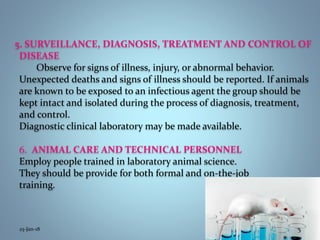
5. SURVEILLANCE, DIAGNOSIS, TREATMENT AND CONTROL OF
DISEASE
Observe for signs of illness, injury, or abnormal behavior.
Unexpected deaths and signs of illness should be reported. If animals
are known to be exposed to an infectious agent the group should be
kept intact and isolated during the process of diagnosis, treatment,
and control.
Diagnostic clinical laboratory may be made available.
6. ANIMAL CARE AND TECHNICAL PERSONNEL
Employ people trained in laboratory animal science.
They should be provide for both formal and on-the-job
training.
25-Jan-18 5
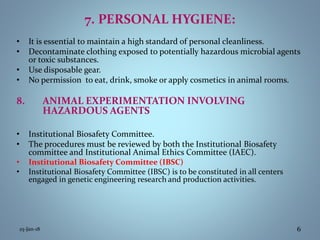
7. PERSONAL HYGIENE:
• It is essential to maintain a high standard of personal cleanliness.
• Decontaminate clothing exposed to potentially hazardous microbial agents
or toxic substances.
• Use disposable gear.
• No permission to eat, drink, smoke or apply cosmetics in animal rooms.
8. ANIMAL EXPERIMENTATION INVOLVING
HAZARDOUS AGENTS
• Institutional Biosafety Committee.
• The procedures must be reviewed by both the Institutional Biosafety
committee and Institutional Animal Ethics Committee (IAEC).
• Institutional Biosafety Committee (IBSC)
• Institutional Biosafety Committee (IBSC) is to be constituted in all centers
engaged in genetic engineering research and production activities.
25-Jan-18 6
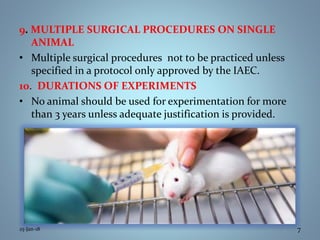
9. MULTIPLE SURGICAL PROCEDURES ON SINGLE
ANIMAL
• Multiple surgical procedures not to be practiced unless
specified in a protocol only approved by the IAEC.
10. DURATIONS OF EXPERIMENTS
• No animal should be used for experimentation for more
than 3 years unless adequate justification is provided.
25-Jan-18 7
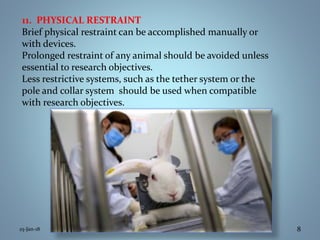
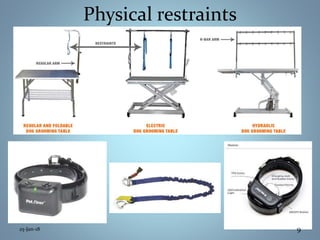
11. PHYSICAL RESTRAINT
Brief physical restraint can be accomplished manually or
with devices.
Prolonged restraint of any animal should be avoided unless
essential to research objectives.
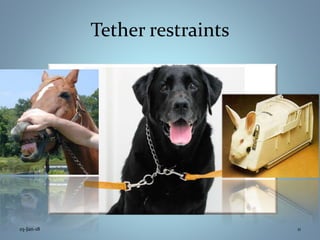
Less restrictive systems, such as the tether system or the
pole and collar system should be used when compatible
with research objectives.
25-Jan-18 8
Physical restraints
25-Jan-18 9
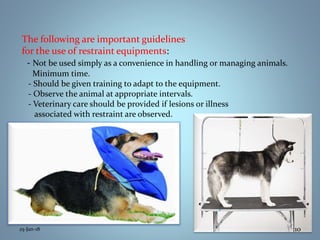
The following are important guidelines
for the use of restraint equipments:
- Not be used simply as a convenience in handling or managing animals.
Minimum time.
- Should be given training to adapt to the equipment.
- Observe the animal at appropriate intervals.
- Veterinary care should be provided if lesions or illness
associated with restraint are observed.
25-Jan-18 10
Tether restraints
25-Jan-18 11
12. PHYSICAL PLANT
• The physical condition and design of animal facility should be well
planned and properly maintained.
 PHYSICAL RELATIONSHIP OF ANIMAL FACILITIES TO LABORATORY
• Isolated far away from human habitation.
• Place animal housing areas adjacent to or near laboratories but separated
13. FUNCTIONAL AREAS
Sufficient animal area required to:
• Ensure separation of species or isolation of individual projects when
necessary;
• Receive, quarantine, and isolate animals;
• Provide for animal housing.
25-Jan-18 12
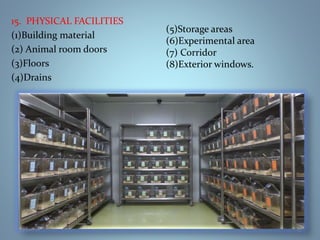
15. PHYSICAL FACILITIES
(1)Building material
(2) Animal room doors
(3)Floors
(4)Drains
(5)Storage areas
(6)Experimental area
(7) Corridor
(8)Exterior windows.
25-Jan-18 13
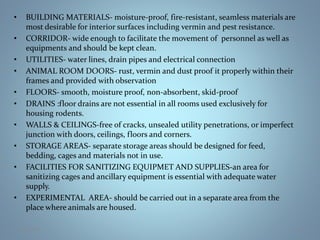
• BUILDING MATERIALS- moisture-proof, fire-resistant, seamless materials are
most desirable for interior surfaces including vermin and pest resistance.
• CORRIDOR- wide enough to facilitate the movement of personnel as well as
equipments and should be kept clean.
• UTILITIES- water lines, drain pipes and electrical connection
• ANIMAL ROOM DOORS- rust, vermin and dust proof it properly within their
frames and provided with observation
• FLOORS- smooth, moisture proof, non-absorbent, skid-proof
• DRAINS :floor drains are not essential in all rooms used exclusively for
housing rodents.
• WALLS & CEILINGS-free of cracks, unsealed utility penetrations, or imperfect
junction with doors, ceilings, floors and corners.
• STORAGE AREAS- separate storage areas should be designed for feed,
bedding, cages and materials not in use.
• FACILITIES FOR SANITIZING EQUIPMET AND SUPPLIES-an area for
sanitizing cages and ancillary equipment is essential with adequate water
supply.
• EXPERIMENTAL AREA- should be carried out in a separate area from the
place where animals are housed.
25-Jan-18 14
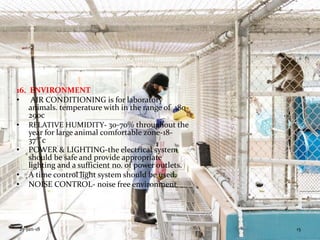
16. ENVIRONMENT
• AIR CONDITIONING is for laboratory
animals. temperature with in the range of 180-
290c
• RELATIVE HUMIDITY- 30-70% throughout the
year for large animal comfortable zone-18-
37°˚c
• POWER & LIGHTING-the electrical system
should be safe and provide appropriate
lighting and a sufficient no. of power outlets.
• A time control light system should be used.
• NOISE CONTROL- noise free environment
25-Jan-18 15
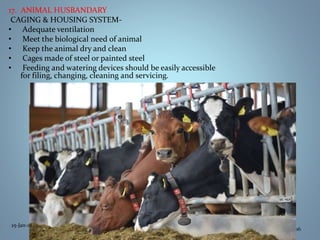
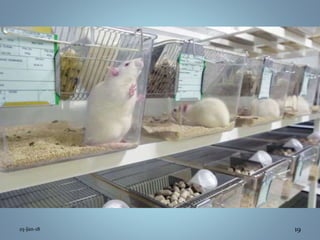
17. ANIMAL HUSBANDARY
CAGING & HOUSING SYSTEM-
• Adequate ventilation
• Meet the biological need of animal
• Keep the animal dry and clean
• Cages made of steel or painted steel
• Feeding and watering devices should be easily accessible
for filing, changing, cleaning and servicing.
25-Jan-18
16
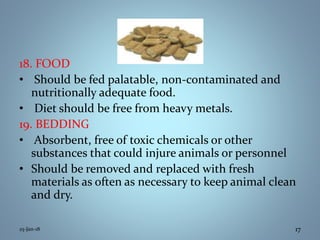
18. FOOD
• Should be fed palatable, non-contaminated and
nutritionally adequate food.
• Diet should be free from heavy metals.
19. BEDDING
• Absorbent, free of toxic chemicals or other
substances that could injure animals or personnel
• Should be removed and replaced with fresh
materials as often as necessary to keep animal clean
and dry.
25-Jan-18 17
20. WATER: Ordinarily animals should have continuous access to fresh,
potable, uncontaminated drinking water, according to their particular
requirements.
21. SANITATION CLEANLIES: Sanitation is essential in an animal
facility. Animal rooms, corridors, storage spaces, and other areas
should be cleaned with appropriate detergents and disinfectant .
22. WASTE DISPOSAL: Wastes should be removed regularly and
frequently. All waste should be collected and disposed in a -safe and
sanitary manner. The most preferred method of waste disposal is
incineration.
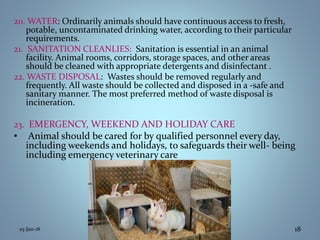
23. EMERGENCY, WEEKEND AND HOLIDAY CARE
• Animal should be cared for by qualified personnel every day,
including weekends and holidays, to safeguards their well- being
including emergency veterinary care
25-Jan-18 18
25-Jan-18 19
25. STANDARD OPERATING PROCEDURES (SOPs)
The Institute shall maintain SOPs describing procedures /methods of :
• Animal Husbandry
• Maintenance
• Breeding
• Animal house microbial analysis
• Experimentation records.
26. TRANSPORT OF LABORATORY ANIMALS
The main considerations for transport of animals are:
• Mode of transport
• Containers
• Animal density in cages
• Food and water during transit
• Protection from transit infections
• Injuries and stress
25-Jan-18 20
25-Jan-18 21
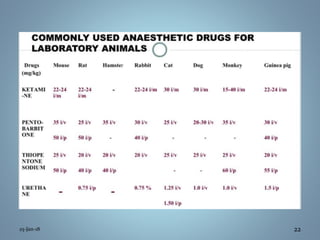
24. ANAESTHESIA
• It must also be ensured that the anesthesia is given
for the full duration of experiment and at no stage
the animal is conscious to perceive pain during the
experiment.
• sedatives, analgesics and anaesthetics should be
used to control pain or distress under experiment
25-Jan-18 22
27. EUTHANASIA
(eu =good: thanatos =death)
PURPOSE
• End of experiment , to provide tissue for scientific
purpose.
• Free the animal of pain
• Diseased animal or animal in bad condition
a) Death, without causing anxiety, pain or distress with
minimum time lag phase.
(b) Minimum physiological and psychological
disturbances.
(c) Compatibility with the purpose of study and minimum
emotional effect on the operator.
(d) Location should be separate from animal rooms and
free from environmental contaminants.
25-Jan-18 23
25-Jan-18 24
REFERENCES:
http://cpcsea.nic.in/Content/55_1_GUIDELINES.aspx
25-Jan-18 25
THANK YOU

CPCSEA- Guidelines

  • 1.
    Committee for thePurpose of Control and Supervision of Experiments on Animals Presented by: M.Sahiti M.Pharm-2nd sem, Dept. of Pharm.Analysis JSS College of Pharmacy Mysuru Submitted to: Dr.Gowrav M P Lecturer Dept. of Pharmaceutics JSS College of Pharmacy Mysore 1
  • 2.
    GOALS:  To promotethe humane care of animals used in biomedical and behavioral research and testing.  To provide quality in gaining advanced biological knowledge that is relevant to humans and animals To provide specifications that will enhance animal well being. 25-Jan-18 2
  • 3.
    GUIDELINES 1. VETERINARY CARE •Adequate veterinary care must be provided and is the responsibility of a veterinarian. • Daily observation 2. ANIMAL PROCUREMENT • All animals must be acquired lawfully as per the CPCSEA guidelines. • A health surveillance program for incoming animals should be carried out to assess animal quality. • Inspect for compliance with procurement specifications. 25-Jan-18 3
  • 4.
    3. QUARANTINE •An effectivequarantine minimizes the chance for introduction of pathogens into an established colony. •A minimum duration of quarantine - Small lab animals - 1 week and - Larger animals - 6 weeks 4. STABILIZATION AND SEPARATION •Newly received animals should be given a period for physiological, psychological and nutritional stabilization before their use. •Duration for stabilization will depend on the type of animal, transportation and intended use. •Physical separation of animals by species is recommended.25-Jan-18 4
  • 5.
    5. SURVEILLANCE, DIAGNOSIS,TREATMENT AND CONTROL OF DISEASE Observe for signs of illness, injury, or abnormal behavior. Unexpected deaths and signs of illness should be reported. If animals are known to be exposed to an infectious agent the group should be kept intact and isolated during the process of diagnosis, treatment, and control. Diagnostic clinical laboratory may be made available. 6. ANIMAL CARE AND TECHNICAL PERSONNEL Employ people trained in laboratory animal science. They should be provide for both formal and on-the-job training. 25-Jan-18 5
  • 6.
    7. PERSONAL HYGIENE: •It is essential to maintain a high standard of personal cleanliness. • Decontaminate clothing exposed to potentially hazardous microbial agents or toxic substances. • Use disposable gear. • No permission to eat, drink, smoke or apply cosmetics in animal rooms. 8. ANIMAL EXPERIMENTATION INVOLVING HAZARDOUS AGENTS • Institutional Biosafety Committee. • The procedures must be reviewed by both the Institutional Biosafety committee and Institutional Animal Ethics Committee (IAEC). • Institutional Biosafety Committee (IBSC) • Institutional Biosafety Committee (IBSC) is to be constituted in all centers engaged in genetic engineering research and production activities. 25-Jan-18 6
  • 7.
    9. MULTIPLE SURGICALPROCEDURES ON SINGLE ANIMAL • Multiple surgical procedures not to be practiced unless specified in a protocol only approved by the IAEC. 10. DURATIONS OF EXPERIMENTS • No animal should be used for experimentation for more than 3 years unless adequate justification is provided. 25-Jan-18 7
  • 8.
    11. PHYSICAL RESTRAINT Briefphysical restraint can be accomplished manually or with devices. Prolonged restraint of any animal should be avoided unless essential to research objectives. Less restrictive systems, such as the tether system or the pole and collar system should be used when compatible with research objectives. 25-Jan-18 8
  • 9.
  • 10.
    The following areimportant guidelines for the use of restraint equipments: - Not be used simply as a convenience in handling or managing animals. Minimum time. - Should be given training to adapt to the equipment. - Observe the animal at appropriate intervals. - Veterinary care should be provided if lesions or illness associated with restraint are observed. 25-Jan-18 10
  • 11.
  • 12.
    12. PHYSICAL PLANT •The physical condition and design of animal facility should be well planned and properly maintained.  PHYSICAL RELATIONSHIP OF ANIMAL FACILITIES TO LABORATORY • Isolated far away from human habitation. • Place animal housing areas adjacent to or near laboratories but separated 13. FUNCTIONAL AREAS Sufficient animal area required to: • Ensure separation of species or isolation of individual projects when necessary; • Receive, quarantine, and isolate animals; • Provide for animal housing. 25-Jan-18 12
  • 13.
    15. PHYSICAL FACILITIES (1)Buildingmaterial (2) Animal room doors (3)Floors (4)Drains (5)Storage areas (6)Experimental area (7) Corridor (8)Exterior windows. 25-Jan-18 13
  • 14.
    • BUILDING MATERIALS-moisture-proof, fire-resistant, seamless materials are most desirable for interior surfaces including vermin and pest resistance. • CORRIDOR- wide enough to facilitate the movement of personnel as well as equipments and should be kept clean. • UTILITIES- water lines, drain pipes and electrical connection • ANIMAL ROOM DOORS- rust, vermin and dust proof it properly within their frames and provided with observation • FLOORS- smooth, moisture proof, non-absorbent, skid-proof • DRAINS :floor drains are not essential in all rooms used exclusively for housing rodents. • WALLS & CEILINGS-free of cracks, unsealed utility penetrations, or imperfect junction with doors, ceilings, floors and corners. • STORAGE AREAS- separate storage areas should be designed for feed, bedding, cages and materials not in use. • FACILITIES FOR SANITIZING EQUIPMET AND SUPPLIES-an area for sanitizing cages and ancillary equipment is essential with adequate water supply. • EXPERIMENTAL AREA- should be carried out in a separate area from the place where animals are housed. 25-Jan-18 14
  • 15.
    16. ENVIRONMENT • AIRCONDITIONING is for laboratory animals. temperature with in the range of 180- 290c • RELATIVE HUMIDITY- 30-70% throughout the year for large animal comfortable zone-18- 37°˚c • POWER & LIGHTING-the electrical system should be safe and provide appropriate lighting and a sufficient no. of power outlets. • A time control light system should be used. • NOISE CONTROL- noise free environment 25-Jan-18 15
  • 16.
    17. ANIMAL HUSBANDARY CAGING& HOUSING SYSTEM- • Adequate ventilation • Meet the biological need of animal • Keep the animal dry and clean • Cages made of steel or painted steel • Feeding and watering devices should be easily accessible for filing, changing, cleaning and servicing. 25-Jan-18 16
  • 17.
    18. FOOD • Shouldbe fed palatable, non-contaminated and nutritionally adequate food. • Diet should be free from heavy metals. 19. BEDDING • Absorbent, free of toxic chemicals or other substances that could injure animals or personnel • Should be removed and replaced with fresh materials as often as necessary to keep animal clean and dry. 25-Jan-18 17
  • 18.
    20. WATER: Ordinarilyanimals should have continuous access to fresh, potable, uncontaminated drinking water, according to their particular requirements. 21. SANITATION CLEANLIES: Sanitation is essential in an animal facility. Animal rooms, corridors, storage spaces, and other areas should be cleaned with appropriate detergents and disinfectant . 22. WASTE DISPOSAL: Wastes should be removed regularly and frequently. All waste should be collected and disposed in a -safe and sanitary manner. The most preferred method of waste disposal is incineration. 23. EMERGENCY, WEEKEND AND HOLIDAY CARE • Animal should be cared for by qualified personnel every day, including weekends and holidays, to safeguards their well- being including emergency veterinary care 25-Jan-18 18
  • 19.
  • 20.
    25. STANDARD OPERATINGPROCEDURES (SOPs) The Institute shall maintain SOPs describing procedures /methods of : • Animal Husbandry • Maintenance • Breeding • Animal house microbial analysis • Experimentation records. 26. TRANSPORT OF LABORATORY ANIMALS The main considerations for transport of animals are: • Mode of transport • Containers • Animal density in cages • Food and water during transit • Protection from transit infections • Injuries and stress 25-Jan-18 20
  • 21.
    25-Jan-18 21 24. ANAESTHESIA •It must also be ensured that the anesthesia is given for the full duration of experiment and at no stage the animal is conscious to perceive pain during the experiment. • sedatives, analgesics and anaesthetics should be used to control pain or distress under experiment
  • 22.
  • 23.
    27. EUTHANASIA (eu =good:thanatos =death) PURPOSE • End of experiment , to provide tissue for scientific purpose. • Free the animal of pain • Diseased animal or animal in bad condition a) Death, without causing anxiety, pain or distress with minimum time lag phase. (b) Minimum physiological and psychological disturbances. (c) Compatibility with the purpose of study and minimum emotional effect on the operator. (d) Location should be separate from animal rooms and free from environmental contaminants. 25-Jan-18 23
  • 24.
  • 25.