Non-Linear
Pharmacokinetics
Presented by: Akash Vikal
M.Pharm (Pharmaceutics)
2nd Semester, 1st Year
Presented to :- Dr. Dilpreet singh
HOD – Regulatory affairs
ISF COLLEGE OF PHARMACY
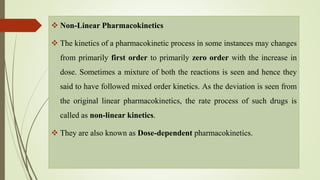
 Non-Linear Pharmacokinetics
 The kinetics of a pharmacokinetic process in some instances may changes
from primarily first order to primarily zero order with the increase in
dose. Sometimes a mixture of both the reactions is seen and hence they
said to have followed mixed order kinetics. As the deviation is seen from
the original linear pharmacokinetics, the rate process of such drugs is
called as non-linear kinetics.
 They are also known as Dose-dependent pharmacokinetics.
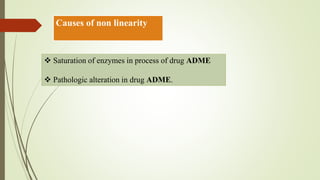
Causes of non linearity
 Saturation of enzymes in process of drug ADME
 Pathologic alteration in drug ADME.
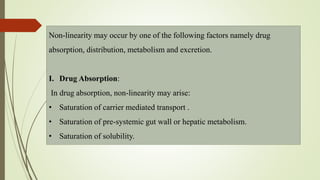
Non-linearity may occur by one of the following factors namely drug
absorption, distribution, metabolism and excretion.
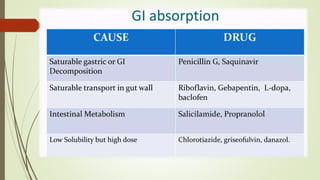
I. Drug Absorption:
In drug absorption, non-linearity may arise:
• Saturation of carrier mediated transport .
• Saturation of pre-systemic gut wall or hepatic metabolism.
• Saturation of solubility.
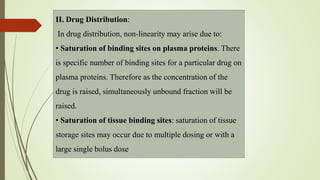
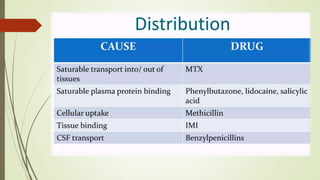
II. Drug Distribution:
In drug distribution, non-linearity may arise due to:
• Saturation of binding sites on plasma proteins. There
is specific number of binding sites for a particular drug on
plasma proteins. Therefore as the concentration of the
drug is raised, simultaneously unbound fraction will be
raised.
• Saturation of tissue binding sites: saturation of tissue
storage sites may occur due to multiple dosing or with a
large single bolus dose
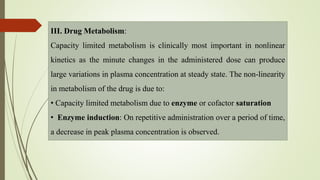
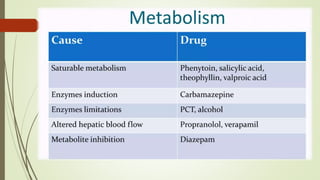
III. Drug Metabolism:
Capacity limited metabolism is clinically most important in nonlinear
kinetics as the minute changes in the administered dose can produce
large variations in plasma concentration at steady state. The non-linearity
in metabolism of the drug is due to:
• Capacity limited metabolism due to enzyme or cofactor saturation
• Enzyme induction: On repetitive administration over a period of time,
a decrease in peak plasma concentration is observed.
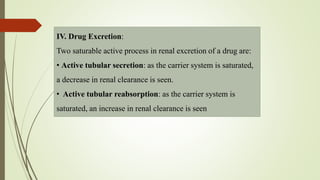
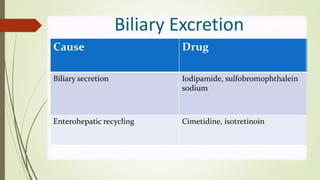
IV. Drug Excretion:
Two saturable active process in renal excretion of a drug are:
• Active tubular secretion: as the carrier system is saturated,
a decrease in renal clearance is seen.
• Active tubular reabsorption: as the carrier system is
saturated, an increase in renal clearance is seen
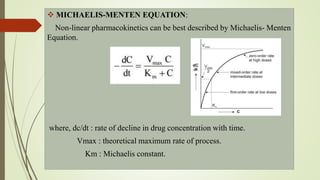
 MICHAELIS-MENTEN EQUATION:
Non-linear pharmacokinetics can be best described by Michaelis- Menten
Equation.
where, dc/dt : rate of decline in drug concentration with time.
Vmax : theoretical maximum rate of process.
Km : Michaelis constant.
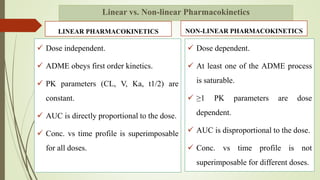
Linear vs. Non-linear Pharmacokinetics
LINEAR PHARMACOKINETICS
 Dose independent.
 ADME obeys first order kinetics.
 PK parameters (CL, V, Ka, t1/2) are
constant.
 AUC is directly proportional to the dose.
 Conc. vs time profile is superimposable
for all doses.
NON-LINEAR PHARMACOKINETICS
 Dose dependent.
 At least one of the ADME process
is saturable.
 ≥1 PK parameters are dose
dependent.
 AUC is disproportional to the dose.
 Conc. vs time profile is not
superimposable for different doses.