PHARMACOKINETICS OF
DRUG INTERACTION
Dr. Ramesh Bhandari
Asst. Professor
Department of Pharmacy Practice
KLE College of Pharmacy, Belagavi
Drug interaction can be defined as “ a measurable
modification (in magnitude and/or duration) of the
action of one drug by the prior or concomitant
administration of another substance, including
prescription, non-prescription drugs, food, alcohol,
cigarette smoking or diagnostic tests”.
A drug interaction generally refers to a modification of
the expected drug response in the patient as a result of
exposure of the patient to another drug or
substance.
RISK OF DRUG INTERACTIONS
i. Narrow Therapeutics drugs
ii. Multiple drug therapy
iii. Multiple prescribers
iv. Poor patient compliance
v. Patient risk factor such as predisposing illness
(Diabetes, Hypertension) or advancing age.
OUTCOMES OF DRUG INTERACTIONS
1) Toxicity
2) Therapeutic failure
3) Beneficial effects (Eg: Additive & Potentiation or
antagonism.
4) Chemical or physical interaction e.g. I.V.
incompatibility in fluid or syringes mixture
MECHANISM OF DRUG INTERACTION
1) Pharmacokinetic Interactions:
 Absorption
 Distribution
 Metabolism
 Excretion
2) Pharmacodynamics Interactions:
 Receptor interaction
 Receptor sensitivity
3) Pharmaceutical Interactions
PHARMACOKINETIC INTERACTIONS
1.Absorption
2.Distribution
3.Metabolism
4.Excretion
ABSORPTION
Altered GIT absorption due to:
a) Altered pH
b) Altered intestinal flora
c) Complexation or chelation
d) Drug – induced mucosal damage
e) Altered motility
a) Altered Gastric pH:
■ Non-ionised form of a drug is more lipid soluble and more
readily absorbed from GIT than the ionized form.
■ Eg: Antacids, H2 receptor blockers delay the absorption of
Ciprofloxacin and ketoconazole
b) Altered Intestinal flora:
■ Antibiotics kill a large number of normal flora of the intestine
that influences the absorption of other drugs.
■ Eg: In Approx 10% of patient – 40 % of digoxin is metabolized
by intestinal flora.
c) Complexation or Chelation:
■ Eg: Tetracycline interacts with Iron preparations, Milk forms
insoluble complexes of drugs.
d) Drug Induced mucosal damage:
■ Antineoplastic agents (cyclophosphamide, vincristine etc)
inhibit absorption of several drugs (Digoxin).
e) Altered Motility:
■ Increased GI motility: Decrease bioavailability
of drugs which are absorbed slowly.
■ Decreased GI motility: Decreases gastric
emptying time results in reduced bioavailability
of drugs which are absorbed from intestine.
DISTRIBUTION
Due to Displaced protein binding:
■ Depends on the affinity of the drug to plasma protein.
■ Most likely bound drugs is capable of displace other drugs.
■ The free drug is increased by displacement by another drug with higher
affinity.
■ Eg; Phenytoin (90%), Tolbutamide (96%) and warfarin (99%) are highly
bound to plasma protein and displaces drugs like Aspirin, sulphonamides,
Phenylbutazone.
■ Effect is transient as clearance returns free levels to pre – interaction
levels.
■ Hence clinically not much important.
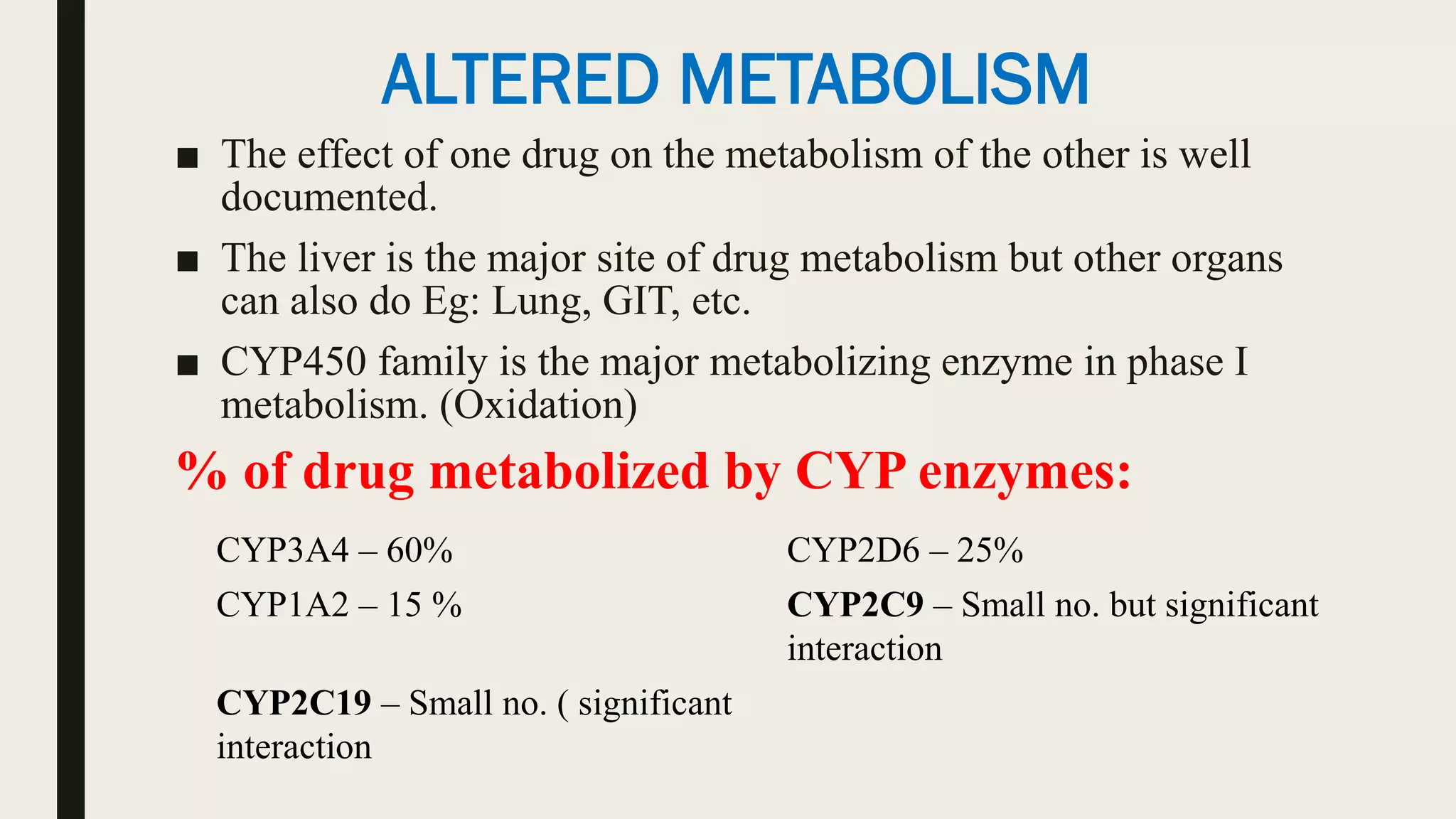
ALTERED METABOLISM
■ The effect of one drug on the metabolism of the other is well
documented.
■ The liver is the major site of drug metabolism but other organs
can also do Eg: Lung, GIT, etc.
■ CYP450 family is the major metabolizing enzyme in phase I
metabolism. (Oxidation)
% of drug metabolized by CYP enzymes:
CYP3A4 – 60% CYP2D6 – 25%
CYP1A2 – 15 % CYP2C9 – Small no. but significant
interaction
CYP2C19 – Small no. ( significant
interaction
a)Enzyme Induction:
A drug may induce the enzyme that is responsible for
the metabolism of another drug or even itself.
Most CYPs are inducible except CYP2D6.
Time course of interaction depends on half – life of
inducer.
Rifampicin has short half life and induction apparent
with 24 hours.
Phenobarbitone has longer half life so time to complete
induction takes longer.
■ Known induction by:
• Rifampicin
• Phenobarbitone
• Carbamazepine
• Cigarette smoke
Eg: Carbamazepine increases its own metabolism.
Phenytoin increases metabolism of theophylline and decreases its
level leading to poor therapy outcome.
Phenobarbital increases the metabolism of warfarin, resulting in
reduced anticoagulation.
 Enzyme induction involves protein synthesis, therefore it needs
time up to 3 weeks to reach a maximal effect.
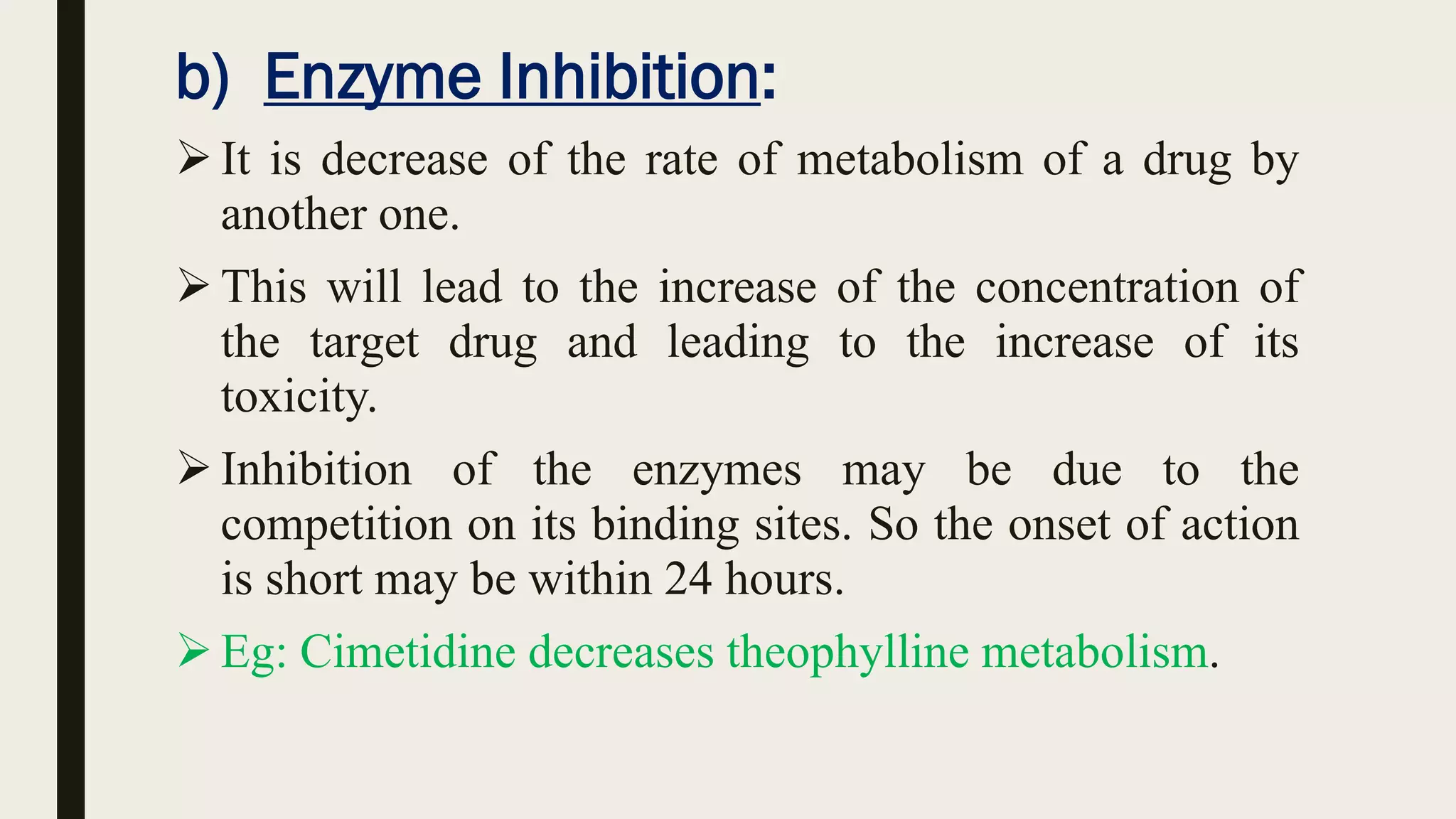
b) Enzyme Inhibition:
It is decrease of the rate of metabolism of a drug by
another one.
This will lead to the increase of the concentration of
the target drug and leading to the increase of its
toxicity.
Inhibition of the enzymes may be due to the
competition on its binding sites. So the onset of action
is short may be within 24 hours.
Eg: Cimetidine decreases theophylline metabolism.
RENAL EXCRETION
a) Active Tubular secretion:
Occurs in Proximal tubules.
Drug combines with a specific protein to pass
through the proximal tubules.
Eg: Probenecid decreases tubular secretion of
penicillin and some cephalosporin antibiotics.
b) Tubular reabsorption:
Excretion and reabsorption of drugs occur in the
tubules
By passive diffusion which is regulated by
concentration and lipid solubility
Ionized drugs are reabsorbed lower than non-ionized
drugs
Eg: sodium bicarbonate increases lithium clearance
and decreases its action.
Antacids increases salicylates clearance and
decreases its action.
PHARMACODYNAMIC INTERACTIONS
■ It means alteration of the drug action without change in
its serum concentration by pharmacokinetic factors.
■ Various types of Pharmacodynamic interactions are:
 Additive effect
 Synergistic effect
 Potentiation effect
 Antagonism
Pharmacokinetic drug interaction

Pharmacokinetic drug interaction

  • 1.
    PHARMACOKINETICS OF DRUG INTERACTION Dr.Ramesh Bhandari Asst. Professor Department of Pharmacy Practice KLE College of Pharmacy, Belagavi
  • 2.
    Drug interaction canbe defined as “ a measurable modification (in magnitude and/or duration) of the action of one drug by the prior or concomitant administration of another substance, including prescription, non-prescription drugs, food, alcohol, cigarette smoking or diagnostic tests”. A drug interaction generally refers to a modification of the expected drug response in the patient as a result of exposure of the patient to another drug or substance.
  • 3.
    RISK OF DRUGINTERACTIONS i. Narrow Therapeutics drugs ii. Multiple drug therapy iii. Multiple prescribers iv. Poor patient compliance v. Patient risk factor such as predisposing illness (Diabetes, Hypertension) or advancing age.
  • 4.
    OUTCOMES OF DRUGINTERACTIONS 1) Toxicity 2) Therapeutic failure 3) Beneficial effects (Eg: Additive & Potentiation or antagonism. 4) Chemical or physical interaction e.g. I.V. incompatibility in fluid or syringes mixture
  • 5.
    MECHANISM OF DRUGINTERACTION 1) Pharmacokinetic Interactions:  Absorption  Distribution  Metabolism  Excretion 2) Pharmacodynamics Interactions:  Receptor interaction  Receptor sensitivity 3) Pharmaceutical Interactions
  • 6.
  • 7.
    ABSORPTION Altered GIT absorptiondue to: a) Altered pH b) Altered intestinal flora c) Complexation or chelation d) Drug – induced mucosal damage e) Altered motility
  • 8.
    a) Altered GastricpH: ■ Non-ionised form of a drug is more lipid soluble and more readily absorbed from GIT than the ionized form. ■ Eg: Antacids, H2 receptor blockers delay the absorption of Ciprofloxacin and ketoconazole b) Altered Intestinal flora: ■ Antibiotics kill a large number of normal flora of the intestine that influences the absorption of other drugs. ■ Eg: In Approx 10% of patient – 40 % of digoxin is metabolized by intestinal flora.
  • 9.
    c) Complexation orChelation: ■ Eg: Tetracycline interacts with Iron preparations, Milk forms insoluble complexes of drugs. d) Drug Induced mucosal damage: ■ Antineoplastic agents (cyclophosphamide, vincristine etc) inhibit absorption of several drugs (Digoxin).
  • 10.
    e) Altered Motility: ■Increased GI motility: Decrease bioavailability of drugs which are absorbed slowly. ■ Decreased GI motility: Decreases gastric emptying time results in reduced bioavailability of drugs which are absorbed from intestine.
  • 11.
    DISTRIBUTION Due to Displacedprotein binding: ■ Depends on the affinity of the drug to plasma protein. ■ Most likely bound drugs is capable of displace other drugs. ■ The free drug is increased by displacement by another drug with higher affinity. ■ Eg; Phenytoin (90%), Tolbutamide (96%) and warfarin (99%) are highly bound to plasma protein and displaces drugs like Aspirin, sulphonamides, Phenylbutazone. ■ Effect is transient as clearance returns free levels to pre – interaction levels. ■ Hence clinically not much important.
  • 12.
    ALTERED METABOLISM ■ Theeffect of one drug on the metabolism of the other is well documented. ■ The liver is the major site of drug metabolism but other organs can also do Eg: Lung, GIT, etc. ■ CYP450 family is the major metabolizing enzyme in phase I metabolism. (Oxidation) % of drug metabolized by CYP enzymes: CYP3A4 – 60% CYP2D6 – 25% CYP1A2 – 15 % CYP2C9 – Small no. but significant interaction CYP2C19 – Small no. ( significant interaction
  • 13.
    a)Enzyme Induction: A drugmay induce the enzyme that is responsible for the metabolism of another drug or even itself. Most CYPs are inducible except CYP2D6. Time course of interaction depends on half – life of inducer. Rifampicin has short half life and induction apparent with 24 hours. Phenobarbitone has longer half life so time to complete induction takes longer.
  • 14.
    ■ Known inductionby: • Rifampicin • Phenobarbitone • Carbamazepine • Cigarette smoke Eg: Carbamazepine increases its own metabolism. Phenytoin increases metabolism of theophylline and decreases its level leading to poor therapy outcome. Phenobarbital increases the metabolism of warfarin, resulting in reduced anticoagulation.  Enzyme induction involves protein synthesis, therefore it needs time up to 3 weeks to reach a maximal effect.
  • 15.
    b) Enzyme Inhibition: Itis decrease of the rate of metabolism of a drug by another one. This will lead to the increase of the concentration of the target drug and leading to the increase of its toxicity. Inhibition of the enzymes may be due to the competition on its binding sites. So the onset of action is short may be within 24 hours. Eg: Cimetidine decreases theophylline metabolism.
  • 16.
    RENAL EXCRETION a) ActiveTubular secretion: Occurs in Proximal tubules. Drug combines with a specific protein to pass through the proximal tubules. Eg: Probenecid decreases tubular secretion of penicillin and some cephalosporin antibiotics.
  • 17.
    b) Tubular reabsorption: Excretionand reabsorption of drugs occur in the tubules By passive diffusion which is regulated by concentration and lipid solubility Ionized drugs are reabsorbed lower than non-ionized drugs Eg: sodium bicarbonate increases lithium clearance and decreases its action. Antacids increases salicylates clearance and decreases its action.
  • 18.
    PHARMACODYNAMIC INTERACTIONS ■ Itmeans alteration of the drug action without change in its serum concentration by pharmacokinetic factors. ■ Various types of Pharmacodynamic interactions are:  Additive effect  Synergistic effect  Potentiation effect  Antagonism